

Your smart home devices, streaming services, cloud backups, and AI tools all rely on data centers, which can place real demand on local water supplies.
Key Takeaways
- Data centers use billions of gallons of water annually to cool their servers, and your daily digital habits can cumulatively affect this hidden utility footprint.
- The surge in artificial intelligence is increasing pressure on data center cooling systems, with research suggesting some generative AI interactions carry a measurable water footprint.
- By optimizing your smart home routines and cleaning up cloud storage, you can actively reduce your digital water footprint and support eco-conscious utility use.
Did you know that a medium-sized data center uses roughly 110 million gallons of water annually? When we set up a new house, we naturally track our immediate household footprint — keeping a close eye on the electric meter and tightening up the plumbing to avoid waste. Yet, the modern digital services we rely on to run our homes require massive resources operating far out of sight. From adjusting smart thermostats to checking cloud-connected security cameras and querying AI voice assistants, our daily convenience relies on expansive server facilities that consume billions of gallons of water. While we diligently monitor what flows from our taps, this guide uncovers the true environmental footprint of data center water usage, distinguishing between direct cooling methods and indirect consumption, and revealing the modern AI impact so you can make more eco-conscious decisions at home.
Why Data Centers Consume Millions of Gallons
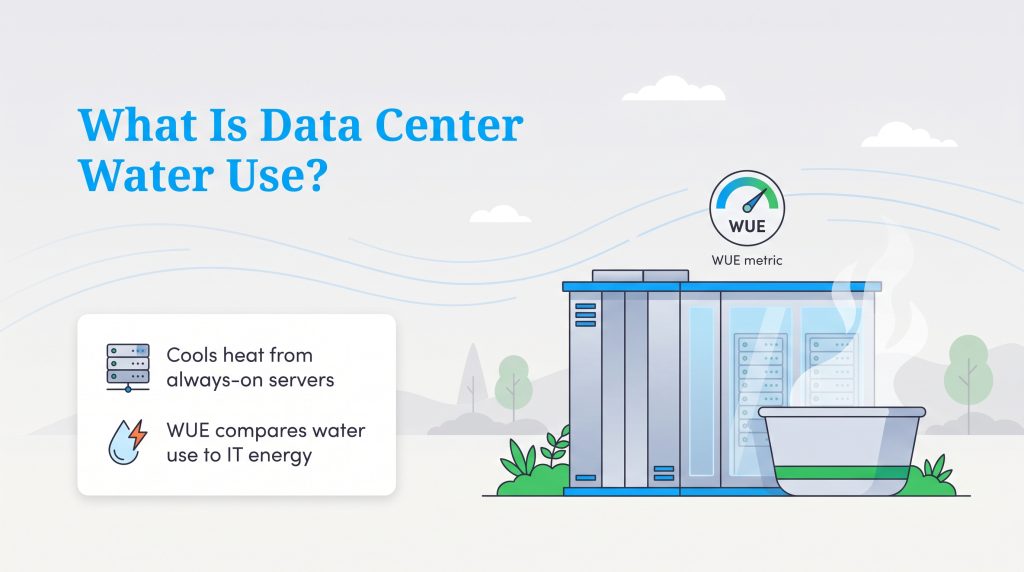
A data center essentially acts as the physical brain behind the internet, hosting the endless racks of servers that store your family photos, process your emails, and stream your favorite shows. Because these robust computers operate continuously to keep our digital world online, they generate an immense amount of heat. Imagine trying to cool down a house running hundreds of ovens simultaneously in the middle of summer. Without reliable cooling, servers can overheat, slow down, shut off, or suffer permanent equipment damage. To prevent these performance issues, facility operators draw incredible volumes of freshwater to keep ambient temperatures stable.
Direct Cooling Systems vs. Indirect Power Generation
When measuring a facility’s data center water footprint, industry professionals break down the consumption into two distinct categories: direct on-site cooling and indirect water consumption caused by electricity generation. Direct cooling refers to the freshwater pumped directly into the facility to remove heat from the server racks. However, we also have to consider the massive indirect water usage tied to powering these sprawling buildings.
Traditional power plants consume vast amounts of water to create the steam needed to generate electricity. So even if a data center operates an incredibly efficient cooling system on-site, the fossil-fuel grid electricity it consumes carries an additional, hidden water cost that heavily impacts the broader environment and your local water utility.
How Much Water Does a Data Center Actually Use?
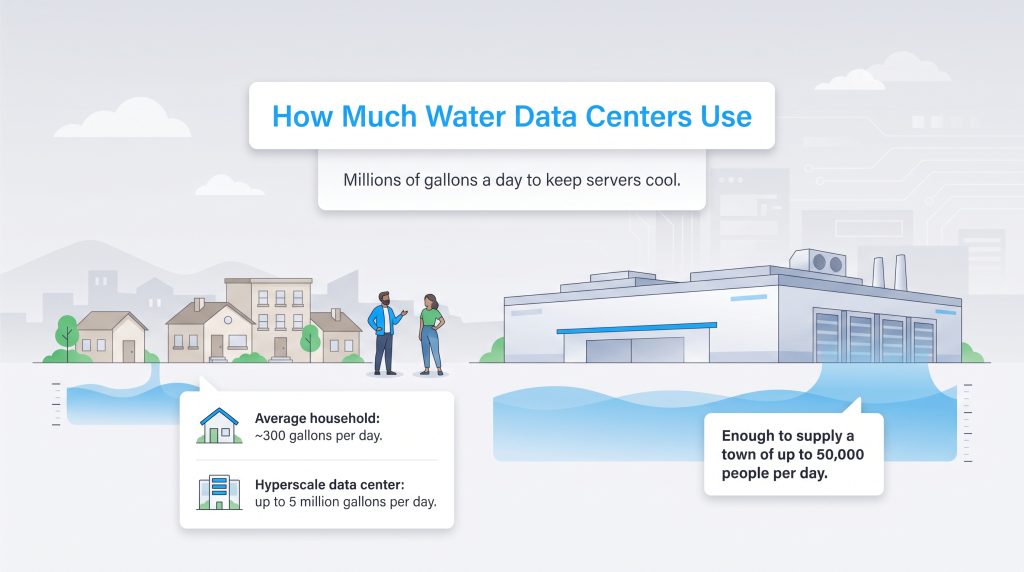
A large data center can use millions of gallons of water per day, though actual usage varies widely by cooling system, climate, and workload. To put the scale of this consumption into perspective, consider that the water needed to cool these facilities often rivals the consumption of entire small towns or massive agricultural operations. When you zoom out, the sheer scale of liquid needed to keep the internet running smoothly becomes a tangible reality for the communities situated near these massive facilities.
| Facility Type | Average Water Usage (Per Day) | Average Water Usage (Per Year) |
|---|---|---|
| Average Household | ~300 gallons | ~110,000 gallons |
| Traditional Data Center (10-20 MW) | ~300,000 gallons | ~110 million gallons |
| Hyperscale Data Center | 1 million to 5 million gallons | 365 million to 1.8 billion gallons |
The Hyperscale Data Center Footprint
As our digital demands grow, the tech industry has shifted toward building hyperscale data centers. These massive facilities are significantly larger than traditional server farms, often encompassing hundreds of thousands of square feet and requiring over 100 megawatts of power. Consequently, hyperscale data center water usage reaches staggering levels, with some of the largest facilities consuming up to 5 million gallons a day just to maintain optimal operating temperatures. That daily volume is enough to sustain a residential town of up to 50,000 people.
The AI Effect: Generative AI Water Consumption
The conversation shifts from abstract statistics to personal responsibility when we start thinking about how our daily routines feed into this macro-level demand. Consider setting up your home internet. The moment everything connects online, your smart home hubs begin chattering continuously with remote servers, subtly expanding your overall household utility footprint.
However, generative artificial intelligence requires an entirely different scale of processing power, dramatically magnifying this issue. 24/7 AI operations demand significantly more cooling than traditional cloud storage because training and querying large language models pushes hardware to its absolute limits, generating an extreme amount of heat. When you use advanced AI models to draft an email or generate an image, the computational demand spikes dramatically compared to a standard web search.
This immense processing surge directly contributes to the AI data center water consumption footprint embedded in modern tech. Industry researchers have calculated the exact water cost per AI query: generating just 10 to 50 AI prompts consumes roughly 16 oz of fresh water. While evaporating a single disposable water bottle’s worth of municipal resources might seem small on an individual level, scaling this across billions of daily global queries places immense strain on local water supplies.
Data Center Cooling Methods Explained
Not every data center uses water the same way. A facility in a cool climate using air-side economization may consume far less water than one in a hot, dry region using heavy evaporation. That’s why location, cooling design, and energy source matter as much as the size of the building. To better understand how these massive facilities manage heat and build toward data center sustainability, here is a quick breakdown of common data center cooling methods:
- Air Cooling: Uses massive fans and outside air to regulate temperatures. While this lowers direct water use, it often results in higher electricity consumption.
- Evaporative Cooling Towers (Open-Loop): Relies on water evaporation to remove heat, resulting in high direct water use.
- Closed-Loop Systems: Recirculates water or coolant continuously in a sealed loop, drastically reducing the need for constant freshwater intake.
- Immersion Cooling Technology: Submerges hardware directly into specialized, non-conductive fluids, providing superior heat transfer without constant water evaporation.
Evaporative Cooling Towers
Historically, many data center operators have relied on open-loop evaporative cooling towers. These systems draw incredible volumes of freshwater, exposing it to the outside air so that evaporation can naturally cool the remaining liquid before it cycles back to the servers. While highly effective at maintaining stable ambient temperatures and saving on energy costs, evaporative cooling towers consume vast amounts of local municipal water, making them a heavily scrutinized choice in drought-prone regions.
Closed-Loop Systems
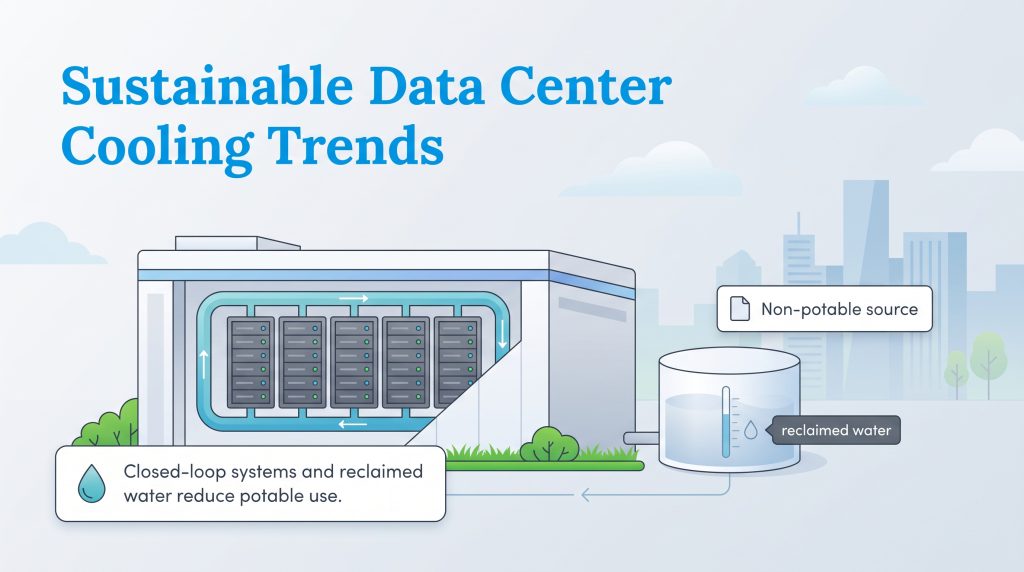
To improve data center sustainability, many operators are pivoting toward closed-loop cooling systems. Unlike open-loop designs that evaporate water directly into the atmosphere, closed-loop systems recirculate the same water or coolant through sealed pipes. Once the initial system is filled, these energy-saving options require very little makeup water, acting as an environmentally mindful choice that preserves precious local supplies.
Immersion Cooling Technology
One of the most promising advancements in the industry is immersion cooling technology. Instead of using fans or water chillers, servers are fully submerged in a bath of dielectric fluid — a specialized liquid that conducts heat but not electricity. This non-conductive fluid absorbs heat much more efficiently than air or water, cutting direct freshwater use down to near zero. While currently reserved for high-density computing and intense AI workloads, immersion cooling represents the next frontier in sustainable server management.
Myths vs. Reality: Draining Municipal Supplies
When tech companies announce plans to build new server facilities, local residents often worry about the immediate impact on their utilities. However, a lot of misinformation surrounds how data centers actually source and process their water. Here is a look at the common myths versus the reality of modern infrastructure.
| Common Myth | The Reality |
|---|---|
| All data centers drain fresh drinking water from municipal supplies. | Modern facilities increasingly utilize reclaimed wastewater, greywater, or non-potable groundwater to cool their servers, reducing the strain on drinking water. |
| The water used to cool servers is permanently destroyed. | Most water used in evaporative towers evaporates into the atmosphere and eventually returns to the global water cycle, while closed-loop systems recycle their internal fluids indefinitely. |
| Using cloud storage at home doesn’t impact my local utilities. | Because of indirect water consumption electricity, the power plants generating electricity for your local grid use massive amounts of water to support your digital demands. |
Measuring Efficiency: Water Usage Effectiveness (WUE)
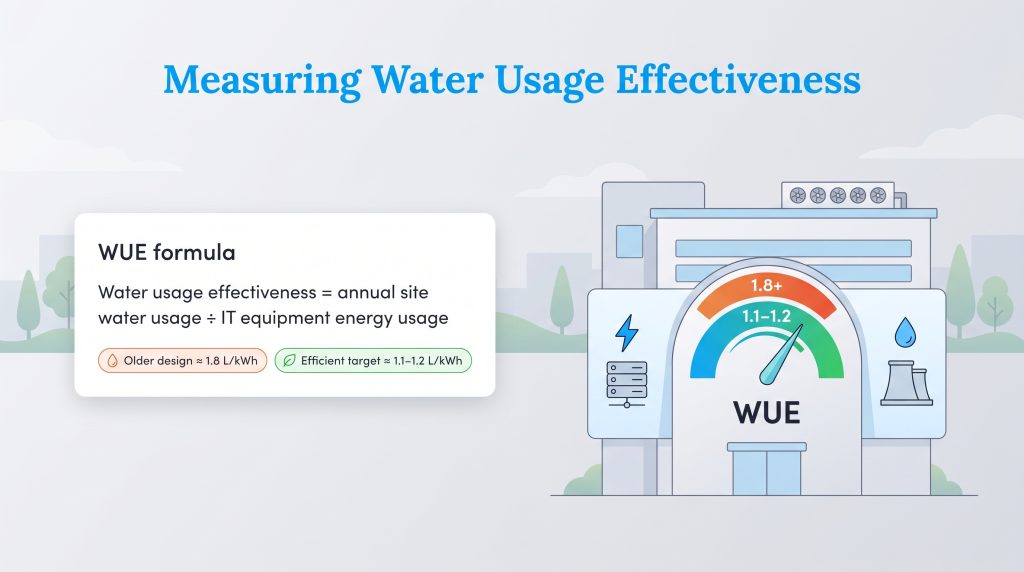
To measure how responsibly these facilities operate, the tech industry uses a critical performance metric called water usage effectiveness (WUE). WUE acts as a straightforward sustainability indicator, allowing operators to pinpoint waste and improve overall performance in water-scarce regions.
You can calculate this metric using a simple formula: Water Usage Effectiveness (WUE) = Annual Site Water Usage / IT Equipment Energy Usage.
The result is typically expressed in liters of water per kilowatt-hour of electricity (L/kWh). While an older facility relying on heavy evaporation might score a 1.8 L/kWh or higher, the current industry benchmark for a highly sustainable WUE rating is between 1.1 and 1.2 L/kWh. Achieving this benchmark demonstrates that a facility is maximizing its computational output while minimizing its physical drain on local resources.
Actionable Steps for Eco-Conscious Digital Consumers
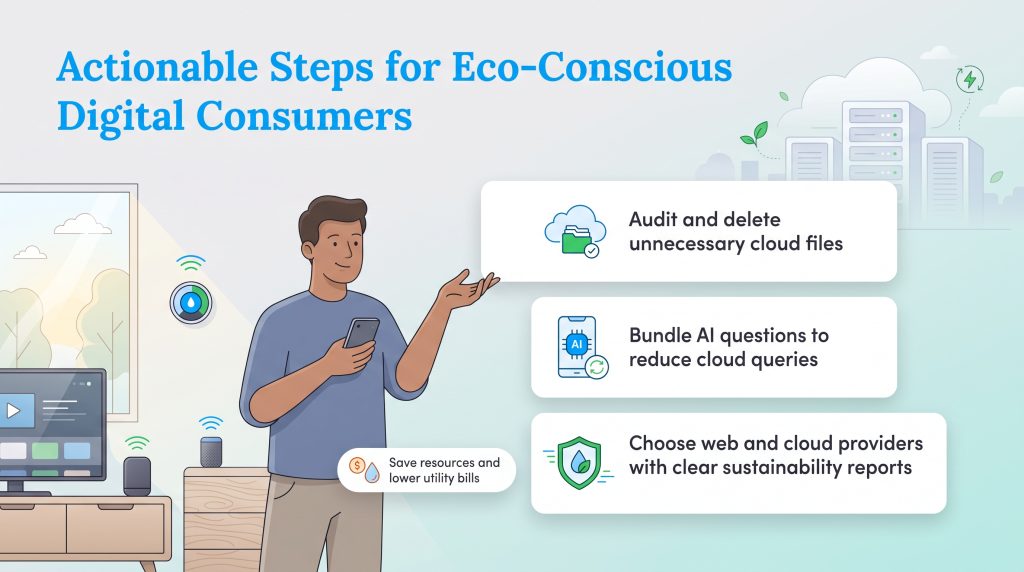
Moving into a new residence is the perfect time to evaluate how your digital infrastructure affects the world outside your walls. Every smart camera, thermostat, and streaming device you install contributes to your household’s background data consumption. When setting up these devices, you have an opportunity to make eco-conscious home setup choices that balance convenience with resource stewardship.
While massive tech corporations bear the primary responsibility for upgrading their infrastructure, we can also make mindful choices at home to limit unnecessary server demand. Individual choices won’t solve data center water demand on their own, but they can reduce unnecessary data use and support companies that invest in more efficient infrastructure. Here are three actionable steps you can take to lighten the load:
- Audit and Delete Unnecessary Cloud Storage: Over time, duplicate photos, outdated backups, and forgotten files pile up on remote servers. Taking time to clean up duplicate files and wipe old backups reduces the constant storage demand, ultimately decreasing the amount of cooling required to keep those servers running.
- Optimize AI Query Efficiency: Since generative AI is highly resource-intensive, rely on on-device processing when possible rather than constantly pinging the cloud. When you do use AI tools, bundle your questions into a single, comprehensive prompt to reduce the sheer number of micro-transactions handled by the servers.
- Select Green Web and Cloud Providers: You can actively choose web hosts and cloud providers committed to water stewardship. Look for companies that publicly report their water usage effectiveness, utilize reclaimed water, or invest in renewable energy procurement, rather than relying on vague “green cloud” marketing.
Protecting Shared Utilities Through Smarter Digital Habits
Being mindful of our digital habits carries the same weight as turning off the tap while brushing your teeth or switching your old lightbulbs to LEDs. The invisible infrastructure supporting our smart homes exacts a very real, physical toll on the resources we share. Recognizing that our online actions ripple out to our municipal systems is a vital part of responsible homeownership.
As the demand for hyperscale data centers and artificial intelligence continues to surge, the tech industry must prioritize sustainable cooling solutions to protect local watersheds. Building a sustainable future for our communities means treating digital consumption as a tangible utility. By making intentional adjustments to how we manage our data, relying on eco-conscious cooling innovations, and demanding transparency from the services we use, we can protect local utility grids and ensure our seamlessly connected lifestyles don’t compromise the environment.
Frequently Asked Questions About Data Center Water Usage
Why do data centers need water?
What is water usage effectiveness (WUE)?
Does cloud computing impact my local water supply?
What is an open-loop vs. closed-loop water cooling data center?
How can I reduce my personal AI water footprint?
Do all data centers use the same amount of water?
Is streaming or AI worse for data center water usage?
How much water does an AI query use?
What is the difference between direct and indirect data center water usage?
Do data centers recycle the water they use for cooling?
About the Author

Claudio is a sustainability-focused writer with a background in Anthropology and Psychology from NC State University. He has spent over 15 years working in writing, interpretation, and translation, driven by a deep interest in how human culture shapes the environment. Today, he shares his curiosity with readers by writing about sustainable living solutions and the connection between everyday choices and environmental impact.

David has been an integral part of some of the biggest utility sites on the internet, including InMyArea.com, HighSpeedInternet.com, BroadbandNow.com, and U.S. News. He brings over 15 years of experience writing about, compiling and analyzing utility data.