

Choosing between Brightspeed and T-Mobile Home Internet comes down to what internet technology is available at your specific address.
Key Takeaways
- T-Mobile 5G Home Internet can be a better value than Brightspeed DSL if your home has strong 5G signal and limited wired options.
- Brightspeed Fiber is usually better for gaming and heavy streaming because fiber tends to offer lower latency and steadier speeds.
- T-Mobile may offer bundle discounts if you already have a qualifying mobile plan, but you should confirm the current offer before ordering.

- 2 Gbps
- Fiber
- 1 TB
- $29.00/mo
- 498 Mbps
- 5G
- 1.2 TB
- $35.00/mo
*Not all internet providers and speeds available in all areas.
Finding a reliable internet service provider can feel incredibly frustrating, especially when you are setting up utilities in a new home and stuck choosing between an expanding legacy network and newer fixed wireless technology. If you are comparing Brightspeed vs T-Mobile Home Internet, your decision largely hinges on the exact type of connection wired to your neighborhood. While T-Mobile delivers an aggressive, wide-reaching 5G network that acts as a competitive alternative for those suffering from slow rural speeds, Brightspeed is rapidly upgrading its older copper lines to highly reliable fiber optics. We want to help you cut through the marketing noise so you can pick the connection that perfectly balances your budget, streaming habits, and everyday browsing needs.
The Bottom Line: Which Internet Service Should You Choose?
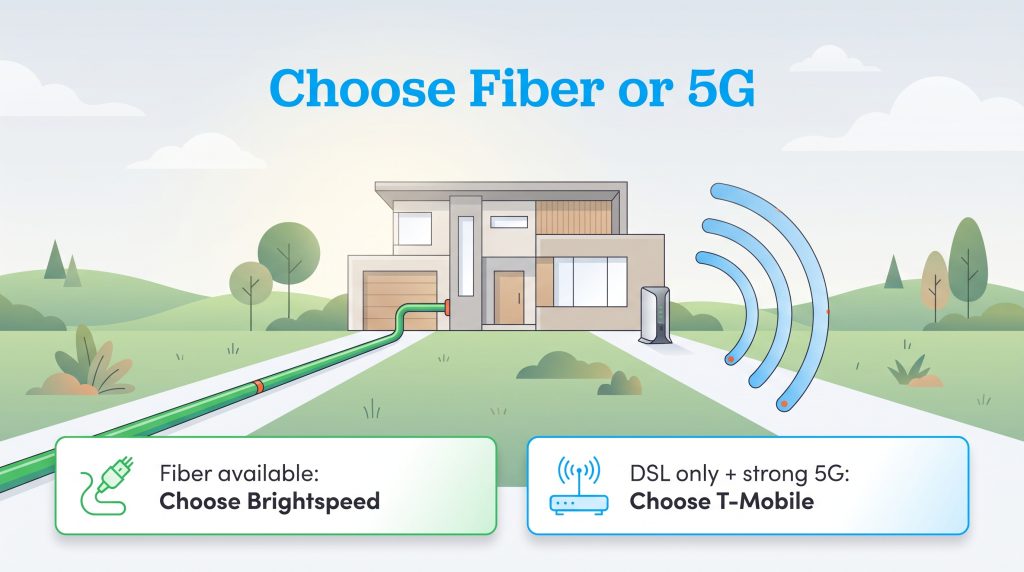
When evaluating these two options, your first step is checking whether Brightspeed offers fiber or just standard DSL at your address. If Brightspeed only offers DSL at your address, T-Mobile may deliver faster speeds and easier setup, especially if your home gets a strong 5G signal. Conversely, if Brightspeed Fiber is available at your home, it is usually the stronger choice for gaming, heavy streaming, and work-from-home households because fiber tends to deliver lower latency and steadier speeds.
How to Choose Between Brightspeed and T-Mobile
- Check whether Brightspeed offers DSL or fiber at your address.
- Check T-Mobile’s 5G Home Internet availability and expected speed range.
- Compare the final monthly cost after autopay, equipment, installation, and mobile bundle discounts.
- Prioritize fiber if you game competitively, upload large files, or take frequent video calls.
- Prioritize T-Mobile if you need a fast self-install option and Brightspeed only offers DSL.
| Situation | Better Choice | Why |
|---|---|---|
| Brightspeed Fiber is available | Brightspeed | Lower latency, higher top speeds, stronger reliability |
| Only Brightspeed DSL is available | T-Mobile | Usually faster and easier to install if 5G signal is strong |
| You already have T-Mobile wireless | T-Mobile | Potential bundle savings |
| Competitive gaming or livestreaming | Brightspeed Fiber | More consistent latency |
| You need internet quickly after moving | T-Mobile | Self-install gateway may be faster |
Quick Fact
Brightspeed launched after acquiring portions of Lumen Technologies’ former CenturyLink local network assets in 20 states, which is why some customers still associate the service with CenturyLink.
Understanding the Technology: 5G Home Internet vs. Fiber and DSL
The core differences between these providers originate from how they physically deliver the internet to your living room. Rather than comparing apples to apples, you are weighing a cellular signal against physical wiring. We highly recommend you check your exact address on the FCC’s National Broadband Map to verify which specific infrastructure reaches your property.
Brightspeed’s Network: Fiber vs. Copper DSL
Brightspeed operates two vastly different networks. Their legacy DSL network runs on aging copper telephone wires, which severely limits bandwidth and distance capabilities. When comparing Brightspeed DSL vs 5G home internet, the physical limitations of copper become obvious. DSL performance depends heavily on your distance from the provider’s equipment, so two homes in the same town may see very different speeds. However, Brightspeed is aggressively replacing these copper lines with a modern fiber optic network. In the battle of 5G home internet vs fiber, fiber optics often perform better by transmitting data via light pulses, delivering symmetrical upload and download speeds that usually outpace fixed wireless networks in both consistency and overall speed.
T-Mobile’s Network: Fixed Wireless 5G
T-Mobile bypasses the need for physical neighborhood wiring entirely. Instead, their fixed wireless 5G gateways pull a cellular signal from the nearest T-Mobile cell tower and convert it into a local Wi-Fi network for your home. While this means your speeds depend heavily on tower congestion and your proximity to the signal, it also allows T-Mobile to offer broadband access in areas that traditional wired providers historically ignored.
Eco Edge
Fixed wireless can reduce the need for new last-mile trenching in some areas, which may make installation less disruptive than running new wired infrastructure. Energy use still depends on the network, equipment, and local conditions.
Plans, Pricing, and Hidden Fees Compared
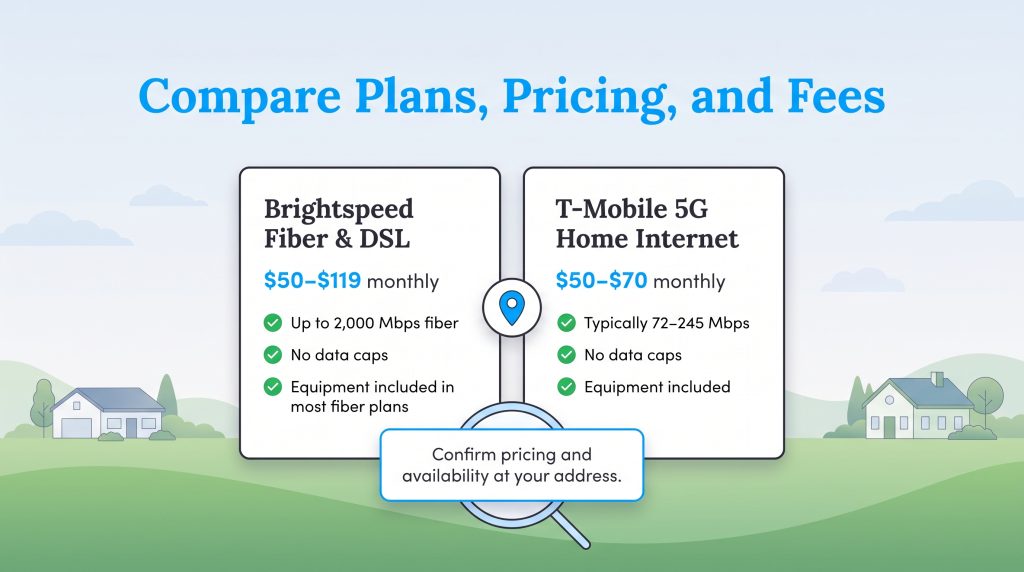
Pricing can look simple at first, but the better deal depends on your address, speed tier, equipment needs, and whether you already have T-Mobile mobile service. Use the table below as a starting point, then confirm the current offer with each provider before you sign up.
| Provider Feature | Brightspeed Fiber & DSL | T-Mobile 5G Home Internet |
|---|---|---|
| Monthly Price | $50 – $119 (depending on speed tier) | $50 – $70 (discounts available) |
| Max Download Speed | Up to 2,000 Mbps (Fiber) / Up to 100 Mbps (DSL) | Typically 72 – 245 Mbps |
| Data Caps | None | None (subject to network deprioritization) |
| Equipment Fees | Included in most fiber plans | Included |
Note: Prices and speeds vary by location, plan, autopay enrollment, and current promotions. Confirm details at your address before ordering.
When you sit down to calculate the financial impact of your new utility bills, both providers present appealing, simplified pricing structures. If you remember this service as CenturyLink, it helps to compare today’s Brightspeed plans against T-Mobile’s current 5G Home Internet offers. T-Mobile operates with a flat-rate mentality, meaning the equipment is included and there are no restrictive data caps. T-Mobile often promotes price guarantees or price-lock offers on select home internet plans, but you should review the current terms before signing up because protections can vary by plan and enrollment date. Furthermore, T-Mobile may offer meaningful monthly discounts when you bundle home internet with a qualifying mobile plan, so it’s worth checking your account-specific offer before comparing final prices.
Brightspeed also deserves credit for keeping their pricing relatively transparent. They do not require annual contracts, which means you won’t be trapped with early termination fees if you decide to move. While Brightspeed Fiber costs slightly more at the highest speed tiers, the exceptional performance justifies the premium. When comparing residential internet plans, it pays to look closely at what you actually need for your household rather than just chasing the cheapest monthly rate.
Brightspeed Plans & Pricing
| Plan Name | Price | Download Speeds | Connection Type | |
|---|---|---|---|---|
| Up to 40 Mbps | $50 /month | Up to 40 Mbps | DSL | Check Availability |
| Fiber Internet 200 Mbps | $29.99 /month | Up to 200 Mbps | Fiber | Check Availability |
| Fiber Internet 500 Mbps | $39.99 /month | Up to 500 Mbps | Fiber | Check Availability |
| Fiber Internet 1 Gig | $49.99 /month | Up to 940 Mbps | Fiber | Check Availability |
| Fiber Internet 2 Gig | $69.99 /month | Up to 2 Gbps | Fiber | Check Availability |
| Fiber Internet 8 Gig | $89.99 /month | Up to 8 Gbps | Fiber | Check Availability |
T-Mobile Home Internet Plans & Pricing
| Plan Name | Price | Download Speeds | Connection Type | |
|---|---|---|---|---|
| Home Internet Backup | $20 /month | Up to 318 Mbps | 5G | Check Availability |
| Rely Home Internet | $35 /month | Up to 354 Mbps | 5G | Check Availability |
| Amplified Home Internet | $45 /month | Up to 498 Mbps | 5G | Check Availability |
| All-In Home Internet | $55 /month | Up to 498 Mbps | 5G | Check Availability |
| Fiber 500 | $75 /month | Up to 500 Mbps | Fiber | Check Availability |
| Fiber 1 Gig | $85 /month | Up to 1000 Mbps | Fiber | Check Availability |
| Fiber 2 Gig | $80 /month | Up to 2 Gbps | Fiber | Check Availability |
Money Saver
Before paying full price for a Brightspeed upgrade, politely ask their customer retention department for current promotional rates; providers often extend discounts to existing customers to keep them from switching to competitors like T-Mobile.
Speeds, Reliability, and Gaming Latency
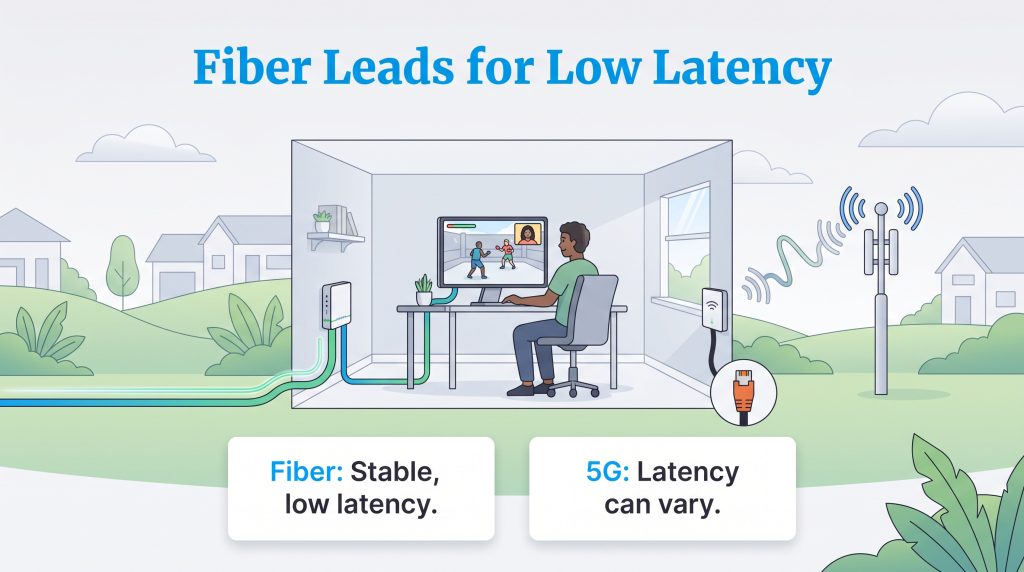
Speed matters, but it’s not the only performance metric that affects your daily experience. Reliability and latency can matter just as much, especially if you work from home, game online, or run several smart-home devices at once.
Everyday Browsing and Streaming
For average households focused on web browsing, scrolling through social media, and streaming Netflix in 4K, both providers handle the workload beautifully. T-Mobile commonly advertises typical 5G Home Internet speeds within a broad range, but your real-world speed can vary by tower congestion, signal strength, and home placement. This is more than enough bandwidth to support multiple smart TVs simultaneously. Brightspeed Fiber has a clear advantage for large families who stream and download massive files all at once.
Online Gaming and Video Calls
The most significant divergence between these technologies emerges when you look at latency, commonly referred to as “ping.” T-Mobile Home Internet can work well for casual gaming, but its fixed wireless connection is more vulnerable to latency swings than fiber, especially when the nearby tower is congested. This delay can make fast-paced competitive gaming nearly unplayable and may occasionally cause stuttering on important Zoom calls. When stacking Brightspeed fiber vs T-Mobile 5G for heavy use cases, fiber usually delivers lower and more consistent latency than fixed wireless, which makes it the stronger choice for competitive gaming, livestreaming, and video calls. Upload speed matters if you send large files, back up photos to the cloud, livestream, or spend much of the day on video calls. Fiber plans often provide more balanced upload and download performance than fixed wireless service.
Pro Tip
You can slightly improve your fixed wireless latency by hardwiring your gaming console or PC directly to the T-Mobile gateway with an Ethernet cable, reducing the wireless interference in your home. Placing your gateway near a window facing the closest cell tower can also improve overall signal consistency.
Regardless of which service you choose, pairing your internet connection with energy-efficient networking equipment helps reduce your home’s phantom power draw, which can help you reduce energy use and keep your utility costs manageable while maximizing performance.
Customer Service and the Setup Experience
The installation processes for these two providers could not be more different. A common theme in Brightspeed internet reviews is the inconvenience of scheduling a technician. Because fiber and DSL require physical lines patched into your home, you must coordinate a multi-hour appointment window to get your service activated. Wired installation can be less convenient during a move because it may require a technician appointment and an installation window, which can add stress to your relocation.
Meanwhile, T-Mobile 5G home internet reviews frequently highlight the sheer convenience of a plug-and-play setup. T-Mobile ships the gateway directly to your door, and you simply plug it into a wall outlet near a window. Using their smartphone app, you self-install the entire network in about 15 minutes. This hassle-free approach reflects broader industry trends; according to ACSI’s latest telecommunications customer satisfaction data, T-Mobile consistently outranks legacy ISPs in customer service, thanks in large part to their straightforward billing and easy equipment management.
Making the Final Call for Your Home Connection
Securing the right internet for your residence does not have to be an overwhelming chore. If Brightspeed Fiber is available, it’s the better long-term connection for most households that need reliable speed, low latency, and strong upload performance. If your Brightspeed option is DSL, T-Mobile 5G Home Internet is often worth trying, especially if you qualify for a mobile bundle discount or need a fast self-install option. Assess your primary household habits, verify the infrastructure at your address, and choose the service that aligns best with your daily routine.
Frequently Asked Questions About Brightspeed vs. T-Mobile Home Internet
Is T-Mobile home internet better than Brightspeed?
Does Brightspeed require an installation fee?
Can I game on T-Mobile 5G Home Internet?
Why does my Brightspeed bill say CenturyLink?
Does T-Mobile Home Internet have a data cap?
Is Brightspeed Fiber better than T-Mobile 5G Home Internet?
Can I try T-Mobile Home Internet before canceling Brightspeed?
About the Author

David has been an integral part of some of the biggest utility sites on the internet, including InMyArea.com, HighSpeedInternet.com, BroadbandNow.com, and U.S. News. He brings over 15 years of experience writing about, compiling and analyzing utility data.

LaLeesha has a Masters degree in English and enjoys writing whenever she has the chance. She is passionate about gardening, reducing her carbon footprint, and protecting the environment. She also recently served as President of the Board for City Sprouts (a community garden).