
Learning how to read your electricity statement helps you track usage, spot hidden fees, and make eco-conscious changes to lower your monthly costs.
Key Takeaways
- Supply and delivery charges make up the bulk of your statement, covering the cost of generating power and bringing it directly to your home.
- Your household electricity usage is measured in kilowatt-hours (kWh), which fluctuates based on your appliances, home size, and seasonal weather patterns.
- Making simple energy-efficient home upgrades can significantly reduce your monthly power consumption and help shrink your overall carbon footprint.
Opening a higher-than-expected electric bill can feel incredibly stressful, especially when the statement arrives packed with confusing industry jargon. We know exactly how frustrating it is to pay a massive total without fully grasping where your hard-earned money actually went. Fortunately, understanding your electric bill serves as the very first step toward taking back control of your monthly energy costs. Once you decode those unfamiliar charges and see the true breakdown of your household power consumption, you can quickly pinpoint wasteful habits and start shrinking your expenses over the upcoming billing cycles.
Why Breaking Down Your Monthly Energy Statement Matters
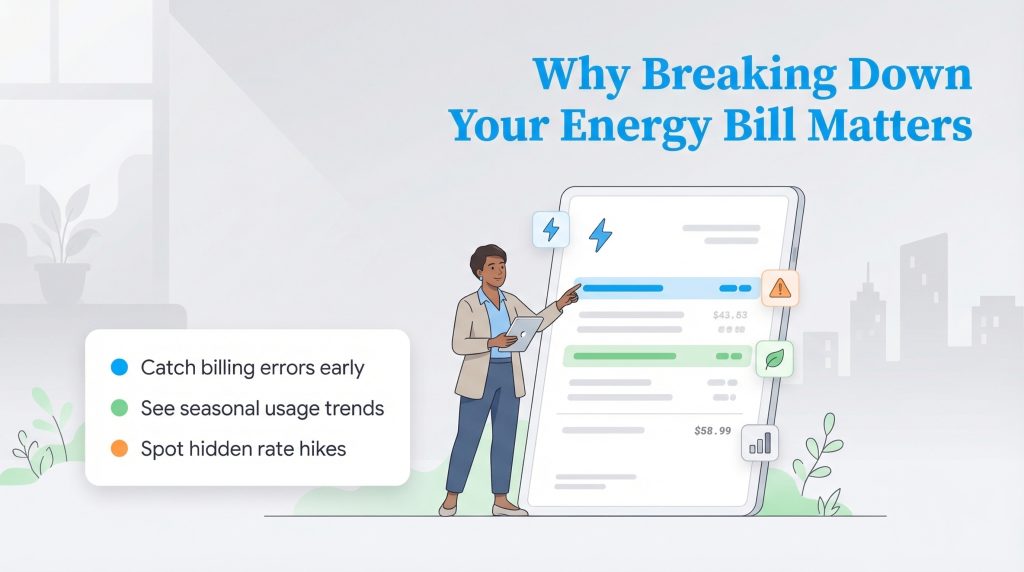
Putting your utilities on autopay and casually tossing the receipts into the trash might save you a few minutes each month, but that convenience often leads to a bloated household budget. Taking the time to properly review your statement allows you to catch billing anomalies, track seasonal usage patterns, and spot unexpected rate hikes before they drain your bank account.
By paying closer attention to these critical details, you empower yourself with the knowledge necessary to make informed, eco-conscious alternative choices. Evaluating your statement line by line is truly the easiest method for taking control of your electricity costs and ensuring you are never overcharged for power you didn’t actually use. When you finally understand the inner workings of your utility statement, you can stop guessing about your budget and start making actionable changes to lower it.
Step-by-Step: How to Read Your Physical or Digital Statement
Many utility customers take one look at their bill, zero in on the final price tag, and ignore the rest of the document. However, learning how to read your electric bill effectively requires knowing exactly where to find the most important data points. Whether you are holding a physical paper copy or viewing a digital PDF on your smartphone, most utility statements share a very similar layout that is designed to communicate your usage quickly.
Here is a practical roadmap to the key sections you should look for on your next statement:
- Account Number: Usually located at the very top right or left corner of your bill, this unique identifier is absolutely essential. You will need this specific number for making payments, setting up online web portals, or calling customer service to dispute a questionable charge.
- Billing Period: Found near your account information, this date range tells you exactly which days you are being charged for. Keep in mind that a billing cycle might cover 28 days one month and 32 days the next, which can artificially inflate or decrease your final total without your actual daily habits changing.
- Historical Usage Graph: Typically displayed as a simple bar chart near the middle or bottom of the front page, this visual tool allows you to easily compare your current monthly consumption against the exact same month from the previous year.
- Total Amount Due: This represents the final number you owe. Be sure to check the specific due date located right next to this total to avoid easily preventable late fees or service interruptions.
The Core Components of Your Electric Bill
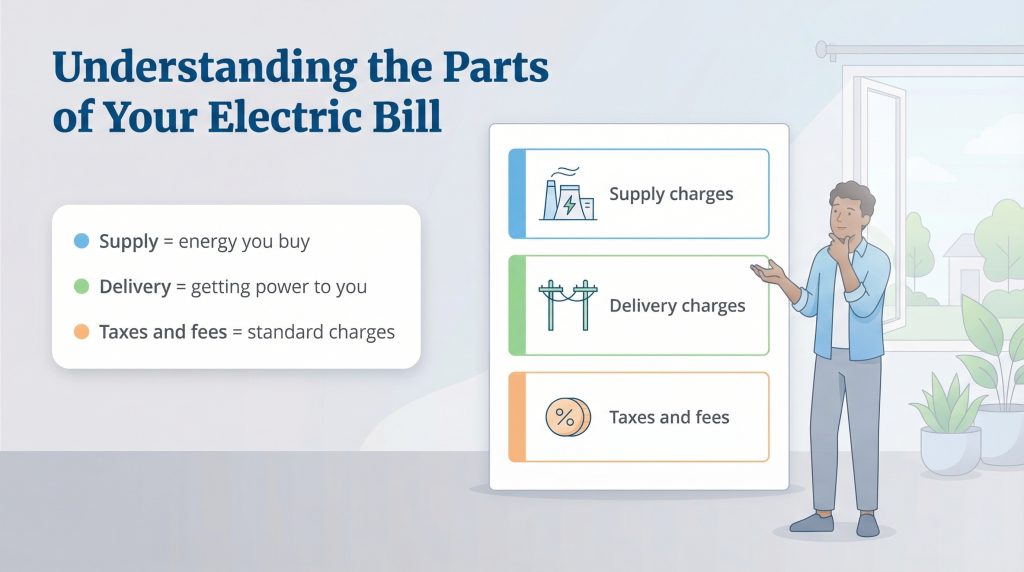
Energy statements look vastly different depending on where you live and which utility company services your neighborhood. Despite those visual differences, almost all providers split your total costs into three primary categories: supply, delivery, and a combination of base fees and taxes. Recognizing how these distinct buckets operate makes it much easier to decipher the actual cost of powering your home.
To help you navigate your specific document, here are a few common terms you might see for each category:
- Supply charges: Generation, Supply, or Purchased Power
- Delivery charges: Distribution, Transmission, TDU, or Delivery
- Taxes and fees: Riders, Surcharges, or Public Purpose Charge
Supply Charges Explained
Your supply charge, sometimes listed as a generation charge, represents the actual cost of the electricity your household consumed over the billing cycle. This fee covers the fuel and the power plants required to create the electricity long before it ever hits the transmission lines.
In many states, your local utility still delivers the power, but you may be able to choose the company that actually supplies it. Eligibility heavily depends on your state and local utility territory. This flexibility gives you a fantastic opportunity to shop around and opt for an environmentally mindful choice, such as a 100% renewable energy plan sourced from regional wind or solar power.
Delivery and Transmission Fees
Delivery charges cover the physical journey your electricity takes from the remote generation plant directly to your living room. This money goes directly to your local utility company to fund the continuous maintenance of power lines, wooden poles, neighborhood transformers, and the broader grid infrastructure.
Unlike supply rates in deregulated markets, delivery fees are entirely fixed by your region’s utility commission. You cannot shop around for a cheaper delivery company, because only one entity owns the physical wires connected to your house. If you are curious about how infrastructure costs impact utility bills, it mostly boils down to the massive expense of keeping the grid functional, resilient, and safe during severe storms and extreme weather events.
Base Charges, Taxes, and Surcharges
Toward the bottom of your statement, you will likely spot a handful of smaller line items. One of the most important to understand is the base charge — sometimes called a customer charge or basic service fee. Base charges are flat monthly connection fees that apply regardless of your energy consumption. Even if you unplugged every appliance and used zero electricity for an entire month, you would still have to pay this fixed fee simply for the privilege of being connected to the grid.
In addition to base fees, you will see state taxes, local municipal fees, and public purpose charges. These are completely standard additions, so there is no need to worry when you see them. In fact, many public purpose surcharges directly fund local low-income assistance programs and community energy efficiency initiatives. Just keep an eye out for easily avoidable penalties, like late payment fees, which can quietly inflate your bill.
What Is a Kilowatt-Hour (kWh)?
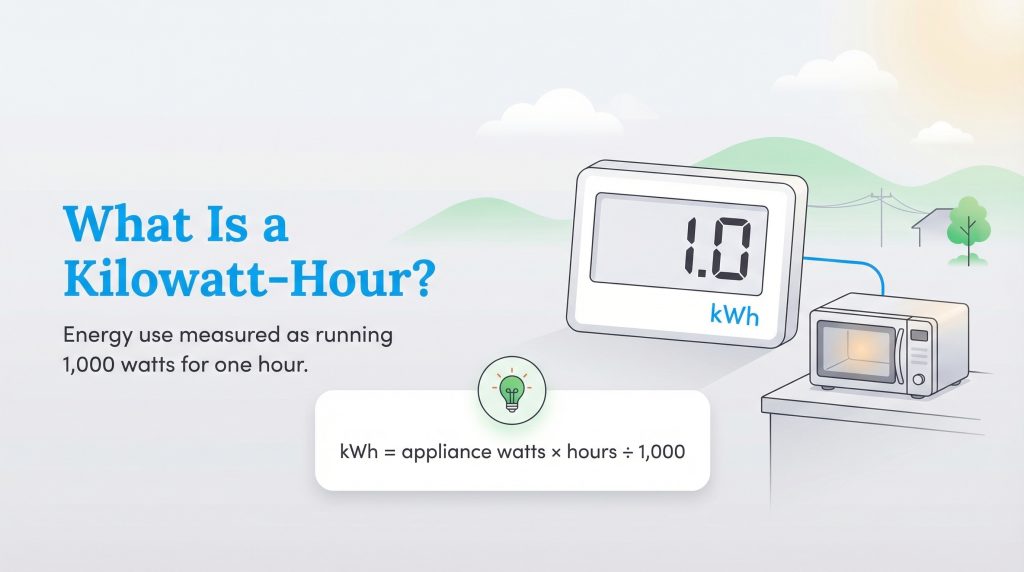
A kilowatt-hour, or kWh, is simply the standard unit of measurement your utility company uses to track your household energy consumption. To picture how it works, imagine running a standard 1,000-watt microwave continuously for exactly one hour — that specific action consumes precisely one kilowatt-hour of energy.
Every single time you flip a light switch, run the dishwasher, or crank the air conditioner, you use a fraction of a kWh. At the end of your billing cycle, your provider adds up all those tiny fractions to get your total kWh usage, then multiplies that number by your current electricity rate to calculate your final bill.
Because electricity usage estimates vary widely based on your specific appliance model, local climate, and personal habits, the Department of Energy recommends checking the wattage on your individual devices to calculate accurate consumption. You can use this simple calculation method to estimate your costs:
| Estimation Step | Example (1,500-Watt Space Heater) |
|---|---|
| Find the wattage on the appliance label | 1,500 Watts |
| Multiply by the hours used per day | 1,500 Watts × 4 hours = 6,000 Watt-hours |
| Divide by 1,000 to find the daily kWh | 6,000 ÷ 1,000 = 6 kWh per day |
| Multiply by 30 days for a monthly estimate | 6 kWh × 30 days = 180 kWh per month |
Fixed Rates, Variable Rates, and Time-of-Use Plans
When learning how to read your electric bill, you must understand the specific rate structure dictating your costs. Your electricity rate directly impacts how much you pay per kilowatt-hour, and being on the wrong plan can easily result in overpaying for your daily energy usage. Depending on your provider and local regulations, you typically have three main options: fixed rates, variable rates, and time-of-use (TOU) plans.
Choosing the right structure heavily depends on your lifestyle, when you are most active at home, and your personal tolerance for financial risk. To help you navigate your options and avoid unexpected rate hikes, review this quick comparison of the three most common electric rate structures:
| Fixed Rate Plans | Variable Rate Plans | Time-of-Use (TOU) Plans |
|---|---|---|
| How it works: You pay the exact same price per kWh for the entire duration of your contract, regardless of seasonal market conditions. | How it works: Your price per kWh fluctuates from month to month based on wholesale energy market conditions and regional demand. | How it works: Your price per kWh changes depending on the time of day, with more expensive rates during peak hours and cheaper rates overnight. |
| Best for: Homeowners who want strict budget predictability and absolute protection against sudden energy market price spikes. | Best for: Renters or users who want short-term flexibility without the commitment of cancellation fees, provided they accept the financial risk. | Best for: Eco-conscious households that can actively shift heavy appliance usage to off-peak, late-night hours. |
| Bill Impact: Your monthly bill will only fluctuate based on how much electricity you actually use, not because the price of power changed. | Bill Impact: Your bill can suddenly skyrocket during extreme summer heatwaves or winter freezes when grid demand dramatically surges. | Bill Impact: You can significantly lower your bill by carefully managing when you consume power, but ignoring peak hours will cause massive spikes. |
How to Spot and Prevent Unexpected Usage Spikes
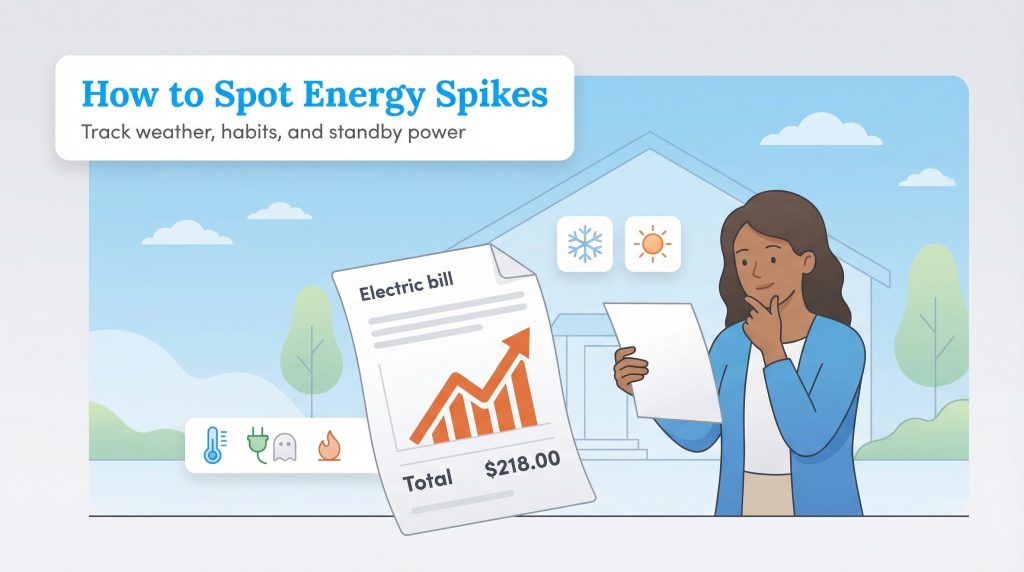
Nothing is more frustrating than opening your bill to find the total has mysteriously doubled since last month. Most unexpected usage spikes stem from drastic seasonal weather changes, like blasting the AC during a sweltering July heatwave or pushing your electric furnace to its limits during a January freeze. Understanding the factors that affect electricity prices, such as increased fuel costs or seasonal rate adjustments, can help you anticipate why your bill might jump even if your usage stays exactly the same.
Whenever you notice a sudden jump in your total amount due, immediately check the historical usage graph on your statement. This visual chart allows you to effortlessly compare your current consumption with the previous year’s metrics for that exact same month. If your usage is significantly higher than it was a year ago, weather or lifestyle changes are likely the culprit. If your usage is identical but the bill is higher, you are likely dealing with a rate increase.
If you are unsure why your current statement is unusually high, use this quick diagnostic guide to find the likely culprit:
| Clue on Your Bill | What It Likely Means | What to Do Next |
|---|---|---|
| kWh usage increased from last month | Your household consumed more electricity | Check your thermostat settings, inspect for air leaks, and monitor daily appliance habits. |
| kWh is flat, but total cost is up | Your supply rate increased or new fees were added | Review your rate plan details and check for recent utility notices about price hikes. |
Beyond the weather, your home might be suffering from phantom energy loads. Devices like gaming consoles, televisions, and smart coffee makers silently draw power 24/7 simply by staying plugged into the wall. Unplugging rarely used electronics or utilizing smart power strips can quickly eliminate this hidden waste.
The Role of Smart Meters in Tracking Usage
Modern grid technology has made it easier than ever to monitor your real-time electricity consumption. While older analog meters required a physical utility worker to walk onto your property and read the spinning dials, modern smart meters wirelessly transmit your usage data directly to your provider. This two-way communication eliminates the need for estimated bills and ensures you are only charged for the exact amount of power you use.
Because smart meters continuously track your data throughout the day, they unlock incredibly powerful tools for avoiding bill shock. Most major utility companies now offer online web portals and mobile applications that sync directly with your smart meter. By logging into your provider’s portal, you can track your energy spikes by the hour, set up high-usage text alerts, and adjust your daily habits long before the final monthly statement ever hits your mailbox.
How Solar Panels and Net Metering Change Your Bill
If you recently moved into a home equipped with a renewable energy system, understanding your electric bill requires learning an entirely new set of rules. When your rooftop solar panels generate more electricity than your household can consume during the day, that surplus power is seamlessly sent back into the local grid. Through a highly beneficial billing mechanism called net metering, your utility company tracks this outgoing electricity and credits your account for the excess energy you produced.
These net metering credits offset the cost of the electricity you pull from the grid at night or on cloudy days when your panels aren’t actively generating power. Because solar generation fluctuates heavily with the seasons, many solar customers receive a specialized annual statement known as a true-up bill. A true-up bill calculates your total grid usage versus your total solar production over an entire 12-month cycle. If you generated more power than you used, your balance will be zero — or you may even receive a small payout. If you consumed more than you produced, you will owe the remaining balance for that extra grid energy.
Eco-Conscious Ways to Lower Your Monthly Electric Bill
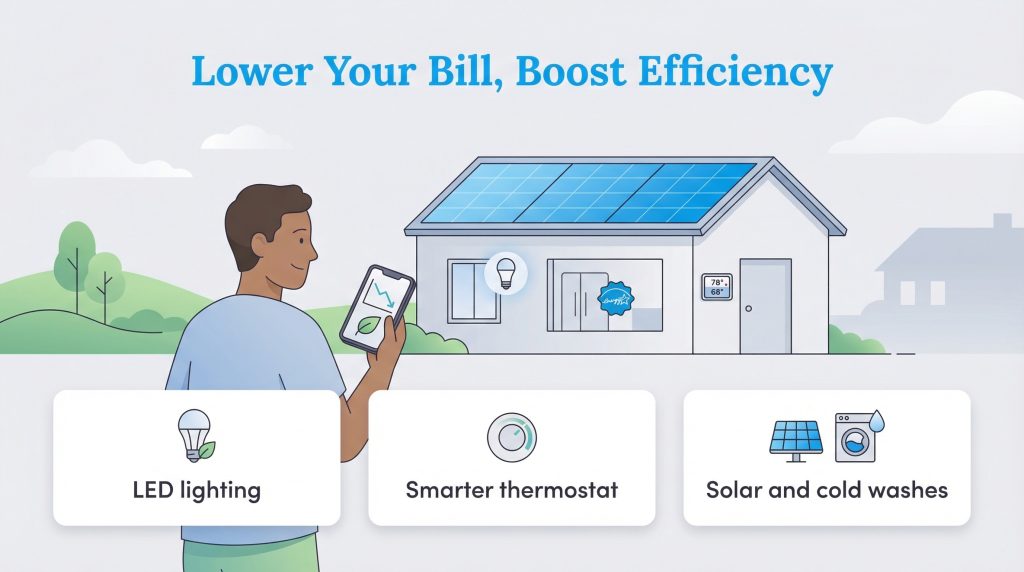
Shrinking your household carbon footprint naturally leads to a significantly smaller utility bill. If you truly want to reduce your monthly energy expenses without sacrificing daily comfort, try implementing a few of these sustainable habits into your routine:
- Upgrade your lighting: Swap out inefficient incandescent or halogen bulbs for highly efficient LED fixtures.
- Adjust the thermostat: Nudge your indoor temperature up to 78 degrees in the summer and down to 68 degrees in the winter to significantly ease the burden on your HVAC system.
- Hunt for the ENERGY STAR label: Choose certified energy-efficient models when replacing old refrigerators, dishwashers, or washing machines.
- Generate your own power: Consider investing in rooftop solar panels after verifying your roof is suitable and reviewing your local net metering rules to offset your reliance on the traditional grid.
- Wash clothes in cold water: Cut out the massive energy required to heat water by running your laundry cycles cold.
Preparing for Your Next Billing Cycle
Decoding the various supply rates, delivery fees, and kWh totals transforms a stressful monthly chore into a powerful financial tool. Once you fully grasp how your household consumes energy, you are no longer at the mercy of a confusing, jargon-filled statement. You can actively track your progress, identify wasteful habits, and implement meaningful strategies to stop throwing your hard-earned cash out the window.
To ensure you stay on top of your utility budget, use this simple three-point checklist to verify your details when your next bill arrives:
- Check the billing days: Look at the exact dates in your billing period to ensure you aren’t simply paying for a longer-than-average 33-day cycle.
- Compare the historical usage: Glance at the bar chart to see if your current kWh consumption aligns with what you used during this exact same month last year.
- Verify your rate plan: Confirm whether your supply rate has suddenly spiked, which could indicate that a promotional fixed-rate contract has expired and rolled into a more expensive variable plan.
Every small, environmentally mindful change you make — whether it is unplugging a phantom device or switching to a renewable supplier — adds up to massive savings over time. You have the power to shape your energy future, one billing cycle at a time.
Frequently Asked Questions About Understanding Your Electric Bill
Why is my first electric bill so high after moving in?
Why is my delivery charge higher than my supply charge?
Can I refuse to pay the delivery charges on my electric bill?
What does a tiered rate structure mean on my statement?
How do time-of-use (TOU) plans affect my monthly charges?
Is a fixed rate or variable rate better for my electric bill?
What is a base charge on my electric bill?
How do I know if my electric meter is reading correctly?
Why is my electric bill so high when I have solar panels?
About the Author

David has been an integral part of some of the biggest utility sites on the internet, including InMyArea.com, HighSpeedInternet.com, BroadbandNow.com, and U.S. News. He brings over 15 years of experience writing about, compiling and analyzing utility data.