
Both providers offer competitive options, but understanding their rate structures is key to avoiding high bill surprises.
Key Takeaways
- Gexa Energy typically offers lower rates for specific usage tiers, often utilizing bill credits to drop the price per kWh.
- TXU Energy is known for stability and customer satisfaction, offering popular “Free Nights” plans that appeal to high-usage households.
- Reviewing the Electricity Facts Label (EFL) is essential for both companies to spot cancellation fees and minimum usage requirements.
Whether you are moving into a new home or just looking to switch providers, choosing an electricity plan in Texas is notoriously confusing. You have the established giant, TXU Energy, promising reliability and innovative perks, and the value-focused challenger, Gexa Energy, tempting you with incredibly low advertised rates on comparison sites. However, savvy Texans know the bold print rarely tells the whole story. We’re going to look past the marketing to the actual math, helping you navigate bill credits, usage traps, and hidden fees to find the plan that truly fits your lifestyle and budget.

- 13.5¢ /kWh
- 3-100%
- 60 days
- 1-36 Months
- Best for Plan Variety & Reliability

- 7.9¢ /kWh
- 100%
- 60 days
- 4-36 Months
- Committed to Renewable Energy
*rates may vary by location and household usage
Quick Comparison: How They Stack Up
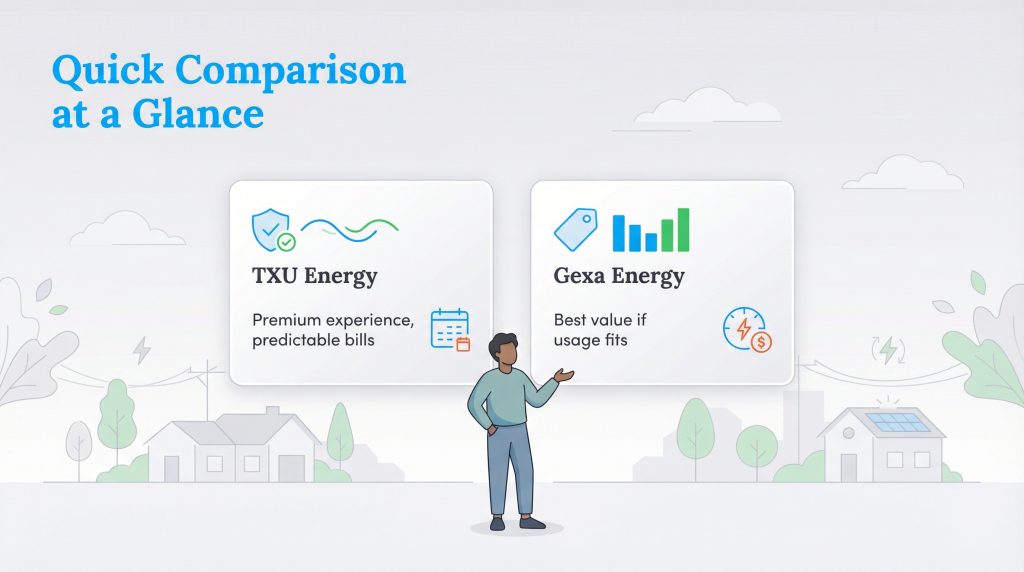
When you look at the big picture, these two companies serve slightly different needs. TXU Energy positions itself as a premium brand with a focus on customer experience and predictable billing, which can be comforting during the stress of a move. Gexa Energy generally positions itself as the value option, often showing up as the cheapest choice, provided you hit specific usage targets found in their contract terms.
| Feature | TXU Energy | Gexa Energy |
|---|---|---|
| Best For | Stability, high usage, and reliable service | Price shoppers and medium usage (1000+ kWh) |
| Price Range | Moderate to Premium | Low to Moderate (Highly dependent on usage) |
| Contract Lengths | Commonly 12 to 36 months | Typically 12 or 24 months |
| Renewable Options | Solar buyback & green add-ons | Many plans are 100% renewable |
| Reputation | Strong support reputation | Good value, mixed billing reviews |
Analyzing Rates and Bill Credits
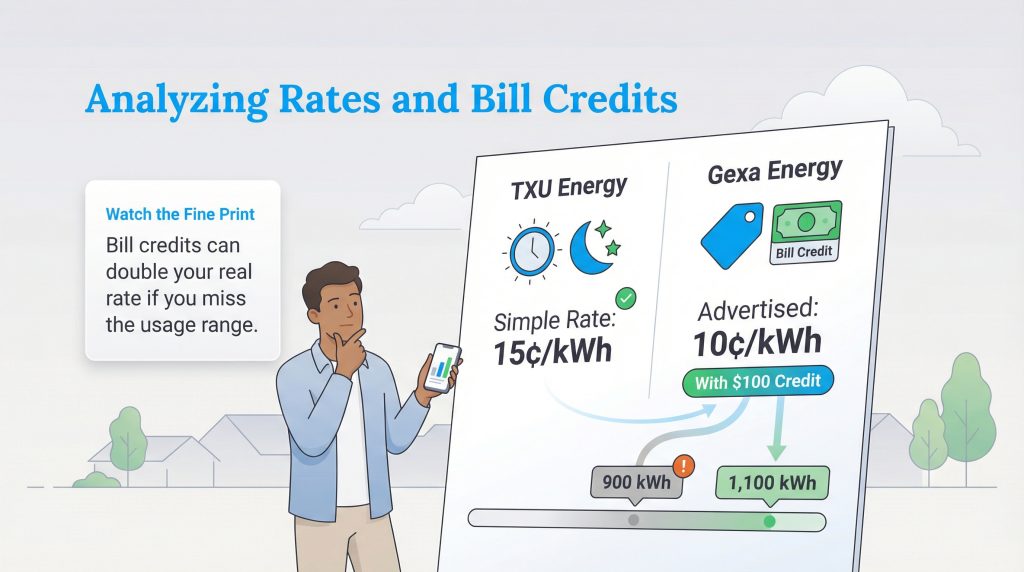
If you are searching for “TXU Energy vs Gexa Energy rates,” you will almost always see Gexa Energy appear cheaper at first glance. This is largely due to how they structure their plans. Gexa frequently utilizes “bill credits” to lower their average price per kilowatt-hour (kWh). For example, a plan might offer a $100 credit if you use between 1000 and 2000 kWh in a billing cycle. When that credit is applied, your effective rate drops significantly.
TXU Energy rates are generally higher per kWh but tend to be more straightforward. While they also use bill credits in some plans, they are well known for “Free Nights” or “Free Weekends” structures where you pay a higher rate during the day but zero charges during specific off-peak hours.
The Math Behind Bill Credits: An Example
To understand the risk, consider a hypothetical plan advertised at 10 cents per kWh. This rate might rely on a $100 bill credit that only kicks in after you use 1,000 kWh.
- Scenario A (1,100 kWh usage): You get the credit. Your bill is low, and your effective rate is around 10 cents per kWh.
- Scenario B (900 kWh usage): You miss the credit entirely. Without that $100 discount, your effective rate might jump to 20 cents per kWh or more.
This is why estimating the usage of your new home accurately is critical before signing a contract.
Plan Features and Renewable Options
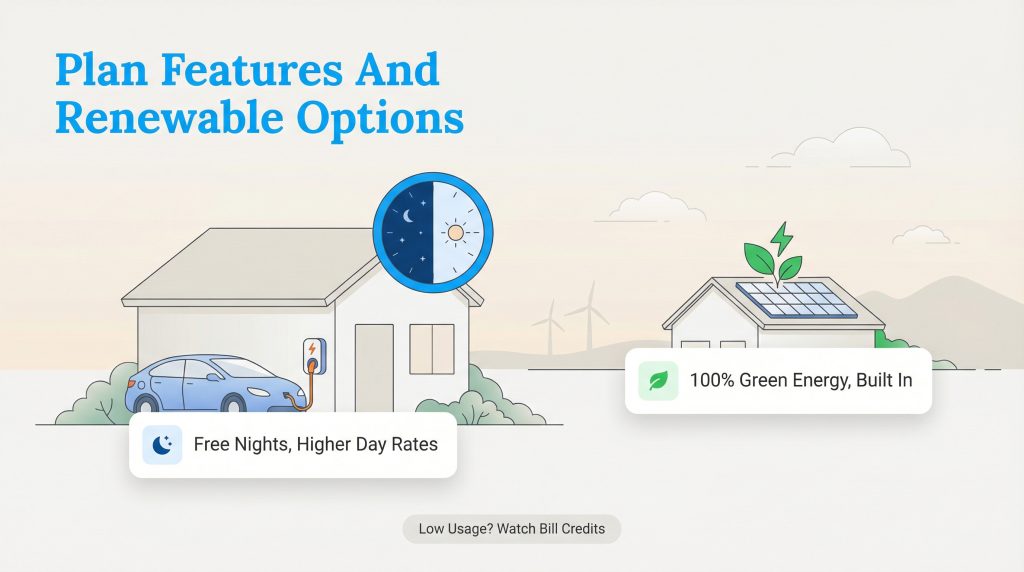
Beyond the basic rate, the specific features of the plans can make a huge difference in your monthly budget.
TXU’s Free Nights & Solar Days
TXU Energy leans heavily into time-of-use plans. Their “Free Nights & Solar Days” plans are excellent if you can shift your heavy energy usage, like doing laundry, running the dishwasher, or charging an electric vehicle, to the evening hours. For EV owners, this can be a major money-saver if you charge overnight. However, the daytime rate on these plans is often significantly higher than the state average. If you work from home and blast the A/C all day, the math might not work in your favor. Learn more about Free Night plans.
Gexa’s Green Plans
If you are looking for an eco-conscious alternative, Gexa Energy is a strong contender. Gexa is a subsidiary of NextEra Energy Resources, one of the world’s largest generators of wind and solar energy. Consequently, many of Gexa’s popular plans come with 100% green energy included without a massive price premium. While TXU offers solar buyback programs and renewable add-ons, Gexa often bakes sustainability right into their low-rate offers. If lowering your home’s carbon footprint is a top priority, these plans are an environmentally mindful choice.
A Note for Low-Usage Homes
If you live in a smaller apartment or a highly efficient home where you consistently use under 500 kWh per month, be very careful with Gexa’s bill credit plans. You will likely never hit the usage threshold needed to get the advertised low price. In this case, a simple flat-rate plan from TXU or another provider might actually be cheaper, even if the advertised rate looks higher.
TXU Energy Plans and Pricing
| Plan Name | Rate | Plan Type | Cancellation Fee | |
|---|---|---|---|---|
| Value Edge 12 | $0.135 /kWh | 12 Months Fixed Rate | $150.00 | Check Availability |
| Clear Deal 12 | $0.139 /kWh | 12 Months Rate | $150 | Check Availability |
| Smart Edge 12 | $0.139 /kWh | 12 Months Fixed Rate | $150.00 | Check Availability |
| Smart Edge 24 | $0.145 /kWh | 24 Months Fixed Rate | $295.00 | Check Availability |
| Clear Deal 24 | $0.155 /kWh | 24 Months Rate | $295 | Check Availability |
| Solar Value 12 | $0.156 /kWh | 12 Months Rate | $150 | Check Availability |
| Simple Value 12 | $0.157 /kWh | 12 Months Fixed Rate | $150.00 | Check Availability |
| Simple Rate 12 | $0.173 /kWh | 12 Months Rate | $150 | Check Availability |
| On Your Terms | $0.175 /kWh | 1 Month Months Rate | $ | Check Availability |
| Free Nights & Solar Days 12 (8 pm) | $0.189 /kWh | 12 Months Rate | $150 | Check Availability |
| Solar Club 12 | $0.191 /kWh | 12 Months Fixed Rate | $150.00 | Check Availability |
| Ultimate Season Pass 12 | $0.192 /kWh | 12 Months Rate | $150 | Check Availability |
| Texas Choice 12 | $0.192 /kWh | 12 Months Fixed Rate | $150.00 | Check Availability |
| Texas Choice 24 | $0.192 /kWh | 24 Months Fixed Rate | $295.00 | Check Availability |
| Flex Rewards | $0.193 /kWh | Variable Rate | $0.00 | Check Availability |
| Flex Forward | $0.193 /kWh | 1 Month Months Rate | $ | Check Availability |
| Smart Deal 12 | $0.196 /kWh | 12 Months Fixed Rate | $150.00 | Check Availability |
| Smart Deal 24 | $0.204 /kWh | 24 Months Fixed Rate | $295.00 | Check Availability |
| Smart Deal 36 | $0.204 /kWh | 36 Months Fixed Rate | $395.00 | Check Availability |
| Solar Saver 12 | $0.205 /kWh | 12 Months Rate | $150 | Check Availability |
| Saver's Discount 12 | $0.217 /kWh | 12 Months Rate | $150 | Check Availability |
| Saver's Discount 24 | $0.228 /kWh | 24 Months Rate | $295 | Check Availability |
Plans and rates may vary by location
Gexa Plans and Pricing
| Plan Name | Rate | Plan Type | Cancellation Fee | |
|---|---|---|---|---|
| Gexa Eco Saver Plus 14 | $0.079 /kWh | 14 Months Rate | $150 | Check Availability |
| Gexa Eco Saver Plus 12 | $0.080 /kWh | 12 Months Rate | $150 | Check Availability |
| Gexa Eco Saver Plus 24 | $0.090 /kWh | 24 Months Rate | $295 | Check Availability |
| Gexa Eco Choice 3 | $0.123 /kWh | 3 Months Fixed Rate | $150.00 | Check Availability |
| Gexa Saver Edge 12 | $0.136 /kWh | 12 Months Rate | $150 | Check Availability |
| Gexa Prime Preferred 24 Plan | $0.139 /kWh | 24 Months Fixed Rate | $295.00 | Check Availability |
| Gexa Prime Preferred 12 Plan | $0.144 /kWh | 12 Months Fixed Rate | $150.00 | Check Availability |
| Gexa Eco Choice 12 | $0.153 /kWh | 12 Months Fixed Rate | $150.00 | Check Availability |
| Gexa Eco Saver Value 12 | $0.159 /kWh | 12 Months Rate | $150 | Check Availability |
| Gexa Light Saver 12 | $0.168 /kWh | 12 Months Rate | $150 | Check Availability |
| Gexa Solar Export Saver 12 | $0.169 /kWh | 12 Months Rate | $150 | Check Availability |
| Gexa Straight Saver 24 | $0.180 /kWh | 24 Months Fixed Rate | $295.00 | Check Availability |
| Gexa Freedom 12 | $0.184 /kWh | 12 Months Fixed Rate | $150.00 | Check Availability |
| Gexa Saver Freedom 36 | $0.184 /kWh | 36 Months Rate | $295 | Check Availability |
| Gexa Saver Freedom 24 | $0.191 /kWh | 24 Months Fixed Rate | $295.00 | Check Availability |
| Gexa Straight Saver 12 | $0.195 /kWh | 12 Months Fixed Rate | $150.00 | Check Availability |
| Gexa Eco Saver Lite 12 | $0.198 /kWh | 12 Months Rate | $150 | Check Availability |
| Gexa Eco Saver Advantage 12 | $0.198 /kWh | 12 Months Rate | $150 | Check Availability |
| Gexa Eco Saver Premier 24 | $0.203 /kWh | 24 Months Rate | $295 | Check Availability |
| Free 3 Day Weekends Preferred 12 | $0.205 /kWh | 12 Months Rate | $150 | Check Availability |
| Gexa Prime Preferred Plus 24 | $0.214 /kWh | 24 Months Fixed Rate | $295.00 | Check Availability |
| Gexa Prime Preferred Plus 12 | $0.217 /kWh | 12 Months Fixed Rate | $150.00 | Check Availability |
| Gexa Eco Saver Premier 12 | $0.224 /kWh | 12 Months Rate | $150 | Check Availability |
Plans and rates may vary by location
Fees, Contracts, and The Fine Print
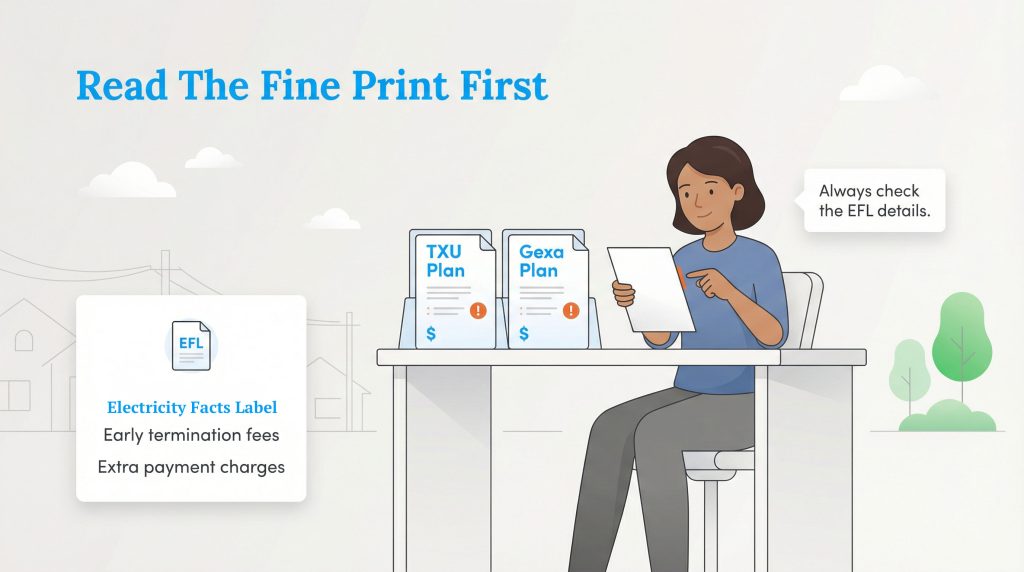
When comparing TXU vs. Gexa cancellation fees, the Electricity Facts Label (EFL) is your best friend. Every plan has one, and you must read it before signing up.
For TXU Energy, early termination fees are usually a flat dollar amount, often around $150 or $295 depending on the plan. It’s a steep price to pay, but it is predictable. With Gexa Energy, cancellation fees also apply and can be similar in size, especially on longer contracts.
Both providers may also charge fees for processing payments over the phone or for insufficient funds. These “hidden costs” aren’t actually hidden if you check the EFL, but they can catch you off guard if you aren’t paying attention.
Customer Service and Reviews
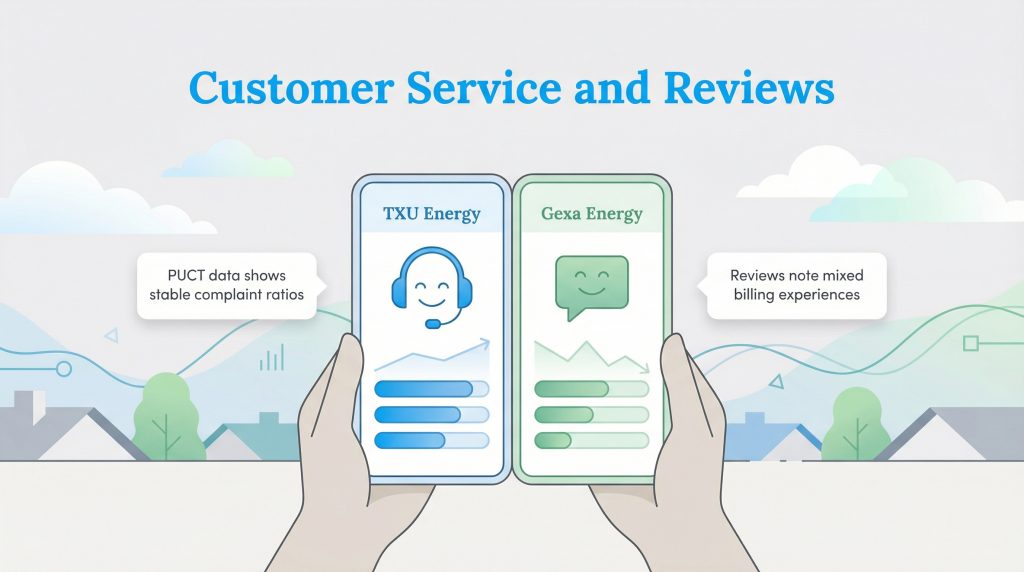
Price isn’t everything; you also want a provider that picks up the phone when the power goes out or a bill looks wrong. When looking at TXU Energy vs. Gexa Energy complaints, historical data often favors the larger incumbent, though experiences vary.
According to statistics from the Public Utility Commission of Texas (PUCT), TXU Energy has historically maintained a complaint ratio that is competitive with or better than many other large Texas retailers. They have invested heavily in their mobile app and customer support teams, earning them a reputation for stability. Gexa Energy reviews are more mixed; while many customers love the low promotional rates, negative reviews often cite frustration with billing disputes when usage targets are missed. Always check the latest PUCT data, as service quality can change over time.
The Final Verdict: Who Wins?
There is no single winner for every household, but there is likely a clear winner for your specific situation. Here is how to decide:
- If you want the absolute lowest price and consistently use between 1000 and 2000 kWh per month: Choose Gexa Energy.
- If you prioritize an eco-conscious alternative and want 100% renewable energy without paying a huge premium: Choose Gexa Energy.
- If you want reliable billing, an excellent mobile app experience, and can shift usage to “Free Nights”: Choose TXU Energy.
- If you are renting and need a shorter commitment: Check contract terms closely. Gexa sometimes offers 12-month value plans, while TXU offers flexibility but often at a premium.
- If you are renting a small apartment with low usage (under 500 kWh): Be careful with Gexa due to minimum usage thresholds and compare closely with TXU’s flat-rate options.
Making the Smart Switch for Your Home
Ultimately, the “best” company depends entirely on your lifestyle and your tolerance for risk. Gexa offers a high-reward potential for those who monitor their usage closely, while TXU offers a “set it and forget it” peace of mind at a slightly higher price point. Regardless of who you choose, reading the fine print on the Electricity Facts Label is the only way to guarantee you get the savings you expect. For more tips on keeping your costs down once you’ve picked a plan, read our guide on how to save on your electric bill. Taking control of your energy choices now can save you hundreds of dollars by the end of the year.
FAQs About TXU Energy And Gexa Energy
Is Gexa Energy really cheaper than TXU?
Does TXU or Gexa have better reviews?
Are Gexa Energy and TXU the same company?
Which company is better for solar buyback plans?
How do I avoid cancellation fees with TXU or Gexa?
About the Author

David has been an integral part of some of the biggest utility sites on the internet, including InMyArea.com, HighSpeedInternet.com, BroadbandNow.com, and U.S. News. He brings over 15 years of experience writing about, compiling and analyzing utility data.