
Choosing between these two Texas power giants comes down to a battle of price versus predictability.
Key Takeaways
- APG&E often offers lower rates for medium usage due to their bill credit structures, but costs can spike if you miss the usage threshold.
- TXU Energy provides strong stability and highly rated customer service, making them a safer choice for homeowners who value peace of mind over the absolute lowest price.
- Always check the Electricity Facts Label (EFL) for base charges and early termination fees, which differ significantly between these two providers.
Navigating the Texas deregulated energy market can feel like walking through a maze without a map, especially with hundreds of plans on “Power to Choose” staring back at you. While TXU Energy stands as the “brand name” giant with a massive footprint and high trust, APG&E acts as the aggressive challenger, often undercutting the big names with attractive introductory rates. We know how stressful it is to worry about picking the wrong plan and getting stuck with a high bill, so we are here to help you decide if TXU’s brand reliability is worth the premium or if APG&E offers the better deal for your home.

- 13.5¢ /kWh
- 3-100%
- 60 days
- 1-36 Months
- Best for Plan Variety & Reliability

- 7.3¢ /kWh
- 6-100%
- None
- 8-36 Months
- Best for Low Rates
*rates may vary by location and household usage
At a Glance: TXU Energy vs. APG&E
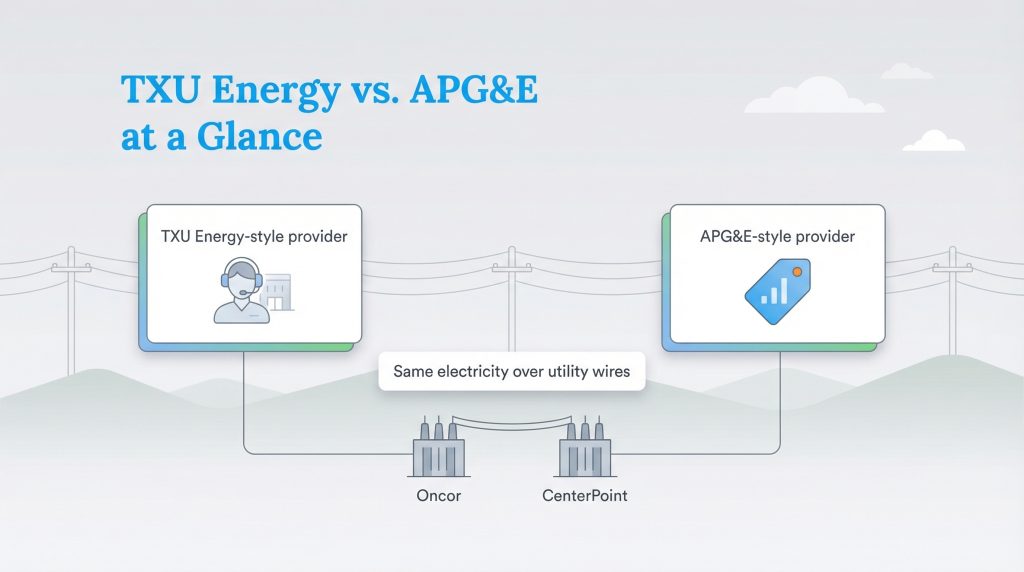
TXU Energy is a legacy provider with deep roots in Texas, often associated with reliability and extensive customer support infrastructure. In contrast, APG&E is a retail electric provider (REP) that focuses heavily on competitive pricing structures. While they both sell the same electricity that travels over wires owned by utility companies like Oncor or CenterPoint, their pricing models and customer service approaches differ significantly.
| Feature | TXU Energy | APG&E |
|---|---|---|
| Best For | Stability, smart home tech, and “free nights” users | Budget-conscious users with predictable usage (1,000+ kWh) |
| Contract Lengths | 12, 24, 36, or 60 months | 12, 24, or 36 months |
| Rate Type | Fixed, Variable, and Time-of-Use | Fixed (heavily reliant on usage credits) |
| Customer Rating | High (Consistently high satisfaction ratings) | Moderate (Varies by plan) |
If you are new to the Texas electricity market, understanding these differences is vital before signing a contract.
Comparing Plan Structures: Free Nights vs. Bill Credits
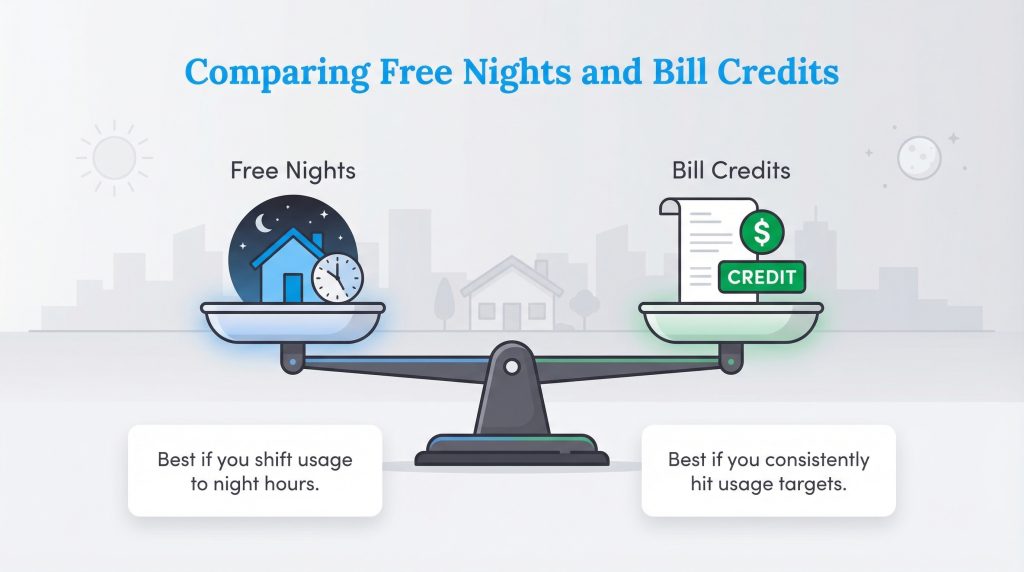
The biggest difference between these two providers lies in the “math” behind their flagship offers. Understanding how they calculate your bill is the only way to avoid surprise charges.
TXU’s Free Nights & Solar Days
TXU Energy is famous for its “Free Nights & Solar Days” plans. Under this structure, you are not charged for electricity usage during specific hours, often from 8:00 p.m. to 5:00 a.m. (though you must check your specific EFL as hours vary). However, the daytime rate on these plans is often significantly higher than the market average to offset those free hours. This structure works perfectly if you can shift your heavy energy usage, like laundry, dishwashing, and EV charging, to the nighttime window. If you work from home or run the AC blast all day, your average rate per kilowatt-hour (kWh) will likely be higher than a standard fixed-rate plan.
TXU Energy Plans & Pricing
| Plan Name | Rate | Plan Type | Cancellation Fee | |
|---|---|---|---|---|
| Value Edge 12 | $0.135 /kWh | 12 Months Fixed Rate | $150.00 | Check Availability |
| Clear Deal 12 | $0.139 /kWh | 12 Months Rate | $150 | Check Availability |
| Smart Edge 12 | $0.139 /kWh | 12 Months Fixed Rate | $150.00 | Check Availability |
| Smart Edge 24 | $0.145 /kWh | 24 Months Fixed Rate | $295.00 | Check Availability |
| Clear Deal 24 | $0.149 /kWh | 24 Months Rate | $295 | Check Availability |
| Simple Value 12 | $0.157 /kWh | 12 Months Fixed Rate | $150.00 | Check Availability |
| Simple Rate 12 | $0.173 /kWh | 12 Months Rate | $150 | Check Availability |
| On Your Terms | $0.175 /kWh | 1 Month Months Rate | $ | Check Availability |
| Solar Value 12 | $0.175 /kWh | 12 Months Rate | $150 | Check Availability |
| Ultimate Season Pass 12 | $0.187 /kWh | 12 Months Rate | $150 | Check Availability |
| Solar Club 12 | $0.191 /kWh | 12 Months Fixed Rate | $150.00 | Check Availability |
| Texas Choice 12 | $0.192 /kWh | 12 Months Fixed Rate | $150.00 | Check Availability |
| Texas Choice 24 | $0.192 /kWh | 24 Months Fixed Rate | $295.00 | Check Availability |
| Flex Rewards | $0.193 /kWh | Variable Rate | $0.00 | Check Availability |
| Flex Forward | $0.193 /kWh | 1 Month Months Rate | $ | Check Availability |
| Smart Deal 12 | $0.196 /kWh | 12 Months Fixed Rate | $150.00 | Check Availability |
| Smart Deal 24 | $0.204 /kWh | 24 Months Fixed Rate | $295.00 | Check Availability |
| Smart Deal 36 | $0.204 /kWh | 36 Months Fixed Rate | $395.00 | Check Availability |
| Solar Saver 12 | $0.205 /kWh | 12 Months Rate | $150 | Check Availability |
| Free Nights & Solar Days 12 (8 pm) | $0.215 /kWh | 12 Months Rate | $150 | Check Availability |
| Saver's Discount 12 | $0.217 /kWh | 12 Months Rate | $150 | Check Availability |
| Saver's Discount 24 | $0.251 /kWh | 24 Months Rate | $295 | Check Availability |
APG&E’s Bill Credit Plans
APG&E frequently uses bill credit plans, such as their “SimpleSaver” or similar offers. These plans look incredibly cheap at first glance because they include a substantial bill credit, often around $100 to $125, once your usage hits a specific threshold, typically 1,000 kWh in a billing cycle. This credit artificially lowers your average price per kWh, making the plan look like a steal on comparison sites.
APG&E Plans & Pricing
| Plan Name | Rate | Plan Type | Cancellation Fee | |
|---|---|---|---|---|
| Simple Saver Smart Credit 15 | $0.073 /kWh | 15 Months Rate | $250 | Check Availability |
| Simple Saver Smart Credit 12 | $0.076 /kWh | 12 Months Rate | $150 | Check Availability |
| Simple Saver Smart Credit 24 | $0.078 /kWh | 24 Months Rate | $250 | Check Availability |
| SimpleSaver 16 | $0.080 /kWh | 15 Months Fixed Rate | $150.00 | Check Availability |
| SimpleSaver 14 | $0.088 /kWh | 14 Months Fixed Rate | $150.00 | Check Availability |
| SimpleSaver 12 | $0.089 /kWh | 12 Months Fixed Rate | $150.00 | Check Availability |
| SimpleSaver 24 | $0.089 /kWh | 24 Months Fixed Rate | $250.00 | Check Availability |
| SimpleSaver 19 | $0.095 /kWh | 19 Months Fixed Rate | $150.00 | Check Availability |
| SimpleSaver 18 | $0.098 /kWh | 18 Months Fixed Rate | $150.00 | Check Availability |
| Simple Saver Smart Credit 36 | $0.099 /kWh | 36 Months Rate | $350 | Check Availability |
| SimpleSaver 36 | $0.108 /kWh | 36 Months Fixed Rate | $350.00 | Check Availability |
| SimpleSaver 15 | $0.109 /kWh | 15 Months Fixed Rate | $150.00 | Check Availability |
| TrueClassic 3 | $0.122 /kWh | 3 Months Fixed Rate | $150.00 | Check Availability |
| TrueClassic 18 | $0.135 /kWh | 18 Months Fixed Rate | $250.00 | Check Availability |
| TrueClassic 12 | $0.141 /kWh | 12 Months Fixed Rate | $150.00 | Check Availability |
| Simple Choice 10 | $0.142 /kWh | 10 Months Fixed Rate | $150.00 | Check Availability |
| True Classic 16 | $0.143 /kWh | 16 Months Rate | $250 | Check Availability |
| TrueClassic 24 | $0.146 /kWh | 24 Months Fixed Rate | $250.00 | Check Availability |
| TrueClassic 36 | $0.150 /kWh | 36 Months Fixed Rate | $350.00 | Check Availability |
| Simple Choice 11 | $0.152 /kWh | 11 Months Fixed Rate | $150.00 | Check Availability |
| True Classic 18 | $0.156 /kWh | 18 Months Fixed Rate | $250.00 | Check Availability |
| True Classic 12 | $0.158 /kWh | 12 Months Rate | $150 | Check Availability |
| Simple Choice 12 | $0.159 /kWh | 12 Months Fixed Rate | $150.00 | Check Availability |
| True Classic 36 | $0.161 /kWh | 36 Months Rate | $350 | Check Availability |
| Simple Choice 24 | $0.162 /kWh | 24 Months Fixed Rate | $250.00 | Check Availability |
| Simple Choice 36 | $0.163 /kWh | 36 Months Fixed Rate | $350.00 | Check Availability |
| Simple Choice 13 | $0.164 /kWh | 13 Months Fixed Rate | $150.00 | Check Availability |
| Simple Choice Green 12 | $0.166 /kWh | 12 Months Fixed Rate | $150.00 | Check Availability |
| Simple Choice Green 24 | $0.167 /kWh | 24 Months Fixed Rate | $250.00 | Check Availability |
| Simple Choice Green 36 | $0.168 /kWh | 36 Months Fixed Rate | $350.00 | Check Availability |
| True Classic 24 | $0.173 /kWh | 24 Months Rate | $250 | Check Availability |
| Simple Choice Green 14 | $0.174 /kWh | 14 Months Fixed Rate | $150.00 | Check Availability |
The “Gotcha” Scenario
The danger with bill credit plans is missing the target. If you sign up for an APG&E plan requiring 1,000 kWh usage to trigger a $125 credit, but you only use 900 kWh in a mild spring month, you lose that discount. This causes your effective rate to jump dramatically, sometimes doubling your price per kWh for that month. You must be diligent about your consumption habits to make these plans work for you.
Example: The Cost of Missing the Mark
Here is how missing a usage threshold by just a small amount can drastically change your bill on a typical bill credit plan (assuming a 22¢/kWh energy charge and a $125 credit at 1,000 kWh):
| Usage Amount | Bill Calculation | Total Bill | Effective Rate |
|---|---|---|---|
| 1,000 kWh (Target Hit) | (1,000 x $0.22) – $125 Credit | $95.00 | 9.5¢ / kWh |
| 900 kWh (Target Missed) | (900 x $0.22) – $0 Credit | $198.00 | 22.0¢ / kWh |
Rate Analysis: Who is Cheaper?
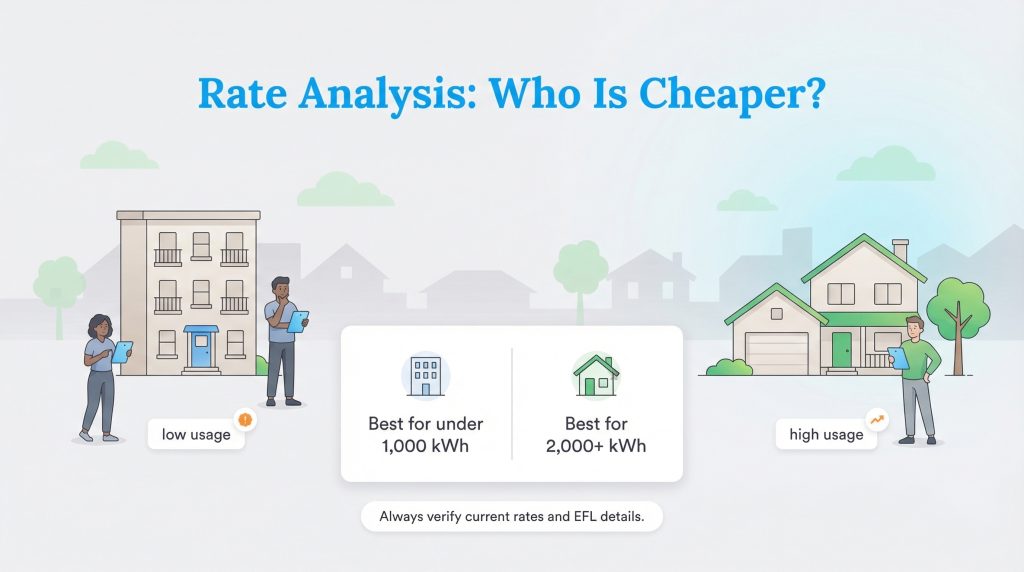
Determining who is cheaper depends entirely on the size of your home and your lifestyle. Rates change daily, so we look at the trends found in the Electricity Facts Label (EFL) rather than today’s specific cents-per-kWh price.
Apartment Renters (500 kWh)
For apartment dwellers, APG&E’s high-threshold bill credit plans are often a trap. Since apartments rarely consume 1,000 kWh except in the heat of summer, renters will frequently miss the credit and pay a much higher rate. In this scenario, you should look for “Base Charge” comparisons. TXU Energy often has plans specifically designed for lower usage that do not rely on massive usage thresholds, making them a more consistent option for renters.
Large Homeowners (2000+ kWh)
For larger homes in cities like Houston or Dallas, the playing field levels out. High usage scales well with APG&E because you are almost guaranteed to hit the bill credit threshold every month. However, TXU Energy also offers competitive pricing for high-usage tiers, often bundling in perks like A/C protection or smart thermostats that add value beyond just the electricity rate.
Quick Chooser: Which Plan Fits You?
| Your Lifestyle | Recommended Strategy |
|---|---|
| Consistently High Usage (2,000+ kWh) | Look for bill credit plans (APG&E) to maximize savings. |
| Apartment / Low Usage (< 1,000 kWh) | Avoid thresholds; seek simple fixed rates (TXU Energy). |
| EV Owner / Night Owl | Time-of-Use / Free Nights plans (TXU Energy). |
| Renting / Moving Soon | Short-term contracts or month-to-month plans with low ETFs. |
For the most current average rates in Texas, you can always reference the U.S. Energy Information Administration (EIA) Texas Dashboard.
Fees and Fine Print: The Hidden Costs
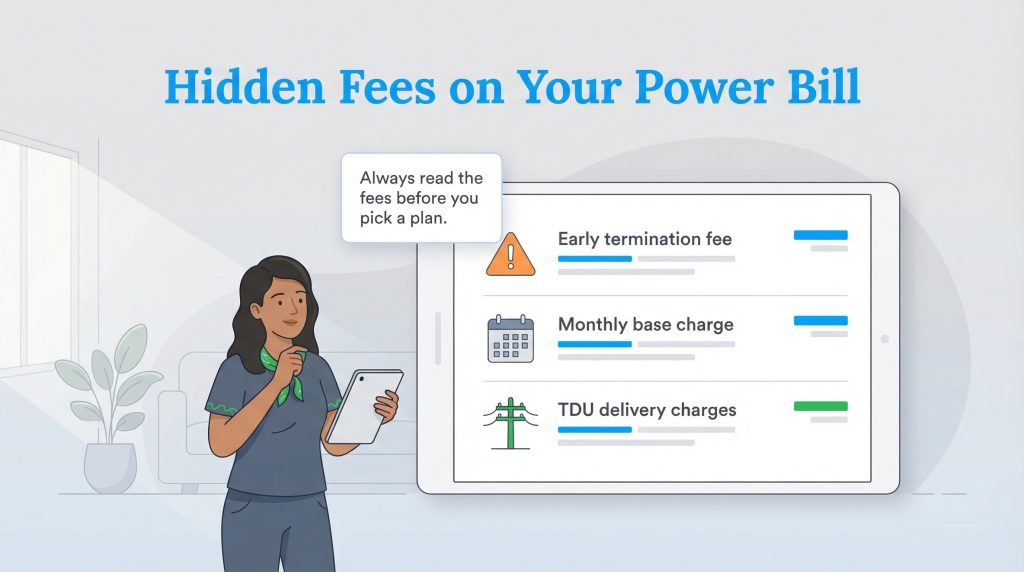
Trust is built by understanding the “ugly” side of the contract. Both providers have fees, but they apply them differently.
Early Termination Fees (ETFs)
If you need to break your contract early, it will cost you. TXU Energy typically charges a flat early termination fee, typically ranging from $150 to $395 depending on if you select a 12, 24, or 36-month plan. APG&E also generally utilizes flat fees, often falling between $150 and $350. While some other competitors charge a fee for every month remaining on the contract, both TXU and APG&E stick to the simpler flat-fee model, which is easier to budget for if you expect to move.
Base Charges
Both providers may include a monthly “base charge” (sometimes called a customer charge) on their plans. This is a fixed fee, often between $4.95 and $9.95, that you pay regardless of how much power you use. It is crucial to check the EFL to see if this fee applies, especially if you are a low-usage customer, as it increases your effective rate per kWh.
TDU Delivery Charges
Remember that TDU delivery charges are pass-through fees from utility companies like Oncor or CenterPoint. These charges cover the cost of maintaining the poles and wires. They are the same regardless of whether you choose TXU or APG&E, and neither provider can discount or waive them. You can learn more about these regulated charges on the Public Utility Commission of Texas (PUCT) website.
Customer Experience and Technology

The “soft” side of your electricity service, how easy it is to pay your bill or track usage, matters just as much as the rate.
Mobile App & Portal
TXU Energy offers a robust mobile app that is feature-rich compared to many competitors. It allows you to track your energy usage by the hour, view projected bills, and manage alerts effortlessly. This level of transparency helps you avoid billing surprises. APG&E provides a functional online portal where you can pay bills and view usage, but it lacks the polish and real-time tech features of the TXU app.
Customer Support
TXU Energy has built a reputation for accessibility, offering 24/7 customer support. If you have a billing issue at midnight, you can reach a human. APG&E typically operates during standard business hours (Monday through Saturday). While their support is generally helpful, the limited availability can be frustrating if you work during the day and need to resolve an issue in the evening.
If you struggle to understand your statement, check out our guide on how to read your electric bill for a breakdown of common line items.
Sustainability Options
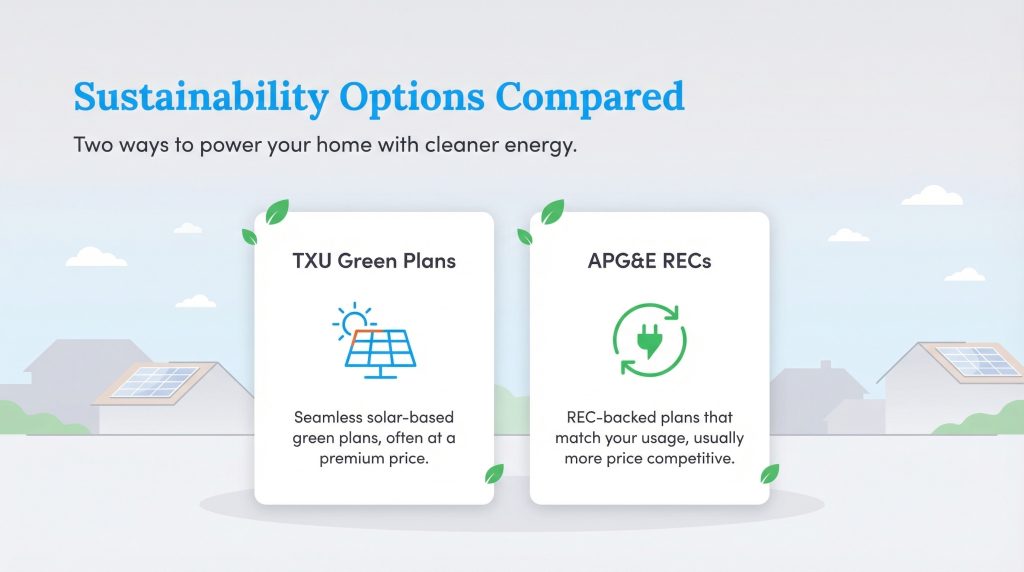
If minimizing your carbon footprint is a priority, both providers have options, though they approach green energy differently.
TXU Green Plans
TXU Energy offers a variety of green options, including their Solar Club plans which allow you to benefit from solar energy without installing panels. They also have buy-back plans for homeowners who do have panels. These robust options often come at a premium price, but they provide a seamless way to support renewable energy.
APG&E Renewable Certificates
APG&E offers plans backed by Renewable Energy Certificates (RECs). This means that for every kWh you use, a purchase of renewable energy is made to match it. These plans are a solid environmentally mindful choice and are often priced competitively, allowing you to go green without breaking the bank.
Final Verdict: Which Provider Should You Pick?
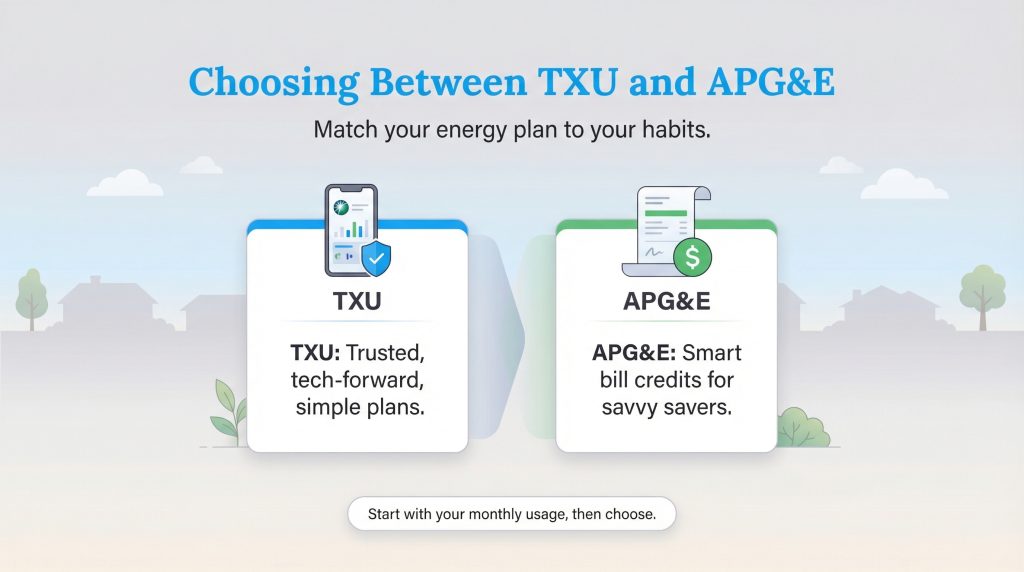
Deciding between TXU Energy and APG&E ultimately depends on what you value more: brand security or aggressive pricing.
Choose TXU Energy if: You want a trusted brand with excellent mobile technology, 24/7 support, and “Free Nights” options, or if you are new to Texas and want a “safe” bet that avoids complex tiered pricing.
Choose APG&E if: You are a savvy budgeter who understands your usage patterns—specifically consistently hitting that 1,000 kWh mark—and wants to maximize bill credits to secure the lowest possible effective rate.
Both companies are reputable, but the right choice requires looking honestly at your monthly energy habits. By matching your lifestyle to the right plan structure, you can ensure your lights stay on without your budget taking a hit.
FAQs About TXU Energy vs. APG&E
Is TXU Energy more expensive than APG&E?
What is the cancellation fee for APG&E compared to TXU?
Do APG&E and TXU require a deposit?
Does TXU or APG&E offer better plans for apartments?
Can I switch from TXU to APG&E without a penalty?
About the Author

David has been an integral part of some of the biggest utility sites on the internet, including InMyArea.com, HighSpeedInternet.com, BroadbandNow.com, and U.S. News. He brings over 15 years of experience writing about, compiling and analyzing utility data.