
Understanding the specific line items on your Texas electricity bill is the first step toward managing your monthly energy costs.
Key Takeaways
- Oncor delivery charges represent the cost of maintaining the grid, including poles, wires, and meters, and are passed through directly to consumers without markup by retail providers.
- The current 2026 Oncor residential delivery rate consists of a fixed monthly fee plus a variable rate per kilowatt-hour (kWh) that changes based on regulatory approvals.
- You cannot negotiate these delivery fees, but you can reduce your total cost by lowering your energy consumption through home efficiency upgrades and smart usage habits.
If you live in the Dallas-Fort Worth metroplex or other parts of North Texas, you have likely noticed a specific line item on your electricity bill labeled “Oncor Delivery Charge” or “TDU Delivery Charges.” For many residents moving into a new home or reviewing their budget, this fee can be a source of confusion and frustration — especially when it seems to continually increase despite your best efforts to shop for a low electricity rate. While you have the power to choose your retail electricity provider, these delivery charges are set by your local Transmission and Distribution Utility (TDU) and approved by state regulators. We are here to help you decode exactly what these charges are, how to calculate them for your specific usage, and why they are necessary for keeping the lights on across Texas.
What Is The Oncor Delivery Charge?

If you want the Oncor delivery fee explained simply, it is a mandatory charge collected to cover the physical cost of delivering electricity to your home. While your Retail Electric Provider (REP) — companies like TXU, Reliant, or Green Mountain Energy — sells you the actual electricity, Oncor is the Transmission and Distribution Utility (TDU) responsible for the physical infrastructure. Oncor owns the poles, the wires, and the advanced smart meters on the side of your house.
It is important to understand that your REP does not profit from this charge. They simply collect it from you and pass it directly back to Oncor. Even if you switch electricity providers to find a cheaper energy rate, your Oncor delivery charges will remain exactly the same because they are tied exclusively to your physical address, not your electricity plan.
The Deregulation Illusion: Unbundled Vs. Bundled Billing
If you recently switched electricity providers, you might be staring at your latest statement wondering where this new fee came from. Welcome to the deregulation illusion. In Texas, some retail electric providers bundle the transmission and distribution utility (TDSP) fee directly into their advertised energy rate. Others prefer to unbundle it, listing the delivery charge as a completely separate line item on your monthly bill.
Because of this variation in billing styles, it might look like you are being hit with a brand-new charge when you switch from a bundled plan to an unbundled one. However, every single resident in the Oncor service area pays this fee, regardless of how your provider decides to format the invoice. Knowing whether your plan is bundled or unbundled helps you accurately calculate your total energy costs and compare current Oncor delivery rates for 2026 against your actual energy usage.
Current Oncor TDU Delivery Charges And Rates (2026 Update)
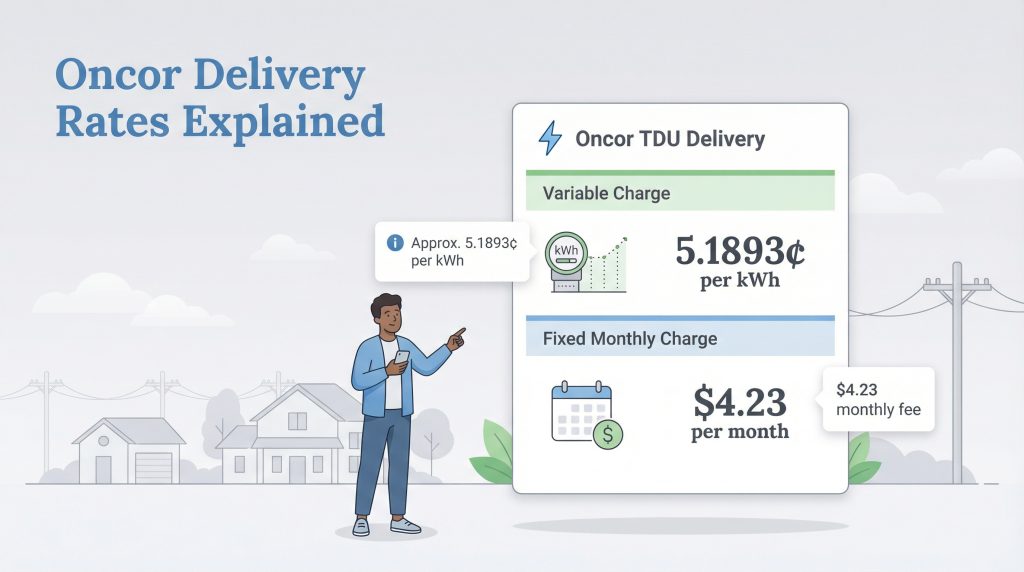
To truly understand your bill, you need to know the current numbers. The Oncor delivery charge is actually made up of two distinct parts: a fixed monthly customer base charge and a variable delivery charge based on how much energy you use. These rates are reviewed and adjusted periodically after receiving approval from the Public Utility Commission of Texas (PUCT).
Based on the latest PUCT tariffs effective as of March 2026, a typical residential Oncor TDU delivery rate structure looks like this:
- Fixed Monthly Base Charge: $4.23 per month. This applies to your account regardless of how much electricity you use.
- Variable Delivery Charge: 5.6183 cents per kWh. Your exact rate is set in the official tariff and appears on your plan’s Electricity Facts Label (EFL).
These rates cover various state-approved riders and tariffs, including transmission cost recovery factors and energy efficiency program costs. When you look at the “Average Price per kWh” on an electricity plan advertisement, it usually includes an estimate of these current Oncor delivery charges based on 1,000 or 2,000 kWh of usage.
Historical Oncor Delivery Rate Increases (2020–2026)
If you feel like your electricity bills are steadily getting more expensive, you are not imagining things. Tracking the historical Texas electricity delivery fees reveals a clear upward trend. The table below illustrates how the Oncor delivery rate increase has impacted the average residential consumer using 1,000 kWh per month over the last several years.
| Year | Fixed Monthly Charge | Variable Rate (per kWh) | Estimated Monthly Cost (1,000 kWh) |
|---|---|---|---|
| 2020 | $3.42 | 3.8210¢ | $41.63 |
| 2022 | $3.42 | 4.4076¢ | $47.50 |
| 2024 | $4.23 | 5.1893¢ | $56.12 |
| 2026 | $4.23 | 5.6183¢ | $60.41 |
As you can see, the estimated monthly cost for a standard household has increased by roughly 45% since 2020. This steady climb highlights why it is so crucial to monitor your energy efficiency, as the usage-based variable rate is the primary driver of these cost hikes.
How To Calculate Your Oncor Delivery Fee
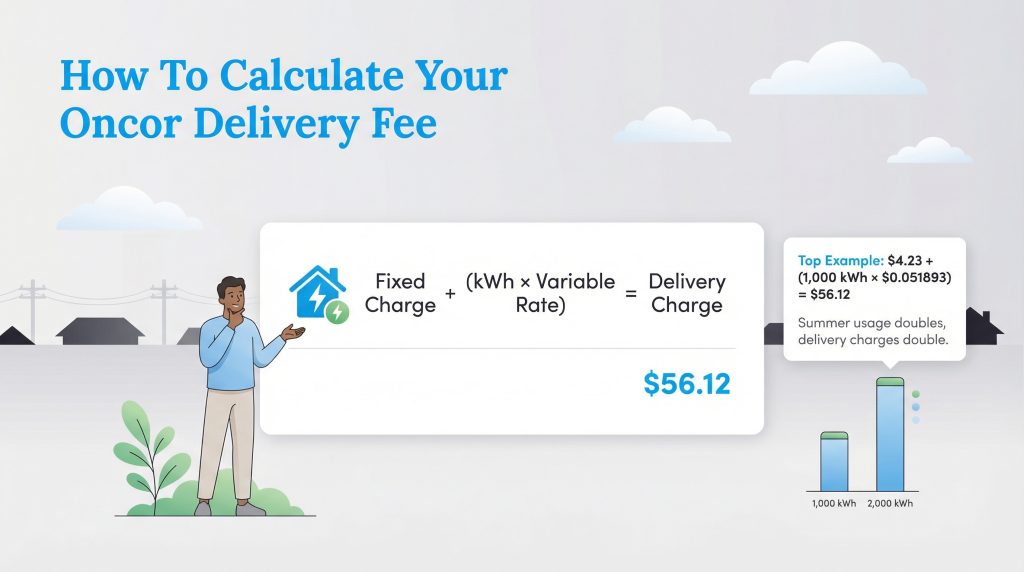
Calculating your exact delivery fee requires a little bit of math, but it is the best way to audit your bill for accuracy. You can calculate your total Oncor fee using this straightforward formula: Fixed Charge + (Monthly Usage in kWh × Variable Rate) = Total Delivery Charge.
The example below uses the rates effective as of March 2026 to show how the math works. Always check your provider’s documentation or the PUCT site for the exact current numbers on your bill.
- Step 1: Start with the fixed monthly fee of $4.23.
- Step 2: Multiply your usage (1,000 kWh) by the variable rate ($0.056183). This equals $56.18.
- Step 3: Add the fixed fee ($4.23) to the variable total ($56.18).
- Total Oncor Charge: $60.41.
This math highlights exactly why your delivery charges skyrocket during the brutal Texas summer. If your usage doubles to 2,000 kWh to run the air conditioner during a heatwave, that variable portion doubles along with it, significantly driving up the final fee.
Why Do Oncor Rates Keep Going Up?
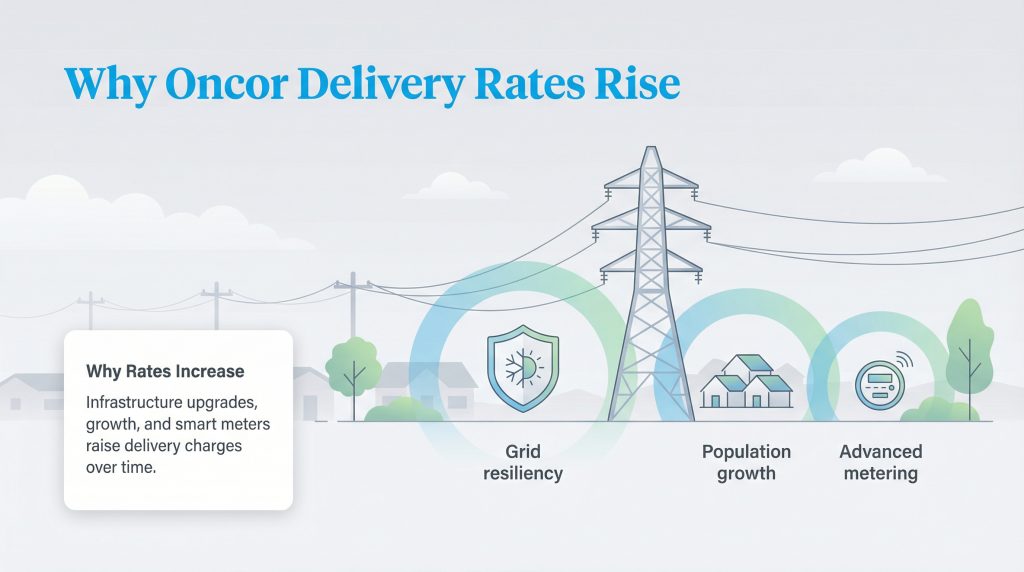
Many Texas residents repeatedly ask why these fees seem to jump higher year over year. The primary driver for an Oncor delivery rate increase is the massive cost of infrastructure investment. Oncor is legally allowed by the state to recover the costs associated with maintaining, repairing, and upgrading the regional power grid.
Several major factors contribute to these recent rate hikes:
- Winter Storm Uri & Grid Resiliency: Following the devastating 2021 winter storm and subsequent major weather events, Oncor has had to invest heavily in weatherizing equipment and hardening the grid against extreme winter freezes and summer heatwaves.
- Dallas-Fort Worth Population Boom: The DFW metroplex is one of the fastest-growing regions in the country. To support this massive population boom, new transmission lines and substations must be rapidly built to reach sprawling new housing developments.
- Advanced Metering Systems: The ongoing cost of installing, maintaining, and securing the smart meters — which you can monitor via Smart Meter Texas — is recovered directly through these delivery fees.
Oncor Vs. CenterPoint: How Do DFW Rates Compare?
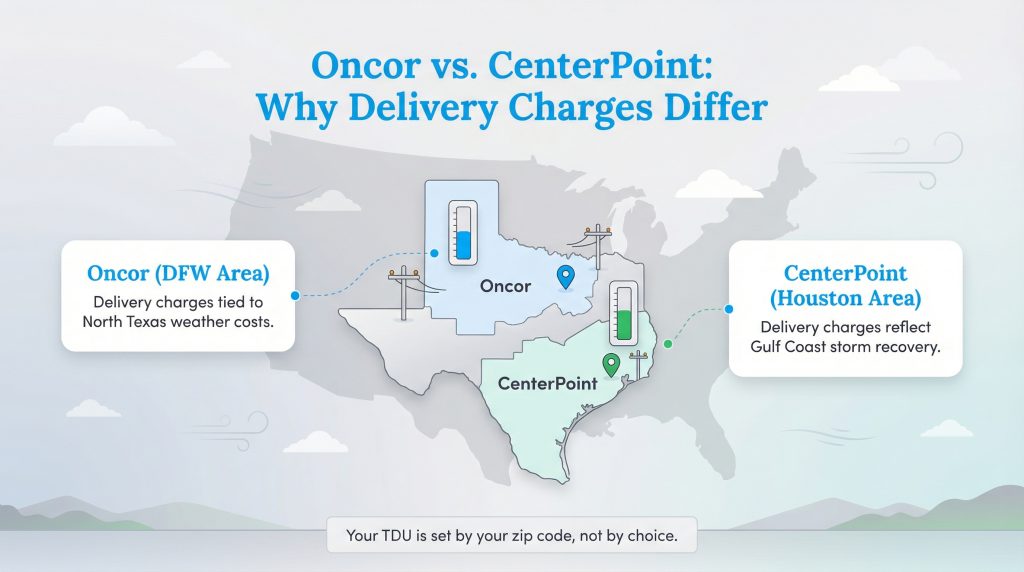
If you have moved to North Texas from Houston, you might notice an immediate difference in your delivery charges. Texas is divided into several regional TDU service areas, with Oncor and CenterPoint Energy standing as the two largest. Generally, Oncor (serving Dallas, Fort Worth, and parts of West Texas) and CenterPoint (serving the greater Houston area) feature comparable rate structures, but they are rarely identical.
| Feature | Oncor (North Texas) | CenterPoint (Houston) |
|---|---|---|
| Primary Service Area | Dallas, Fort Worth, Waco, Midland | Houston, Galveston, surrounding areas |
| Primary Cost Drivers | Population boom, winter storm hardening | Hurricane recovery, coastal resilience |
| Can You Switch? | No (Location-based) | No (Location-based) |
Historically, rates fluctuate between the two based on localized recovery costs. For example, if a hurricane batters the Gulf Coast, CenterPoint rates may rapidly rise to cover the millions of dollars in repair costs. Conversely, severe ice storm damage in North Texas can drive subsequent Oncor rate cases. Comparing the two is useful for understanding regional economic differences, but remember that you cannot choose your TDU — it is dictated entirely by your zip code.
Can You Lower Your Oncor Delivery Charges?
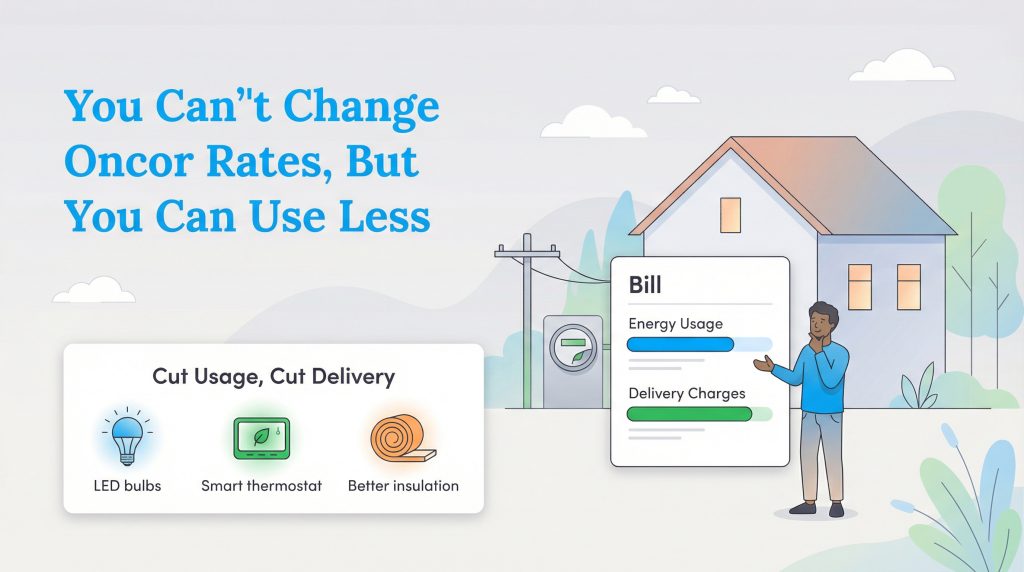
Because the Public Utility Commission of Texas actively regulates these baseline rates, you cannot call Oncor to negotiate a lower fee, nor can you switch retail providers to magically avoid them. However, you absolutely can lower the total amount you pay each month by actively reducing your household electricity consumption.
Even though you can’t change the core Oncor transmission and distribution rates, you can shrink your final Oncor delivery charge by simply using fewer kilowatt-hours. Because the bulk of the fee is usage-based, every single kWh you avoid saves you both on energy costs and delivery costs simultaneously. Implementing sustainable lifestyle changes — such as installing LED lighting, upgrading to a smart thermostat, or improving your home’s attic insulation — directly reduces the painful “variable” portion of the delivery fee. For more ideas on reducing usage, check out our guide on how to save on your electric bill.
Who To Contact For Power Outages
When the lights unexpectedly go out, many Texans mistakenly reach for the phone to call their retail electricity provider. Remember, your REP just handles the monthly billing and customer service side of your plan — Oncor manages the physical poles, transformers, and wires. If you experience a local grid emergency, spot a downed power line, or lose power during a storm, you need to contact the utility directly so they can dispatch a repair crew.
- Phone: Call the 24/7 Oncor outage reporting line directly at 888-313-4747.
- Text: Text “OUT” to 66267 (MyOncor) from a registered mobile device for quick reporting.
- Online: Visit the official Oncor Online Outage Map to report an issue, track neighborhood outages, or check the estimated restoration time for your specific address.
Preparing For Future Bills: Taking Control Of Your Total Energy Costs

While seeing the ever-increasing Oncor delivery charge on your monthly statement can be deeply annoying, understanding that it pays for the essential wires, poles, and grid resiliency that keep your home powered safely helps put it into perspective. You may not be able to change the regulatory rate set by the state, but by understanding the math and focusing heavily on energy efficiency, you can exert real control over the final total. Focus on what you can change — your personal usage habits and your home’s baseline efficiency — to make smart, sustainable decisions that keep your electricity bills manageable regardless of the season.
Frequently Asked Questions About Oncor Delivery Charges
Why did my Oncor delivery charge suddenly appear on my new electricity bill?
How much of my electricity bill goes to Oncor?
Does PowerToChoose show Oncor delivery charges?
Why is my Oncor delivery charge higher than my energy charge?
Do solar panels eliminate Oncor delivery charges?
How often do Oncor rates change?
Can I switch TDUs to get a better rate?
Where can I find the official Oncor tariff rates?
Does the Oncor delivery charge include taxes?
About the Author

David has been an integral part of some of the biggest utility sites on the internet, including InMyArea.com, HighSpeedInternet.com, BroadbandNow.com, and U.S. News. He brings over 15 years of experience writing about, compiling and analyzing utility data.