
Decoding your Electricity Facts Label is the best way to accurately compare energy plans and protect your wallet from unexpected charges
Key Takeaways
- The Electricity Facts Label serves as a nutrition label for your energy plan, breaking down the exact pricing, terms, and renewable energy content.
- Understanding the difference between your base charge and energy charge helps you calculate your true average price per kWh based on your home’s actual usage.
- Reviewing the fine print for minimum usage fees and bill credits will protect you from sudden rate spikes during extreme weather months.
Shopping for a new energy plan can feel like navigating a maze of marketing jargon and teaser rates, but the Electricity Facts Label cuts straight through the noise. Mandated by the state, this standardized document forces retail energy providers to reveal the actual math behind your monthly bill. Whether you are moving into your first apartment or shopping for a better rate for your family home, reading your facts label allows you to accurately estimate your real costs and avoid common pricing traps. By breaking down base fees, delivery charges, and fine-print usage thresholds, you can confidently lock in a plan that fits your lifestyle without the fear of sudden surprises on your next statement.
What Is an Electricity Facts Label?
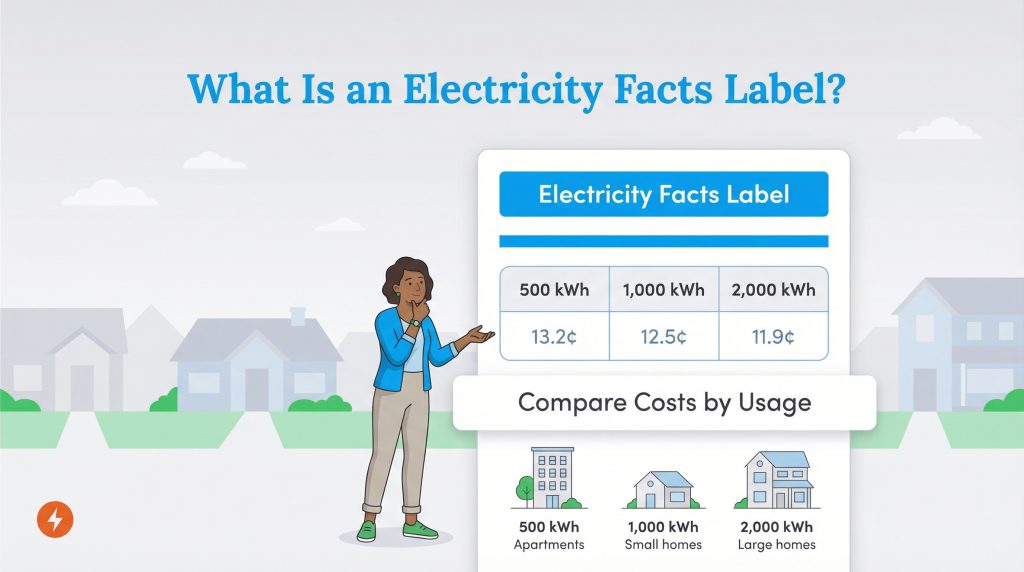
If you have ever wondered what an electricity facts label is, think of it as the mandatory nutrition label for your home energy plan. Instead of tracking calories and sodium, this document tracks cents, fees, and renewable energy percentages. The Public Utility Commission of Texas requires all retail electric providers to supply an EFL for every single plan they sell. This guarantees that shoppers receive a standardized breakdown of costs. Having the electricity facts label explained simply means stripping away the flashy marketing banners and focusing entirely on the raw numbers that will dictate your monthly expenses. Knowing how to read this one-page sheet is one of the most reliable ways to ensure you know exactly what you are agreeing to before signing a contract.
Finding the Average Price Per kWh
When you open your EFL, the first section you encounter is a grid detailing the average price per kWh EFL across three standardized usage tiers. These benchmarks are required by the state so consumers have a baseline comparison. The 500 kWh tier represents a typical apartment or a home with extremely low energy usage. The 1,000 kWh tier reflects moderate usage, common for small-to-medium homes during mild weather. Finally, the 2,000 kWh tier indicates high usage, typical for larger homes or during the peak heat of summer. Identifying which of these three columns closely matches your historical usage helps you accurately visualize your expected costs.
A Step-by-Step Checklist for Reading Any EFL
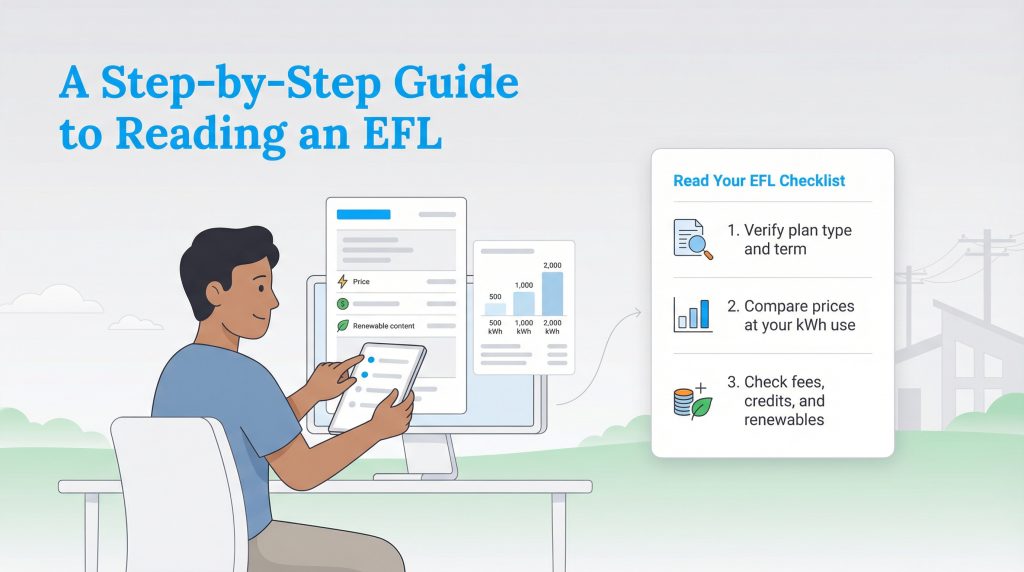
While every provider designs their marketing materials differently, the state requires all facts labels to follow the exact same format. Use this quick checklist to evaluate any plan before you enroll:
- Check the contract term and plan type: Verify whether the plan is fixed, variable, or indexed, and confirm how many months you are locking in.
- Find the average price at your usage level: Look at the 500, 1,000, or 2,000 kWh tiers to see which rate aligns with your historical monthly consumption.
- Identify the base charge: Look for any flat monthly administrative fees the provider charges just for keeping the account open.
- Identify bill credit rules: Check the disclosure chart for conditional credits that disappear if you miss a specific usage window.
- Confirm TDU charges are included: Ensure the utility delivery fees are passed through at cost, and note that these can change bi-annually.
- Review the early termination fee (ETF): See exactly how much you will be penalized if you need to break the contract before it expires.
- Check the renewable content: Compare the plan’s renewable energy percentage against the state average listed at the bottom of the document.
Base Charges vs. Energy Charges: The Math Behind Your Bill
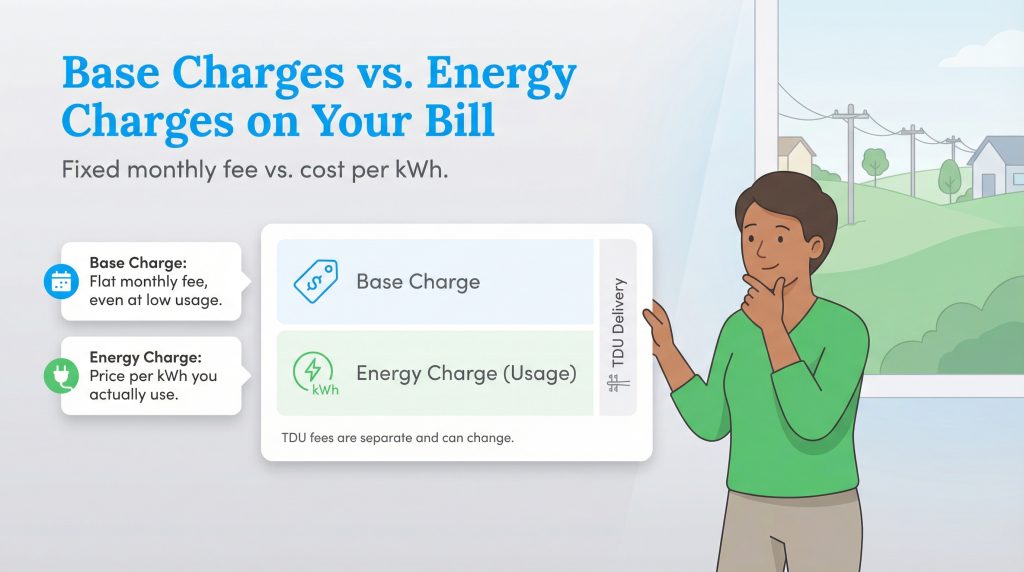
Grasping the relationship of the base charge vs energy charge is critical for understanding your electric bill components. Providers split your monthly costs into two distinct categories. The base charge operates as a flat monthly fee you pay just to keep your account open, regardless of whether you use one kilowatt-hour or a thousand. Conversely, the energy charge represents the actual rate you pay for the electricity your household consumes. If you happen to be a low-energy user living in a small space, choosing a plan with a high base charge heavily penalizes you because that fixed fee makes up a much larger percentage of your overall bill.
- Base Charge: A fixed monthly administrative fee applied to your account before any electricity usage is factored in.
- Energy Charge: The variable cost you pay per kilowatt-hour of electricity that actively powers your lights, appliances, and HVAC system.
Estimate Your Bill Using the EFL Numbers
To see how base fees distort your actual price per kilowatt-hour, it helps to run a quick calculation. Let’s look at a hypothetical fixed-rate plan with a $9.95 monthly base charge, a 10-cent per kWh energy charge, and standard TDU delivery fees (estimated at $4 plus 4 cents per kWh). As your usage goes up, the impact of those flat monthly fees goes down, completely changing your effective rate.
| Usage (kWh) | Base Charge | Energy Charge (10¢) | Est. TDU Charges | Estimated Bill | Effective ¢/kWh |
|---|---|---|---|---|---|
| 500 | $9.95 | $50 | $24 | $83.95 | 16.8¢ |
| 1,000 | $9.95 | $100 | $44 | $153.95 | 15.4¢ |
| 2,000 | $9.95 | $200 | $84 | $293.95 | 14.7¢ |
Understanding TDU Delivery Charges and Updates
Beyond what your retail provider charges, your label also includes fees from your Transmission and Distribution Utility. Having tdu delivery charges explained is simple: these are pass-through fees paid directly to the local utility company, like Oncor or CenterPoint, for maintaining the physical poles, wires, and meters in your neighborhood. What catches many consumers off guard is that TDU charges do not stay stagnant. The state regulatory commission often updates these delivery fees bi-annually. Even if you secure a fixed-rate energy plan, your final bill will slightly fluctuate when these mandatory utility maintenance fees are adjusted.
Spotting Common Pricing Traps and Disappearing Bill Credits
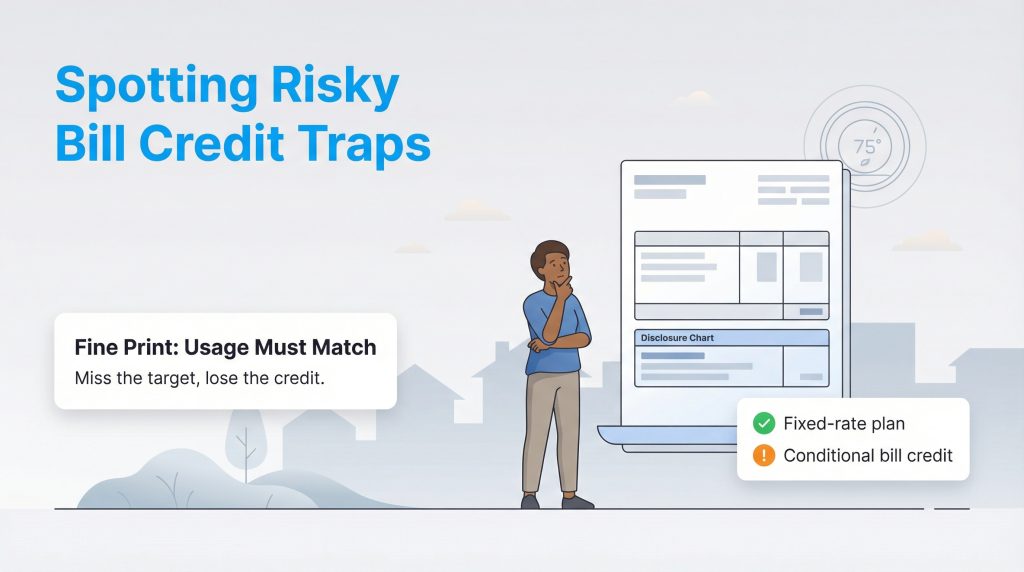
The “Disclosure Chart” section of your label is where you will spot the real terms of your contract, and it serves as your best defense against fine-print charges and conditional discounts. Providers often create structured plans that offer an enticing $50 bill credit, but only if your usage falls perfectly between 1,000 and 1,500 kWh for that billing cycle. While this sounds like a great deal, energy consumption is highly unpredictable. If a mild week in October drops your usage to 999 kWh, you lose that entire credit. Missing this narrow usage window by just a single kilowatt-hour causes your average rate to skyrocket.
Understanding the strict parameters of these tier-based plans prevents you from falling into an expensive trap. Always review the exact usage thresholds detailed in the disclosure section. Unless you have highly consistent energy habits or meticulously monitor your smart thermostat every single day, relying on conditional bill credits is a risky gamble. Standard fixed-rate plans without arbitrary usage requirements typically offer much more stability for the average homeowner.
How Solar Panels and Net Metering Impact Your EFL
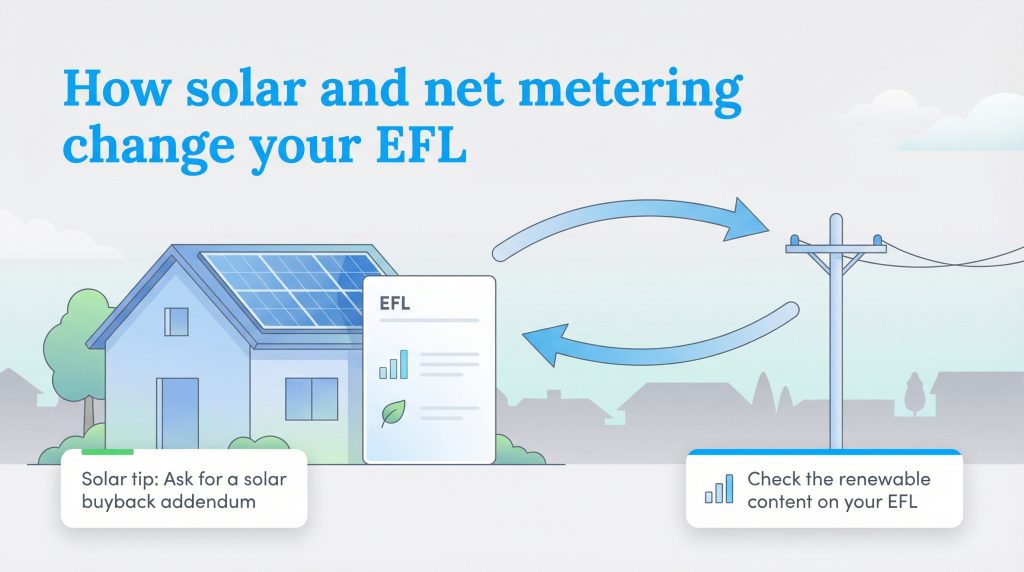
Standard EFL documents are built for traditional consumers drawing power from the grid, which means they do not account for solar buyback credits or net metering. If you are currently investing in home solar panels, you need to dig a little deeper. Solar owners should evaluate the “Renewable Content” percentage listed at the bottom of the document, but more importantly, they must request a specialized solar buyback addendum from the provider to see how their excess generation is credited.
For consumers without panels who still want an eco-conscious alternative, checking the renewable content section is an easy way to verify a provider’s claims. The EFL shows the plan’s renewable content and the state average so you can compare them side-by-side. If you browse the Power to Choose website, you can specifically filter for 100% renewable plans to easily outpace the standard state mix.
Empowering Your Energy Choices for a Smarter Home
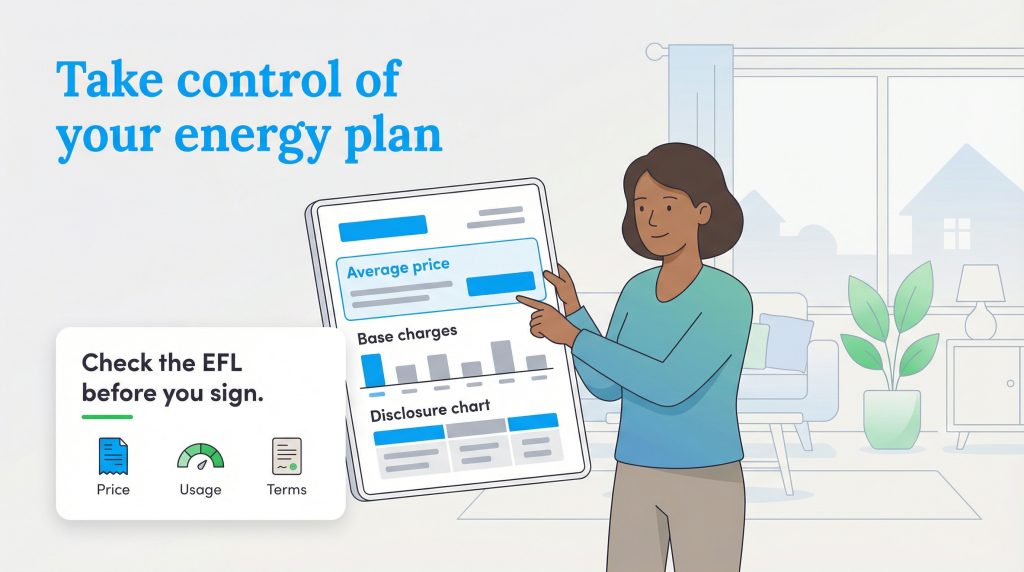
Mastering the details hidden within this one-page document puts the power back in your hands. Taking five extra minutes to review your average price at your usage tier, your base charges, and the disclosure chart can save you hundreds of dollars over the course of a year. You no longer have to guess what your monthly statement will look like or fall victim to clever marketing tactics. Whether you are figuring out how to save on your electric bill or setting up services for a new property, always download the EFL before signing a contract. Comparing these facts side-by-side ensures you secure a reliable rate that genuinely matches your household’s unique energy footprint.
Frequently Asked Questions About Electricity Facts Labels
Where can I find the Electricity Facts Label for my current plan?
Do fixed-rate and variable-rate plans use the same type of label?
Why is the price on my bill different from the average price on the EFL?
Are TDU delivery charges included in the EFL average price?
Can an energy provider change the terms of my EFL after I sign up?
About the Author

LaLeesha has a Masters degree in English and enjoys writing whenever she has the chance. She is passionate about gardening, reducing her carbon footprint, and protecting the environment.