


Harnessing the Breeze Can Lower Your Electric Bill, But It Requires the Right Location and Significant Upfront Planning
Key Takeaways
- Residential wind turbines require specific wind speeds (typically 10+ mph) and ample acreage to be efficient and compliant with local zoning laws.
- The cost of a home wind system typically ranges from $15,000 to $80,000, though the 30% federal tax credit can significantly reduce the final price tag.
- Wind energy vs. solar energy often comes down to consistency; while wind can generate power at night, it is generally less predictable and requires more maintenance than solar panels.
Harnessing the breeze sounds like the ultimate dream for total energy independence, but achieving that goal requires very specific environmental conditions to be viable. It is crucial to understand that residential wind power is a highly niche solution, far from suitable for standard suburban or urban environments. Unlike widespread solar setups that can be quickly mounted onto almost any average roof, generating your own wind energy requires wide-open spaces — specifically a minimum of one full acre of land and average annual wind speeds of at least 10 mph. If you are exploring how to lower your utility bills and shrink your household’s carbon footprint, this comprehensive guide will give you a brutally realistic look at what it takes to power your home with wind, how much it actually costs, and whether your property is a suitable candidate.
Does Residential Wind Power Make Sense for You?
Deciding if a home turbine makes sense for your family requires setting aside the romanticized idea of living off the grid and looking strictly at the hard geographic data. For the vast majority of homeowners living in tightly packed neighborhoods or city limits, a wind turbine is simply not a realistic option. Wind energy systems demand unrestricted, smooth airflow to efficiently spin their blades. This means nearby trees, two-story houses, and commercial buildings create turbulent air that will drastically reduce your potential power output.
However, if you own expansive, rural property in a geographically breezy area, home wind generation can be an incredibly powerful asset. Unlike solar energy, which effectively shuts down the moment the sun sets, a properly sited turbine can generate reliable electricity 24 hours a day, including during harsh winter storms. It all comes down to knowing your exact land limitations and recognizing that small residential wind turbines are a major mechanical investment, not a casual weekend project.
Understanding Home Wind Turbines: Horizontal vs. Vertical
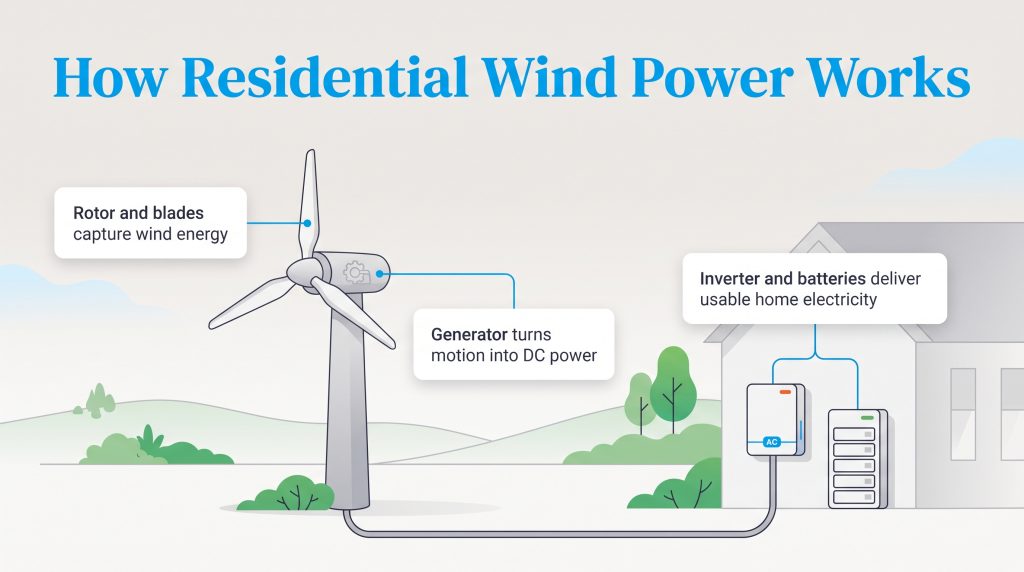
When shopping for a system, you will encounter two primary engineering designs. Both capture kinetic energy from the breeze, use a generator to create direct current (DC), and route it through an inverter to supply your electric service panel with usable alternating current (AC). However, their physical structures dictate how well they perform in different environments.
Horizontal Axis Wind Turbines (HAWT)
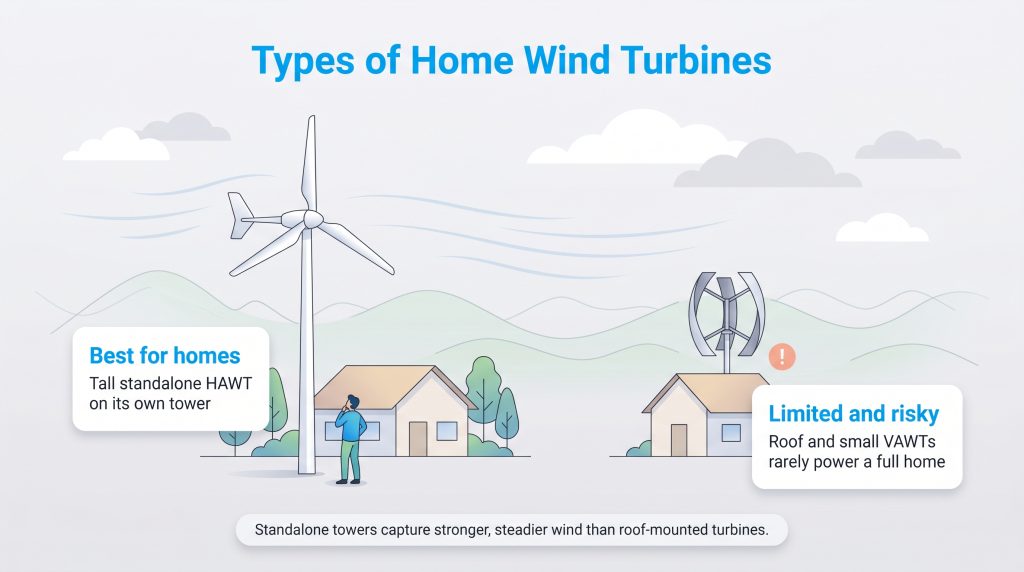
Horizontal axis models are the traditional turbines that look like large airplane propellers sitting atop a massive, independent tower. They are the undeniable industry standard for whole-home generation because their tall stature allows them to capture much stronger, cleaner winds high above the tree line.
- Pros: Highly efficient power generation, proven long-term reliability, and ideal for completely offsetting a large rural home’s electricity usage.
- Cons: Requires a massive tower footprint, involves high installation costs, and generates a noticeable mechanical swooshing noise as the blades spin.
Vertical Axis Wind Turbines (VAWT)
Vertical axis wind turbines feature blades that spin around a central, upright shaft — often resembling a large eggbeater or spinning cylinder. Because they sit much closer to the ground, they are far less powerful. While you might see them marketed as compact, space-saving alternatives, they rarely produce enough electricity to run an entire household and are better suited for supplemental power.
- Pros: Can capture wind from any direction without needing to pivot, operates quietly with minimal vibration, and requires a much smaller spatial footprint.
- Cons: Generates significantly less power than horizontal models, sits in low-efficiency turbulent wind zones, and struggles to provide a quick financial payback.
The Three Key Property Requirements for Wind Energy
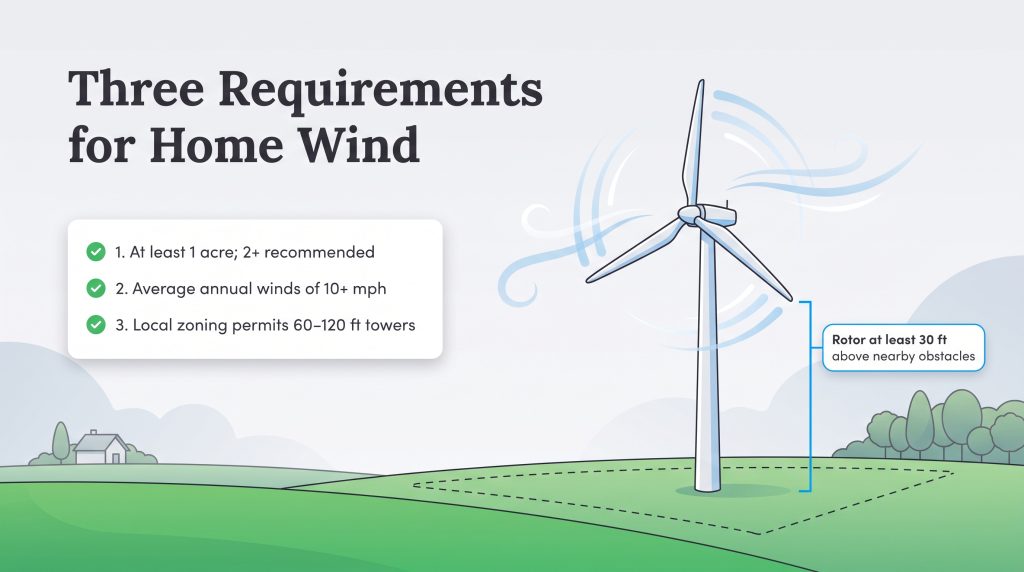
Before you start pricing out wind turbine kits for home use, you must rigorously evaluate your land. If your property does not meet the necessary criteria, you will likely spend thousands of dollars on a system that fails to spin. To guarantee a successful installation that provides a meaningful return on investment, ensure you can confidently check off all three of these mandatory property requirements:
- A Minimum of One Acre of Land: You need at least one full acre — though two or more is highly recommended. This expansive space is essential for accommodating the physical footprint of a tilt-down tower or supportive guy wires. More importantly, it ensures you can safely meet your county’s mandatory “fall zone” setback distances, which require the tower to sit far enough away from property lines so that it will not damage neighboring structures if it ever collapses.
- Average Annual Wind Speeds of 10+ mph: Wind power is an exponential energy resource. A turbine operating in a 10 mph breeze produces drastically more power than one in an 8 mph breeze. Your specific geographic location must sustain a minimum average annual wind speed of 10 miles per hour. You can verify your local wind resources by utilizing the Department of Energy’s WINDExchange maps or by hiring a professional to install an anemometer on your property.
- Favorable Zoning Laws for Tall Towers: To avoid efficiency-killing ground turbulence, industry standards require residential towers to be mounted 60 to 120 feet in the air, with the rotor sitting at least 30 feet above any nearby obstacle. Unfortunately, most residential municipalities cap accessory structure heights at a strict 35 feet. You must research your local zoning laws and HOA bylaws to confirm whether you are permitted to build a towering structure, or if you have a realistic path to securing a special use zoning variance.
How Much Does a Small Wind Turbine Cost?
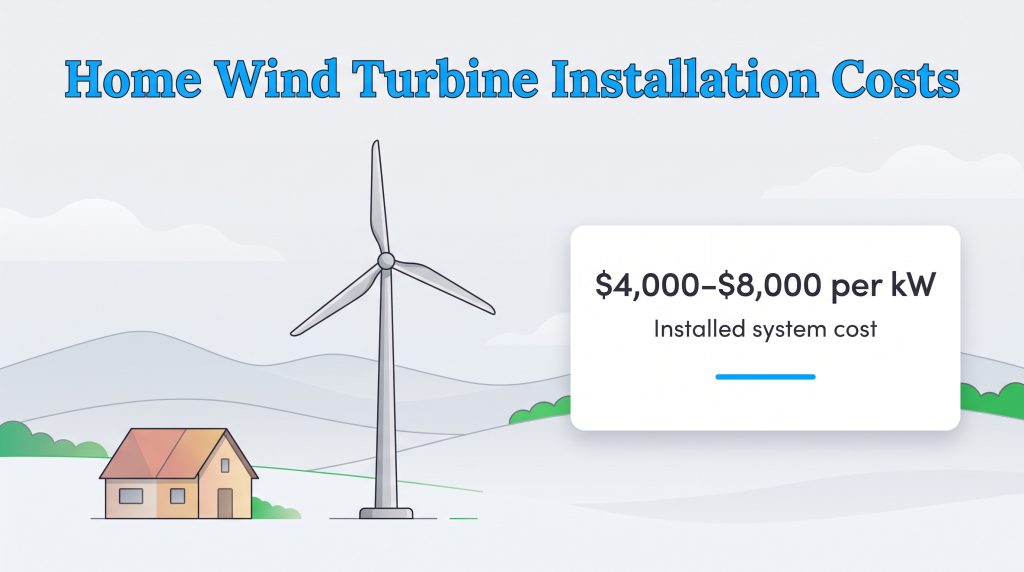
A professionally installed, whole-home wind turbine requires a serious financial commitment. While you may encounter cheap DIY micro-turbines online for a few hundred dollars, these novelty items lack the capacity to meaningfully impact your electric bill. For a legitimate, grid-tied or off-grid home setup, the average home wind turbine cost typically lands between $4,000 and $8,000 per kilowatt (kW) of capacity.
This steep upfront price tag covers much more than just the fiberglass blades. It includes the heavy steel monopole, a massive poured concrete foundation, costly crane rentals, specialized inverters, and highly skilled electrical labor. Here is a realistic breakdown of what you can expect to pay based on the system’s size:
| Turbine Output Capacity (kW) | Average Total Installation Cost | Best Suited For |
|---|---|---|
| 2 kW | $8,000 – $16,000 | Supplemental power for a small cabin or outbuilding |
| 5 kW | $20,000 – $40,000 | Offsetting usage for a highly energy-efficient home |
| 10 kW | $40,000 – $80,000 | Complete energy independence for a large household |
Fortunately, you do not have to shoulder that entire financial burden alone. The federal government offers robust incentives to encourage energy efficient home improvements. Under current legislation, the Federal Residential Clean Energy Credit allows homeowners to claim a 30% tax credit on the total cost of eligible wind energy property, which includes all necessary labor and installation fees. This credit acts as a dollar-for-dollar reduction on your federal income taxes, drastically lowering your true out-of-pocket expenses.
Wind vs. Solar: Which is Better for Your Home?
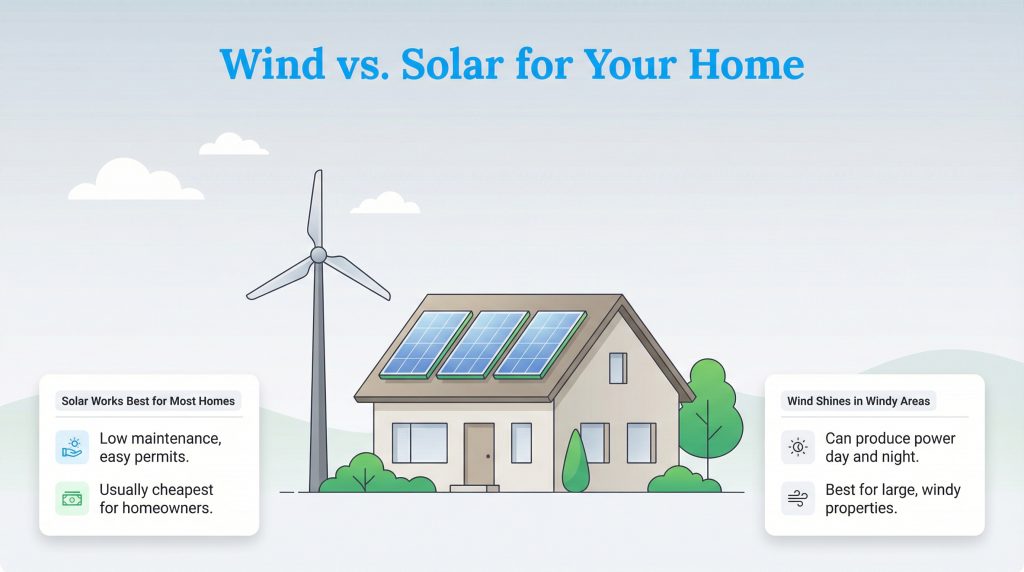
The debate of wind vs. solar for home energy is incredibly common, as both systems provide an eco-conscious alternative to grid reliance. However, they operate under completely different rules regarding economics, space, and maintenance. To determine which technology will yield the best results for your property, review this direct comparison:
| Evaluation Metric | Residential Wind Power | Residential Solar Panels |
|---|---|---|
| Initial Cost | High ($4,000 – $8,000 per kW) | Moderate ($2,500 – $4,000 per kW) |
| Space Required | High (1+ acres with an 80+ foot tall tower) | Low (Standard, unobstructed roof space) |
| Maintenance | High (Moving parts require annual lubrication and inspection) | Low (Minimal upkeep, occasional surface cleaning) |
| Reliability | Consistent day and night; highly productive during winter storms | Daytime generation only; peaks during sunny summer months |
| Zoning Restrictions | Strict (Height variances and noise ordinances heavily enforced) | Lenient (Many states legally protect solar access rights) |
The Clear Winner for Suburban Homes: Solar Panels. For the vast majority of consumers living in standard neighborhoods, solar panels are unequivocally the smarter, more practical investment. They are significantly cheaper to install, seamlessly pass through HOA guidelines, and have zero moving parts to break down.
The Clear Winner for Expansive Rural Property: Wind Power. If you own sweeping farmland or wide-open acreage in a perpetually blustery region, a wind turbine shines where solar falls short. Because the wind blows 24 hours a day, a properly sized turbine can drastically reduce your need for a massive, expensive overnight battery bank.
Calculating Your ROI and Payback Period
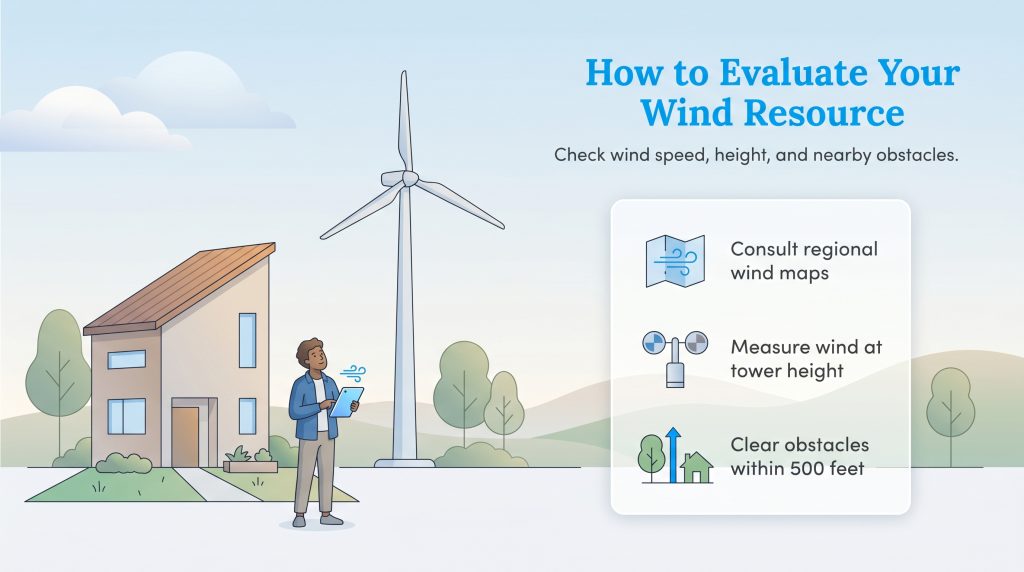
When dropping tens of thousands of dollars on renewable energy equipment, you need to know exactly when that investment will begin paying for itself. Your residential wind power ROI hinges heavily on your local utility’s kilowatt-hour (kWh) rates. If you live in a state with exceptionally high electricity costs, your payback period will be significantly shorter.
To calculate your estimated payback period, follow this straightforward, three-step formula:
- Determine Your Net Cost: Take the total quoted installation price of your turbine and subtract the 30% federal tax credit (and any local rebates you qualify for). For example, a $40,000 whole-home system becomes $28,000 after applying the federal credit.
- Calculate Your Annual Energy Savings: Estimate how much electricity your turbine will generate annually (e.g., 10,000 kWh). Multiply that figure by your current utility provider’s rate (e.g., $0.18 per kWh). In this scenario, you would save roughly $1,800 on your electric bill each year.
- Divide the Cost by the Savings: Divide your net cost ($28,000) by your annual savings ($1,800). The resulting number is your break-even point in years.
Based on this financial math, the realistic average payback period for residential wind turbines typically falls between 7 and 15 years. After you cross that break-even threshold, every kilowatt your turbine produces translates directly into free, environmentally mindful energy for your household.
Preparing for Your Off-Grid or Hybrid Setup
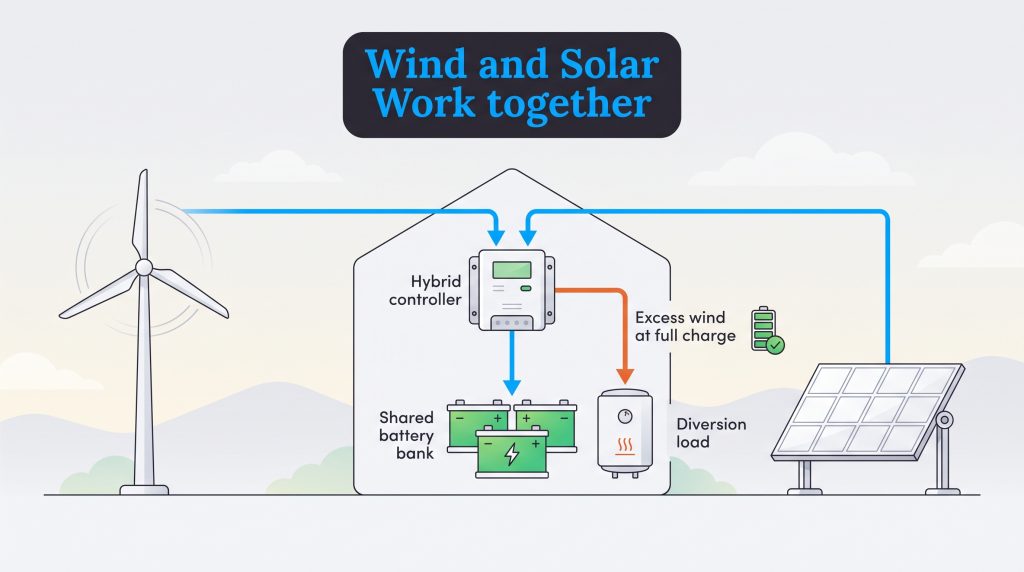
Relying exclusively on one renewable energy source can occasionally leave you vulnerable to seasonal weather patterns. Preparing an off-grid wind power system alongside solar panels — creating a hybrid setup — is one of the most effective strategies for achieving total, year-round energy independence. These two power sources act as perfect counterparts; solar panels reach peak efficiency during the long, sunny days of summer, while wind speeds typically surge at night and throughout the stormy winter months.
By blending both technologies, you create a deeply balanced power supply that drastically reduces your reliance on an oversized battery bank. To safely bridge these unique systems into a unified home grid, you will need to invest in a few specialized pieces of equipment:
- Hybrid Charge Controllers: Solar panels and spinning turbines generate electricity differently. A specialized hybrid controller manages the unpredictable voltage spikes from the wind while simultaneously regulating the steady flow from your roof array.
- A Unified Battery Bank: Rather than running two separate storage configurations, your hybrid controllers will safely feed all generated electricity directly into a single, high-capacity deep-cycle battery bank.
- Diversion Loads: When your battery bank hits 100% capacity and the wind is still howling, your turbine must remain under a mechanical load. Otherwise, it will free-spin out of control and destroy its internal bearings. A diversion load automatically reroutes that excess energy into a secondary household output, such as an electric water heater or space heater.
Taking the Next Steps Toward a Wind-Powered Home
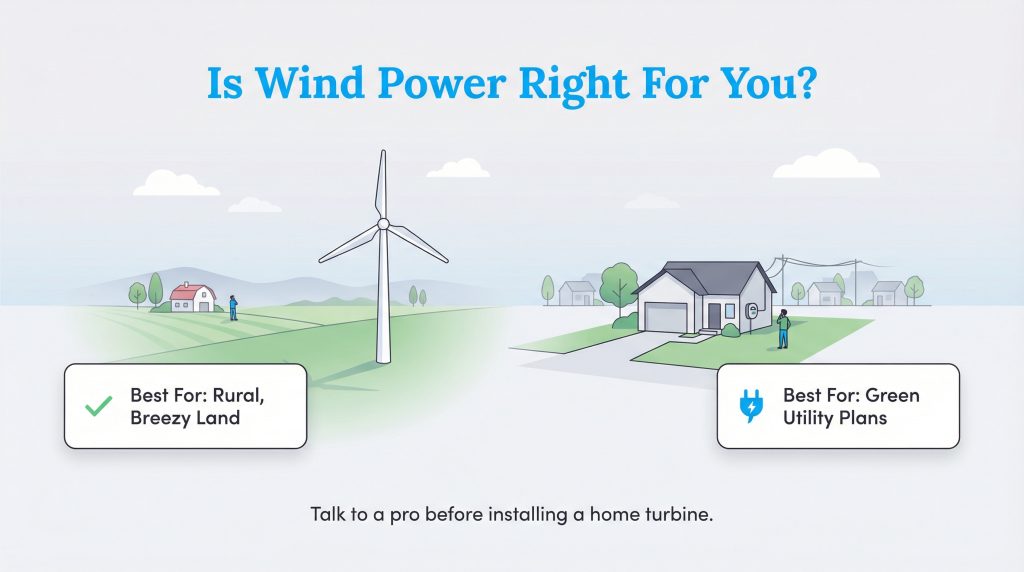
Investing in a home wind turbine is an incredible way to generate clean, sustainable power, but it is undeniably a rigorous undertaking that requires the perfect blend of geographic luck, open space, and financial readiness. If you have expansive acreage, favorable zoning laws, and a steady 10 mph breeze, scheduling a professional site assessment is your best path toward total energy independence.
However, if your property falls short of these strict spatial requirements, you do not have to abandon your eco-conscious goals. You can achieve similar environmental benefits by exploring rooftop solar arrays or simply switching to a renewable energy plan provided directly by your local electric utility. Carefully weigh your sustainable options, consult with certified renewable energy professionals, and choose the path that makes the most functional and financial sense for your household.
Frequently Asked Questions About Residential Wind Power
Can a single residential wind turbine power a whole house?
Yes, a single residential wind turbine can absolutely power your entire house, provided you install a model with a large enough kilowatt capacity (typically 10 kW or more) and live in a geographic location with exceptional, consistent wind speeds. To guarantee reliable electricity, you will also need to invest heavily in a high-capacity deep-cycle battery bank to store excess energy for calm days.
What happens to wind power when the wind stops blowing?
When the wind dies down, your turbine will temporarily stop generating electricity. If your home is tied to the local utility grid, your electrical system will seamlessly pull backup electricity directly from your utility provider. If you are entirely off the grid, your home will transition to drawing stored energy from your deep-cycle battery bank until the breeze picks back up.
Can I install a small wind turbine in a residential neighborhood?
It is highly unlikely. Most residential neighborhoods and Homeowners Associations (HOAs) strictly prohibit towering structures and heavily enforce noise ordinances. Furthermore, the trees, nearby buildings, and two-story homes typical of standard suburbs block the clean, sweeping airflow a turbine desperately needs to generate electricity efficiently.
How noisy is a home wind turbine?
Home wind turbines are often described as producing a rhythmic, mechanical swoosh as the blades rapidly cut through the air. While modern residential models are engineered to be significantly quieter than large commercial turbines, they still generate notable noise. This is exactly why zoning laws require them to be placed a significant distance from property lines, ensuring the decibel level remains below 60 dBA and does not disturb your neighbors.
How much land do I need for a residential wind turbine?
You need a minimum of one full acre of open land to safely install a residential wind turbine, though having two or more acres is highly recommended. This space is required to meet zoning fall-zone setbacks, accommodate the physical footprint of the tower or guy wires, and ensure the turbine is placed far enough away from wind-blocking obstacles.
Do rooftop wind turbines actually work?
Generally, no. Traditional wind turbines vibrate significantly as they spin, which can cause severe structural damage to your roof trusses over time. Furthermore, the wind flowing just above a roofline is highly turbulent and inefficient, meaning the turbine will rarely generate enough power to justify the investment. Standalone towers planted firmly in the ground remain the only reliable choice.
How much wind speed is required to power a home?
You generally need an average annual wind speed of at least 10 miles per hour (mph) for a residential turbine to be economically viable and generate meaningful electricity. You can verify your local wind speeds using free resources from the Department of Energy’s WINDExchange program or by hiring a professional to conduct a localized site assessment with an anemometer.
About the Author

David has been an integral part of some of the biggest utility sites on the internet, including InMyArea.com, HighSpeedInternet.com, BroadbandNow.com, and U.S. News. He brings over 15 years of experience writing about, compiling and analyzing utility data.

LaLeesha has a Masters degree in English and enjoys writing whenever she has the chance. She is passionate about gardening, reducing her carbon footprint, and protecting the environment. She also recently served as President of the Board for City Sprouts (a community garden).

Jared Evans is a licensed electrician and the owner of Full Circuit Electric in Omaha, Nebraska. As an expert reviewer for UtilitiesForMyHome.com, Jared uses his 10+ years of hands-on experience to ensure our electrical advice is safe, accurate, and easy to follow. Whether he's troubleshooting a complex wiring issue or sharing tips on green energy upgrades, Jared is dedicated to helping you power your home efficiently — and safely.