
Understanding how solar financing works can save you money and headaches when buying or selling a home.
Key Takeaways
- A Power Purchase Agreement (PPA) is a financial arrangement where a developer installs solar panels on your roof, and you purchase the power they generate at a set rate.
- Unlike owning panels, you do not own the equipment in a PPA, which means you avoid upfront costs but miss out on federal tax incentives like the Solar Investment Tax Credit (ITC).
- If you are moving, transferring a PPA to a new homeowner requires specific credit checks and contract reviews, making it a critical step in the real estate closing process.
Solar energy is rapidly becoming a standard feature in modern homes, but the financial contracts behind those shiny panels can easily overwhelm new buyers and long-time homeowners alike. Whether you want to lower your household carbon footprint without a massive down payment or you are purchasing a property that already has panels installed, understanding how Power Purchase Agreements work is essential. A Power Purchase Agreement offers a unique pathway to renewable energy by treating the solar system on your roof like a mini-utility company rather than a traditional home improvement project. In this guide, we will break down the mechanics of these agreements, compare a solar PPA vs lease and loan options, expose contract red flags to avoid, and outline the exact steps you need to take if you are moving into or out of a home with existing solar contracts.
What Is a Power Purchase Agreement (PPA)?
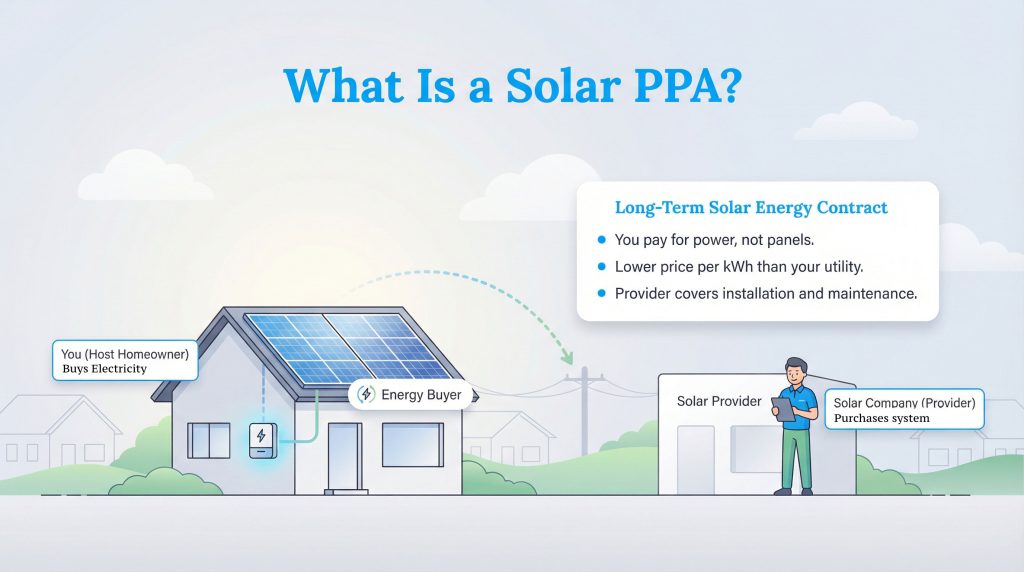
A Power Purchase Agreement (PPA) is a specific third-party ownership model where a solar developer installs, owns, and operates a solar energy system on your property. In this arrangement, you act as the property “host,” while the solar company acts as the “provider.” Instead of purchasing the solar panels themselves, you explicitly agree to buy the electricity the system generates at a predetermined rate per kilowatt-hour (kWh). This rate is usually lower than what your local utility company charges, providing immediate savings on your monthly energy bills.
You can think of a residential power purchase agreement as a long-term energy contract. It essentially places a localized power plant on your roof that sells you energy directly, bypassing the traditional electrical grid for that specific portion of your household usage. Because the solar developer retains full ownership of the equipment, they handle all the upfront installation costs, the ongoing maintenance, and the eventual system removal. This structure makes a PPA an accessible, low-barrier entry point into the world of solar energy for homeowners who want green energy without taking out a massive loan.
How Does a Power Purchase Agreement Work?
If you are wondering how the entire process unfolds from your first inquiry to flipping the switch, the journey follows a standardized timeline. Here is exactly how a power purchase agreement works step by step:
- Initial Site Assessment and Energy Audit: The solar developer evaluates your roof’s condition, orientation, and sun exposure. They will also review your past 12 months of utility bills to understand your average household energy consumption.
- System Design and Proposal: Based on your home’s unique energy needs, the developer engineers a custom solar array. They will present a proposal detailing the estimated energy production, the starting PPA rate per kWh, and the projected savings compared to your current utility provider.
- Contract Signing and Permitting: Once you agree to the PPA contract terms, you sign the agreement — which typically spans 20 to 25 years. The solar company then handles the heavy lifting of pulling local building permits and securing approval from your homeowners association (HOA) if applicable.
- Installation and Grid Interconnection: The developer’s crew installs the panels, wiring, and inverters on your property. After passing a final city inspection, your local utility company must grant “Permission to Operate” (PTO), officially connecting your new solar system to the municipal energy grid.
- Ongoing Power Generation and Billing: Your system goes live, and you begin generating clean energy. Moving forward, you will receive two monthly bills: one from the solar developer for the exact amount of power the panels generated, and a smaller bill from your local utility company for grid connection fees and any supplemental night-time energy you consumed.
Solar PPA vs Lease vs Solar Loan
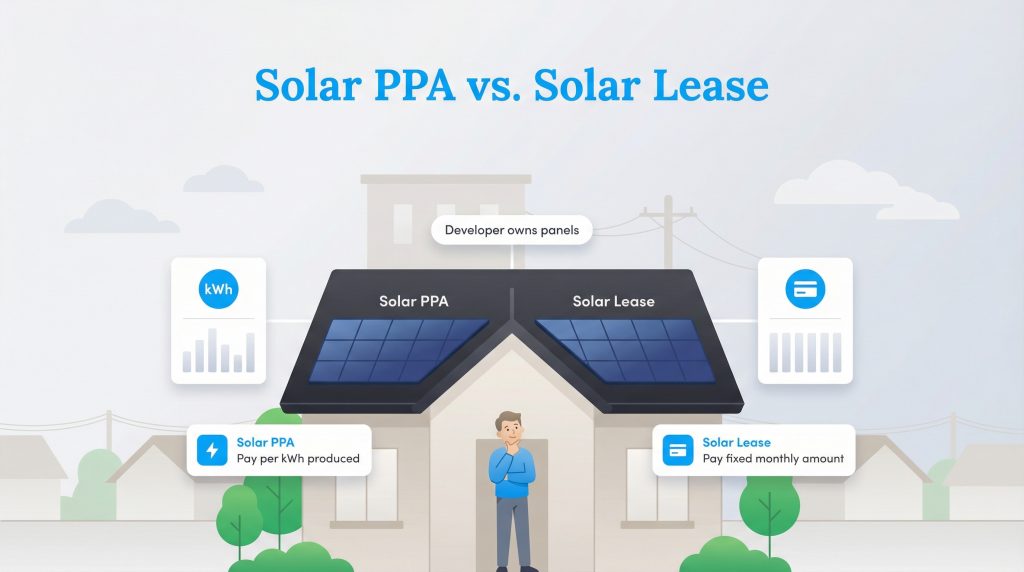
Navigating the solar market requires understanding the core differences between third-party ownership and personal financing. While both PPAs and solar leases allow you to enjoy solar energy without purchasing the panels, their payment structures are fundamentally different. Furthermore, comparing a solar PPA vs lease against a traditional solar loan changes the conversation from immediate savings to long-term return on investment.
With a PPA, your monthly bill fluctuates based on how much energy the system actively produces; you pay a set rate for every kWh generated. If the sun shines intensely in July, you buy more solar power from the developer. With a Solar Lease, you pay a fixed monthly rent to use the equipment, regardless of its actual energy output. Whether the system generates 100 kWh or 1,000 kWh that month, your lease payment remains completely identical.
On the other hand, a Solar Loan puts you on the path to ownership. You borrow money from a lender to purchase the system outright. While you are responsible for paying back the loan with interest, you own the equipment from day one. This means you — not the developer — are legally eligible to claim the highly lucrative Federal Solar Investment Tax Credit (ITC) and any state-level rebates. Below is a comprehensive breakdown of how these financing options compare to a direct cash purchase.
| Feature | Power Purchase Agreement (PPA) | Solar Lease | Solar Loan | Cash Purchase |
|---|---|---|---|---|
| Ownership | Developer | Developer | Homeowner | Homeowner |
| Upfront Cost | $0 | $0 | $0 (usually) | High |
| Monthly Payment | Variable (pay per kWh) | Fixed (rent for equipment) | Fixed Loan Payment | None |
| Maintenance | Developer | Developer | Homeowner | Homeowner |
| Tax Incentives (ITC) | Developer Claims | Developer Claims | Homeowner Claims | Homeowner Claims |
Financial Mechanics: Rates, Escalators, and the Solar PPA Calculator
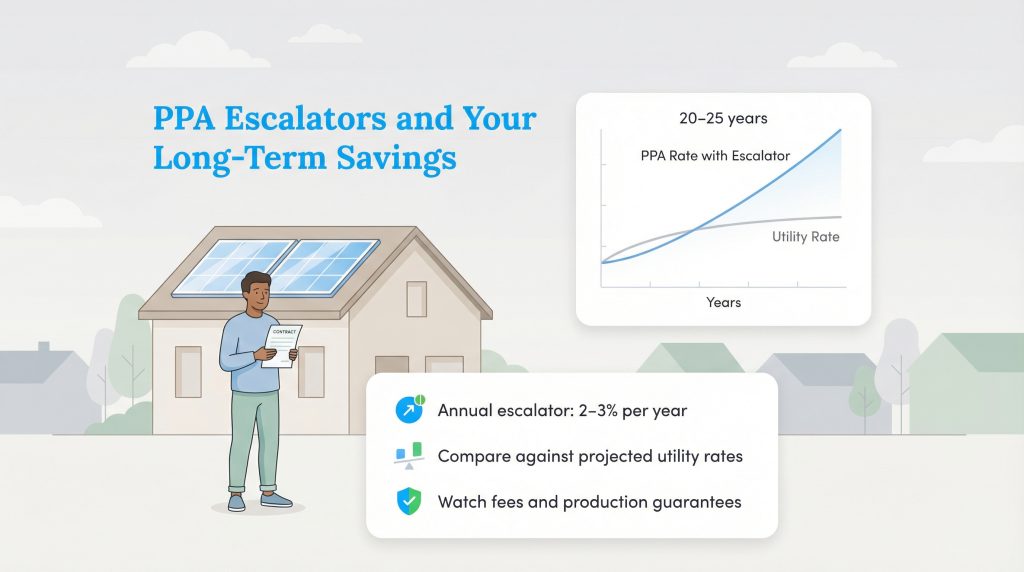
The primary appeal of entering into a PPA is securing immediate financial relief. The solar provider will lock in an initial rate per kWh that deliberately undercuts your current utility rate. However, you must remember that these are sophisticated, long-term financial products — often spanning up to 25 years. The fine print in these agreements dictates your long-term success, and the most critical component to evaluate is the “annual escalator.”
An annual escalator is a contractual clause that allows the solar provider to automatically increase the rate you pay for solar power by a fixed percentage every single year. A typical escalator ranges between 2% and 3.5%. The industry logic behind this escalator is that municipal utility rates historically rise over time, so the solar rate can gently rise alongside it while still keeping you in the green.
To truly understand the impact of this clause, we highly recommend running your numbers through a solar PPA calculator. For example, if your starting PPA rate is $0.15 per kWh with a 2.9% annual escalator, your rate will climb to roughly $0.30 per kWh by year 25. If your local utility rates stay relatively flat or rise much slower than your PPA escalator, your savings will quickly erode. By the final years of your contract, you might find yourself paying significantly more for the solar power generated on your roof than you would for standard grid power. Running a solar PPA calculator helps you forecast this break-even point and prevents you from signing a financially backward deal.
Red Flags in PPA Contract Terms
While an environmentally mindful choice, signing a power purchase agreement binds your property to a corporate developer for decades. Because these contracts are drafted to protect the provider’s bottom line, you need to read the fine print closely. Before you finalize any paperwork, look out for these three major PPA contract red flags.
- Aggressive Annual Escalators: As discussed, an escalator above 3% is a massive gamble against future utility markets. If a sales representative pushes a contract with a 3.5% or 4% annual increase, walk away. This aggressive compounding math guarantees you will overpay in the back half of your contract lifecycle.
- Hidden Early Termination Fees: Life is unpredictable, and you may need to break your contract due to an unexpected home sale or a roof replacement. Some providers bury exorbitant cancellation fees in their terms, forcing you to pay the entire projected remaining balance of a 25-year contract in one lump sum if you attempt to cancel early.
- Undefined Maintenance SLAs: While the developer is responsible for repairs, a poorly written contract will not include a Service Level Agreement (SLA) dictating when they must fix a broken system. If your inverter dies in June and the contract has no SLA timeframe, the developer could take three months to send a technician. During that downtime, you are forced to buy expensive summer grid power while still being locked into your solar agreement. Always demand a guaranteed repair timeline.
Residential Power Purchase Agreement vs. Commercial & Virtual PPAs
When you hear the term PPA in the news, it doesn’t always refer to panels on a suburban roof. The renewable energy market has scaled this financing model to meet the massive demands of global corporations. Understanding the broader landscape helps clarify how a residential power purchase agreement differs from commercial and virtual models.
A commercial solar PPA functions almost identically to a residential one, but on a massive physical scale. Instead of a 6-kilowatt system on a home, a commercial developer might install a 500-kilowatt array on the roof of a warehouse or a university campus. The business host agrees to purchase the power generated, allowing them to drastically cut operational overhead without tying up their capital in solar infrastructure.
A Virtual Power Purchase Agreement (VPPA), however, is an entirely different mechanism. A VPPA — also known as a synthetic PPA — decouples the physical flow of electricity from the financial transaction. In this setup, a corporation agrees to finance a massive off-site solar or wind farm by guaranteeing a fixed price for the power it produces. The physical green energy generated goes directly into the public grid, not the corporation’s headquarters. In return, the corporation receives Renewable Energy Certificates (RECs) to offset their carbon footprint. VPPAs are the primary tool tech giants use to claim 100% renewable energy operations, even if their downtown office buildings don’t have a single solar panel on the roof.
PPA Solar Pros and Cons
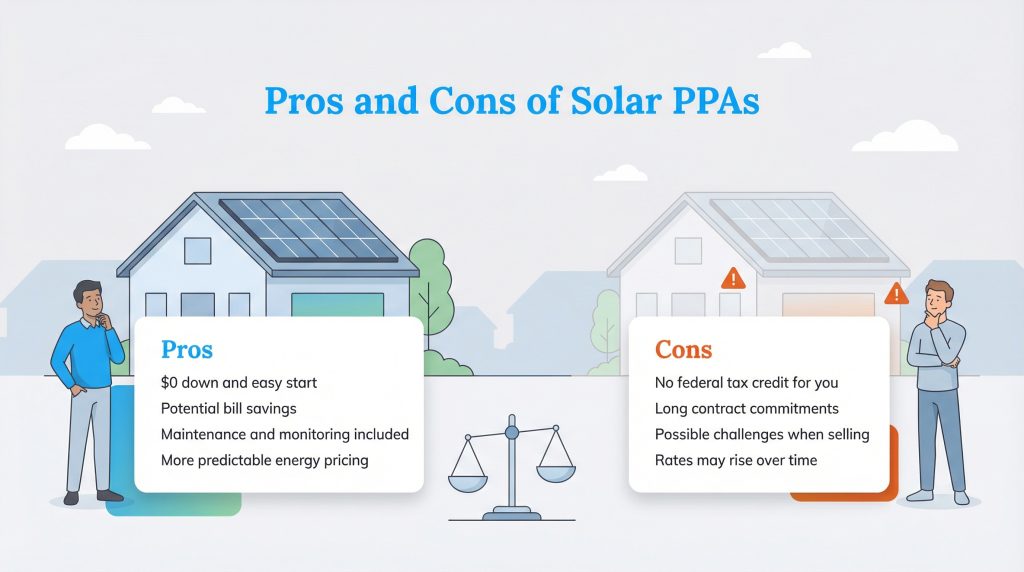
Deciding if a PPA is the right sustainable living choice for you depends entirely on your financial goals, your tax liability, and your long-term flexibility. To help you evaluate whether a solar PPA is worth it, here is a balanced side-by-side comparison of the core advantages and disadvantages.
Pros of a Solar PPA
- $0 Down Required: Providers market these as zero-down solutions, meaning you can start using green energy without liquidating your savings.
- Immediate Savings: Starting rates are designed to be immediately lower than your current utility price, creating instant monthly budget relief.
- Total Maintenance Included: The developer handles all system monitoring, hardware repairs, and eventual equipment disposal.
- Predictable Forecasting: Your contract clearly spells out how your solar rate will change over time, allowing for easier long-term household budgeting.
Cons of a Solar PPA
- No Tax Incentives: Because you do not own the hardware, you are legally disqualified from claiming the 30% federal tax credit; the developer keeps it.
- Long Contract Commitments: You are locking your property into a binding legal agreement that often lasts up to 25 years.
- Real Estate Complications: Transferring the contract requires credit checks and can actively scare off cautious potential homebuyers.
- Escalator Risk: Aggressive annual rate increases could outpace standard utility inflation, ultimately costing you more money over time.
For more data on solar costs, ownership models, and renewable energy market trends, the National Renewable Energy Laboratory (NREL) offers excellent resources and consumer reports to guide your research.
Navigating Real Estate with a Solar PPA
Perhaps the most misunderstood aspect of third-party solar agreements is how they impact real estate transactions. A PPA is legally tied to the property, but the financial obligation is tied to the homeowner. Whether you are hunting for a new place to live or preparing to list your current property, the solar contract requires dedicated attention during the escrow process to ensure a smooth transition.
Buying a House With an Existing PPA
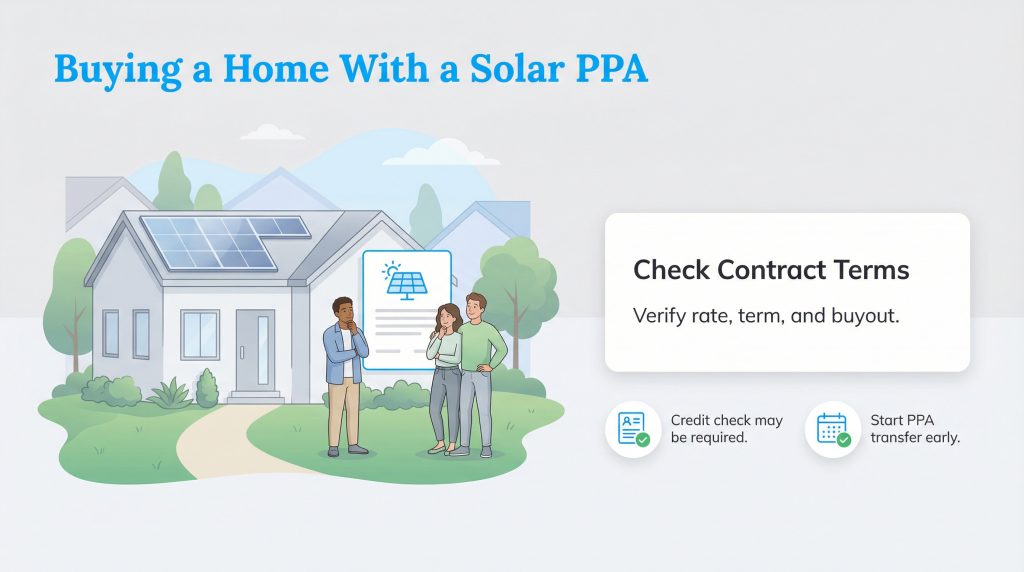
Falling in love with a home that already features solar panels can feel like a massive bonus, but if those panels are tied to a PPA, you are inheriting a complex financial contract along with the house. Before you close the deal, you must perform serious due diligence. Ask the seller for a complete copy of the original PPA contract immediately. You need to verify the remaining term length, current rate per kWh, annual escalator percentage, and specific PPA buyout options. Understanding these details will prevent unwanted surprises in your monthly household budget after you move in.
Additionally, the solar company will likely require you to pass an independent credit check before they approve the legal transfer of the agreement to your name. This is a standard part of the third-party solar process, but it adds a frustrating layer of complexity to the standard real estate transaction. If you are preparing for a move, be sure to coordinate closely with your real estate agent to ensure the PPA transfer is initiated early in the closing process. For more practical tips on establishing essential services in a new home, check out our resources on moving and utilities.
Selling Your Home: PPA Buyout Options and Transfers
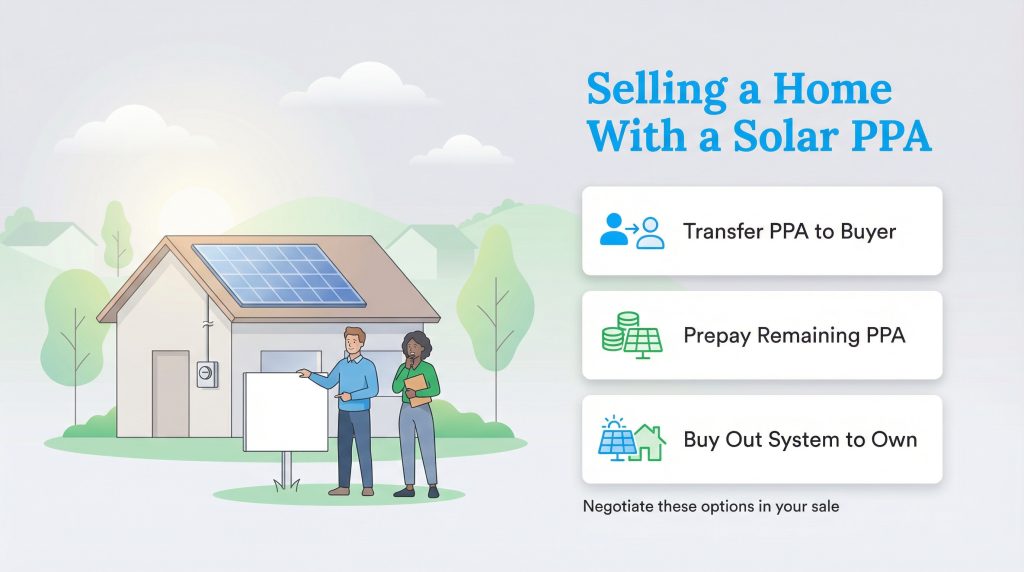
If you are trying to sell a home equipped with a PPA, you generally have three distinct options to handle the outstanding contract. Not every solar contract offers all three options, so it is vital to read your specific agreement or call your provider directly to confirm what is available in your terms.
The most common route is to transfer the agreement directly to the incoming buyer. This allows the new homeowner to seamlessly step into your shoes, taking over the monthly payments and enjoying the generated solar energy. However, this is heavily contingent on the buyer agreeing to the terms and passing the solar company’s required credit check. Some conservative buyers may be highly hesitant to take on a long-term contract they didn’t personally negotiate.
Your second option is to prepay the PPA. In this scenario, you pay the estimated cost of the remaining power generation upfront before closing. Prepaying means you are essentially buying the future power in advance, while the developer still retains physical ownership of the system. The homebuyer then gets the incredible benefit of using the solar system without any monthly payments to the developer for the remainder of the contract term, which can be an incredibly strong selling point.
The third option is to pursue a PPA buyout. This involves purchasing the equipment outright from the developer at its current fair market value. Once you formally own the panels, you can roll their value into the total asking price of the home, allowing the buyer to own the system free and clear immediately. Expect to heavily negotiate these options with buyers as part of your overall home sale strategy.
Determining if a Solar PPA is Your Best Move
A Power Purchase Agreement is a highly capable tool for homeowners who desperately want to support renewable energy and lower their monthly bills without taking on the stressful burden of ownership or maintenance. By entirely removing the massive barrier of high upfront capital costs, PPAs effectively democratize green energy, making solar power accessible to a much wider audience across the country. Even if your primary focus is strictly on reducing monthly operational costs, opting into a PPA remains a deeply environmentally mindful choice because it helps add more renewable energy directly to the municipal grid.
Here is a practical way to contextualize your decision:
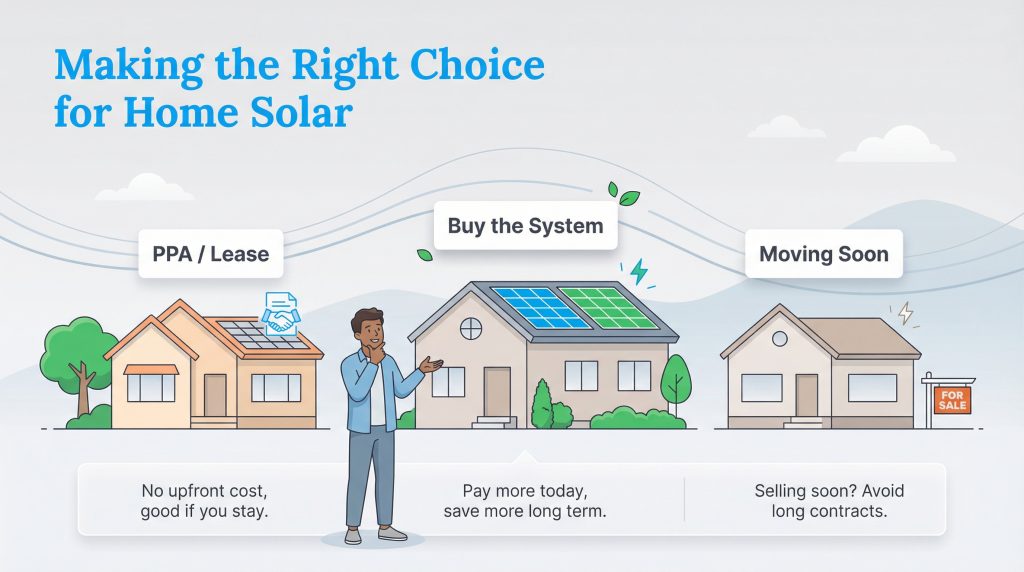
- If you actively plan to move within the next five years, entering into a new, long-term PPA may not be the smartest financial fit unless you are extremely confident a future buyer in your specific housing market will readily accept the contract transfer.
- If you desperately want solar with zero large upfront payments, lack the tax liability to benefit from the ITC, and expect to stay put in your home for decades, a PPA provides a fantastic, low-stress bridge to clean energy.
- If you can easily afford the upfront cash cost or qualify for a low-interest solar loan, buying the system outright will practically always offer you the absolute strongest long-term return on investment and maximum property control.
Solar energy is a brilliant investment in your home’s future, but it is not without its legal complexities — particularly when it comes time to eventually sell your property. If you prioritize flexibility, maintenance-free living, and immediate day-one utility savings, a PPA is an incredibly viable option. Just remember to meticulously read the fine print, push back on aggressive price escalators, and confidently secure your energy future before you sign on the dotted line.
Frequently Asked Questions About Power Purchase Agreements
What is the average length of a solar PPA contract?
The standard length for a residential solar PPA contract is typically between 20 and 25 years. This extended timeframe allows the solar developer to slowly recoup their initial hardware and installation costs while providing you with a predictable, lower energy rate over two decades.
Is a solar PPA worth it if I plan to move in 5 years?
Generally, no. If you know you are moving relatively soon, signing a new 25-year contract can create major headaches during your home sale. You will either have to convince the buyer to take over the agreement, prepay the remaining balance, or buy out the system — all of which can severely complicate the real estate transaction.
Can I negotiate PPA contract terms with the developer?
Yes, you absolutely can and should negotiate. While the foundational legal boilerplate might be rigid, you can actively push back on the starting kWh rate and the annual escalator percentage. Always ask for a 0% escalator option or request competing bids from multiple solar developers to leverage better terms.
What happens to the solar PPA if I sell my house?
You typically have three main options: transfer the long-term agreement to the new homeowner (subject to credit approval), prepay the remaining estimated power generation, or buy out the remainder of the contract yourself so the physical system is included with the home sale free and clear.
Is a solar PPA better than a solar lease?
It heavily depends on your personal preference for variable versus fixed expenses. A PPA charges you strictly for the power actively produced (a variable cost based on seasonal sunlight), while a lease charges a flat monthly rental fee for the equipment (a fixed cost). If you want to pay only for the exact energy you use, a PPA is often the preferred choice.
Can I get the solar tax credit with a PPA?
No. Under a Power Purchase Agreement, the third-party solar developer legally owns the system, meaning they are the only entity entitled to claim the lucrative Federal Solar Investment Tax Credit (ITC) and any related local financial incentives.
Do I still pay my utility company if I have a PPA?
Yes, you will. Most residential solar systems are grid-tied, meaning you will still receive a smaller, secondary bill from your local utility company for any supplemental electricity you use when your panels aren’t actively producing (like at night) and for the standard mandatory grid connection fees.
Are solar PPAs available in every state?
No. Solar PPAs are currently only available in states where third-party energy sales are legally permitted. Some states strictly restrict or entirely ban third-party energy sales, while others actively promote them. Check your individual state’s regulations or ask a local solar provider to see if they are a viable option in your specific area.
About the Author

David has been an integral part of some of the biggest utility sites on the internet, including InMyArea.com, HighSpeedInternet.com, BroadbandNow.com, and U.S. News. He brings over 15 years of experience writing about, compiling and analyzing utility data.