
Solar energy prices have stabilized, making 2026 an excellent time to invest in a system that can pay for itself in under a decade.
Key Takeaways
- The average cost of a solar panel system is typically between $15,000 and $30,000 before applying federal tax credits.
- The federal solar tax credit allows you to deduct 30% of your installation costs from your federal taxes.
- Return on investment often falls in the 7 to 12 year range, after which the electricity generated by your panels is essentially free.
Seeing the upfront price tag for a new solar array can definitely cause some sticker shock. It is not every day you consider a home improvement project that costs as much as a new car. However, focusing solely on the initial expense misses the bigger picture of long-term energy independence and substantial utility bill savings. While the numbers might look high at first glance, financing options and robust government incentives in 2026 make renewable energy more accessible than ever. We are here to walk you through the real numbers, including the installation fees and hidden costs that some sales representatives might skip over, so you can decide if this investment is right for your home.
The Short Answer: Average Solar Costs in 2026
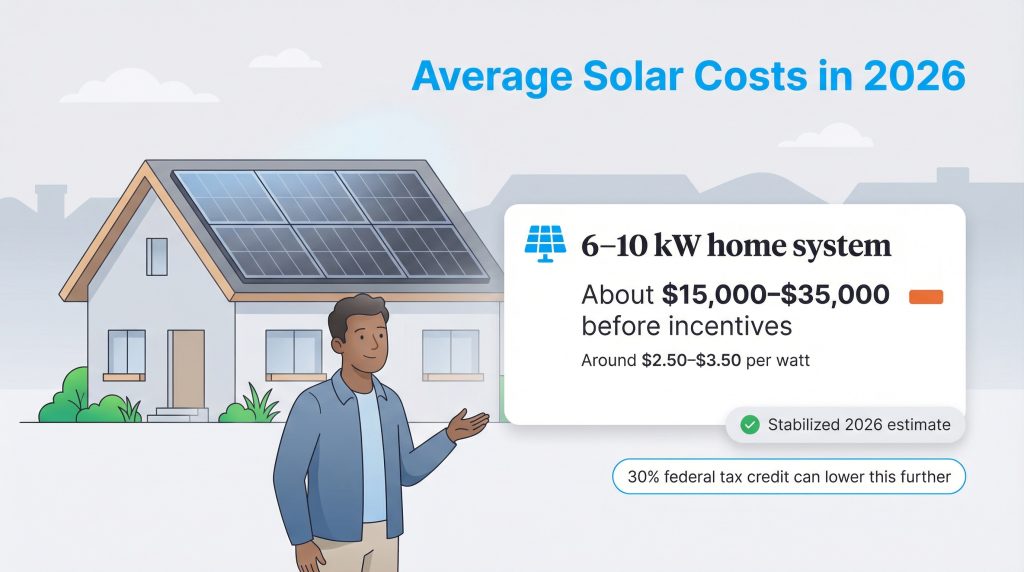
If you are looking for the bottom line, the average cost of solar panels in the U.S. is typically in the range of about $2.50 to $3.50 per watt. For a standard residential system, which usually ranges from 6 kilowatts (kW) to 10kW, you can expect to pay anywhere from $15,000 to $35,000 before incentives. These figures have stabilized over the last year as supply chains normalized, making pricing more predictable for homeowners. Since 2026 data is still emerging, these figures are estimates based on recent market trends.
The following table outlines the national average costs for common system sizes. These estimates reflect the price before and after the 30% federal tax credit is applied.
| System Size | Average Gross Cost | Cost After 30% Tax Credit |
|---|---|---|
| 6 kW | $15,000 – $21,000 | $10,500 – $14,700 |
| 8 kW | $20,000 – $28,000 | $14,000 – $19,600 |
| 10 kW | $25,000 – $35,000 | $17,500 – $24,500 |
These figures are based on market data consistent with reports from the National Renewable Energy Laboratory (NREL). Keep in mind that your specific price per watt will vary based on your equipment choices and local labor rates.
Solar Panel Costs by System Size and Home Type
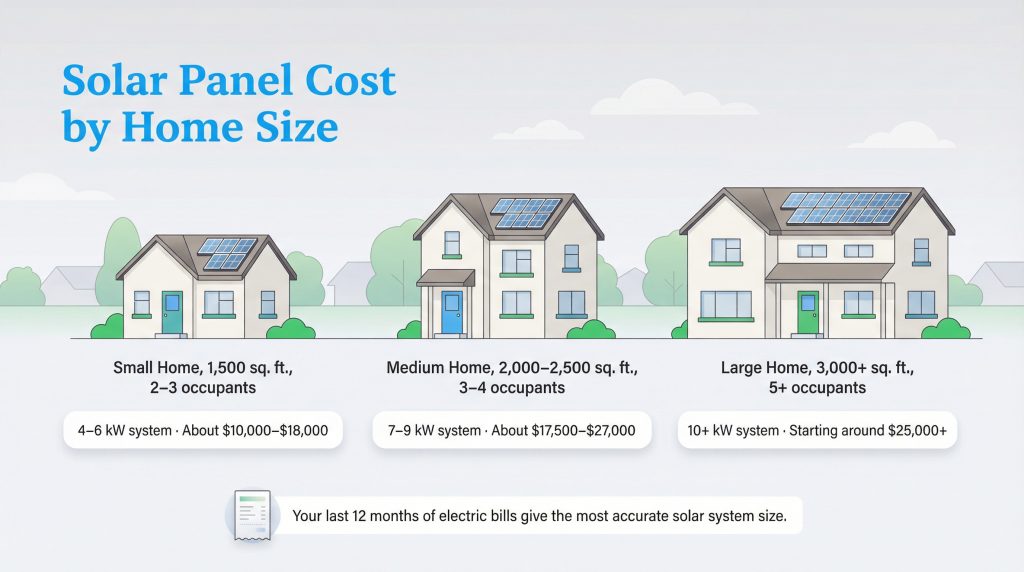
Understanding “kilowatts” can be confusing if you are just trying to figure out what fits on your roof. In reality, the size of the system you need depends more on your monthly electricity usage than the square footage of your house. However, we can look at general averages to give you a clearer picture of what the solar panel installation cost might be for your specific living situation.
- Small Home (1,500 sq. ft. / 2-3 occupants): These homes typically require a 4kW to 6kW system. You can expect to see pricing on the lower end of the spectrum, usually between $10,000 and $18,000 before incentives.
- Medium Home (2,000–2,500 sq. ft. / 3-4 occupants): This is the standard scenario when calculating the cost of solar panels for 3 bedroom house. Most homes of this size need a 7kW to 9kW system to cover their energy needs, costing roughly $17,500 to $27,000.
- Large Home (3,000+ sq. ft. / 5+ occupants): Larger homes with higher energy demands, especially those with EV chargers or heated pools, often require systems sized at 10kW or larger. Costs for these robust systems generally start around $25,000 and go up from there.
If you are unsure about the components involved, you can learn more about how these systems work in our solar energy guide.
Breakdown of Installation Costs: Hard vs. Soft Costs
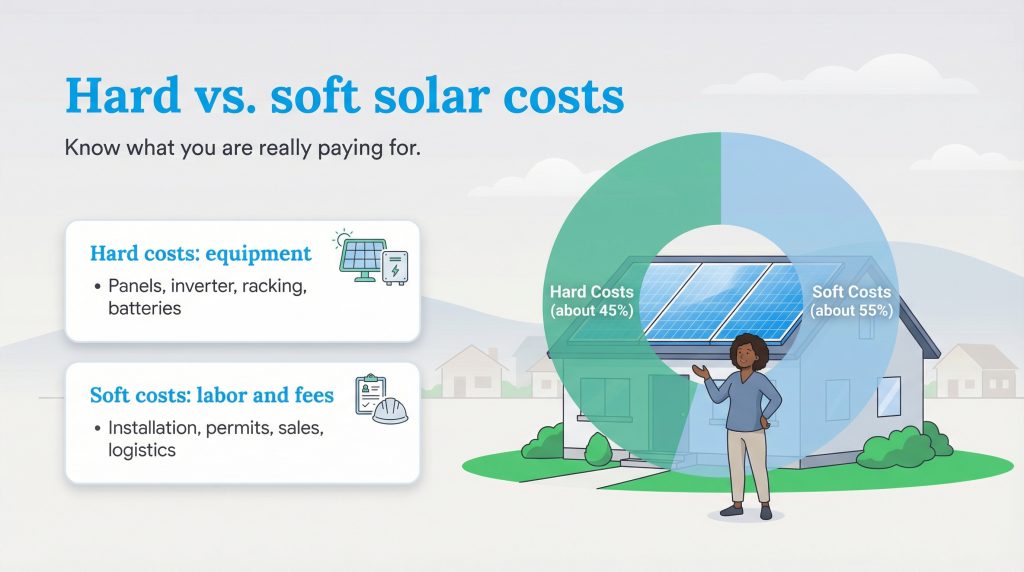
When you pay for a solar installation, you aren’t just buying the glass panels on your roof. In fact, the equipment itself often makes up less than half of the total price. The industry divides expenses into “hard costs” and “soft costs,” and understanding the difference can help you negotiate better quotes.
Hard Costs account for approximately 40% to 50% of the total price according to analyses from national labs. This covers the physical hardware: the solar panels, the inverters (which convert DC power to AC power for your home), the racking and mounting hardware that secures the panels to your roof, and any battery storage you choose to add. Batteries are optional but can significantly increase the upfront price.
Soft Costs often make up the remaining 50% to 60%. These include labor for the installation crew, local permitting and inspection fees, sales and marketing expenses, and supply chain logistics. Because soft costs like labor and permitting vary wildly from one company to another, it is crucial to get quotes from multiple installers to see who offers the best value for the service provided.
State-by-State Solar Pricing Estimates
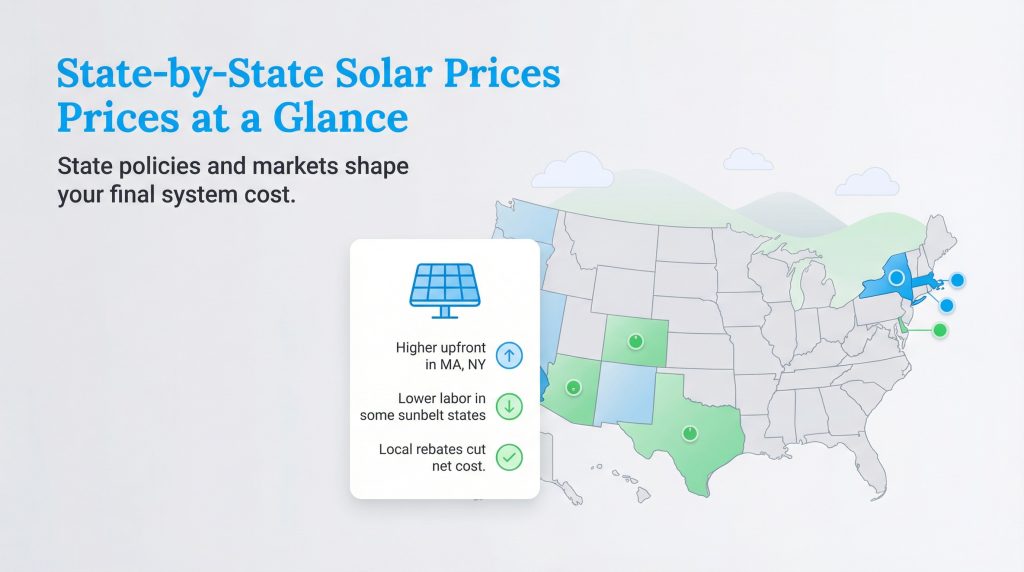
Geography plays a massive role in the final price of your system. Local labor rates, state-specific regulations, and the competitive landscape of installers in your area all influence the average solar panel cost by state. Additionally, states with more mature solar markets often have more streamlined permitting processes, which can lower those soft costs we mentioned earlier.
The table below provides an estimate for a standard 6kW system across several key states.
| State | Avg. Cost Per Watt | Avg. System Cost (6kW) |
|---|---|---|
| Arizona | $2.40 | $14,400 |
| California | $2.95 | $17,700 |
| Florida | $2.60 | $15,600 |
| Massachusetts | $3.40 | $20,400 |
| New York | $3.20 | $19,200 |
| Texas | $2.50 | $15,000 |
Estimates based on typical residential quotes reported by major solar marketplaces and public data; your actual quote may differ.
While some states like Massachusetts or New York have higher upfront costs, they often offer aggressive local rebates or performance incentives that can lower your net price significantly.
Hidden Costs to Watch Out For
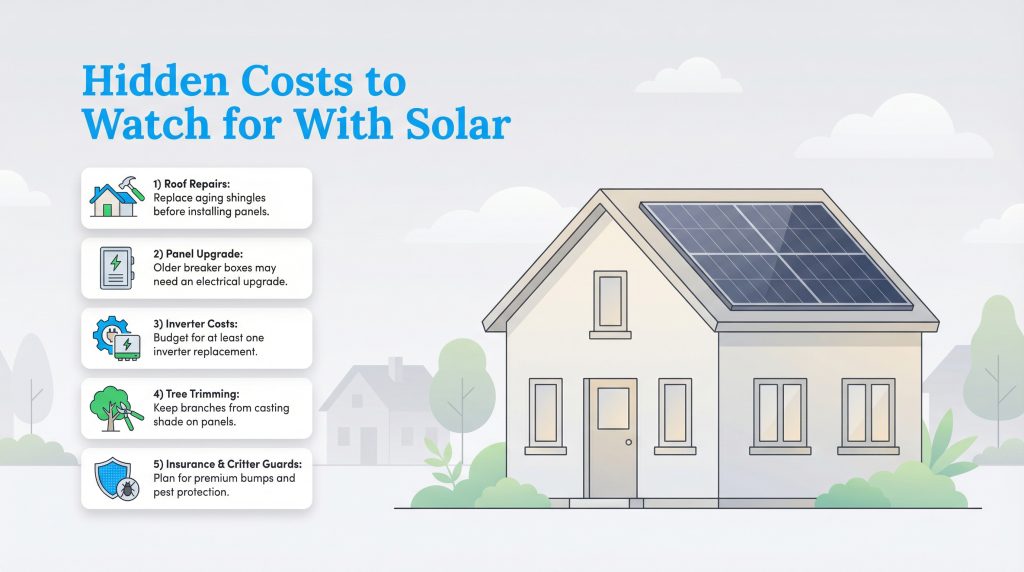
While the quote for the system is the biggest number you will see, there are often other expenses required to get your home “solar ready.” Honest installers will be upfront about these, but less scrupulous sales reps might gloss over them to close the deal. Here are the hidden costs of solar panels you need to be aware of.
- Roof Repairs: You should never install solar panels on an old or damaged roof. If your roof only has a few years of life left, you will likely need to replace it before installation. Removing and reinstalling panels later to fix a roof is extremely expensive.
- Electrical Panel Upgrades: Older homes, particularly those with 100-amp service, may need a main breaker box upgrade to handle the new solar feed. This can add $1,500 to $3,000 to your project.
- Inverter Replacement: String inverters typically last 10–15 years. You should budget for at least one replacement during the 25-year life of your panels, which can cost $1,000 to $3,000.
- Tree Trimming: Shade is the enemy of solar production. You may need to pay for professional tree trimming initially and budget for ongoing landscaping to keep your panels in direct sunlight.
- Insurance Premiums: Your homeowner’s insurance will likely cover the panels, but your premium might increase slightly to account for the added value attached to the home.
Financing Options: Cash, Loan, or Lease?
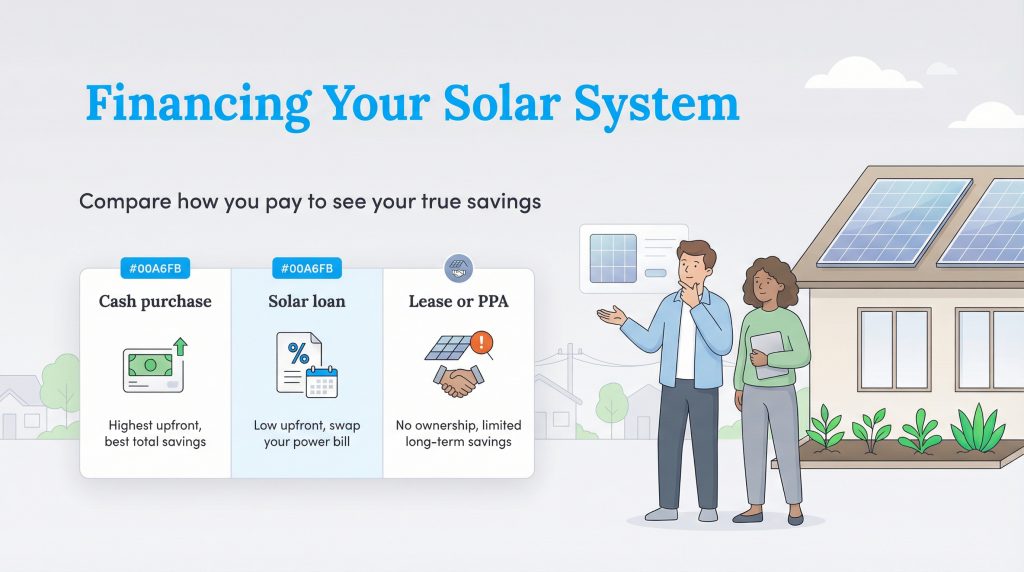
How you pay for your system affects your total savings just as much as the price of the equipment. Generally, there are three main ways to finance a solar project, each with its own pros and cons.
- Cash Purchase: This requires the highest upfront cost but offers the best long-term return on investment. By avoiding interest payments, you maximize your savings, and you own the equipment immediately.
- Solar Loan: Many homeowners choose this route because zero-down options are available. The goal is to swap your monthly electric bill for a solar loan payment that is roughly the same amount or lower. Loans can be unsecured (solar-specific) or secured (like a HELOC). Just be mindful that interest rates will affect your total payback.
- Solar Lease / PPA (Power Purchase Agreement): With a lease or PPA, you do not own the panels. Instead, a third-party company installs them, and you pay for the power they produce. While this means zero maintenance for you, it also means lower long-term savings. Crucially, you do not get the tax credit with a lease, the installer keeps it.
Be cautious with leases, as they can make selling your home more complicated if the new buyer doesn’t want to take over the contract. If solar feels out of reach right now, there are other ways to reduce your expenses. Check out our guide on how to save on your electric bill for immediate, low-cost strategies.
Solar Incentives and the Federal Tax Credit (2026)
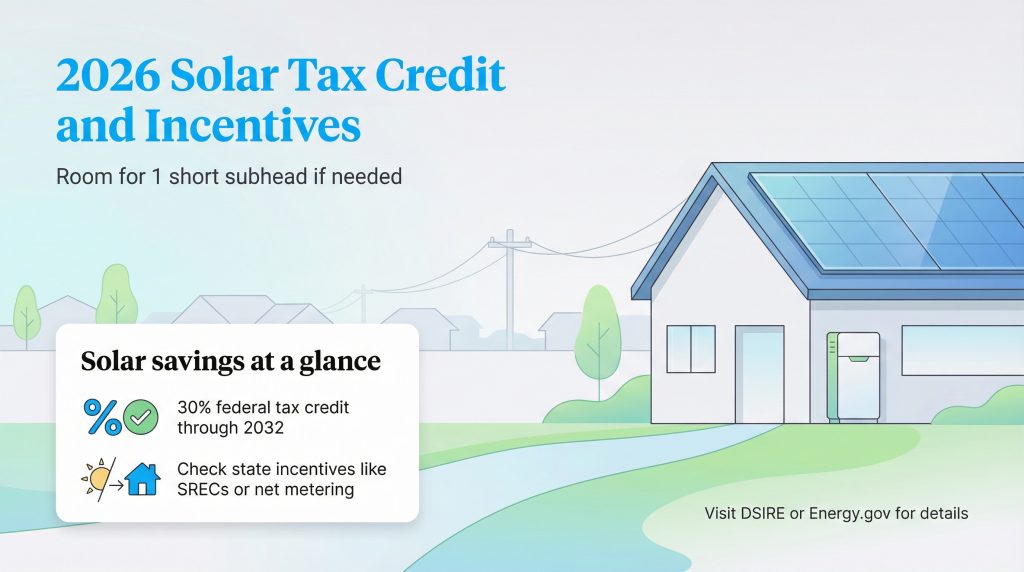
The biggest factor making solar affordable right now is the federal Investment Tax Credit (ITC). For 2026, the solar tax credit remains at 30%. This allows you to deduct 30% of the total cost of your solar system (including labor and equipment) from your federal tax liability. Under current law, this credit is available at the full 30% rate until 2032. It is important to note that this is a non-refundable credit, meaning it reduces the taxes you owe but does not guarantee a refund check if you have no tax liability.
Beyond the federal credit, many states offer additional perks like SRECs (Solar Renewable Energy Certificates) or net metering programs, which allow you to sell excess power back to the grid. However, net metering policies are changing in states like California, making battery storage increasingly important to capture the full value of your energy. We recommend visiting DSIRE (Database of State Incentives for Renewables & Efficiency) or Energy.gov to see the specific incentives available in your zip code.
Verdict: Are Solar Panels Worth It?
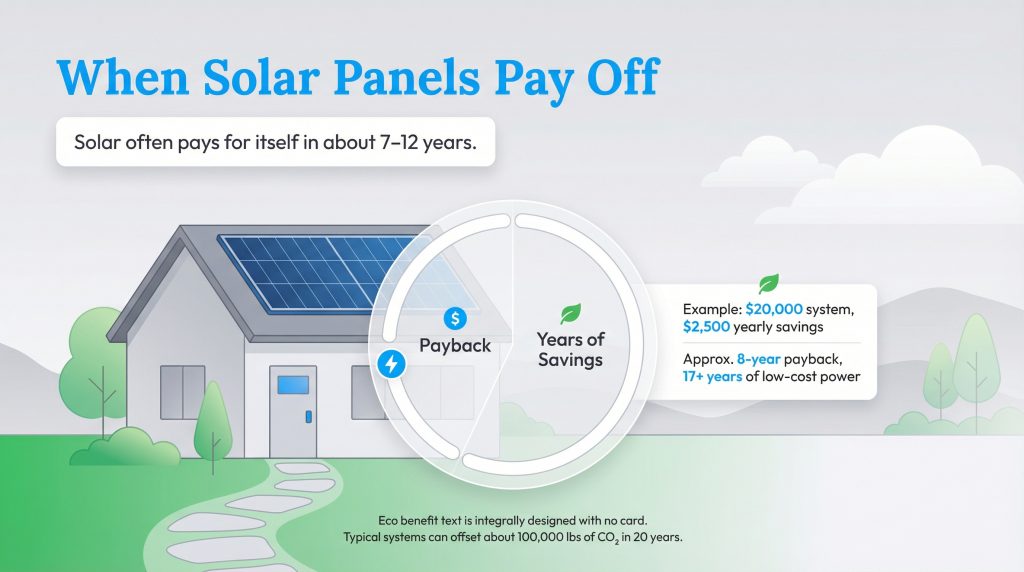
For many homeowners, especially where electricity prices are high, solar can be worth it. While the upfront cost is significant, the long-term math usually works in your favor. A standard solar panel return on investment calculation shows a “payback period” of roughly 7 to 12 years depending on your local rates. If your system costs $20,000 (after incentives) and saves you $2,500 a year on electricity, it pays for itself in 8 years. Since panels are warrantied for 25 years, that leaves you with 17+ years of essentially free electricity.
However, solar might not be the right fit if your monthly electric bill is already very low, if you plan to move in the next few years, or if your roof is heavily shaded. In these cases, energy efficiency upgrades might offer a faster return.
Furthermore, some analyses, including research from Zillow, found an average premium of around 4% in many markets. Buyers view it as an upgrade that lowers their future cost of living. Beyond the money, you are also making a tangible difference for the planet.
Reviewing Your Solar Options And Next Steps
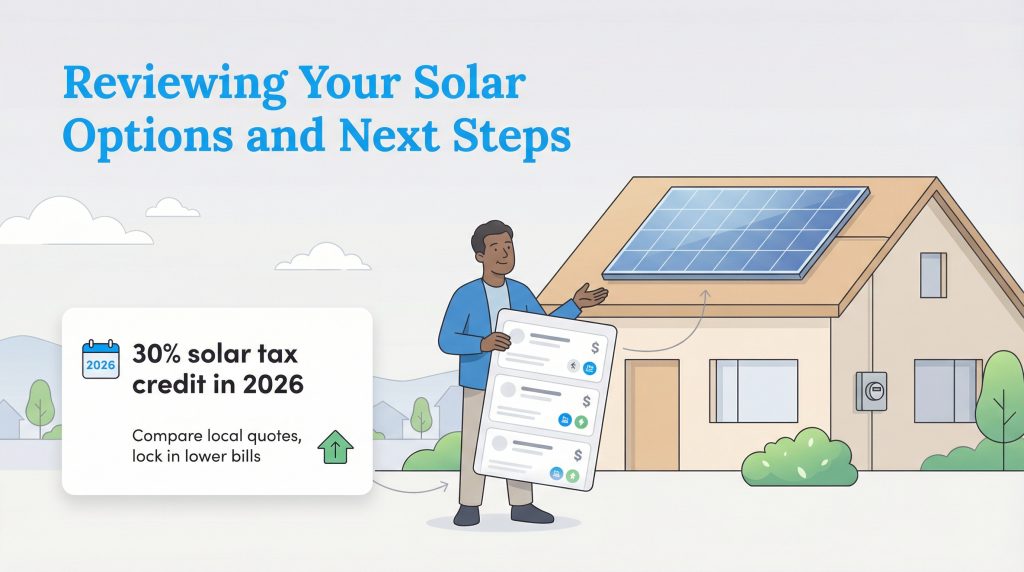
Deciding to go solar is a major financial move, but it is one of the few home improvements that actually pays you back over time. By taking advantage of the 30% tax credit available in 2026 and comparing quotes from reputable local installers, you can secure a system that protects you from rising utility rates for decades. If you plan to stay in your home for at least five years, the combination of monthly savings and increased property value makes solar a smart, sustainable choice for your future.
FAQs About Solar Panel Costs
Do solar panels really increase my home value?
What happens if I move before my solar loan is paid off?
Is solar cheaper than paying my electric bill?
Do I still have to pay an electric bill with solar panels?
How much does it cost to clean and maintain solar panels?
About the Author

LaLeesha has a Masters degree in English and enjoys writing whenever she has the chance. She is passionate about gardening, reducing her carbon footprint, and protecting the environment.