
SCANA Energy offers accessible plans for credit-challenged customers, while Georgia Natural Gas provides competitive fixed rates and Delta SkyMiles rewards for long-term homeowners.
Key Takeaways
- Georgia Natural Gas (GNG) often advertises some of the most competitive fixed rates per therm for customers with established credit, especially on 12- and 24-month plans.
- SCANA Energy operates a specific Regulated Division that acts as the state-designated “provider of last resort,” making it a reliable option for residents with limited or poor credit history.
- Both providers charge monthly customer service fees and early termination fees that you must factor into your total annual cost.
Moving into a new home in the Atlanta Gas Light territory can feel overwhelming when you realize just how many marketers are vying for your business. The deregulated market in Georgia means you have the power to choose, but it also creates a lot of marketing noise that makes it hard to see the real bottom line. As of early 2026, we created this comparison guide to help you cut through the confusion and look at the actual costs and benefits of the state’s two most prominent providers. Whether you prioritize the lowest possible rate or need a provider with flexible credit requirements, we will help you make a decision that fits your budget and lifestyle.

- $0.599 /THM
- $5.95-6.95
- None
- 1-36 Months
- $0.399 /THM
- $0.00-9.99
- None
- 1-24 Months
*rates may vary by location and household usage
At a Glance: SCANA vs. GNG Comparison Table
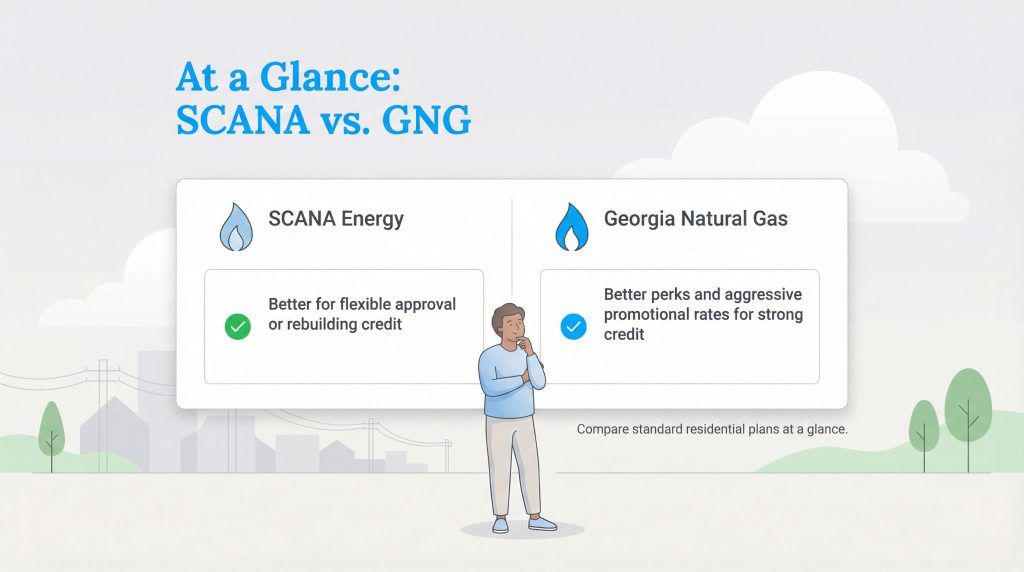
To help you compare these two major players quickly, we have broken down the essential features of their standard residential plans. This table highlights the primary differences in costs and target audiences so you can see which marketer aligns best with your specific situation.
| Feature | SCANA Energy | Georgia Natural Gas |
|---|---|---|
| Typical Fixed Rate | Moderate/Market Average | Competitive/Promotional |
| Monthly Service Charge | Typically ~$6.95 (varies by plan) | Typically $5.99 – $9.99 (varies by plan) |
| Contract Lengths | 6, 12, 18, 24, 36 months | 6, 12, 18, 24 months |
| Early Termination Fee | $100 – $200 (scales with term) | Typically $50 – $150 (scales with term) |
| Best For | Reliability & credit flexibility | Low rates & travel rewards |
For many homeowners with strong credit, Georgia Natural Gas often comes out ahead on perks and aggressive promotional rates. SCANA Energy, on the other hand, is often a better fit if you’re rebuilding credit or need a more flexible approval path.
Comparing Rates and Plans: Who is Cheaper?
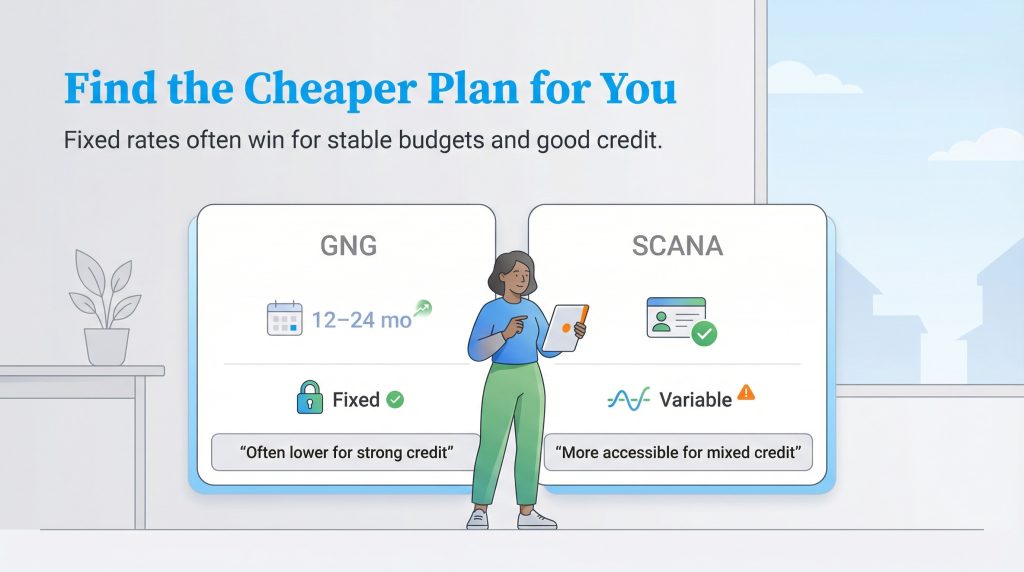
For many prime-credit customers looking at 12–24 month fixed plans, GNG is often among the lowest-price options, while SCANA can be more accessible for customers with limited or damaged credit. When you look strictly at the numbers, the “cheaper” option often depends on your credit score and how long you plan to stay in your home. Both companies offer a variety of plans, but their pricing strategies differ slightly.
SCANA Energy Plans
| Plan Name | Rate | Plan Type | Base Charge | Cancellation Fee | |
|---|---|---|---|---|---|
| Introductory Variable Rate - $100 Bill Credits | $0.599 /THM | 1 Months Variable Rate | $5.95 | None | Check Availability |
| 12 Month | $0.659 /THM | 12 Months Fixed Rate | $6.95 | $150 | Check Availability |
| 24 Month | $0.699 /THM | 24 Months Fixed Rate | $6.95 | $150 | Check Availability |
| 18 Month | $0.799 /THM | 36 Months Fixed Rate | $6.95 | $300 | Check Availability |
Georgia Natural Gas Plans
| Plan Name | Rate | Plan Type | Base Charge | Cancellation Fee | |
|---|---|---|---|---|---|
| Market Intro | $0.399 /THM | 2 Months Fixed Rate | $0 | None | Check Availability |
| 6-Month Fixed | $0.649 /THM | 6 Months Fixed Rate | $6.99-7.99 | $50 | Check Availability |
| 12-Month Fixed | $0.749 /THM | 12 Months Fixed Rate | $7.99-8.99 | $100 | Check Availability |
| 24-Month Fixed | $0.749 /THM | 24 Months Fixed Rate | $8.99-9.99 | $200 | Check Availability |
| 18-Month Fixed | $0.749 /THM | 18 Months Fixed Rate | $8.99-9.99 | $150 | Check Availability |
| Variable Select | $2.009 /THM | 1 Months Variable Rate | $3.99-6.99 | None | Check Availability |
| Pre-Pay | $2.109 /THM | 1 Months Variable Rate | $8.99 | None | Check Availability |
Fixed Rate Plans
Fixed-rate plans are the most popular choice because they protect you from price spikes during the winter months. Georgia Natural Gas rates per therm often feature some of the more competitive introductory pricing for new customers, frequently undercutting competitors to win market share. If you have a strong credit history, GNG typically offers attractive pricing on 12-month or 24-month contracts. SCANA Energy generally offers consistent, competitive rates, but they may be slightly higher than GNG’s introductory offers because SCANA maintains a broader customer base, including higher-risk accounts.
Variable Rate Plans
Both providers offer variable rate plans where the price per therm fluctuates monthly based on the natural gas market. These plans provide flexibility since they usually don’t require a long-term contract or carry cancellation fees. However, we generally recommend avoiding variable plans for long periods, as rates can spike unexpectedly during cold snaps or market volatility. GNG and SCANA both tend to have higher rates on variable plans compared to their fixed-term offers.
Fees, Fine Print, and Contract Terms
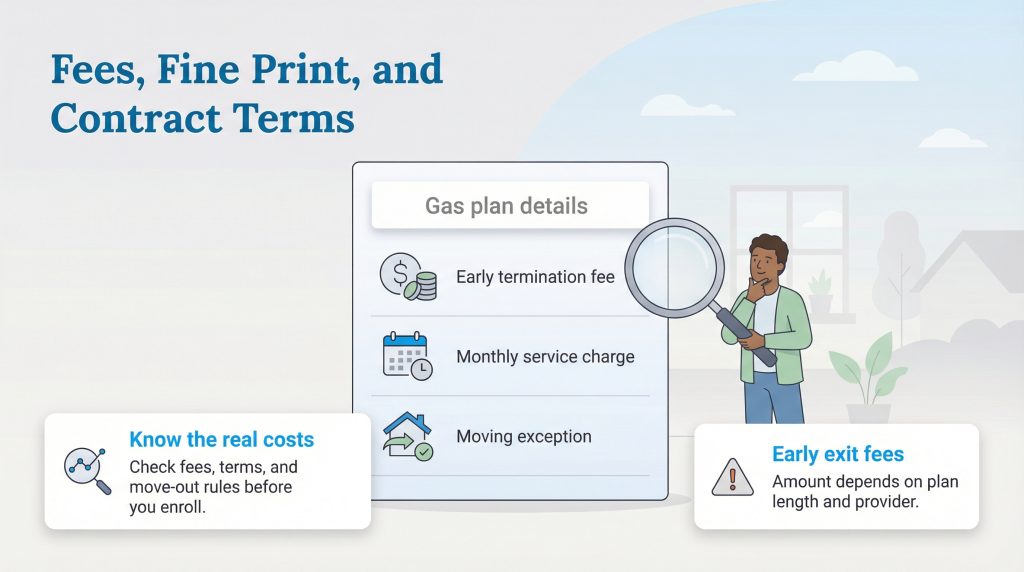
The price per therm isn’t the only cost you need to consider. Hidden fees can quickly eat into your savings if you aren’t careful. You need to look closely at the fine print regarding cancellation and monthly service charges. Always confirm the exact early termination fee for the specific plan you’re considering before you enroll.
If you need to break your contract early, you will likely face a penalty. As an example, the Georgia Natural Gas cancellation fee has historically ranged from $50 to $150, depending on the length of your agreement. SCANA Energy charges similar early termination fees, which can go up to $200 for longer-term contracts like their 36-month plan. However, both providers generally waive these fees if you provide proof that you are moving out of the residence, which is a standard industry practice.
Monthly service charges are another factor. These are flat fees charged by the marketer just for managing your account, separate from the Atlanta Gas Light pass-through charges. GNG’s service charges usually fall in roughly the $6–$10 range depending on the plan you choose, while SCANA’s standard monthly customer service charge is typically in the mid–single digits, similar to many other Georgia gas marketers. A major differentiator for SCANA is its Regulated Division, overseen by the Georgia Public Service Commission. This division ensures that customers who can’t qualify with other marketers, often due to credit challenges, can still obtain basic natural gas service with lower or no deposit requirements.
Customer Service and Reputation
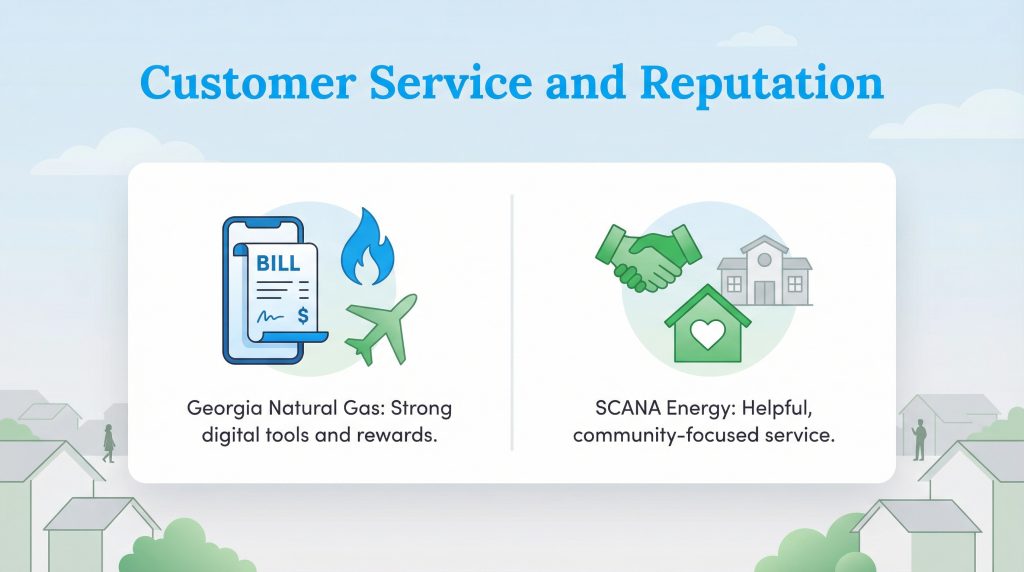
Trust is a massive factor when choosing a utility provider. You want to know that if you have a billing question or a service issue, someone will be there to help. Both companies are well-established, but they excel in different areas of customer satisfaction.
Georgia Natural Gas has scored well in several customer satisfaction rankings, including in the J.D. Power Gas Utility Residential Customer Satisfaction Study, particularly around billing and digital tools. Their partnership with Delta SkyMiles is a significant perk for Atlanta residents, allowing you to earn miles just for paying your gas bill. Their mobile app and online billing systems are also rated highly for ease of use.
SCANA Energy also maintains a solid reputation, particularly for its community involvement and reliability. When you look at SCANA Energy customer service reviews, you often see praise for their helpfulness in establishing service for first-time buyers or those with tricky credit situations. While they may not offer airline miles, their focus on community support and accessible service makes them a trusted name in Georgia.
Sustainability and Green Energy Options
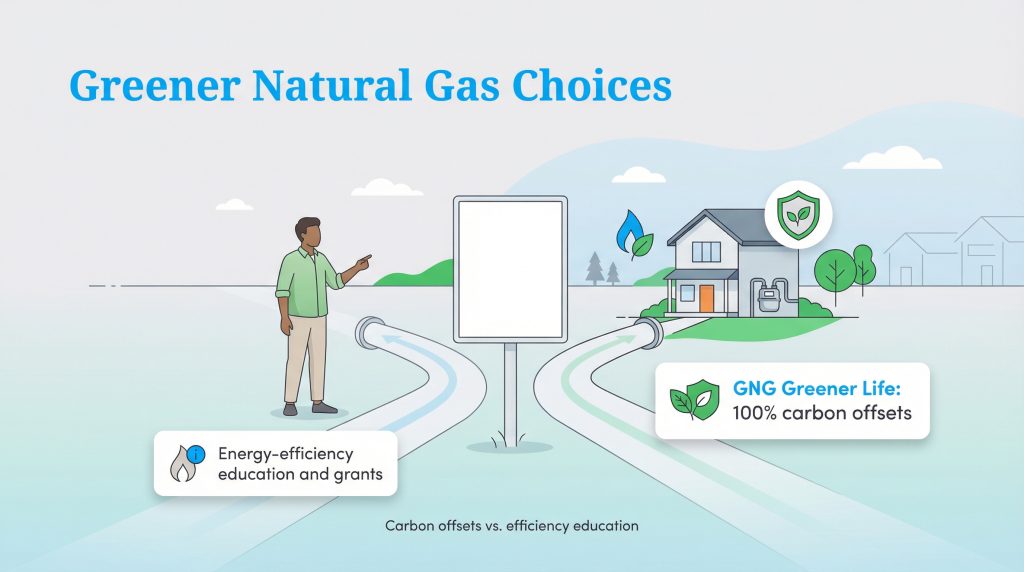
As we all look for ways to reduce our impact on the planet, your choice of natural gas provider can actually make a difference. While natural gas is a fossil fuel, many providers now offer programs to help offset the carbon emissions associated with your usage.
Georgia Natural Gas offers a “Greener Life” program, which allows you to offset 100% of your natural gas usage for a small monthly fee. According to Georgia Natural Gas, they achieve this by purchasing carbon offsets that fund projects like forest protection and methane capture. If sustainability is a priority for you, GNG positions itself as the environmentally mindful choice thanks to this straightforward add-on. SCANA Energy focuses heavily on energy efficiency education and community grants, but GNG’s direct carbon-offset program is more aggressive for the eco-conscious consumer.
The Verdict: Which Provider Should You Choose?
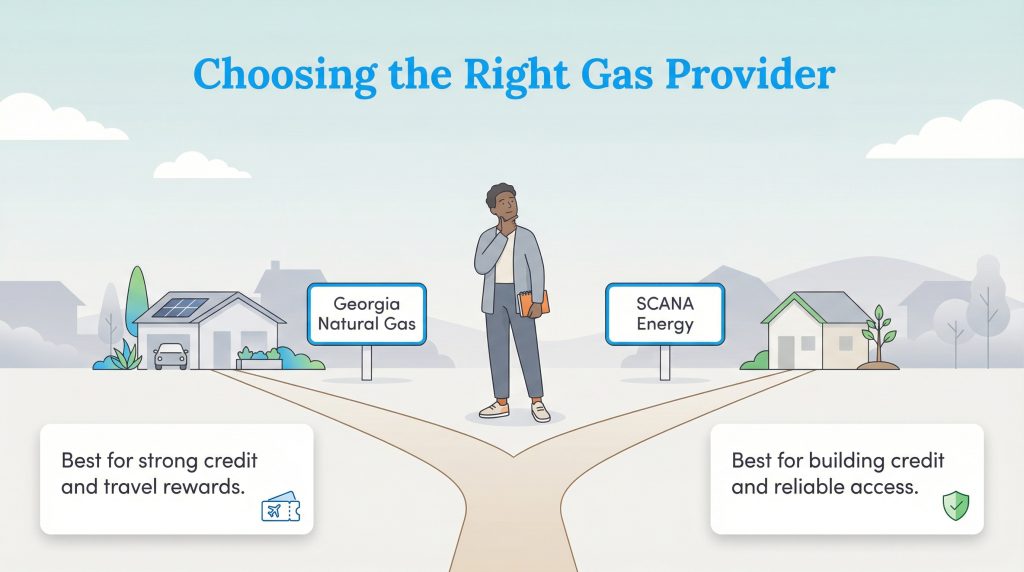
Choosing between these two heavyweights ultimately comes down to your financial profile and what “extras” you value most. We recommend different paths based on your specific situation.
Choose Georgia Natural Gas if: You have good or established credit, you value travel rewards like Delta SkyMiles, and you plan to stay in your home for at least 12 months. Their fixed rates for prime borrowers are often the most competitive in the market, making them excellent for established homeowners.
Choose SCANA Energy if: You are building your credit, you want a straightforward and reliable provider, or you have been denied service by other marketers. Their role in operating the Regulated Division makes them the most reliable safety net in the state, ensuring you can get gas service turned on without jumping through impossible hoops.
Make the Right Choice for Your Wallet and Home
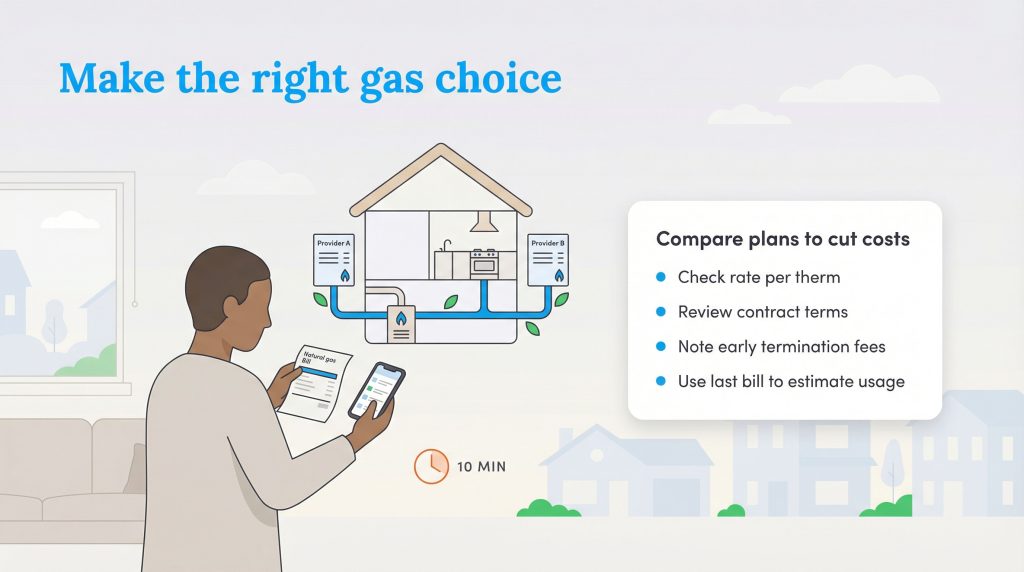
At the end of the day, the gas that flows into your furnace and stove is exactly the same regardless of who sends you the bill. Your decision should be based on the rate per therm and the terms of the contract. Before you sign up, we strongly encourage you to grab your most recent bill if you are switching, or estimate your usage if you are moving to Atlanta. Read the fine print on the early termination fee to avoid buyer’s remorse later. By taking ten minutes to compare natural gas plans now, you can save hundreds of dollars over the next year.
FAQs About SCANA vs. Georgia Natural Gas
Is SCANA Energy the same as Georgia Natural Gas?
Who has the cheapest gas supplier in Atlanta?
What is the difference between the regulated and unregulated divisions of SCANA?
Does Georgia Natural Gas charge a cancellation fee?
Can I switch from SCANA to GNG without penalty?
About the Author

David has been an integral part of some of the biggest utility sites on the internet, including InMyArea.com, HighSpeedInternet.com, BroadbandNow.com, and U.S. News. He brings over 15 years of experience writing about, compiling and analyzing utility data.