
Calculate the real cost difference between propane and natural gas to make the smartest energy choice for your next move.
Key Takeaways
- Natural gas is typically cheaper per unit of energy, but availability heavily depends on your local utility infrastructure.
- Propane is more energy-dense than natural gas, meaning you use less physical fuel volume to produce the same amount of heat.
- Upfront equipment and conversion costs play a massive role in deciding which fuel source makes long-term financial sense for your property.
Figuring out the true propane vs natural gas cost for your home shouldn’t feel like a high school math test, but comparing gallons of liquid fuel to cubic feet of gas requires a specific mathematical conversion to reveal the cheapest option. Natural gas typically stands out as the most affordable and convenient choice for urban homes connected directly to municipal utility lines, while propane serves as an essential, high-efficiency alternative for rural properties without pipeline access. To accurately determine if one is better suited for your property, you have to look well beyond the initial commodity price tag and calculate the total cost of ownership. By comparing exact heating efficiencies, upfront delivery fees, and equipment conversion requirements, you can confidently choose the most cost-effective and eco-conscious setup for your daily household needs.
Propane vs Natural Gas Cost: Which Fuel Is Usually Cheaper
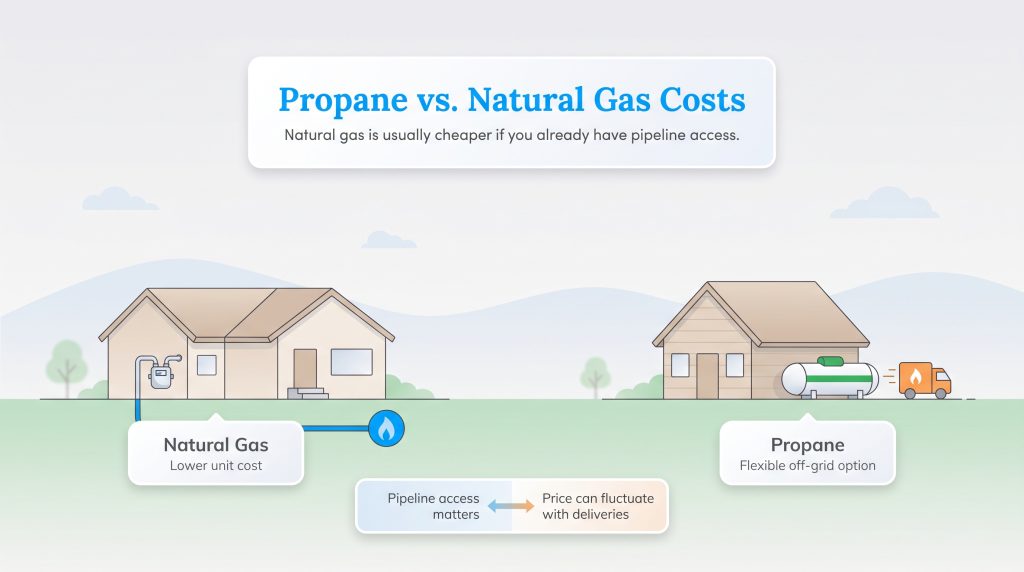
When you start crunching the numbers on your monthly utility bills, answering the core question — is propane cheaper than natural gas — rarely results in a straightforward yes. Because these fuels are measured and distributed differently, putting them side-by-side requires establishing a reliable baseline metric. To accurately gauge which fuel gives you the most heat for your dollar, we rely on the British Thermal Unit (BTU), which simply measures the amount of energy required to heat one pound of water by one degree Fahrenheit.
Understanding Fuel Measurements: BTUs, Therms, and Gallons
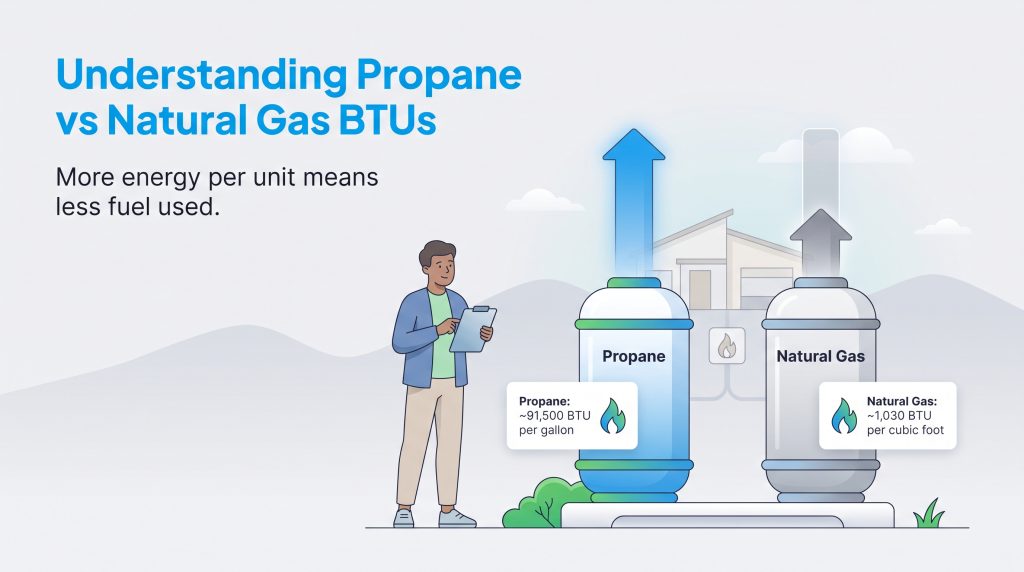
Understanding the propane vs natural gas BTU comparison is the absolute key to unlocking the true cost of your home energy. According to the U.S. Energy Information Administration, propane packs a serious punch. Natural gas contains slightly less energy per cubic foot than propane, which is why understanding natural gas measurements is so important since utilities physically bill it differently. Because propane is highly energy-dense, your furnace physically uses less fuel volume to generate the exact same amount of warmth.
- 1 Therm of Natural Gas = 100,000 BTUs
- 1 Gallon of Propane = 91,500 BTUs
- Current natural gas prices: Average around $1.20 to $1.60 per therm nationwide, regulated by state utility commissions for more predictable seasonal billing.
- Current propane vs natural gas prices: Propane typically averages $2.40 to $3.00 per gallon, heavily subjecting your wallet to open market fluctuations, complex delivery logistics, and intense winter demand.
Before you make any final calls based on commodity rates alone, we highly recommend researching the process of setting up gas service in your new home to see if your specific address even qualifies for municipal connections.
The Propane vs Natural Gas Cost Conversion Formula
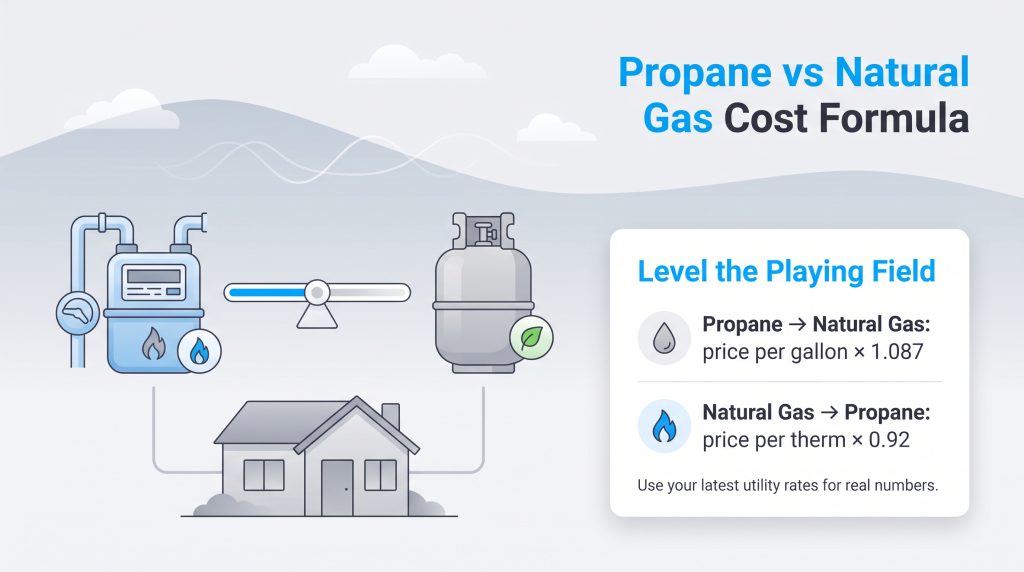
Doing utility math is nobody’s favorite weekend activity, but putting a reliable propane vs natural gas heating cost calculator to work will save you thousands of dollars over the lifespan of your home. To figure out the real financial winner for your specific address, you have to level the playing field between gallons and therms. To effectively convert propane to natural gas cost equivalent metrics, you simply need a recent utility statement or a current quote from a local supplier.
Here is the exact mathematical formula you need to use: multiply the propane price per gallon by 1.087 to find the natural gas equivalent, and multiply the natural gas price per therm by 0.92 to find the propane equivalent.
| Conversion Goal | Calculation Formula |
|---|---|
| Find the natural gas equivalent of propane | Propane Price per Gallon × 1.087 |
| Find the propane equivalent of natural gas | Natural Gas Price per Therm × 0.92 |
Let’s run through a step-by-step calculation example to uncover the true cost of propane vs natural gas per month:
- Locate your local price per gallon of propane (let’s assume it is $2.50) and the price per therm of natural gas (let’s assume it is $1.40).
- To accurately match the energy output, multiply your $2.50 propane gallon by 1.087. This brings your adjusted natural gas equivalent of propane to roughly $2.71 per therm.
- Compare this $2.71 adjusted price to your local natural gas quote of $1.40 per therm. In this scenario, natural gas is significantly cheaper on an energy-equivalent basis.
Upfront Infrastructure and Delivery Costs
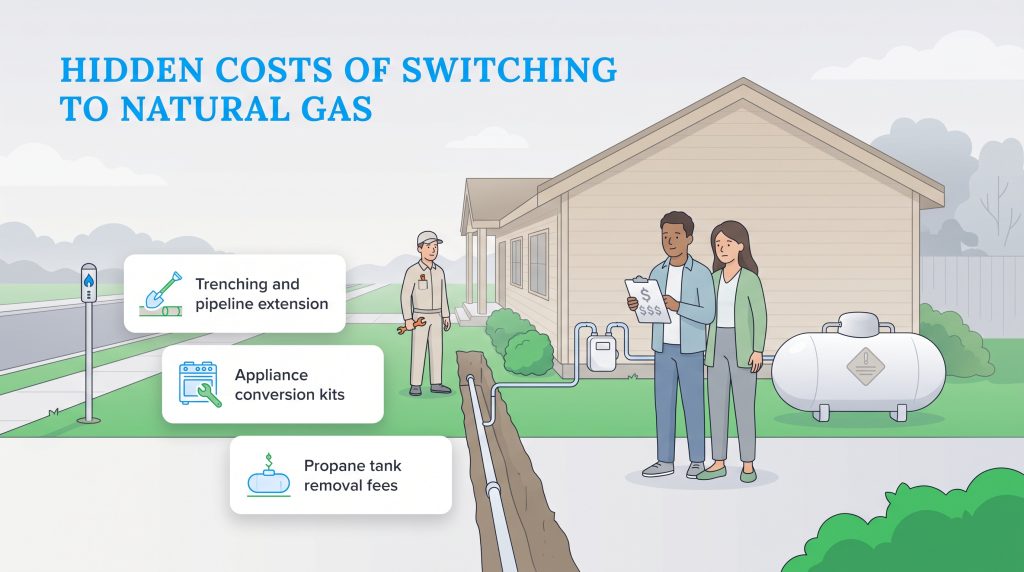
Focusing strictly on the monthly fuel price only covers half the battle. If you buy a house that currently runs on one energy source but want to swap it out for another, the hardware expenses will hit your wallet hard. Accurately budgeting for your utility bills requires examining the Total Cost of Ownership (TCO), which rolls your upfront installation costs, complex delivery mechanics, and ongoing maintenance fees into one realistic number.
Propane Tank Installation and Refill Fees
When you rely on delivered fuels, you are paying for both the commodity itself and the logistics of transporting it to your property. Homeowners must either purchase a specialized propane tank outright — which easily costs thousands of dollars for a large underground unit — or lease one directly from their supplier for a recurring annual fee. Additionally, many regional companies enforce strict minimum delivery requirements, charging hefty penalties or immediate emergency dispatch fees if you run out of fuel unexpectedly.
Natural Gas Pipeline Connection Fees
While utility pipelines provide highly reliable and uninterrupted service, connecting a previously off-grid home to a distant municipal gas main requires major construction. Homeowners bear the brunt of these municipal pipeline connection costs, paying out of pocket for professional trenching across their yard, local municipality construction permits, and the initial installation of a new meter. Between pulling permits and budgeting for utility setup costs during your move, switching energy sources requires serious financial forethought.
Before committing to a comprehensive fuel swap, factor in these common hidden fees for both fuel types:
- Trenching and pipeline extension: Digging up your yard to physically connect your home to the street’s main municipal natural gas line costs thousands of dollars in professional labor.
- Appliance conversion kits: Every single gas-powered appliance requires a licensed technician to safely install new burner orifices and adjust internal pressure regulators.
- Tank removal fees: If you lease your propane tank, the supplier will undoubtedly charge a pickup fee. Excavating and safely removing an underground tank is a major construction expense.
- Monthly utility riders: Natural gas bills typically include fixed customer charges and municipal distribution taxes that you must pay regardless of how much fuel you actually consume.
Heating Efficiency and Appliance Performance
Comparing the propane vs natural gas efficiency of your household appliances is vital because the equipment you install directly dictates how effectively your raw fuel translates into usable heat. Modern high-efficiency furnaces and tankless hot water heaters operate beautifully on both fuels, but their real-world consumption rates look incredibly different on paper.
To fully understand propane vs natural gas for home heating, consider the direct BTU output per hour of your equipment. A standard high-efficiency natural gas furnace might consume exactly 100,000 BTUs per hour, meaning it burns through one full therm of natural gas during that 60-minute window. A propane equivalent furnace outputs the exact same amount of intense heat, but because propane is physically denser, it only needs to burn about 1.09 gallons to get the job done. Upgrading to appliances with a 95% or higher Annual Fuel Utilization Efficiency (AFUE) rating ensures you squeeze every ounce of warmth out of your chosen energy source, which is a practical way to save on your gas bill and dramatically lower operational costs regardless of the fuel type.
Regional Price Fluctuations and Seasonal Demand
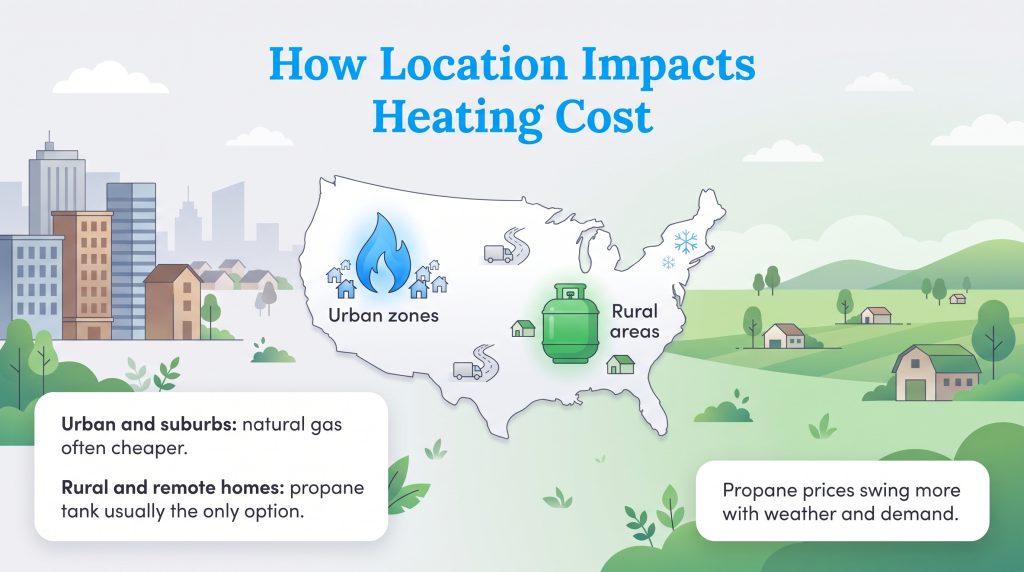
The geographic reality of where you live plays a massive role in availability, but unpredictable seasonal weather heavily dictates your final bills. Utility companies lay thousands of miles of underground pipes in densely populated areas, allowing them to deliver fuel safely and affordably. Because natural gas is piped safely underground, it remains largely insulated from surface-level delivery disruptions. Propane, on the other hand, relies entirely on a physical supply chain of commercial delivery trucks navigating local suburban and rural roadways.
When a harsh winter freeze hits, seasonal heating demand naturally spikes. For natural gas customers, heavily regulated pricing structures keep rates relatively stable. For propane customers, a severe snowstorm can quickly create immediate supply chain bottlenecks. If slick roads delay a delivery truck, localized truck-delivered propane prices can surge rapidly, leaving you paying emergency premiums just to keep your pipes from bursting. Checking out authoritative forecasts like the Winter Fuels Outlook report can help you safely anticipate regional price jumps before they hit your wallet.
Environmental Impact: Which Fuel Is Greener?
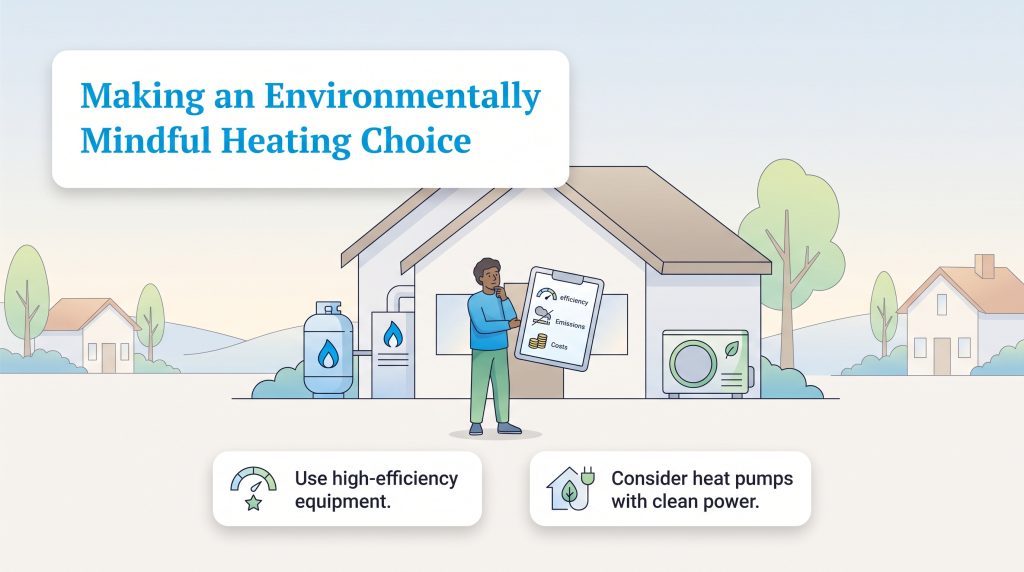
When critically assessing the natural gas vs propane environmental impact of your daily life, how you choose to heat your property matters. Both of these energy sources are relatively clean-burning fossil fuels, especially when you compare them to older coal or heavy heating oil systems. However, propane possesses one distinct environmental advantage: if it happens to leak from a localized tank, it does not act as a greenhouse gas and does not carry the same severe methane-leak concerns typically associated with sprawling natural gas pipelines.
Still, both fuels are finite fossil resources. The biggest sustainability gains usually come from proactively reducing your overall consumption and choosing high-efficiency equipment. If you are deeply comparing fuel sources during a major home renovation, it may also be highly beneficial to price out a modern electric heat pump. Heat pumps provide an excellent energy-saving option to reduce direct fossil fuel use, especially in homes with immediate access to renewable electricity or community solar options.
Selecting the Most Cost-Effective Energy Setup for Your Home
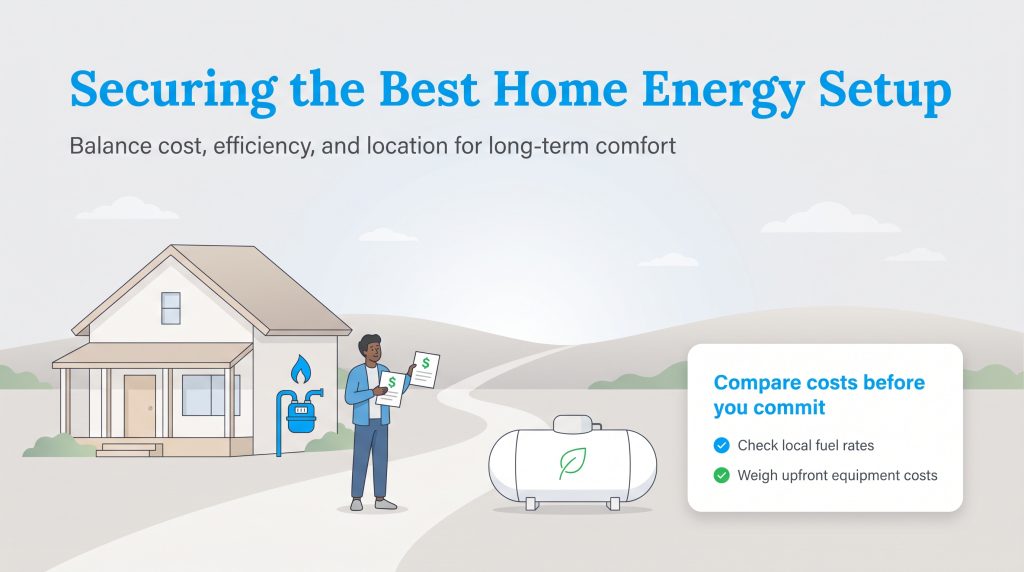
While natural gas generally takes the crown when it comes to low, stabilized monthly fuel costs for urban homeowners, propane remains a highly efficient, powerful, and entirely necessary alternative for properties located well beyond the city limits. Selecting the best configuration requires balancing your immediate geographic realities against the long-term efficiency ratings of your appliances. We encourage you to grab your latest utility quotes, crunch your local numbers using our exact conversion formula, and heavily weigh the steep upfront costs of equipment changes before signing any long-term service contracts. Evaluating the entire cost of ownership today ensures you secure an environmentally mindful choice that keeps your home comfortably heated for years to come.
Frequently Asked Questions About Propane vs Natural Gas Costs
These quick answers cover the most common cost, safety, and appliance questions homeowners ask when comparing propane and natural gas. Use them as a final check before you call a supplier, contractor, or utility company.
Is it cheaper to heat a home with natural gas or propane?
How many gallons of propane equal one therm of natural gas?
Can I convert natural gas appliances to run on propane?
Do natural gas appliances use more fuel than propane appliances?
How much does it cost to convert a gas stove to propane?
Why do propane prices fluctuate so much during the winter?
Can I run my entire house on propane if I live off the grid?
Is it cheaper to run an outdoor fire pit on natural gas or propane?
About the Author

LaLeesha has a Masters degree in English and enjoys writing whenever she has the chance. She is passionate about gardening, reducing her carbon footprint, and protecting the environment. She also recently served as President of the Board for City Sprouts (a community garden).