
Key Takeaways
- The “Big Three” Hike Rates: Consumers Energy, DTE Energy, and SEMCO Energy have all increased their natural gas commodity rates effective January 1, 2026.
- It’s Not Just Inflation: The price jump is driven by a “double whammy” of rising global gas prices and state-approved surcharges for replacing aging pipelines.
- Geography Matters: Homeowners in Metro Detroit face the highest “Urban Premium,” while rural customers in the Upper Peninsula are seeing higher fixed fees.
- Check Your Bill: While often confused with electricity hikes, these specific increases apply to natural gas (measured in Mcf, Ccf, or Therms) and will directly impact winter heating bills.
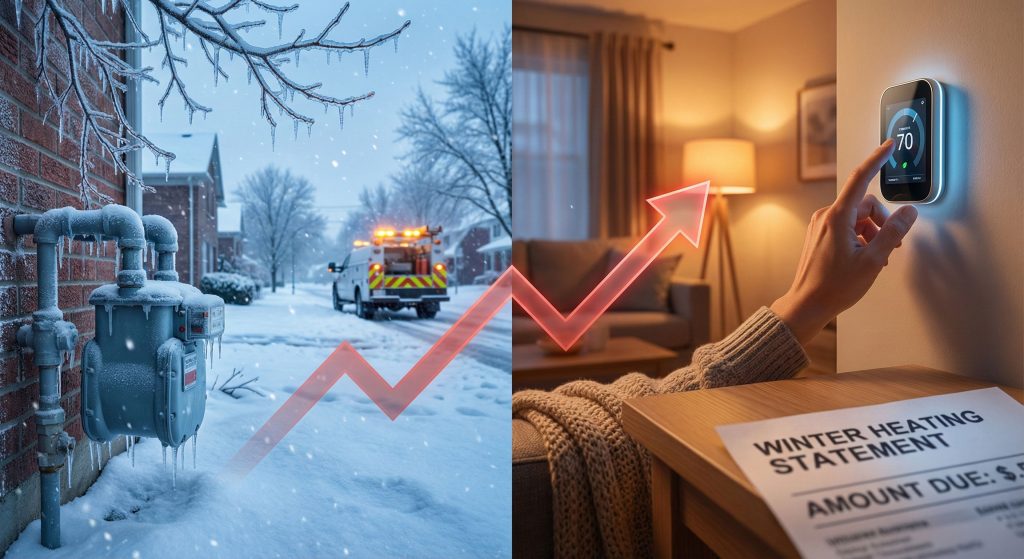
Michigan residents opening their utility bills this month may notice a sharp uptick in costs. Effective January 1, 2026, the state’s three largest natural gas providers, Consumers Energy, DTE Energy, and SEMCO Energy, have adjusted their rates upward, creating a challenging financial landscape for the peak of the winter heating season.
While many ratepayers often group these costs under general “electricity” increases, the specific numbers hitting mailboxes this week are unequivocally tied to natural gas, the fuel used to heat roughly 77% of Michigan homes.
Here is a breakdown of what is changing, why it is happening, and which cities are most impacted.
The Numbers: What You Are Paying Now
The most immediate change is in the Gas Cost Recovery (GCR) factor. This is the rate utilities charge for the natural gas itself, which they are legally required to pass through to customers without a profit markup.
- Consumers Energy: Customers will see a rate of $3.3590 per Mcf (thousand cubic feet). This is a steady climb from the December rate of $3.2656, reflecting a strategy to cover the higher cost of winter gas purchases.
- DTE Energy: The rate for Metro Detroit’s primary provider has risen to $0.394 per Ccf (hundred cubic feet). When converted to the same unit Consumers Energy uses, this is roughly $3.94 per Mcf, making DTE’s commodity cost significantly higher than its counterpart.
- SEMCO Energy: Serving rural areas and the Upper Peninsula, SEMCO has set its rate at $0.32790 per Therm. While this appears to be the lowest commodity rate of the group, SEMCO customers face higher fixed monthly charges to maintain their sprawling rural infrastructure.
Why Are Rates Rising?
The January price shock is the result of two converging forces: global market volatility and local construction.
1. The “Spot Market” Spike Utilities buy gas in the summer when it is cheap and store it underground. However, during the coldest months (like January), they must supplement that storage with gas bought on the “spot market.” In January 2026, spot market prices have hovered near $4.00 per unit due to tightening production and increased exports of Liquefied Natural Gas (LNG) to Europe and Asia. Since Michigan utilities are now competing with global buyers for American gas, local rates have had to adjust upward.
2. The Construction Bill Comes Due Beyond the cost of the gas, the cost to deliver it has skyrocketed.
- Consumers Energy recently received approval for a rate hike to fund its Natural Gas Delivery Plan, which includes major pipeline overhauls in Southeast Michigan.
- DTE Energy has reset its Infrastructure Recovery Mechanism (IRM) surcharge for 2026. This fee pays for the accelerated removal of aging cast-iron pipes in Detroit and Ann Arbor, a safety necessity that nonetheless adds to the monthly bill.
Impact Report: Is Your City on the List?
The impact of these rate changes varies significantly depending on where you live.
Consumers Energy Territory
- Major Impact Zone: The “Four Cities” project is causing disruptions and driving costs in Royal Oak, Madison Heights, Clawson, and Warren, where 1950s-era pipelines are being dug up and replaced.
- Other Key Cities: Residents in Flint, Bay City, Kalamazoo, Lansing, and Grand Rapids will also feel the 8.1% base rate increase authorized late last year.
DTE Gas Territory
- Major Impact Zone: The “Urban Premium” hits hardest in Detroit, Dearborn, Wyandotte, and Grosse Pointe. These areas have the oldest infrastructure, requiring the most expensive maintenance.
- Northern Michigan: DTE also serves Traverse City, Petoskey, and Alpena with gas service. Residents here will pay the same elevated $0.394/Ccf rate as those in Detroit, despite the different geography.
SEMCO Energy Territory
- Major Impact Zone: The Upper Peninsula (Marquette, Houghton, Escanaba) relies heavily on SEMCO. While the gas rate itself is competitive, the “Main Replacement Program” surcharge of $1.70/month and high customer fees mean low-usage households still face steep bills.
- Other Key Cities: Port Huron, Battle Creek, and Holland (township areas) are also seeing these adjusted winter rates.
What Can You Do?
Michigan is a “Gas Choice” state, meaning you can shop for a different natural gas supplier. With DTE at ~$0.39/Therm and Consumers at ~$0.33/Therm, you may find an Alternative Gas Supplier (AGS) offering a lower fixed rate. However, experts warn to watch out for variable rates and hidden fees.
If switching suppliers isn’t for you, the most effective way to lower the distribution portion of your bill is to lower your usage. With delivery rates rising by roughly 8%, weatherizing drafty windows and lowering your thermostat by even one degree remains the most reliable hedge against the 2026 rate hike.
About the Author

David has been an integral part of some of the biggest utility sites on the internet, including InMyArea.com, HighSpeedInternet.com, BroadbandNow.com, and U.S. News. He brings over 15 years of experience writing about, compiling and analyzing utility data.