
We Analyzed the Rates, Hidden Fees, and Customer Service Reputations of Georgia’s Two Biggest Providers to Help You Decide Where to Sign Up
Key Takeaways
- Gas South often wins on flexibility with potential no deposit requirements for qualified customers and a permanent discount for staying loyal.
- Georgia Natural Gas offers brand stability and a variety of fixed-rate plans that appeal to homeowners looking for long-term predictability.
- Hidden fees usually determine the real cost, so you must compare the cancellation fees and monthly service charges before signing a contract.
With the average residential price of natural gas in Georgia frequently fluctuating during the peak winter heating season, opening your utility bill can easily make your jaw drop. If you just moved into a new residence or simply want to lower your monthly expenses, you need a transparent Georgia Natural Gas vs. Gas South comparison to understand exactly where your money goes every month. It is critical to realize that both of these providers use the exact same Atlanta Gas Light infrastructure, meaning the physical gas reliability and delivery to your home are identical regardless of the marketer you choose. We look past the flashy marketing to evaluate real-world rates, hidden administrative charges, and credit waiver requirements so you can confidently determine the best natural gas provider in Georgia for your household budget.

- $0.390 /THM
- $6.95-9.95
- None
- 1-24 Months

- $0.399 /THM
- $0.00-9.99
- None
- 1-24 Months
*rates may vary by location and household usage
The Role of Atlanta Gas Light in Your Service
When running an Atlanta Gas Light marketers comparison, you must understand who actually maintains your neighborhood’s physical pipes. The AGL Pass-Through Charge is often the most confusing part of your monthly statement, but it is standard across the entire state. Atlanta Gas Light (AGL) owns the infrastructure, reads the physical meters, and safely delivers the gas to your residence. AGL pass-through charges are identical regardless of whether you choose GNG or Gas South.
Neither marketer controls this regulated fee, which goes directly toward funding state infrastructure maintenance rather than padding the provider’s profits. Because your physical reliability does not change based on the marketer you select, you will never experience weaker gas pressure or slower emergency response times just because you chose a cheaper monthly plan.
🚩 Heads Up: Because Atlanta Gas Light manages the physical system, they are your primary contact for any physical emergencies. If you ever smell a natural gas leak in your home, you must leave the area immediately and call Atlanta Gas Light or dial 911 — do not call your marketer.
Side-by-Side: Gas South vs Georgia Natural Gas Rates
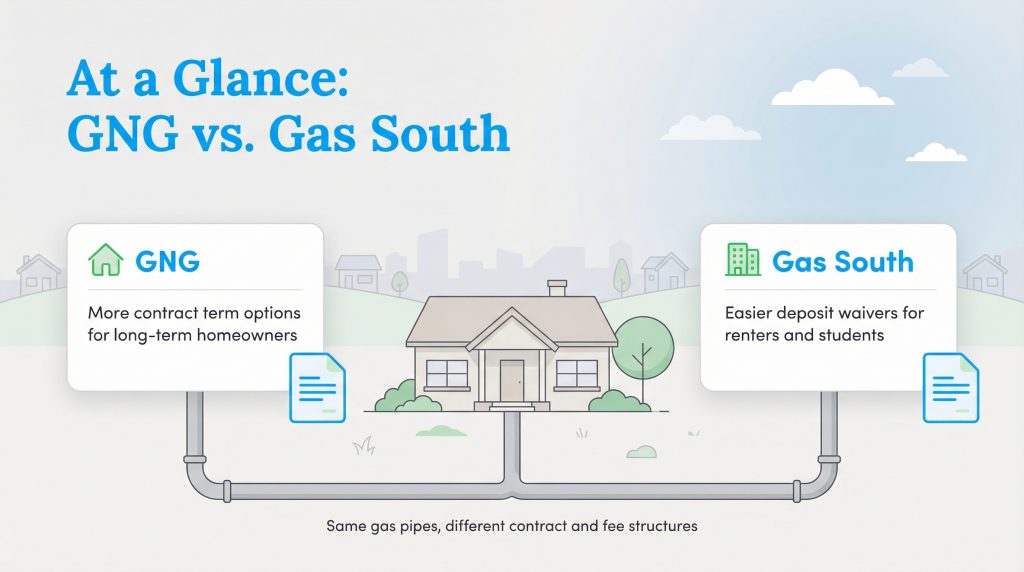
These two providers dominate the Georgia market because they both deliver highly dependable customer experiences, but their rate structures differ significantly. GNG leans heavily on its expansive reputation to attract long-term homeowners who want zero surprises and are willing to pay for premium brand stability. Conversely, Gas South differentiates itself by attacking common utility pain points and often undercutting competitors on price per therm, making them an incredibly strong contender for budget-conscious residents comparing Gas South vs Georgia Natural Gas rates.
| Comparison Metric | Georgia Natural Gas (GNG) | Gas South |
|---|---|---|
| Current Fixed Rate per Therm | Competitive promotional entry rates | Frequently offers lower standard fixed rates |
| Current Variable Rate per Therm | Subject to standard market spikes | Often features the cheapest variable rate |
| Monthly Customer Service Fee | $5.99 — $9.99 (Varies by plan) | $6.95 — $9.95 (Varies by plan) |
Contract Flexibility and Early Termination Fees
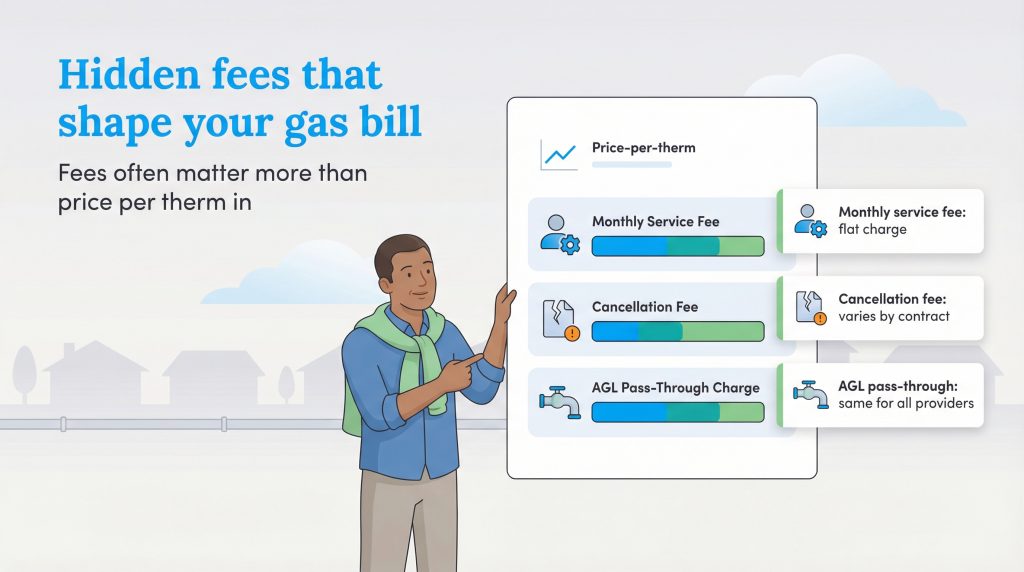
The price per therm is only part of the equation when hunting for the cheapest natural gas in Atlanta. To find the true cost of keeping your home warm, you must look closely at the fine print. Your monthly invoice is heavily impacted by additional administrative charges that are easy to overlook during the initial sign-up process. When you sign up for a fixed-rate plan, your rates are locked by a legal contract, and breaking that agreement early usually triggers a strict penalty known as an Early Termination Fee (ETF).
The Georgia Natural Gas cancellation fee utilizes a tiered system, meaning the financial penalty decreases the closer you get to your contract expiration date. This tiered approach is generally more forgiving if you need to move out just a few months before your lease ends. On the other hand, Gas South frequently utilizes a standard flat-fee structure for its penalties, charging up to the maximum amount regardless of how much time is left on your term. Here is a quick look at what you might pay if you need to break your contract early:
| Contract Term | Georgia Natural Gas ETF | Gas South ETF |
|---|---|---|
| 6-Month Plan | $50 (Tiered decline over time) | Up to $150 (Standard flat fee) |
| 12-Month Plan | $100 (Tiered decline over time) | Up to $150 (Standard flat fee) |
| 24-Month Plan | $150 (Tiered decline over time) | Up to $150 (Standard flat fee) |
💡 Money-Saver: Gas South occasionally runs aggressive promotional offers where they will cover your current provider’s cancellation fee if you switch your service over to them, eliminating the financial risk of leaving a bad contract.
Perks, Bill Credits, and Deposit Requirements
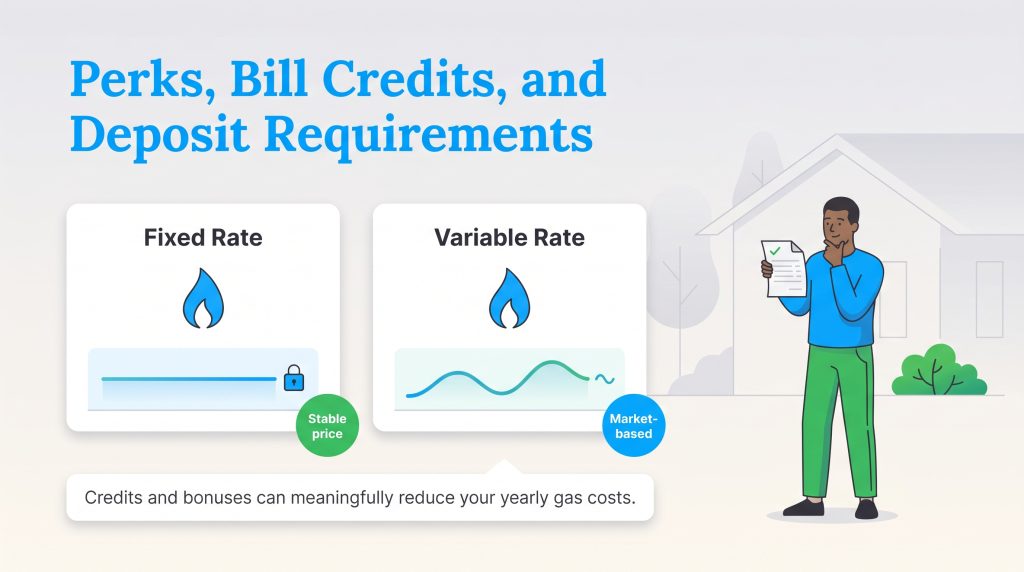
To differentiate themselves in a highly competitive market, both brands offer robust perks and unique value-adds to help undecided consumers make a final purchasing decision. The average Atlanta household uses roughly 717 therms per year, which means small bonuses and credits can make a significant dent in your annual heating budget.
Understanding how a fixed-rate plan locks in your exact price compared to a variable-rate plan that fluctuates based on the current commodities market price of natural gas can help you secure a more stable and potentially lower price per therm. If you are new to the area, check out our guide on understanding your natural gas bill to learn how these rates and credits interact.
Gas South: No Deposit Options and Flat Bills

Gas South frequently positions itself as the more accessible, flexible provider. Their deposit policy is incredibly lenient compared to traditional standards. By running a soft credit check during sign-up, Gas South routinely offers no deposit natural gas in Georgia for applicants with developing or good credit. This makes them a top choice for college students and young professionals signing their first lease.
Gas South also heavily advertises its proprietary OnePrice Plan. Both marketers offer incredibly convenient flat rate natural gas plans, but the OnePrice plan charges a steady, flat monthly amount tailored to your home’s historical usage data, completely eliminating the fear of a massive true-up bill at the end of the term.
| Plan Name | Rate | Plan Type | Base Charge | Cancellation Fee | |
|---|---|---|---|---|---|
| Intro Variable | $0.390 /THM | 1 Months Month to Month Rate | $6.95 to 9.95 MRC (Monthly Recurring Charge) is a fixed monthly fee charged by the energy provider, separate from the cost of the energy you use. | $150.00 | Check Availability |
| 12 Month Fixed plus $50 in Bill Credits | $0.670 /THM | 12 Months fixed rate Rate | $6.95 to 9.95 MRC (Monthly Recurring Charge) is a fixed monthly fee charged by the energy provider, separate from the cost of the energy you use. | $150.00 | Check Availability |
| 6 Month Fixed plus $50 in Bill Credits | $0.690 /THM | 6 Months fixed rate Rate | $6.95 to 9.95 MRC (Monthly Recurring Charge) is a fixed monthly fee charged by the energy provider, separate from the cost of the energy you use. | $150.00 | Check Availability |
| 24 Month Fixed plus $50 in Bill Credits | $0.770 /THM | 24 Months fixed rate Rate | $6.95 to 9.95 MRC (Monthly Recurring Charge) is a fixed monthly fee charged by the energy provider, separate from the cost of the energy you use. | $150.00 | Check Availability |
| Variable | $2.090 /THM | 1 Months Month to Month Rate | $6.95 to 9.95 MRC (Monthly Recurring Charge) is a fixed monthly fee charged by the energy provider, separate from the cost of the energy you use. | $150.00 | Check Availability |
Georgia Natural Gas: SkyMiles and Greener Life

Georgia Natural Gas counters with exclusive lifestyle perks designed for established homeowners and frequent travelers. They routinely partner with major airlines, allowing customers to earn Delta SkyMiles simply by paying their monthly utility bill. In addition, GNG frequently runs promotional offers granting new sign-ups up to $100 in promotional bill credits applied across their first few invoices.
If sustainability is a priority for your household, GNG offers an environmentally mindful choice known as the Greener Life program. For a small monthly fee, they calculate your exact greenhouse gas emissions from your home’s natural gas usage and purchase verified carbon offsets to make your consumption carbon neutral. Combining programs like this with upgrades like installing ENERGY STAR appliances can dramatically reduce your carbon footprint and your monthly bill.
| Plan Name | Rate | Plan Type | Base Charge | Cancellation Fee | |
|---|---|---|---|---|---|
| Market Intro | $0.499 /THM | 2 Months fixed rate Rate | $9.95 MRC (Monthly Recurring Charge) is a fixed monthly fee charged by the energy provider, separate from the cost of the energy you use. | Check Availability | |
| 12-Month Fixed | $0.499 /THM | 12 Months fixed rate Rate | $7.99 to 8.99 MRC (Monthly Recurring Charge) is a fixed monthly fee charged by the energy provider, separate from the cost of the energy you use. | $100 during first half of agreement, $50 during second half. | Check Availability |
| 18-Month Fixed | $0.599 /THM | 18 Months fixed rate Rate | $8.99 to 9.99 MRC (Monthly Recurring Charge) is a fixed monthly fee charged by the energy provider, separate from the cost of the energy you use. | $150 in the first six months of the plan term, $100 in the second six months and $50 in the final six months. | Check Availability |
| 6-Month Fixed | $0.599 /THM | 6 Months fixed rate Rate | $6.99 to 7.99 MRC (Monthly Recurring Charge) is a fixed monthly fee charged by the energy provider, separate from the cost of the energy you use. | $50.00 | Check Availability |
| 24-Month Fixed | $0.599 /THM | 24 Months fixed rate Rate | $8.99 to 9.99 MRC (Monthly Recurring Charge) is a fixed monthly fee charged by the energy provider, separate from the cost of the energy you use. | $200 in the first six months of the plan term, $150 in the second six months, $100 in the third six months, and $50 in the final six months. | Check Availability |
| Variable Select | $2.109 /THM | 1 Months Month to Month Rate | $3.99 to 6.99 | Check Availability |
Customer Service and Industry Reviews
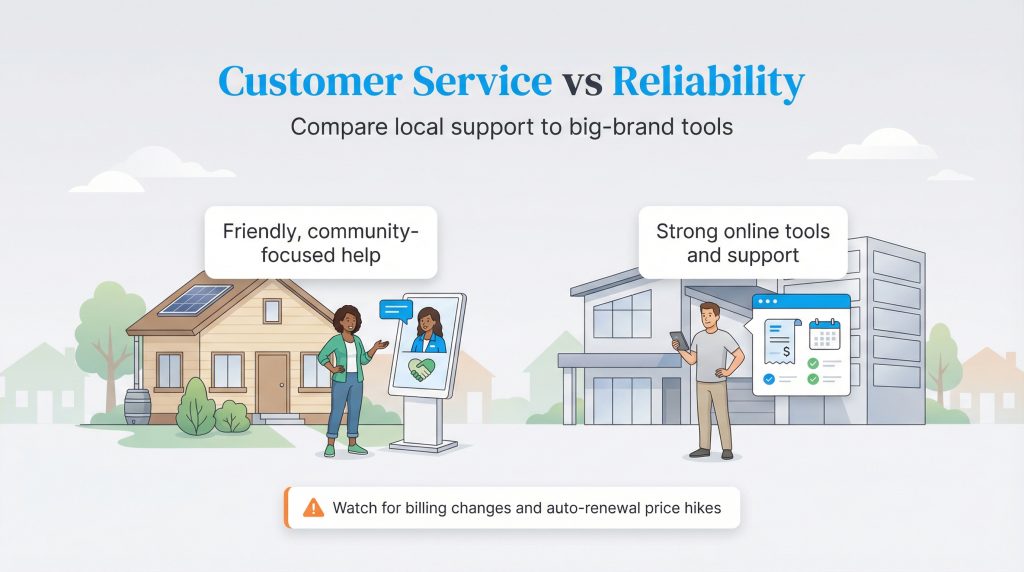
Online Gas South reviews are notoriously skewed, as customers rarely log on just to praise an accurate utility bill. To get an objective view of reliability, we look to official state regulatory data. According to the Georgia PSC Gas Marketer Scorecard, both of these major providers consistently maintain excellent service records with remarkably low formal complaint ratios regarding billing transparency and complaint resolution.
However, when analyzing the historical customer service performance, Gas South frequently pulls ahead as the clear winner in the service category. They log an exceptionally low volume of formal billing complaints relative to their massive market share. Gas South positions itself as a tight-knit, community-focused company that invests heavily in local charities, and this localized approach translates directly to superior satisfaction scores.
Meanwhile, Georgia Natural Gas utilizes its massive corporate infrastructure to offer seamless, highly sophisticated online portals and mobile apps for digital bill management. While their formal complaint ratios are occasionally slightly higher than Gas South’s on the PSC scorecard, their overall historical performance proves they are still an incredibly dependable organization.
Final Verdict: Choosing the Right Provider for Your Household
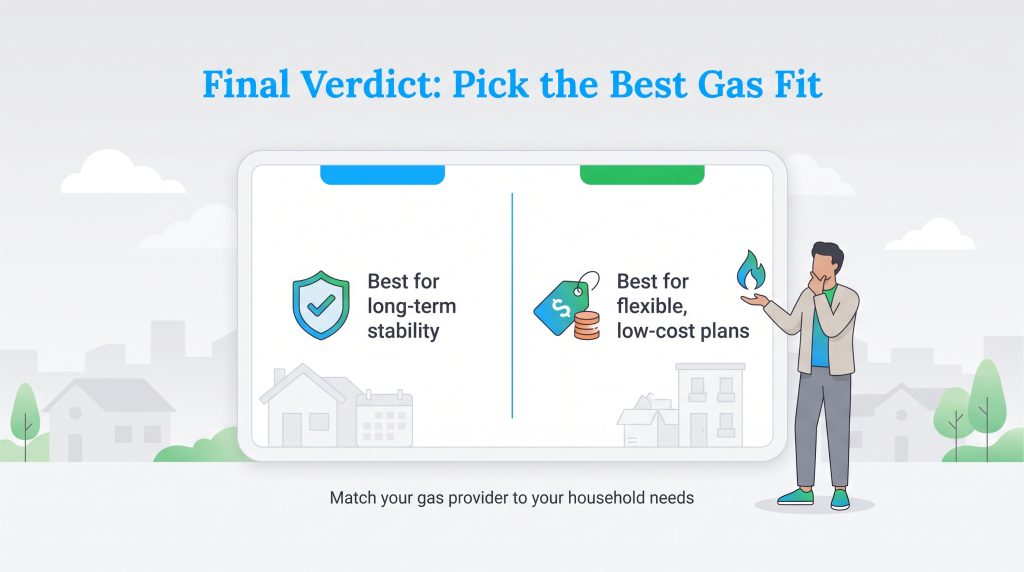
After compiling all the data for this comprehensive Georgia Natural Gas vs. Gas South comparison, the question of “Which is cheaper?” ultimately depends on your lifestyle. Both companies offer premium, reliable service, but there is a clear categorical winner based on your specific household needs.
Choose Georgia Natural Gas if: You deeply value brand stability and plan to stay in your current home for many years. Their 24-month fixed plans offer immense long-term peace of mind, their digital account management tools are top-tier, and their Delta SkyMiles perks are excellent for travelers. They are the established market leader for a reason.
Choose Gas South if: You want contract flexibility, are renting your home, or need to keep upfront costs to an absolute minimum. Their flexible credit waivers and aggressive no-deposit promotions make them highly accessible for movers with developing credit. Plus, their consistently cheaper standard rates per therm make them the best choice for budget-conscious consumers.
For more information on your rights as a consumer, or to verify the official license status of a natural gas marketer, you can visit the Georgia Public Service Commission website.
Ready to Switch? Here Is How to Do It Painlessly

If you want to switch natural gas providers in Georgia, the process is much easier than most people think. You do not need a technician to come to your house, and your physical pipes absolutely do not get dug up.
It is purely an administrative billing change. Simply go to the new provider’s website, enter your ZIP code, select your preferred fixed-rate plan, and input your AGL account number during checkout. The new provider automatically handles the entire switch with Atlanta Gas Light behind the scenes to ensure you never lose heat.
What Happens When Your Contract Ends?
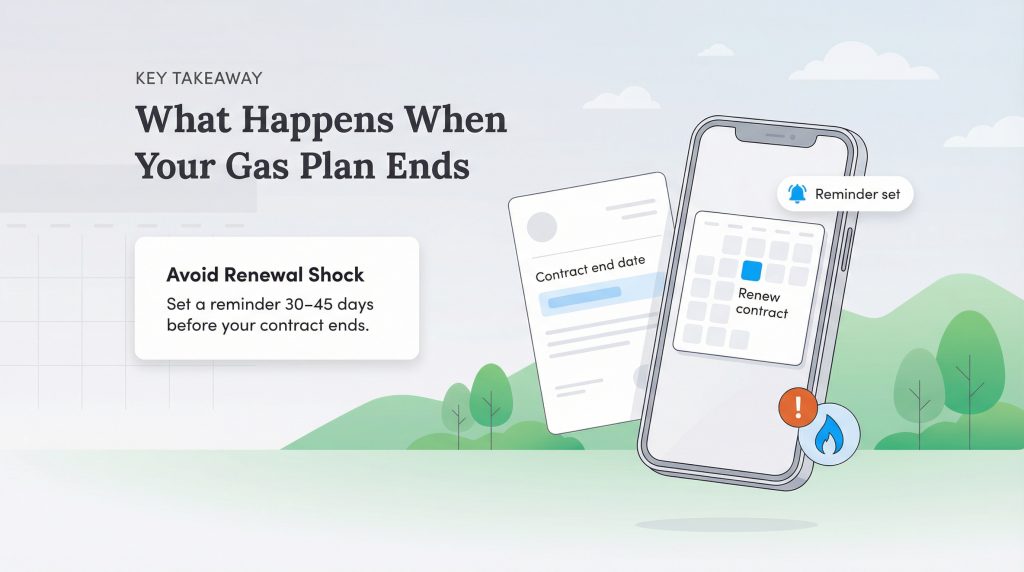
The most dangerous moment for your wallet is the exact day your contract expires. If you do nothing, both companies will automatically roll your account over to a variable-rate plan.
These variable rates are almost always significantly higher than the fixed rate you were previously paying. We highly recommend setting a digital calendar reminder on your phone for 30 to 45 days before your expiration date so you have ample time to shop for a new rate.
Frequently Asked Questions About Georgia Natural Gas and Gas South
Which provider is cheaper, Georgia Natural Gas or Gas South?
What is the current Gas South customer service fee compared to Georgia Natural Gas?
Does Atlanta Gas Light charge differently based on my chosen marketer?
Who is the best natural gas provider in Georgia for renters?
How do I switch my natural gas provider in Georgia without losing service?
What is the cancellation fee for Georgia Natural Gas?
Who do I call if I smell a natural gas leak in my home?
About the Author

David has been an integral part of some of the biggest utility sites on the internet, including InMyArea.com, HighSpeedInternet.com, BroadbandNow.com, and U.S. News. He brings over 15 years of experience writing about, compiling and analyzing utility data.