

Pennsylvania Utility Setup Is Easier When You Know Which Services Are Assigned by Address and Which Energy Suppliers You Can Compare
Key Takeaways
- Start establishing your essential services at least two weeks before your official move-in date.
- Pennsylvania allows you to shop around to find the best electric and natural gas suppliers for your new home.
- Water and sewer services operate as regional monopolies, so your provider depends entirely on your new ZIP code.
Coordinating a relocation brings a flood of tasks, but tackling your new household services doesn’t need to add to the chaos. Our comprehensive guide to moving to Pennsylvania utilities takes the guesswork out of your transition, allowing you to spend less time on the phone and more time exploring your new neighborhood. We crafted this moving utilities checklist to help you quickly activate your connections, save money, and lock in energy-saving options before moving day arrives.
How Pennsylvania Utility Setup Works
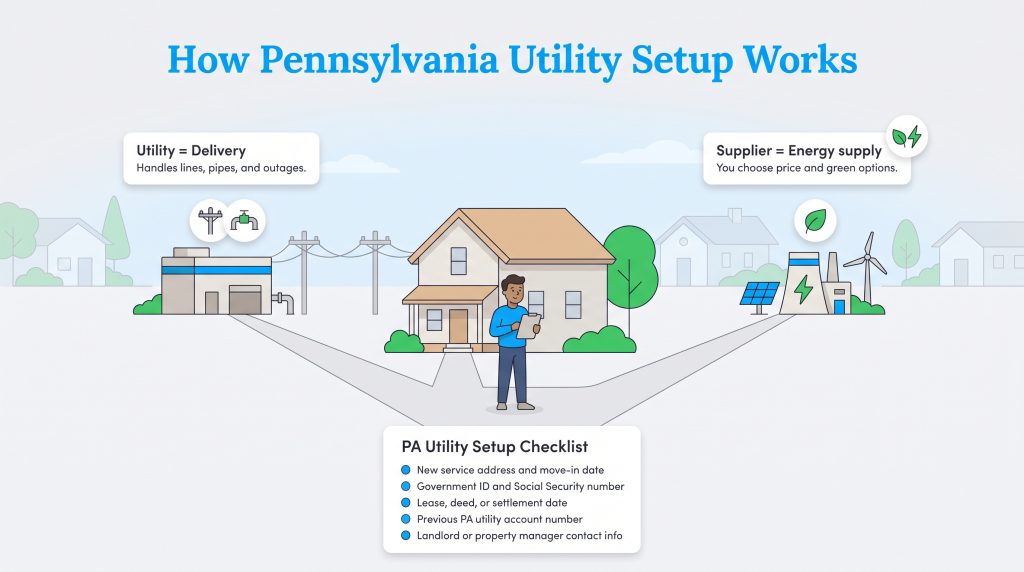
Relocating from another state often brings a learning curve when setting up the power grid. Managing your Pennsylvania utility setup properly requires understanding the state’s deregulated energy market, which allows many residents to choose the company that supplies their electricity and natural gas. This structure forces companies to compete for your business, which frequently leads to better pricing, varied contract lengths, and robust green energy alternatives.
Learning how to choose an electric supplier in PA starts with clearly defining the exact difference between a utility and a supplier. If you come from a state where one company handles everything, this split-billing concept can be slightly confusing at first. Here is exactly how the system is divided:
- The Utility (Delivery): Your regional utility company owns the physical infrastructure. They are responsible for fixing downed power lines, maintaining underground pipes, reading your meter, and restoring power during a storm. You cannot choose your utility; it is assigned by your geographic location.
- The Supplier (Generation): The supplier is the company that actually generates or purchases the raw electricity or natural gas pumping into your home. Thanks to deregulation, you have the power to shop around and choose a supplier that aligns with your household budget or sustainability goals.
To help you prepare, here is a quick checklist of what you need before you start making phone calls or setting up accounts online:
- New service address and official move-in date
- Government-issued ID and Social Security number
- Lease agreement, property deed, or settlement date
- Previous utility account number (if transferring service within the state)
- Landlord or property manager contact information (if renting)
Your Pennsylvania Utility Setup Timeline
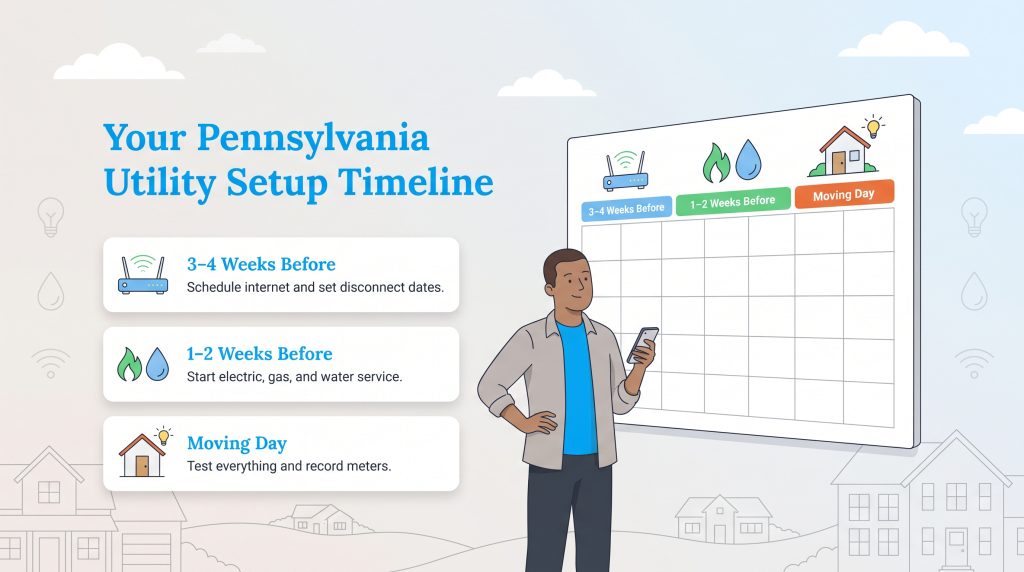
Knowing how to set up utilities in PA is only half the battle; knowing exactly when to initiate these requests is the secret to a stress-free transition. Waiting until the last minute can result in expedited service fees, limited appointment availability, or spending your first night unpacking boxes in the dark. We recommend following this chronological timeline to ensure every pipe, wire, and router is ready the moment you turn your key in the door.
3 to 4 Weeks Before Your Move
- Schedule your internet installation: High-speed internet providers often have the longest lead times for technician appointments. Research fiber-optic or cable providers at your new address and lock in an installation date.
- Contact your current providers: If you are moving out of an existing Pennsylvania home, log into your portals to set a disconnection date for the day after you leave.
- Research local regulations: Check if your new municipality handles water, sewer, and trash collection, or if you need to hire a private waste hauler.
1 to 2 Weeks Before Your Move
- Initiate electric delivery: Contact your regional utility to establish your base delivery account. This guarantees the power will be active on moving day.
- Schedule gas and water turn-ons: Call your municipal water authority and natural gas utility. If the gas has been shut off for an extended period, the utility might require you to be physically present for a brief safety inspection before turning the valve.
- Shop for suppliers: Once your base electric account is active, use your new account number to compare competitive supply rates on the state’s shopping platform.
Moving Day
- Verify your connections: Run the faucets, flush the toilets, and test the light switches as soon as you walk in.
- Record final meter readings: Snap a clear photo of the electric and water meters at your old home, as well as the meters at your new home. This protects you from being billed for energy used before you officially took possession of the property.
Step 1: Start Electric Delivery Service
Navigating the various PA electric companies requires a simple two-part process. First, you must establish an active account with your regional utility company to turn the lights on. Once you know your move-in date, call or visit your local utility’s website to schedule the connection. The state is divided into distinct geographic territories dominated by major infrastructure providers. Depending on where you live, you will need to contact one of the following major utility delivery companies to start electric service in PA:
- PECO (Serving the greater Philadelphia region)
- PPL Electric Utilities (Serving central and eastern Pennsylvania)
- Duquesne Light (Serving the greater Pittsburgh area and Allegheny County)
- FirstEnergy/West Penn Power (Serving various western and central regions)
After your utility account is active and you have your new account number, you can officially shop for a supplier. We recommend checking options early to ensure you secure a plan that matches your monthly budget and sustainability goals. If you aren’t sure where to begin, you can use the state’s shopping platform to review your local options.
💡 Pro Tip: If you don’t choose a supplier, your utility will provide default supply service at the Price to Compare. That rate can be competitive, so use it as your benchmark when reviewing supplier offers, contract terms, renewable content, and fees.
Step 2: Compare Electric Suppliers on PA Power Switch
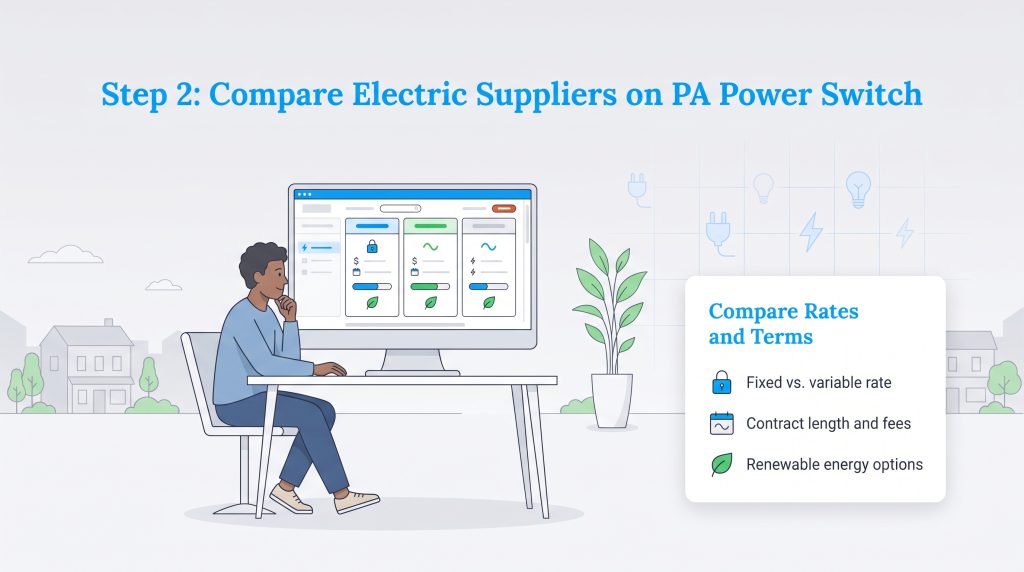
With your utility account active, plug that account number into the official PA Power Switch electricity shopping tool. Finding your ideal pennsylvania electric company is incredibly straightforward once you understand how the platform works. By typing in your future address and ZIP code, you can view dozens of competing offers, filter by contract term, and select environmentally mindful choices that align with your financial goals.
When comparing options, consider how different plan features affect your monthly expenses. You will encounter several types of pricing models, and understanding the fine print is vital to preventing unexpected bill spikes down the road:
| Plan Feature | Why It Matters |
|---|---|
| Fixed rate | Better for predictable bills. The rate stays the same for the entire contract term, protecting you from seasonal market spikes. |
| Variable rate | May change month to month based on wholesale energy markets. Risky during extreme winter or summer weather. |
| Cancellation fee | Can make switching expensive. Always check for early termination fees (ETFs) if you plan on moving again soon. |
| Introductory rate | May drastically increase after the promotional period ends. Always read the terms of service. |
| Renewable content | Shows whether the plan supports green generation like wind or solar energy. |
| Contract length | Usually ranges from 6 to 36 months. Longer contracts offer stability, while shorter ones offer flexibility. |
Don’t sign up with an electric or gas supplier until you’ve verified the rate, contract length, cancellation fee, and whether the price is fixed or variable. A low teaser rate can cost more later if it jumps after the introductory period ends. Taking five extra minutes to read the terms of service ensures you won’t be caught off guard.
This shopping phase is the perfect time to explore sustainable energy providers in PA. Using the state’s filtering tools, you can easily isolate plans that source green energy. Opting for a 100% renewable plan not only shrinks your household carbon footprint, but it also allows you to support the growth of clean infrastructure without installing physical panels on your roof. You can learn more about reducing your environmental impact through our guide on how to save on your electric bill.
🌱 Eco Edge: Many 100% renewable plans are backed by renewable energy certificates, which support clean energy generation even though your home still receives electricity from the shared grid.
Step 3: Set Up Natural Gas, Water, and Sewer
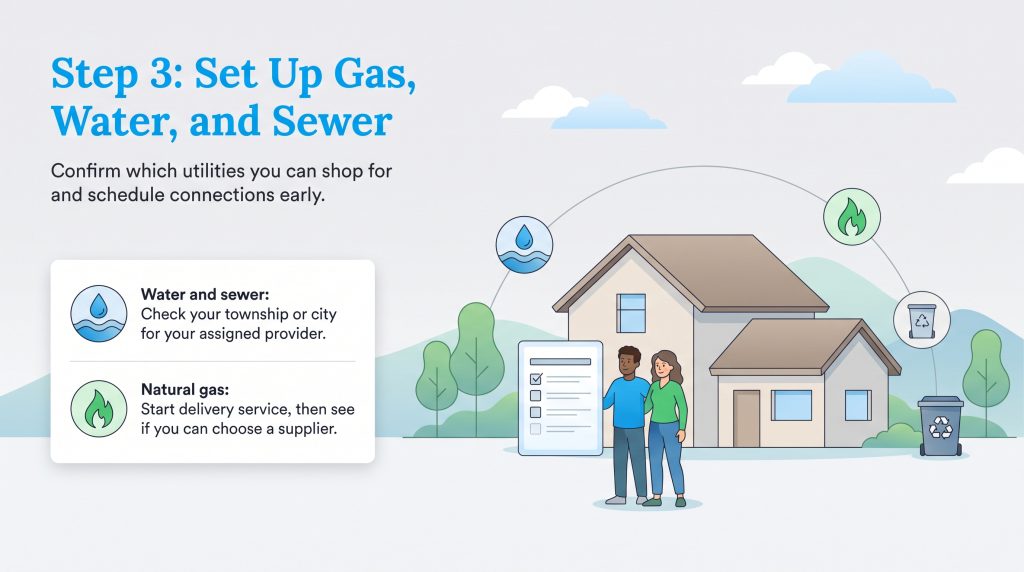
While setting up electricity takes top priority, securing your other essential utility services is just as important. Water and sewer service are usually assigned by your municipality or regional provider, so you typically won’t shop for those services. Natural gas is different: your local gas utility handles delivery and emergency service, but many Pennsylvania customers can shop for a competitive gas supplier, similar to electric supply. Check local regulations to see if your new territory offers gas choice.
To establish your water service, check with your local township or borough website. Many suburban and urban homes rely on large regional providers like AQUA Pennsylvania or Pennsylvania American Water, while city dwellers may use municipal authorities. Natural gas follows a similar localized structure for delivery. You will need to contact major pennsylvania natural gas suppliers and delivery monopolies — specifically Philadelphia Gas Works (PGW), Peoples Natural Gas, or UGI — to initiate service based on your region.
Here is a quick breakdown of how these essential services are typically structured across the state:
| Service | Can You Shop for It? | Who Handles Delivery or Service? | What to Do Before Moving |
|---|---|---|---|
| Electricity | Yes, for supply | Local electric utility (e.g., PECO, Duquesne) | Start utility service, then compare suppliers on PA Power Switch |
| Natural gas | Often yes, for supply | Local gas utility (e.g., PGW, Peoples, UGI) | Start delivery service, then check supplier choice |
| Water/sewer | Usually no | Municipality or regional authority | Contact township, borough, city, or provider |
| Trash/recycling | Sometimes | Municipality, HOA, or private hauler | Confirm pickup rules and billing structure |
We recommend initiating these connections at least two weeks early to secure a favorable appointment window, as natural gas turn-ons sometimes require a technician to physically unlock the meter. For more detailed insights, explore our water and natural gas hubs.
Regional Utility Providers in Philadelphia and Pittsburgh
The state of Pennsylvania spans a vast geographic area, meaning your utility experience on the eastern seaboard will look vastly different than it does in the rolling western hills. Whether you are moving to Philadelphia or coordinating your Pittsburgh utilities, knowing the exact default providers in these major metropolitan areas will save you hours of frustrating online research.
In Philadelphia, the dense urban grid is managed by a distinct set of legacy providers that have served the region for generations. Conversely, the Pittsburgh market relies on utility companies specially equipped to handle the area’s intense terrain and unique infrastructure. Use the table below to quickly identify the default utility providers for your target region:
| Utility Type | Philadelphia Metropolitan Area | Pittsburgh Metropolitan Area |
|---|---|---|
| Electric Delivery | PECO | Duquesne Light Company (DLC) |
| Natural Gas Delivery | Philadelphia Gas Works (PGW) | Peoples Natural Gas |
| Water / Sewer | Philadelphia Water Department (PWD) or Aqua Pennsylvania (Suburbs) | Pittsburgh Water and Sewer Authority (PWSA) or West View Water Authority |
If you are relocating to the suburbs surrounding these cities, always double-check with your realtor or landlord. While the electric and gas delivery companies usually remain consistent across the greater metropolitan area, water and sewer authorities can change drastically simply by crossing a municipal border.
Step 4: Schedule Internet, Trash, and Recycling
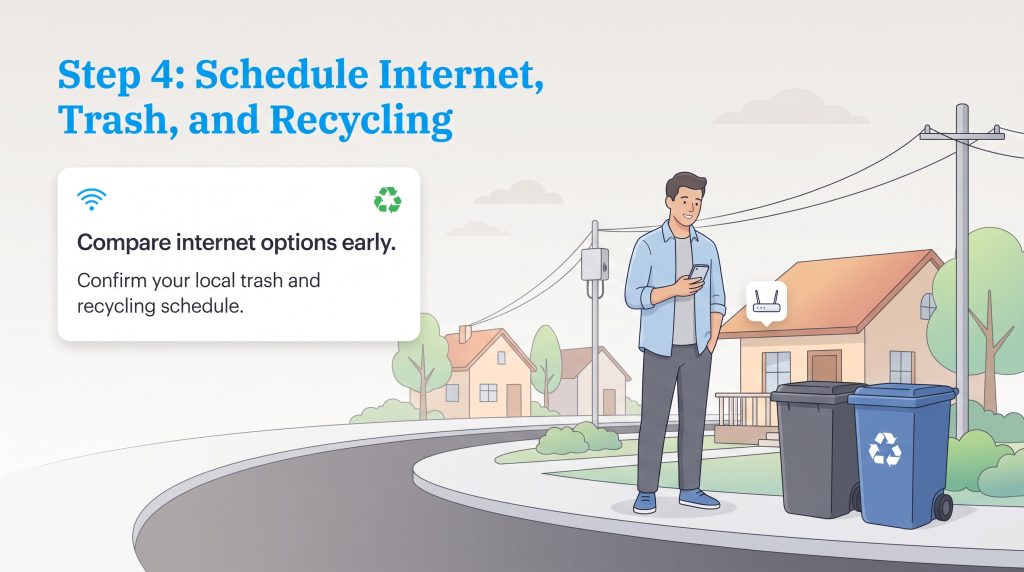
For a truly comfortable move, you need more than just running water and working lights. Connecting to the digital world is essential, so take time to compare internet options for your new home early in the process. Provider availability depends heavily on your specific address, with some areas offering lightning-fast fiber-optic connections and others relying on standard cable or satellite networks. Because internet companies often require specialized technicians to wire your home, appointment slots fill up fast—especially during the busy summer moving season.
Additionally, managing household waste is an important part of your local routine. Check with your municipality, landlord, or homeowners association to understand your trash and recycling rules. Some neighborhoods include waste collection automatically in your property taxes, while others require you to hire a private hauler independently. It is also wise to ask about bulk trash days, as moving usually generates an enormous amount of cardboard and packing debris that might require a special pickup.
Average Utility Costs in Pennsylvania
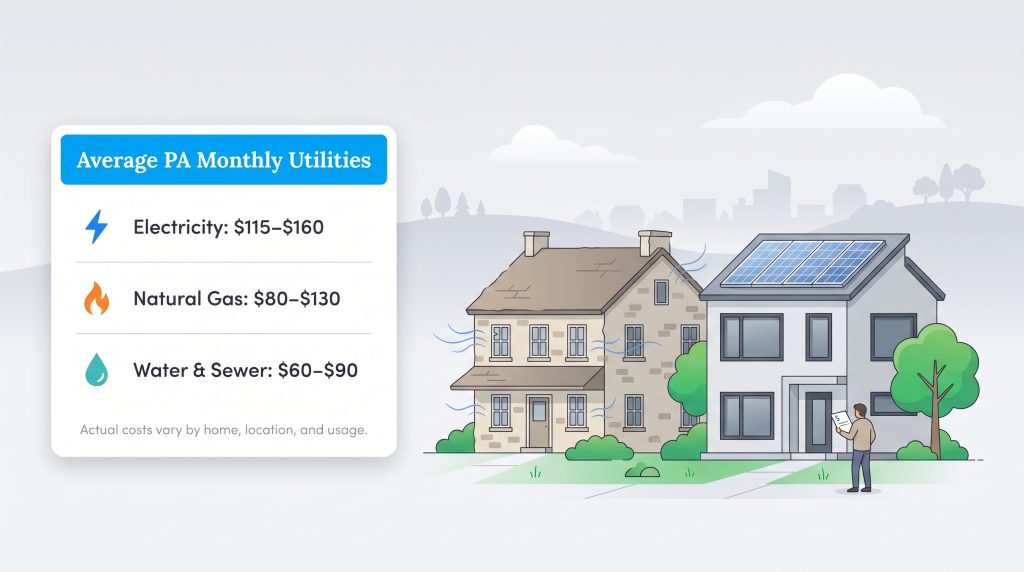
Understanding the average utility costs in Pennsylvania is crucial when budgeting for your new household, but keep in mind that these rates fluctuate heavily based on seasonal demand, the age of your home, and local municipality fees. The state features incredibly diverse architecture, ranging from brand-new, highly efficient construction to centuries-old stone farmhouses. Older homes frequently suffer from poor insulation and drafty windows, meaning your heating and cooling systems must work much harder during freezing winters and humid summers.
Based on residential data from the U.S. Energy Information Administration and statewide averages, residents can expect a standard monthly baseline, though family size and daily habits will swing these numbers. Natural gas typically spikes during the winter months for heating, while electricity sees its peak usage during the summer air conditioning season.
| Utility Type | Estimated Monthly Cost (Range) | Primary Usage Factors |
|---|---|---|
| Electricity | $115 to $160 | Home size, air conditioning usage, supplier rate |
| Natural Gas | $80 to $130 | Winter heating demands, water heater type, insulation quality |
| Water & Sewer | $60 to $90 | Number of occupants, lawn irrigation, municipal rates |
These ranges are planning estimates for a typical household and can vary widely by home size, local rates, insulation, heating fuel, and daily usage. Always check your assigned utility or municipality for current rates. You can explore more about regional power trends online.
How to Transfer Utilities to a New Home in PA
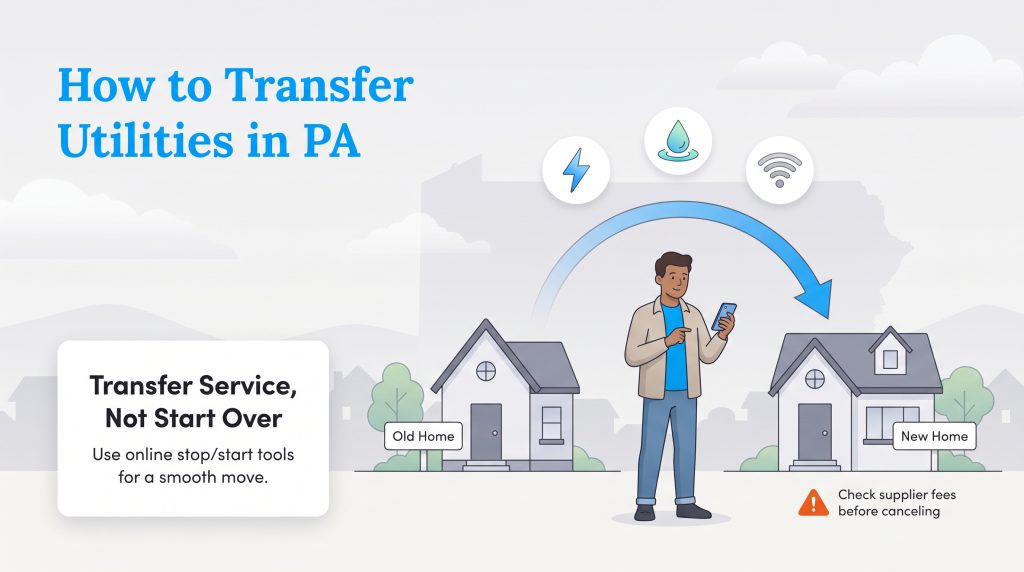
If you already reside within the state, you might simply need to understand how to transfer utilities when moving without starting entirely from scratch. When relocating within the same utility territory, most companies allow you to seamlessly shift your current service — including your existing supplier contract — to the new property. This prevents early cancellation penalties and maintains the favorable fixed rate you previously secured.
To execute a smooth transition, we recommend using the digital “Stop/Start” service portals offered by all major Pennsylvania utility companies. By following these step-by-step instructions, you can bypass long phone hold times and handle the transfer on your own schedule:
- Step 1: Gather your documents. Have your current account number, your new address, and your desired move-in date ready before logging in.
- Step 2: Log into your dashboard. Access your online portal (such as the PECO or Duquesne Light website) and locate the “Moving” or “Transfer Service” tab.
- Step 3: Submit your dates. Enter a “stop service” date for your old residence (ideally the day after you move out) and a “start service” date for your new residence (ideally the day before you move in).
- Step 4: Verify the confirmation. Always check your email for a transfer confirmation receipt, which serves as your proof of transition if any billing errors occur later.
Keep in mind that if your new home falls outside your current utility company’s coverage map, you will need to close your account entirely and open a brand new one with the appropriate provider.
🚩 Heads Up: Always review the fine print of your current electric supplier contract before canceling outright during a move, as some providers charge early termination fees if you break the agreement prematurely.
Smart Ways to Lower Your First Utility Bills
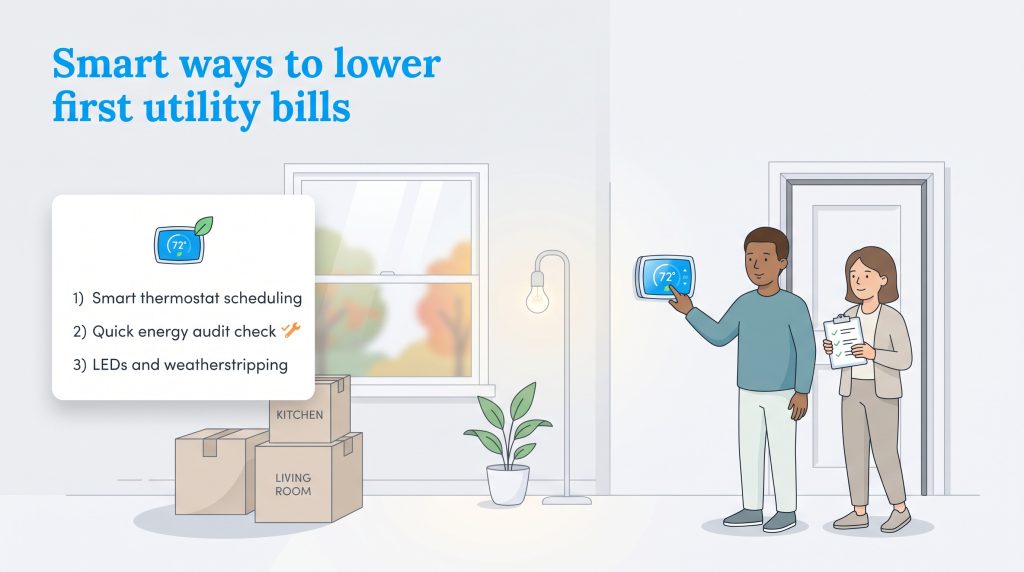
When you first move in, energy efficiency might not be your primary focus amid the sea of cardboard boxes, but taking a few proactive steps can save you money right away. Pennsylvania experiences distinct, dramatic seasons, meaning your HVAC system will inevitably work overtime to keep your family comfortable. By making small adjustments during your first few weeks in the home, you can permanently lower your long-term energy footprint.
Consider implementing these simple, cost-effective strategies to optimize your home’s efficiency:
- Install a smart thermostat: Upgrading to a programmable or smart thermostat allows you to automatically adjust the temperature when you are sleeping or away at work, cutting down unnecessary heating and cooling costs.
- Schedule a home energy audit: Many Pennsylvania utility companies offer free or deeply discounted energy audits. A professional will inspect your home for drafts, poor insulation, and outdated appliances, providing a clear roadmap for improvements.
- Upgrade to LED lighting: As you unpack, replace any old incandescent lightbulbs with energy-efficient LEDs. They use a fraction of the electricity and last significantly longer.
- Check weatherstripping: Inspect the seals around your doors and windows. Replacing worn weatherstripping is an inexpensive weekend project that prevents expensive, climate-controlled air from escaping outside.
If your new property relies on private systems like a well or septic tank instead of municipal lines, you might also want to schedule specialized inspections to ensure everything runs efficiently without unexpected repair costs down the line. Taking the time to understand your home’s unique infrastructure is the key to preventing emergencies.
Preparing for Your Pennsylvania Relocation
Activating your water, gas, and power lines well before the moving truck pulls into the driveway ensures a comfortable, stress-free first night in your new space. However, before you submit any final turn-on requests, it is vital to double-check your official move-in dates with your landlord, real estate agent, or property manager. Miscommunications regarding your settlement date can lead to utilities being turned on too early, leaving you responsible for energy used by construction crews or previous tenants.
By taking advantage of the state’s competitive energy market, you have a unique opportunity to shape your monthly budget and support renewable energy initiatives right out of the gate. With the heavy lifting handled and the lights securely switched on, you can finally shift your focus to the rewarding parts of your relocation. We hope your new home brings you lasting comfort as you settle in and explore everything Pennsylvania has to offer.
Frequently Asked Questions About Moving to Pennsylvania Utilities
How do I find out who my electric company is in Pennsylvania?
Do I need a home inspection before turning on the gas in PA?
How long does it take for PECO or Duquesne Light to turn on electricity?
Do I have to choose an electric supplier in Pennsylvania?
Can I choose a natural gas supplier in Pennsylvania?
How do I find my Pennsylvania water or sewer provider?
Are there deposits required to set up utilities in PA?
Can my power go out while switching to a new PA electric company?
Can I bundle my gas and electric utilities in Pennsylvania?
Does a smart meter lower my Pennsylvania utility bills?
About the Author

LaLeesha has a Masters degree in English and enjoys writing whenever she has the chance. She is passionate about gardening, reducing her carbon footprint, and protecting the environment. She also recently served as President of the Board for City Sprouts (a community garden).

David has been an integral part of some of the biggest utility sites on the internet, including InMyArea.com, HighSpeedInternet.com, BroadbandNow.com, and U.S. News. He brings over 15 years of experience writing about, compiling and analyzing utility data.