
Rising default rates and distribution fee changes mean Pennsylvania homeowners need to act now to protect their monthly utility budgets.
Key Takeaways
- Default electric rates jumped across major Pennsylvania utilities on June 1, 2026, driving up the cost of keeping your home cool.
- A landmark distribution settlement for PPL Electric went into effect on July 1, 2026, adding a mandatory delivery fee while freezing base distribution rates until 2028.
- You can easily bypass default rates by switching to a lower fixed-rate plan with a competitive supplier.
If you have recently opened your utility bill only to find a painful surprise, you are certainly not alone. On June 1, 2026, major Pennsylvania electric utilities like PECO, Met-Ed, and PPL Electric officially adjusted their default electric rates upward, just as summer heatwaves begin driving up our household energy usage. Navigating these changes can feel overwhelming when you are just trying to keep your home comfortable and your expenses predictable. Fortunately, Pennsylvania’s deregulated energy market gives you the power to take control of your energy costs. At Utilities For My Home, we want to help you make smart, budget-friendly, and eco-conscious decisions. In this comprehensive guide, we will break down exactly why these rates are changing, how they will affect your typical monthly bill, and the simple steps you can take to lock in a lower rate and keep more money in your pocket.
Why Pennsylvania Electric Rates Are Rising
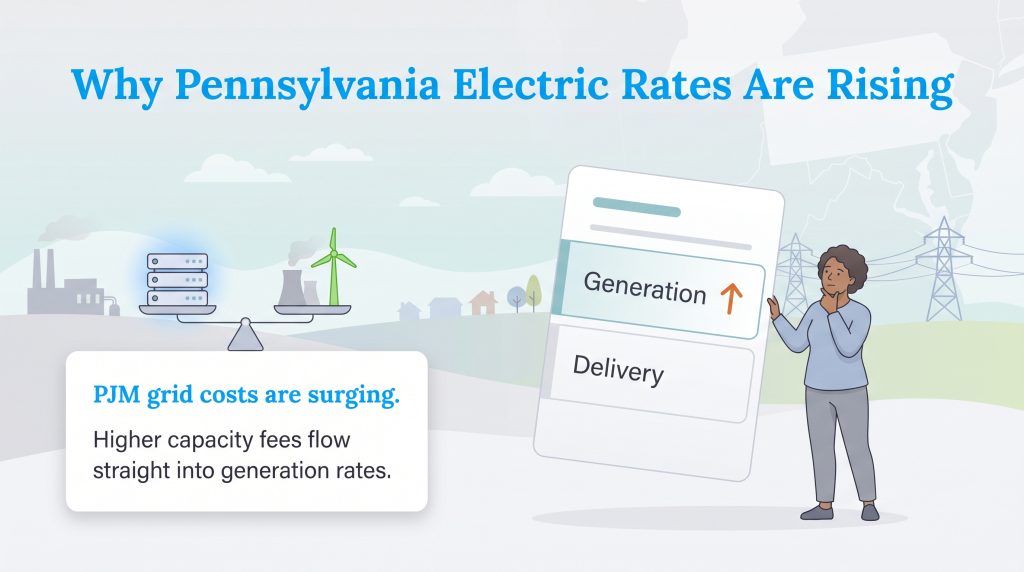
To understand why your electric bills are climbing, we have to look at how electricity is priced and managed behind the scenes. Your monthly bill is split into two primary charges — generation (the actual electricity you use) and delivery (the physical poles and wires that bring power to your home). While your local utility has to get state approval to change its delivery fees, the default supply rate fluctuates based on the broader energy market. Currently, a perfect storm of tightening supply and skyrocketing demand is pushing retail generation costs to new heights.
The PJM Interconnection Capacity Crisis
The primary force driving up your supply rate is a structural crisis within the PJM Interconnection, the regional transmission grid that manages the flow of electricity across 13 states and Washington, D.C. Each year, PJM holds capacity auctions where power plant operators bid to guarantee they can produce enough electricity to meet peak grid demands during extreme winter and summer weather.
Lately, these capacity auction prices have exploded. In PJM’s recent auctions, capacity prices surged from a baseline of $28.92 per megawatt-day to a federally capped rate of $329.17 per megawatt-day for the 2026/2027 delivery year. Because utilities are legally required to pass these wholesale capacity charges directly to customers, the rising grid fees are flowing straight to your monthly default service rates.
High-Tech Demand and Power Plant Retirements
Why have capacity prices spiked so dramatically? It comes down to a basic supply-and-demand mismatch. On the demand side, the rapid growth of high-performance computing, artificial intelligence, and hyper-scale data centers is putting unprecedented strain on the grid. In fact, data centers now account for nearly 97% of peak load growth across the Mid-Atlantic region.
On the supply side, older coal-fired and natural gas-fired power plants are retiring faster than clean, renewable energy projects can be connected to the grid. Grid infrastructure bottlenecks and regulatory backlogs have slowed the integration of new solar and wind power, leaving the region with limited excess generation capacity.
What the June 2026 Rate Hikes Mean for Your Bill
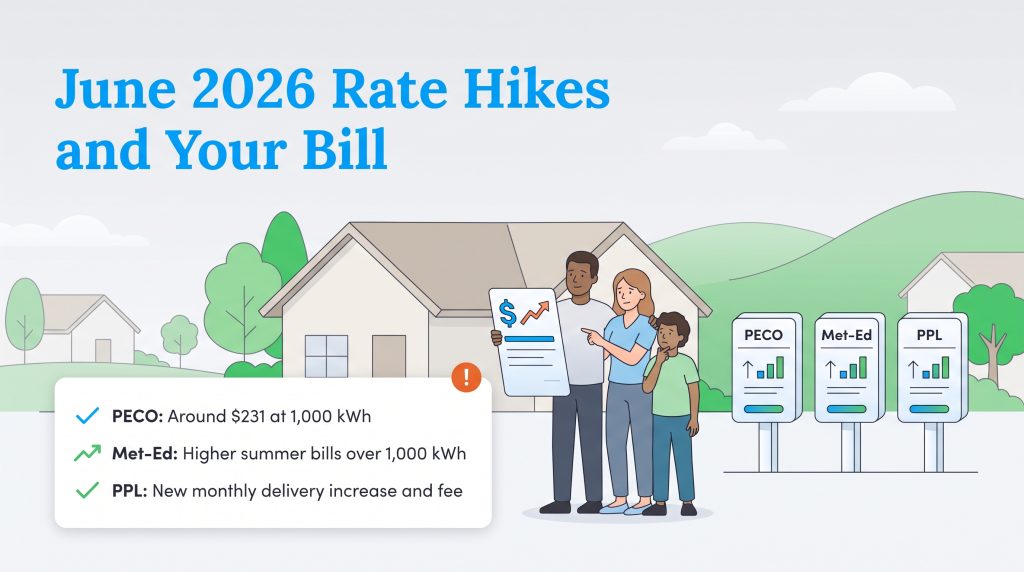
When you do not shop for an independent electricity provider, you automatically pay your utility’s default supply charge, known as the Price to Compare. These default benchmarks reset twice a year, and the June 1, 2026, adjustments brought noticeable rate hikes for families across the commonwealth. Understanding how your specific utility’s rates are shifting is the first step toward finding relief.
PECO Energy Rate Impact
If you are a PECO customer in the Philadelphia area, your residential default Price to Compare adjusted upward from 11.024¢ per kWh to 11.759¢ per kWh on June 1, 2026. This default rate is scheduled to remain in effect through Nov. 30, 2026.
When you combine this new supply rate with PECO’s standard distribution charges and fixed customer fees, your all-in retail rate lands around 23.90¢ per kWh. For a typical family home consuming 1,000 kWh of electricity per month, your total monthly bill will likely climb to about $231. This represents a substantial budget increase compared to early 2025, when all-in household rates were closer to 16.00¢ per kWh.
Met-Ed Rate Impact
Met-Ed customers in eastern Pennsylvania are facing an even steeper default rate adjustment. Met-Ed’s residential Price to Compare climbed by 7.6% on June 1, 2026, jumping from 12.965¢ per kWh to 13.951¢ per kWh.
This supply tariff is locked in until late November, but it will hit households hardest during peak summer cooling months. If you run central air conditioning frequently, your monthly electricity usage can easily exceed 1,000 kWh. At these levels, your total Met-Ed bill could quickly climb past $200 per month, driven by a combination of the higher default supply charge, a fixed $11.25 customer fee, and a variable delivery charge of 4.80¢ per kWh.
PPL Electric and the New Distribution Rate Settlement
PPL Electric customers in central and eastern Pennsylvania saw their default supply rate rise slightly to 13.147¢ per kWh on June 1, 2026. However, the most significant changes for PPL customers relate to a major distribution rate case that was finalized by the state utility commission.
On June 4, 2026, regulators approved a modified official PPL Electric rate settlement authorizing PPL to increase its annual distribution revenues by $275 million, effective today, July 1, 2026. Under this newly approved settlement, typical residential distribution charges will increase by $7.42 per month (or about $6.48 depending on your exact usage pattern). Additionally, PPL’s flat monthly customer charge will rise from $14.09 to $15.00.
While this distribution hike is mandatory and cannot be avoided, the settlement does provide a few consumer-friendly protections:
- Two-Year Base Rate Freeze: PPL has agreed to a stay-out commitment, meaning the utility cannot file for another distribution base rate increase until at least mid-2028.
- Specialized Data Center Tariffs: To ensure residential customers do not shoulder the grid-upgrade costs associated with new technology hubs, the settlement requires data centers to sign binding 10-year service contracts and fund $11 million annually for low-income utility assistance.
How These Rate Changes Impact Your Neighborhood
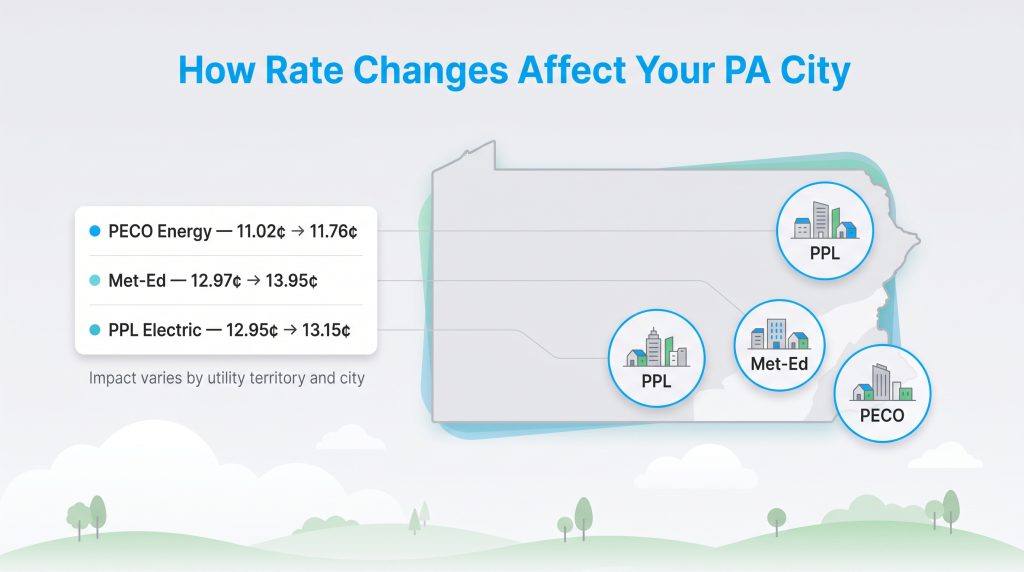
Depending on where you live in Pennsylvania, your local electric distribution company dictates your default pricing and delivery terms. Because these rate changes are regional, the specific towns and cities impacted vary by utility territory. Below is a quick look at how the latest rate adjustments translate across major metropolitan areas and counties.
| Utility | Previous Default PTC | New Default PTC | Primary Areas & Major Cities Impacted |
| PECO Energy | 11.024¢ / kWh | 11.759¢ / kWh | Philadelphia, Levittown, Norristown |
| Met-Ed | 12.965¢ / kWh | 13.951¢ / kWh | Reading, York, Berks County, and Cumberland County |
| PPL Electric | 12.953¢ / kWh | 13.147¢ / kWh | Allentown, Harrisburg, Scranton, and Schuylkill County |
Take Control of Your Electricity Supply Rate
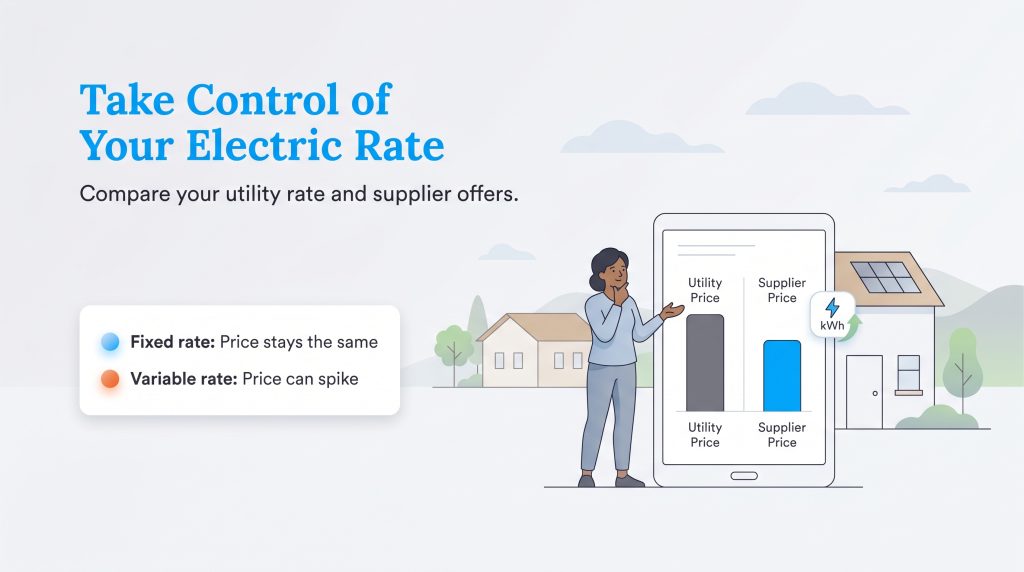
Because Pennsylvania is a deregulated energy market, you are never locked into your utility’s default electricity price. While your local utility is always responsible for delivering your power, reading your meter, and fixing downed lines during a storm, you have the total freedom to choose a third-party electric supplier for the generation portion of your bill. If default rates rise too high, you can fire your default utility supplier and switch to a competitive provider with a better deal.
Shop the Best Rates on State Portals
Your utility’s default Price to Compare serves as your target benchmark when shopping. If you can find a competitive supplier offering a rate below your current utility PTC, you will save money immediately on the generation portion of your monthly bill.
You can compare competitive offers on the official state portal, PA Power Switch, or browse hand-selected rate packages tailored for your home on our own local directories. In PECO territory, for instance, you can currently find competitive fixed-rate plans starting as low as 9.59¢ per kWh, which represents a substantial savings compared to the 11.759¢ default tariff. In Met-Ed territory, competitive options are available around 12.40¢ per kWh, comfortably below the utility’s default 13.951¢ rate.
Fixed-Rate vs. Variable-Rate Plans
When shopping for an electricity supplier, you will need to choose between a fixed-rate and a variable-rate contract structure. Each option comes with specific advantages and potential risks:
- Fixed-Rate Plans: These plans lock in a set price per kWh for a contract term of six, 12, or 24 months. Fixed-rate plans protect your household from extreme price spikes during severe winter storms and summer heatwaves. However, be sure to check for early termination fees, which usually range from $50 to $150 if you break the contract before the term ends.
- Variable-Rate Plans: These contracts feature no cancellation fees, but your supplier can adjust the supply price monthly without caps. While they can occasionally offer savings during mild spring or autumn months, variable plans expose you to sudden, budget-straining bill spikes when energy demand peaks.
Practical Ways to Lower Your Electric Bill Today
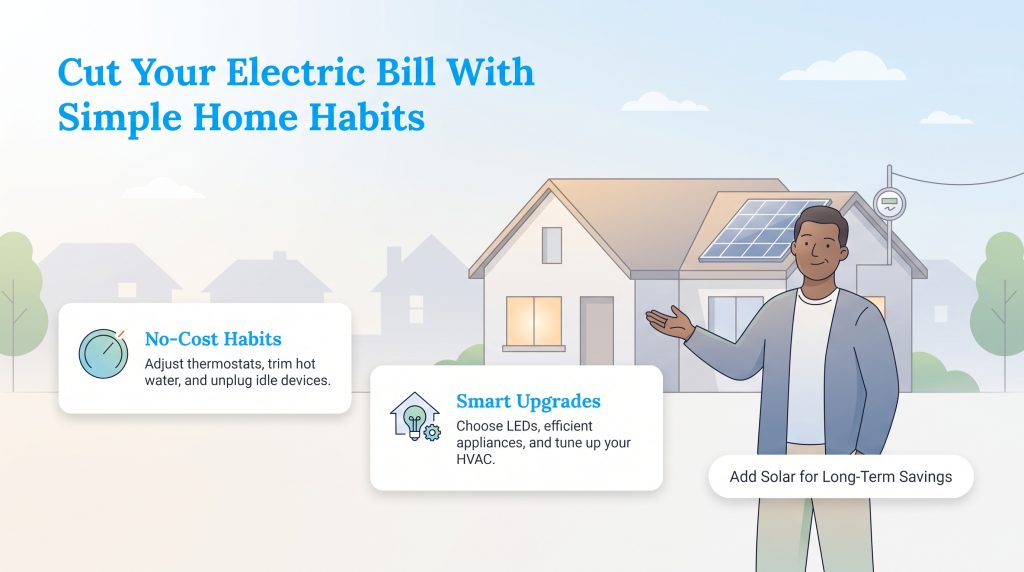
While shopping for a competitive supply rate is the fastest way to lower your energy costs, your delivery fees are calculated based on your total volumetric electricity consumption. This means that reducing the amount of power your home draws from the grid is a highly effective way to lower both the supply and delivery portions of your bill. Adopting smart, energy-saving habits around your home is an easy, eco-conscious alternative that will instantly keep more money in your pocket.
Implement Zero-Cost Energy Savings
You do not need to spend a fortune to see immediate energy savings. Making a few simple adjustments to your daily routine can yield noticeable results:
- Adjust Your Thermostat: Heating and cooling systems account for roughly 52% of your home’s total energy use. Setting your thermostat to 78°F during hot summer days can save up to 10% on your annual cooling costs.
- Lower Your Water Heater: Most water heaters are preset to a blistering 140°F. Dropping the dial to 120°F provides plenty of hot water for household chores while yielding an estimated savings of up to 22% annually on your water-heating costs.
- Slay Standby Phantom Loads: Electronics plugged into your walls consume standby power even when turned off, representing up to 10% of your total household usage. Unplugging idle game consoles, chargers, and television setups can save up to $100 per year.
Invest in Energy-Efficient Upgrades
If you want to maximize your home’s efficiency over the long run, small investments in energy-saving products will pay for themselves quickly:
- Switch to LED Bulbs: Replacing your five most frequently used household lightbulbs with highly efficient LED bulbs uses at least 75% less energy and can save you an estimated $75 per year.
- Look for the ENERGY STAR Label: When aging appliances begin to fail, always choose an environmentally mindful choice bearing the ENERGY STAR label. These appliances meet strict efficiency standards set by the Environmental Protection Agency, using 10% to 50% less energy than standard models.
- Optimize Your HVAC System: Replacing drafty weatherstripping around exterior doors and changing your HVAC system’s air filters every one to three months can improve overall heating and cooling efficiency by up to 15%.
Consider Distributed Solar and Net Metering
For homeowners interested in long-term energy independence, behind-the-meter solar panels are an exceptionally strong hedge against rising electric rates. Pennsylvania offers a highly favorable, statewide net-metering policy that requires your utility to credit customer-generators at the full retail rate for any excess solar electricity your panels export back to the local grid. At current retail default rates, an average household solar installation can achieve a payback period of under 11 years, delivering decades of clean, free power.
Safeguard Your Home with Utility Assistance Programs
If you find yourself struggling to keep pace with rising summer electricity costs despite practicing good energy habits, please remember that valuable community assistance programs are available. Pennsylvania utilities fund a well-supported network of universal service programs designed to keep vulnerable families connected to the grid.
You can contact your utility provider directly to ask about enrollment in a Customer Assistance Program, which provides low-income households with customized, affordable monthly bills based on a set percentage of your household income. Additionally, utilities offer Low-Income Usage Reduction Programs to provide eligible homes with free energy audits and efficiency installations. If you face a sudden financial emergency, partnerships like Met-Ed’s collaboration with the Dollar Energy Fund provide emergency hardship grants of up to $500 per year to resolve past-due accounts.
Taking Charge of Your Energy Future in Pennsylvania
While rising Pennsylvania electric rates present a real challenge for household budgets this summer, you do not have to accept default utility prices. Thanks to the power of state energy deregulation, you have the freedom to shop around, compare competitive contracts, and choose a supplier that aligns with your household budget and environmental values. By combining smart shopping habits with simple, energy-saving upgrades around your home, you can easily offset default tariff hikes. At Utilities For My Home, we believe that taking control of your monthly utility choices is the first step toward building a more sustainable and financially secure household.
Frequently Asked Questions About Pennsylvania Electric Rates
Why are Pennsylvania electric rates changing?
What is a Price to Compare and how do I use it?
Can I avoid the PPL Electric distribution rate increase?
What is the most reliable way to lower my monthly electric bill?
About the Author

Claudio is a sustainability-focused writer with a background in Anthropology and Psychology from NC State University. He has spent over 15 years working in writing, interpretation, and translation, driven by a deep interest in how human culture shapes the environment. Today, he shares his curiosity with readers by writing about sustainable living solutions and the connection between everyday choices and environmental impact.