

Your Oklahoma address determines most utility providers, while housing, insurance, and seasonal energy use shape your moving budget
Key Takeaways
- Calling Oklahoma home means enjoying housing costs generally below the national median, alongside regional variations in monthly electricity and water bills.
- Because Oklahoma operates on residential utility service territories, your specific street address determines your electricity and natural gas providers rather than an open marketplace.
- Over 40% of the state’s electricity comes from wind generation, making it easy to opt into green utility plans and weatherization rebates as soon as you unpack.
Packing up your life for the Sooner State requires balancing regional perks with practical preparation. People are increasingly drawn to Oklahoma for its growing job markets and lower cost of living, but navigating the actual costs means understanding how extreme seasonal weather and local taxes impact your household budget. Whether you are relocating for an aerospace job or simply want to explore different neighborhoods, your actual monthly expenses will heavily depend on property insurance, commuting needs, and home energy efficiency. We put together this guide to walk you through real monthly expenses, how Oklahoma City and Tulsa compare, how to budget for Oklahoma’s weather, and step-by-step instructions for checking your address, setting up utilities, and accessing eco-conscious home services.
What to Expect From Life in Oklahoma
Before the moving truck pulls into your driveway, it helps to take an honest look at daily life in the Sooner State. If you are wondering, “Is Oklahoma a good place to live?”, the answer depends on how you weigh major financial perks against a few geographic realities. Among the top things to know before moving to Oklahoma are the state’s aerospace and energy industries, its rich Native American heritage spanning 39 federally recognized tribes, and commutes that are generally lighter than those in coastal metros.
| Pros of Living in Oklahoma | Cons of Living in Oklahoma |
|---|---|
| Accessible housing costs: Home prices and rent sit well below national averages in many counties, letting you buy more space for less money. | Extreme seasonal weather swings: Spring brings tornado watches and hail, while July and August frequently hit triple-digit heat. |
| Easygoing commute times: Even in Oklahoma City and Tulsa, rush hour rarely rivals the congestion seen in larger national metros. | Car-dependent suburbs: Public transit is limited outside downtown cores, so owning a reliable vehicle and paying turnpike tolls is often essential. |
| Rich cultural and tribal heritage: Home to 39 federally recognized tribes headquartered in the state, offering incredible festivals, museums, and art. | Year-round wind and allergens: Constant prairie winds stir up cedar, ragweed, and grass pollen, making seasonal allergies a real nuisance. |
| Groceries are exempt from state sales tax: As of late 2024, Oklahoma eliminated the 4.5% state sales tax on groceries, providing daily savings (though local municipal taxes still apply). | Fewer major pro sports leagues: Aside from the beloved NBA Oklahoma City Thunder and powerhouse college football, major league pro teams require a drive to Dallas or Kansas City. |
| Abundant clean wind energy: Massive investment in wind turbines keeps residential electricity rates competitive and sustainable options accessible. | Rural infrastructure gaps: Small towns outside the main metros can have fewer healthcare facilities and patchier fiber internet coverage. |
When you weigh the pros and cons, Oklahoma’s weather deserves a place in your moving budget and safety plan. Before signing a lease or buying a home, check shelter access, insurance coverage, HVAC condition, and the property’s recent utility usage. Upgrading your home’s air filtration tames the prairie pollen, and grabbing a turnpike transponder makes suburban commuting more manageable.
Cost of Living in Oklahoma and Average Monthly Utility Bills
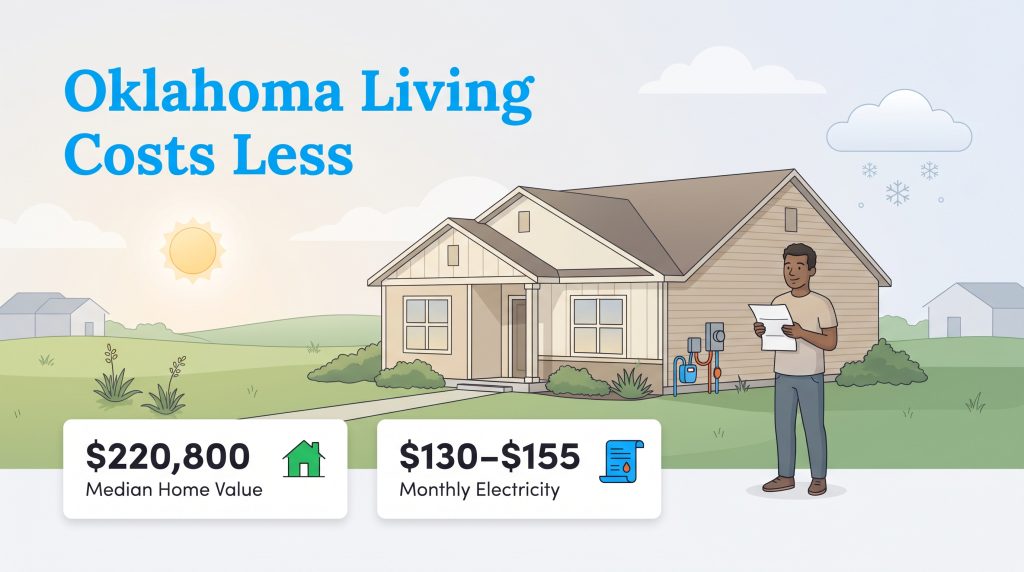
Your paycheck stretches remarkably far here compared to the national average or booming metros in neighboring Texas and Colorado. The overall cost of living in Oklahoma sits roughly 12% to 15% below the U.S. norm, driven largely by affordable real estate. Typical single-family home values hover around $220,800 according to late 2026 Zillow data, though real estate prices vary widely by county. We highly recommend obtaining address-specific homeowners or renters insurance quotes before committing to housing, as wind and hail coverage can materially affect the economics of a move. When shopping, you will also pay a 4.5% state base sales tax rate (though the state grocery tax was eliminated in 2024), plus whatever local municipalities add for their own city and county sales taxes.
| Expense Category | Average Cost in Oklahoma | What to Expect |
|---|---|---|
| Median Home Value | ~$220,800 | Based on late 2026 Zillow data; significantly below the national median, varying heavily by county. |
| Median Monthly Rent | Varies by location and property type | Ask your landlord if water, sewer, and trash are included in your rent before you set up new accounts. |
| Average Monthly Electricity Bill | 130–155 | Based on EIA residential data; high summer consumption offsets competitive retail rates. |
| Average Monthly Natural Gas Bill | Usage-dependent | Varies sharply by season and whether your home uses gas, electric, or propane heating. |
| Municipal Water & Sewer | Billed by local municipality | Varies based on address and local usage rates. |
| Trash & Recycling | Fees vary by municipality | Often bundled directly with your municipal water and sewer bill. |
| Average High-Speed Internet Bill | 60–80 | Advertised base prices; installation and equipment fees may apply. |
| State Base Sales Tax Rate | 4.5% | Combined with local city and county additions, checkout tax usually lands around 8.5% to 9% (state tax on groceries is exempt). |
| Average Property Tax Rate | ~0.79% | Estimated effective statewide rate according to the Tax Foundation, though bills vary based on exemptions and local levies. |
How Oklahoma’s Weather Affects Your Home Energy Budget
While the average utility bill in Oklahoma benefits from competitive rates, the state’s dramatic four seasons create noticeable swings in monthly energy usage. Oklahoma regularly sees long stretches of 90°F+ temperatures each summer, forcing central air conditioners to work overtime in July and August. Then, in January and February, Arctic cold fronts and winter ice storms sweep across the plains, causing spikes in natural gas or electric furnace bills. Fortunately, data from the U.S. Energy Information Administration Oklahoma State Profile shows that while Oklahoma households consume more electricity than the national average due to summer cooling needs, the state’s retail electricity rates keep total monthly bills relatively balanced compared to the national average. To prevent seasonal bill shock, we recommend enrolling in “Average Monthly Billing” (levelized billing) with your electric and gas providers right after moving in, which averages your costs over a rolling 12-month period. Keep in mind that average billing smooths your payments; it does not reduce your total consumption or overall charges.
Money-Saver
Sealing air leaks around doors and windows can reduce unnecessary heating and cooling demand. Before enrolling in your electric provider’s time-of-use pricing plan, check whether you can reliably shift major electricity use away from its higher-priced hours, as these plans can increase bills for households unable to shift usage during summer heatwaves.
Setting Up Utilities in Oklahoma: Who to Call and How It Works
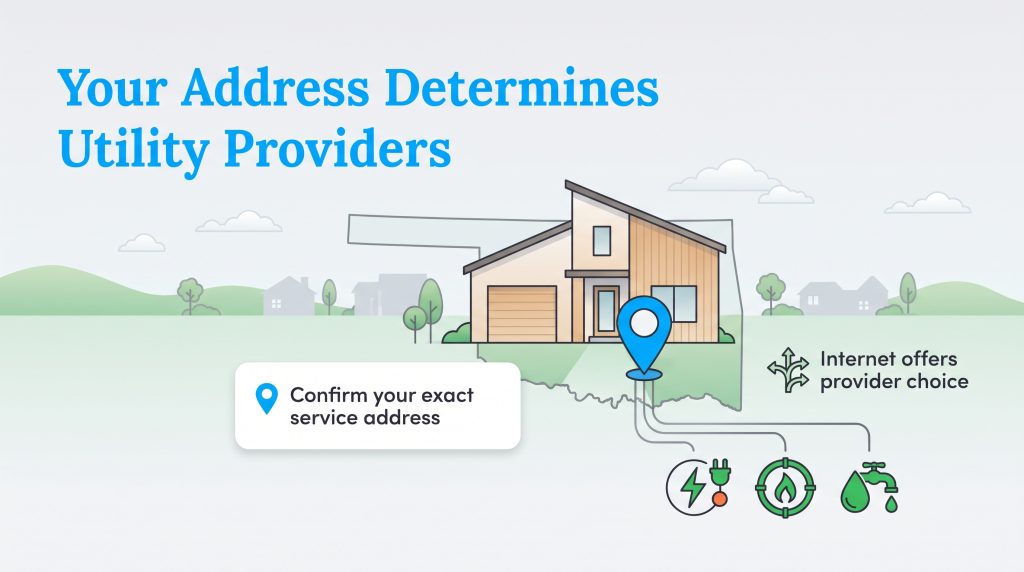
If you are relocating from a deregulated state like Texas or Ohio, the golden rule of setting up utilities in Oklahoma will save you hours of confusion: Oklahoma operates through residential utility service territories. You don’t have to spend your weekend comparing dozens of retail energy marketers or worrying about deceptive teaser rates. Instead, your utility provider is assigned directly by the geographic service territory of your home’s street address, and the Oklahoma Corporation Commission Public Utility Division oversees investor-owned utilities to ensure fair, stable rates across the state.
Whether you are setting up electricity in your new home, scheduling natural gas service, activating municipal water service, or comparing home internet options, knowing who covers your zip code makes move-in week effortless. Always confirm providers for your exact service address, not just the city or ZIP code.
Electricity Providers and Renewable Wind Options
When researching Oklahoma electricity providers and rates, your new home will fall into one of three service categories based on where you live:
- OG&E (Oklahoma Gas & Electric): Despite having “Gas” in its historic name, OG&E is an electric-only utility that powers the Oklahoma City metro and much of central, western, and south-central Oklahoma.
- PSO (Public Service Company of Oklahoma): PSO supplies electricity to the Tulsa metro, Lawton, McAlester, and much of eastern and southwestern Oklahoma.
- Municipal Utilities and Rural Electric Cooperatives: Numerous towns and cities — including major suburbs like Edmond (served by Edmond Electric) and Stillwater — run their own city-owned electric grids. Meanwhile, rural areas and outer suburbs rely on member-owned cooperatives like Oklahoma Electric Cooperative (OEC) in the Norman area or Verdigris Valley Electric Cooperative near Tulsa.
One of the best perks of Oklahoma’s grid is that roughly 40% of the state’s electricity comes from renewable wind power, ranking Oklahoma among the top states in the nation for wind generation. You can make an environmentally mindful choice right at sign-up by opting into OG&E’s Solar Power or Wind Power programs or PSO’s Renewable Energy Choice program (formerly WindChoice). These programs let you match up to 100% of your monthly electricity usage with renewable energy certificates. While you have your provider on the phone, ask about instant rebates for ENERGY STAR smart thermostats and discounted home weatherization audits — an energy-saving option that pays for itself by increasing your home’s seasonal efficiency.
Eco Edge
Enrolling in PSO’s Renewable Energy Choice or OG&E’s renewable energy programs matches your electricity consumption with renewable energy certificates without requiring you to install rooftop solar panels, making it an effortless eco-conscious alternative for both renters and homeowners.
Natural Gas Service
Many Oklahoma homes rely on natural gas for central furnace heating, water heaters, and kitchen ranges. Oklahoma Natural Gas (ONG) is the primary distributor across the state, serving a vast majority of residents, including most of the Oklahoma City and Tulsa metropolitan areas (small pockets in rural eastern Oklahoma are served by Summit Utilities or municipal gas systems). We recommend scheduling your ONG turn-on or service transfer online or by phone at least five business days before your closing date or lease start. Be sure to verify your provider’s specific appointment windows and connection charges ahead of time.
Water, Sewer, and Trash Collection
Water, wastewater, and curbside trash and recycling are often managed directly by your local city or town government, such as the City of Oklahoma City or the City of Tulsa. To open your municipal utility account, keep a digital copy of your signed lease agreement or closing disclosure, a government-issued photo ID, and a debit or credit card handy for the refundable account deposit. When setting up your curbside carts, request the largest recycling bin your city offers and check local drop-off rules for flattening and recycling cardboard moving boxes so you can manage your household waste and recycling responsibly from day one. If you live outside city limits, you may need to set up service with a rural water district or hire a private waste hauler instead.
High-Speed Internet and Fiber Footprints
Unlike electricity and water, you actually get to shop around for internet service in Oklahoma, and fiber-optic networks have expanded rapidly across the state in recent years. In the Oklahoma City and Tulsa metros, AT&T Fiber and Cox Communications are common options in most neighborhoods, offering symmetrical fiber or multi-gig cable speeds. If you are moving to a mid-sized city or outer suburb like Weatherford, Shawnee, or McAlester, look for Dobson Fiber or rural electric co-op fiber networks (such as OEC Fiber near Norman). For acreage properties outside city limits where fiber lines haven’t reached yet, T-Mobile 5G Home Internet and Starlink satellite service provide dependable broadband. We recommend checking provider address tools and the FCC National Broadband Map to confirm advertised availability at your specific address. Always compare upload speeds, latency, equipment costs, promotional pricing, and data policies before signing a contract.
How Oklahoma City and Tulsa Compare
First-time visitors are often surprised by Oklahoma’s diverse geography, which shifts from the pine-covered mountains and rolling green hills of the east to the red-rock canyons and wide-open prairies of the central and western plains. Choosing among the best places to live in Oklahoma starts with deciding whether your lifestyle fits better in the state’s bustling capital hub, its leafy riverfront second city, or a top-rated college or commuter suburb.
| City / Suburb | Housing Market Vibe | Primary Electric Provider | Top Industries & Employers | Local Vibe |
|---|---|---|---|---|
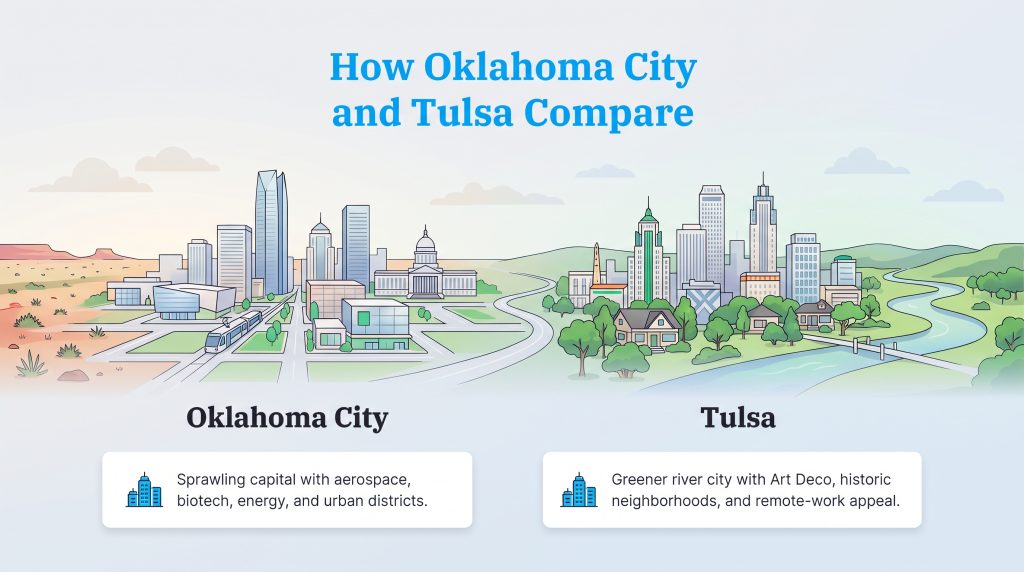
| Oklahoma City | Broad range of urban and suburban homes | OG&E | Aerospace (Tinker AFB), Biotech, Energy, State Government | Sprawling, modern metro with revitalized urban districts and pro basketball. |
| Tulsa | Historic bungalows and established neighborhoods | PSO | Aerospace, Tech & Remote Work, Healthcare, Energy, Manufacturing | Hilly, tree-lined city known for Art Deco architecture and world-class river parks. |
| Edmond (OKC Metro) | Premium suburban housing market | Edmond Electric | Higher Education (UCO), Healthcare, Professional Services | Upscale, manicured suburb prized for recognized public school districts. |
| Norman (OKC Metro) | Diverse mix of student rentals and large estates | OG&E / OEC | University of Oklahoma, Meteorology & Radar Tech, Healthcare | Lively college town with walkable dining districts and spirited game days. |
| Broken Arrow (Tulsa Metro) | Family-oriented suburban developments | PSO | Advanced Manufacturing, Retail, Education, Healthcare | Eastern suburb with a thriving Rose District main street and numerous parks. |
| Jenks (Tulsa Metro) | Higher-end riverside neighborhoods | PSO | Education, Healthcare, Retail | Charming southern suburb featuring the Oklahoma Aquarium and antique shops. |
| Stillwater | Mid-sized market with strong collegiate influence | Stillwater Electric | Oklahoma State University, Agricultural Tech, Aerospace Research | Welcoming, tight-knit college town halfway between OKC and Tulsa. |
Moving to Oklahoma City vs Tulsa
When weighing moving to Oklahoma City vs Tulsa, you are comparing two distinct personalities:
- Oklahoma City (OKC): Home to over 1.4 million metro residents, OKC is a sprawling, forward-looking capital city propelled by decades of voter-approved MAPS public infrastructure investments. Its economy is anchored by Tinker Air Force Base, a growing biomedical corridor, energy headquarters, and state government. Neighborhoods like the Paseo Arts District, Midtown, Plaza District, and Bricktown offer trendy food halls, streetcar transit, and loud nights cheering on the NBA’s Oklahoma City Thunder.
- Tulsa: Tucked into northeast Oklahoma’s “Green Country” along the Arkansas River and the foothills of the Ozarks, Tulsa feels noticeably greener, hillier, and more compact than OKC. Famous for its historic Art Deco skyline, the massive Gathering Place riverfront park, and the nationally recognized Tulsa Remote incentive program, Tulsa attracts remote workers, artists, and families looking for historic bungalow neighborhoods and slightly lower housing costs.
Top Family-Friendly Suburbs and Mid-Sized Towns
If you prefer suburban quiet or a college-town rhythm over downtown living, these communities consistently rank at the top of local relocation lists:
- Edmond (OKC Metro): Sitting just north of Oklahoma City, Edmond is famous for having some of the most recognized public high schools in the state, dozens of miles of paved multi-use trails, and its own reliable municipal utility, Edmond Electric.
- Norman (OKC Metro): Located 20 miles south of downtown OKC along I-35, Norman blends easy commuter access with the cultural energy of the University of Oklahoma and the National Weather Center, complete with vibrant dining along Campus Corner and Main Street.
- Broken Arrow and Jenks (Tulsa Metro): Bordering Tulsa to the southeast and south, Broken Arrow draws families with its revitalized Rose District — packed with local boutiques, splash pads, and farmers markets — while Jenks charms newcomers with the Oklahoma Aquarium, antique shops, and nationally recognized public schools.
- Stillwater: Situated roughly an hour from both OKC and Tulsa, the home of Oklahoma State University offers a relaxed pace of life, Red Dirt live music history, and an exceptionally friendly small-city community.
Your Oklahoma Move-In Checklist
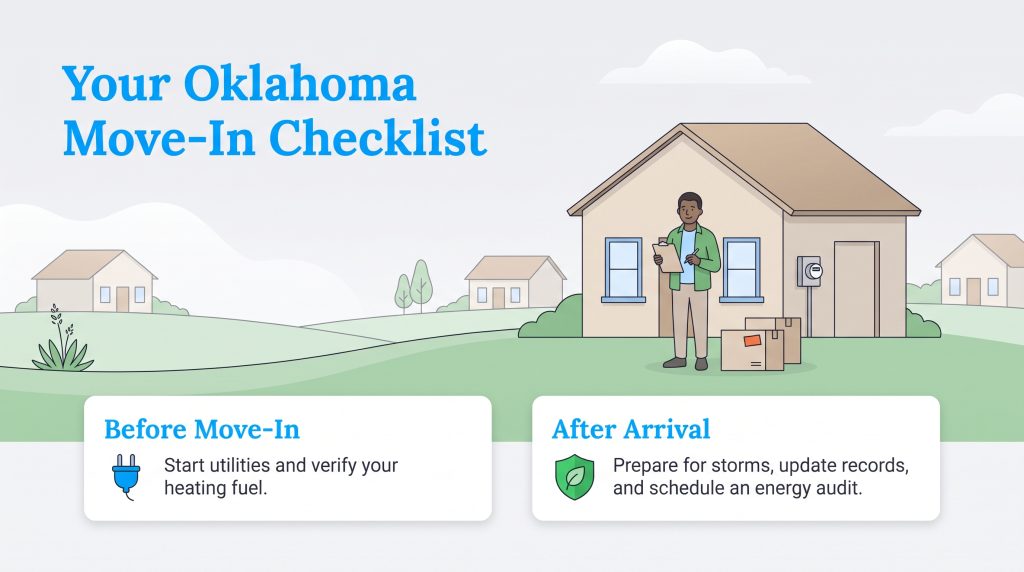
Once you have signed your lease or closed on your house, following a structured moving checklist keeps move-in week stress-free. Use this action plan during the two weeks before and four weeks after arrival to knock out Oklahoma-specific essentials, and check out our complete moving and utility setup hub alongside our sustainable living guides for more ways to unpack with a lighter footprint.
- Two Weeks Before Move-In — Schedule Your Utilities: Contact OG&E or PSO (or your local municipal/co-op utility), Oklahoma Natural Gas, your city water department, and your chosen fiber internet provider. You should also verify your home’s heating fuel source (natural gas, electric, or propane) to ensure you set up all necessary accounts. Set your service activation for the day before your moving truck arrives.
- Move-In Week — Test Weather Safety Gear and Register Your Storm Shelter: Don’t assume your new home has a storm shelter. If you rent, ask your property management about shelter arrangements before moving. If your home does have a shelter, registering it with your local emergency manager provides coordinates to first responders, though it does not guarantee immediate rescue. If you lack a safe room, locate a nearby sturdy building and plan your route well before a warning is issued. Put fresh batteries in a NOAA weather radio and keep sturdy shoes and a flashlight inside your designated safe space.
- Within 30 Days — Get Your Oklahoma Driver’s License and REAL ID: Oklahoma splits driver and vehicle services into two steps. For your driver’s license or state ID card, visit the Service Oklahoma Driver Licenses and ID Cards portal to verify your paperwork. A standard license transfer generally requires one proof of residency, while a REAL ID requires two. Always verify the current document requirements through Service Oklahoma before your visit.
- Within 30 Days — Register Your Vehicle and Grab a PIKEPASS: To transfer your out-of-state car title and get an Oklahoma license plate, head to a neighborhood Licensed Operator (still affectionately called a “Tag Agency” by locals), which can be found in strip malls across all 77 counties. While sorting out your car, check if an existing interoperable transponder from another state already works, or order a PIKEPASS. Oklahoma relies heavily on toll highways like the Turner Turnpike, and having a PIKEPASS cuts your toll rates compared to PlatePay camera billing.
- Month Two — Schedule a Home Energy Audit: After the last moving box is unpacked, take advantage of utility rebates from OG&E, PSO, or ONG to seal leaky ductwork, blow extra insulation into your attic, or install an ENERGY STAR smart thermostat before peak summer or winter weather arrives.
Heads Up
Peak tornado season in Oklahoma runs from April through June (with a smaller secondary peak in October), so keeping portable power banks charged, storing three days of emergency drinking water, and turning on wireless emergency alerts on your phone should be day-one priorities. Remember that severe weather can happen outside of these peak seasons, so having a year-round plan is critical.
Putting Down Roots and Powering Up Your New Oklahoma Home
Moving to Oklahoma gives you the rare chance to lower your monthly housing and utility overhead while upgrading your daily quality of life. Instead of stressing over high mortgages or complicated deregulated electricity marketplaces, you get straightforward utility service, manageable property taxes compared to many national markets, and a state grid already powered heavily by clean prairie wind. With a little upfront preparation — knowing which regulated electric utility serves your street, opting into a renewable wind rider, sticking a PIKEPASS on your windshield, and knowing your storm shelter routine — settling into the Sooner State is remarkably smooth. Welcome to the neighborhood, and enjoy all the extra space your new Oklahoma home has to offer.
Frequently Asked Questions About Moving to Oklahoma
Relocating to a new state often comes with a steep learning curve, especially regarding regulated utility territories and severe weather safety. Here are the most common questions newcomers ask when setting up their home in Oklahoma.
Is Electricity Deregulated in Oklahoma?
What Is a Good Salary to Live Comfortably in Oklahoma?
How Much Do Utilities Cost per Month in Oklahoma?
Do I Need a Storm Shelter When Buying or Renting a Home in Oklahoma?
Can I Power My Oklahoma Home With Solar or Wind Energy?
How Long Do I Have to Transfer My Driver’s License and Car Tags After Moving to Oklahoma?
About the Author

LaLeesha has a Masters degree in English and enjoys writing whenever she has the chance. She is passionate about gardening, reducing her carbon footprint, and protecting the environment. She also recently served as President of the Board for City Sprouts (a community garden).

David has been an integral part of some of the biggest utility sites on the internet, including InMyArea.com, HighSpeedInternet.com, BroadbandNow.com, and U.S. News. He brings over 15 years of experience writing about, compiling and analyzing utility data.