

Setting up utilities in Delaware doesn’t have to be stressful when you follow a strategic relocation checklist.
Key Takeaways
- Relocating to Delaware offers unique tax advantages and a moderate cost of living compared to neighboring East Coast cities.
- Setting up utilities requires exploring your options, as Delaware participates in a customer energy choice program for electricity providers.
- Tapping into Delaware renewable energy programs can help you lower your carbon footprint, while efficiency upgrades may reduce monthly bills over time.
Whether you’re chasing favorable tax policies, beautiful shorelines, or a quieter pace of life, planning your relocation requires more than just packing boxes. We’ve designed this guide to give you an honest look at the pros and cons of moving to the First State, along with an actionable home setup and utility checklist. You’ll learn how to compare utility options, estimate monthly costs, handle key moving deadlines, and make your new home comfortable from day one.
Is Moving to Delaware Worth It? Understanding the Pros and Cons
Deciding whether to relocate often comes down to balancing financial benefits against lifestyle changes. If you’re wondering, “is moving to Delaware worth it,” the answer heavily depends on your personal priorities. Many new residents are drawn by the financial relief the state provides, particularly when coming from high-tax areas like New York or Maryland. However, evaluating moving to Delaware pros and cons means looking past the immediate financial perks to understand what daily life actually feels like. You might appreciate the slower pace and convenient access to the Atlantic coastline, but you’ll also need to adjust to different infrastructure and community dynamics. Here are the biggest benefits and drawbacks to weigh before you settle in.
Pros: Tax Advantages and Strategic Location
For most everyday purchases, you won’t see a state sales tax added at checkout, which can help when you’re buying furniture, home supplies, and moving essentials. Furthermore, Delaware is often ranked among the states with lower effective property tax rates, though your actual bill depends on your county, assessment, exemptions, and local school taxes. This favorable tax structure helps keep the overall cost of living in Delaware quite manageable. Geographically, you get the best of both worlds. The state’s location offers highway and rail connections to major metropolitan centers like Philadelphia, Baltimore, and Washington, D.C. You can easily commute or enjoy weekend city trips while returning to a more affordable, spacious home base.
Cons: Development and Limited Big-City Amenities
The trade-off for that manageable cost of living is a noticeable lack of massive metropolitan hubs. If you thrive on the constant energy, extensive public transit, and endless culinary scenes of a major city, Delaware might feel a bit too quiet. Additionally, the state has experienced a rapid influx of new housing developments to accommodate incoming residents. This suburban sprawl is actively altering the historic, small-town feel of areas like Sussex County. You’ll likely encounter increased traffic on local roads that weren’t originally built to handle such dense populations.
Where to Live: Comparing Delaware’s Counties
If you haven’t finalized your destination, understanding regional differences can help you manage your budget and lifestyle expectations. Housing density, utility options, and daily commute times vary significantly depending on which part of the state you choose.
| Region | Best Fit For | Utility and Lifestyle Notes |
|---|---|---|
| New Castle County | Commuters, professionals, families wanting access to Wilmington, Newark, and Philadelphia | More provider options in dense areas, but housing and traffic can be more competitive |
| Kent County | Buyers seeking a central location and slower pace | Dover offers services and shopping without the density of northern Delaware |
| Sussex County | Retirees, beach lovers, and remote workers | Coastal areas may have higher housing demand, seasonal traffic, and varied internet options |
Your Essential Moving to Delaware Checklist
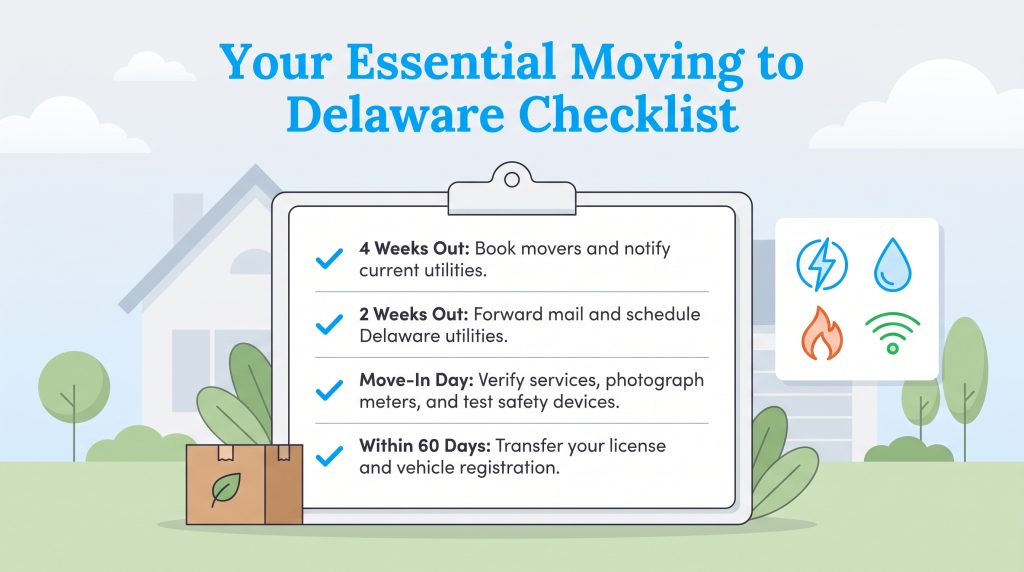
Once you decide to make the transition, tackling the logistics early prevents last-minute panic. A reliable moving to Delaware checklist ensures you handle critical administrative and household tasks well before the moving truck arrives. From forwarding your mail to registering your car, mapping out these duties on a timeline keeps you organized. We recommend breaking your tasks down week by week so you can steadily chip away at the paperwork and scheduling required for a smooth relocation.
What to Do First: The Core Setup
Before packing boxes, prioritize the logistical foundation of your move. These early steps ensure you don’t face sudden service delays:
- Confirm your address and move-in date.
- Identify the electric, gas, water, sewer, trash, and internet providers serving the address.
- Compare electric supplier options if eligible.
- Schedule service start dates at least two weeks before move-in.
- Take meter readings or photos on move-in day.
- Set up online accounts and autopay after confirming the first bill.
Weeks Before the Move
As your move-in date approaches, focus on scheduling and transferring responsibilities:
- Four weeks out: Research and book a reputable moving company, begin decluttering, and notify your current utility providers of your upcoming cancellation date.
- Two weeks out: Submit your official change of address with the USPS, update your billing information for subscriptions, and schedule your utility activation appointments for your new Delaware address.
- Moving day: Complete a final walkthrough of your old home, verify that your new utilities are active upon arrival, and unpack your essentials box.
Move-In Day Utility Checklist
Once you arrive at your new property, completing a few essential checks ensures your household runs smoothly from day one:
- Confirm electricity, water, heat, and internet are active.
- Locate the electric panel, water shutoff valve, gas shutoff, and thermostat.
- Photograph meter readings if accessible.
- Test outlets, HVAC, hot water, smoke detectors, and carbon monoxide detectors.
- Ask the landlord, seller, or property manager for trash/recycling pickup days.
Quick Fact
When you relocate, you must transfer your out-of-state driver’s license and vehicle registration at the Delaware DMV within 60 days of establishing residency.
Setting Up Utilities in Delaware: What You Need to Know
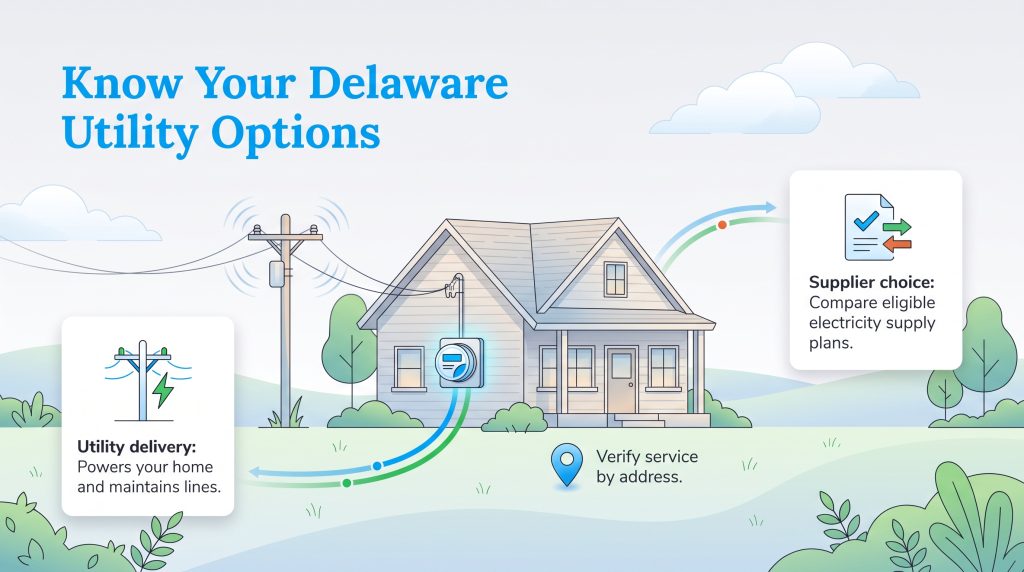
Managing your home’s infrastructure is a priority, and setting up utilities in Delaware requires understanding how the local energy market operates. Delaware has a customer electric choice program, which means eligible customers can compare licensed electric suppliers for the supply portion of their bill. Your local utility still delivers the electricity, maintains power lines, and responds to outages. Before you compare plans, confirm which utility serves your exact address because supplier options can vary by service territory. You can explore your options and learn more about this system on the Delaware Public Service Commission’s Customer Electric Choice page. If you’ve never lived in a state with retail energy options, the process might seem unfamiliar at first. Taking the time for understanding energy deregulation helps you navigate supplier contracts, compare rates, and ultimately secure a plan that aligns with your household budget and usage habits.
Delaware Utility Setup by Service
Because availability varies by address, use this overview to understand which providers you might encounter when connecting your home:
| Service | What to Know | Examples to Verify by Address |
|---|---|---|
| Electricity delivery | Your local utility still delivers power and maintains lines. Supplier choice may depend on your service territory. | Delmarva Power, Delaware Electric Cooperative, municipal electric utilities |
| Electricity supply | Some customers can compare licensed retail suppliers through Delaware’s electric choice program. | Fixed-rate, variable-rate, and renewable supply plans |
| Natural gas | Service availability depends heavily on your neighborhood and existing infrastructure. | Delmarva Power, Chesapeake Utilities, or local providers |
| Water/sewer | Often handled by a municipality, county, or private water company. | City/town water departments, Artesian Water, Tidewater Utilities |
| Internet | Options vary by address, especially between Wilmington/Newark, Dover, and coastal or rural areas. | Cable, fiber, fixed wireless, or DSL providers |
How to Compare Electricity Providers in Delaware
Evaluating your retail energy supplier options means carefully determining how each plan fits your household needs. Consider fixed-rate plans, which lock in your energy price per kilowatt-hour for the duration of your contract. This protects you from seasonal price spikes during hot summers or freezing winters. Always review the contract term lengths carefully — some providers offer great rates but require a 36-month commitment. You should also watch out for early cancellation fees, which can quickly erase any savings if you need to switch providers or move again before your contract expires.
When comparing your options, keep these key factors in mind:
- Compare the supply rate in cents per kWh.
- Check whether the rate is fixed or variable.
- Review the contract length.
- Look for early termination fees.
- Confirm whether the advertised rate is introductory.
- Check the renewable energy percentage if sustainability matters to you.
- Compare the estimated total monthly cost, not just the supply rate.
Water, Gas, and Internet Setup
While you have a choice in your electricity supplier, other utilities are more restricted. Your water and natural gas territories are typically determined by the municipality or local utility infrastructure. You’ll need to contact the specific provider assigned to your neighborhood to establish service. Internet providers, on the other hand, can vary heavily by county, with fiber-optic connections available in some areas and standard cable broadband in others. We highly recommend researching your options and scheduling your activation appointments at least two weeks before your official move-in date. This proactive approach ensures you have running water, heat, and a reliable Wi-Fi connection the moment you walk through your new front door.
Delaware Average Utility Costs and Living Expenses
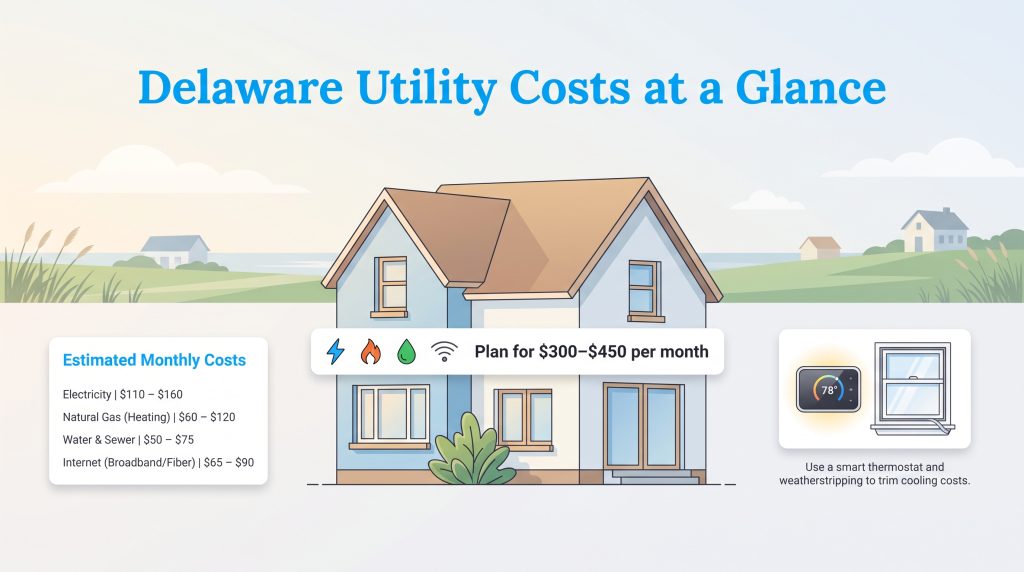
Budgeting accurately is crucial when settling into a new home. When estimating your Delaware average utility costs, you’ll find that expenses generally align with national averages, though seasonal weather shifts can cause fluctuations. For example, according to the U.S. Energy Information Administration’s Delaware Electricity Profile, recent data places Delaware’s average residential electricity price in the mid-to-high teens per kilowatt-hour, but your actual rate depends on your utility, supplier, plan type, and monthly usage. Natural gas heating costs will rise during the brisk winters, while electricity bills peak during the humid summer months when air conditioners run constantly. For planning purposes, many households should budget roughly $300 to $450 per month for electricity, natural gas, water/sewer, and internet, though larger homes, older insulation, electric heating, or coastal pricing can push costs higher.
| Utility Service | Estimated Monthly Cost |
|---|---|
| Electricity | $110 – $160 |
| Natural Gas (Heating) | $60 – $120 |
| Water & Sewer | $50 – $75 |
| Internet (Broadband/Fiber) | $65 – $90 |
Money Saver
Combat the humid Delaware summers and lower your cooling costs by programming a smart thermostat to raise the temperature slightly while you aren’t home. Sealing drafty windows with affordable weatherstripping also prevents that expensive chilled air from escaping.
Maximizing Delaware Renewable Energy Programs
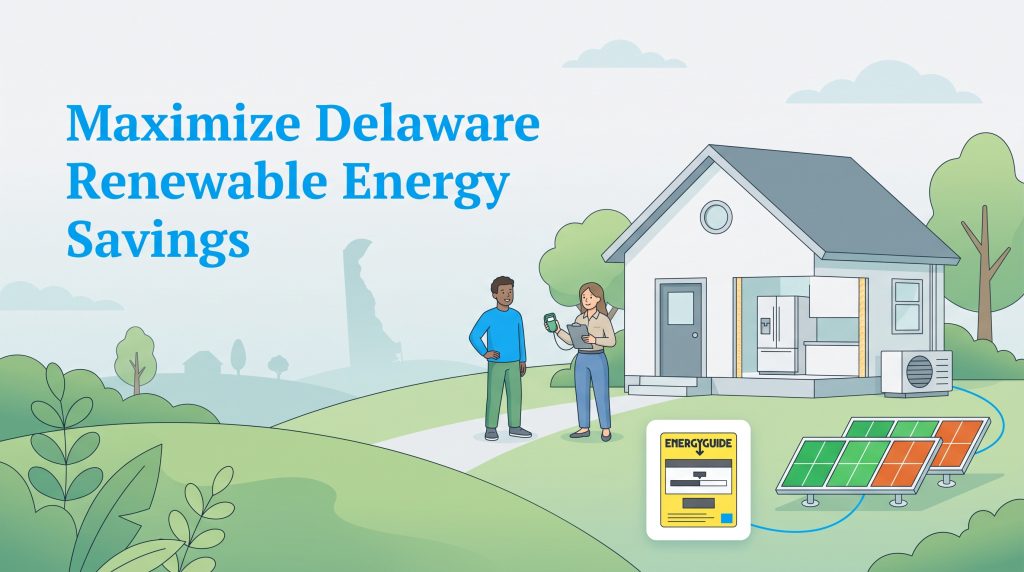
If you want to merge cost savings with sustainable living, Delaware offers several practical resources for residents who want an energy-saving option or an environmentally mindful choice. Taking advantage of Delaware energy-efficiency and renewable energy programs can help lower your carbon footprint, and efficiency upgrades may reduce monthly bills over time. New homeowners should explore the various Delaware energy efficiency incentives available, which often include rebates for upgrading outdated HVAC systems or adding heavy-duty insulation. One of the best starting points is the Energize Delaware initiative. By browsing their statewide residential energy efficiency programs, you can schedule a comprehensive home energy assessment to identify exactly where your house is losing energy. From there, making environmentally mindful choices like purchasing ENERGY STAR certified appliances ensures your home operates at peak efficiency year-round.
Before buying replacement appliances, compare the estimated annual energy use on the EnergyGuide label and look for ENERGY STAR certified models. A more efficient refrigerator, heat pump, washer, or dehumidifier can make a noticeable difference in Delaware’s humid summers.
Eco Edge
Renters or homeowners who cannot install traditional rooftop solar panels can still support the grid by enrolling in a community solar project or choosing a 100% green energy supply plan through the state’s choice program, depending on your utility and address.
Ready to Make Your Move to the First State?
Relocating always involves a few moving pieces, but proper planning, early utility setup, and a clear understanding of your expected monthly costs make the transition to Delaware much more manageable. By taking control of your energy choices and utilizing state efficiency programs, you can build a comfortable, cost-effective home environment from the very start. We know that organizing a move is a substantial undertaking, but checking off these logistical boxes early frees you up to enjoy everything your new community has to offer. Enjoy exploring the First State, and welcome to your new home.
Frequently Asked Questions About Moving to Delaware
Relocating to a new state often brings up highly specific logistical questions that demand straightforward answers. We’ve compiled this section to address the most common concerns about living in and setting up a home in Delaware, helping you finalize your moving preparations with absolute confidence.
Is Setting Up Utilities in Delaware Complicated?
How Should I Compare Electricity Providers in Delaware?
Are There Tax Benefits to Living in Delaware?
Does Delaware Offer Energy Efficiency Incentives for New Homeowners?
How Much Should I Budget for Delaware Average Utility Costs?
About the Author

LaLeesha has a Masters degree in English and enjoys writing whenever she has the chance. She is passionate about gardening, reducing her carbon footprint, and protecting the environment. She also recently served as President of the Board for City Sprouts (a community garden).

David has been an integral part of some of the biggest utility sites on the internet, including InMyArea.com, HighSpeedInternet.com, BroadbandNow.com, and U.S. News. He brings over 15 years of experience writing about, compiling and analyzing utility data.