
Understanding if a flat rate, unlimited-style electricity planfits your budget and lifestyle
Key Takeaways
- Flat rate plans offer a consistent monthly bill regardless of usage, similar to a subscription service, but they often come with usage caps or thresholds.
- There is a major difference between “flat rate” and “fixed rate” plans; flat rate locks your total bill amount, while fixed rate locks your price per kilowatt-hour (kWh).
- High-usage households often benefit most from these plans, while energy-conscious users or frequent travelers may end up overpaying for electricity they don’t use.
Opening your electricity bill during a scorching summer or freezing winter can be a stressful experience, especially when the total amount is double what you expected. This financial uncertainty is exactly why many energy providers market “flat rate” or “unlimited” electricity plans as a stress-free solution. The idea of paying a single, predictable price every month, just like you do for streaming services or gym memberships, sounds incredibly appealing for anyone trying to stick to a strict household budget. However, these plans are not as simple as they appear on the surface. We want to help you strip away the marketing hype to determine if this billing structure will actually save you money or if it will cost you significantly more in the long run.
What Is a Flat Rate Electricity Plan?
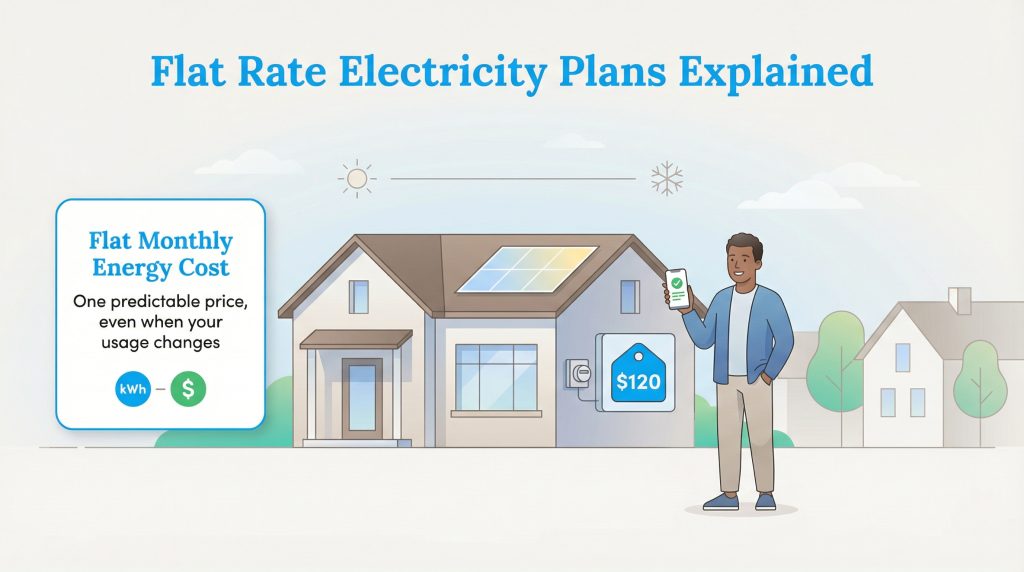
A flat rate electricity plan is a billing structure where you pay one set price for your electricity service each month, regardless of how much power you actually consume, up to a certain limit. Think of it like an unlimited cell phone plan or a Netflix subscription. You pay the same monthly fee whether you watch one movie or binge-watch an entire series. In the energy world, this provides a level of predictability that is rare in the utility sector.
These plans are most commonly found in deregulated energy markets, such as Texas, Pennsylvania, and Ohio. In these areas, Retail Electricity Providers (REPs) compete for your business by offering creative pricing models. While traditional billing charges you for every single kilowatt-hour (kWh) you use, a flat rate plan focuses on convenience and stability. It removes the volatility of seasonal weather spikes from your monthly expenses, allowing you to run your air conditioning without constantly worrying about the meter spinning.
How Flat Rate Billing Actually Works
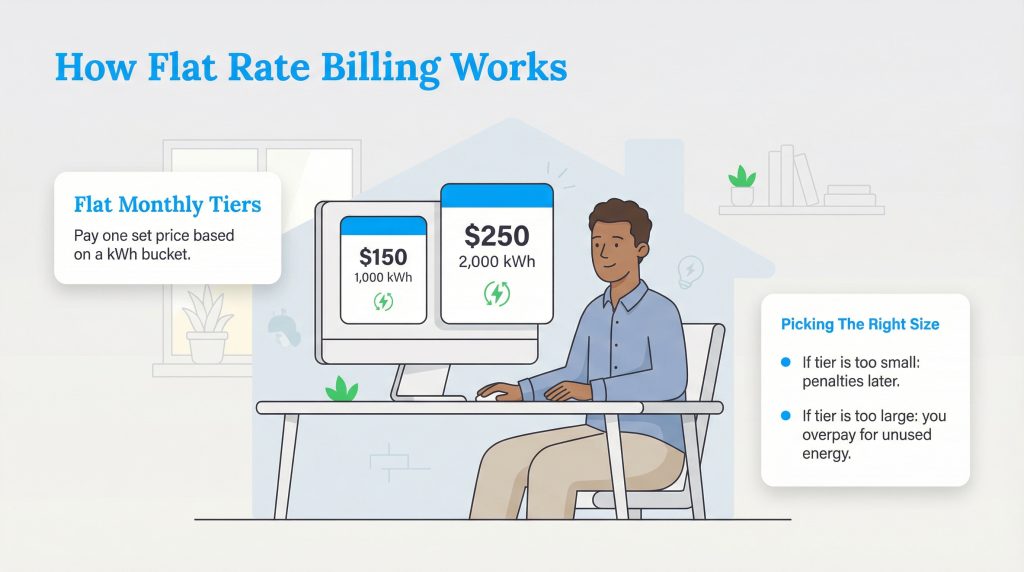
When you sign up for a flat rate plan, the provider typically offers different “tiers” or “buckets” based on your home’s estimated usage. For example, you might see a plan that costs $150 per month for usage up to 1,000 kWh, or a plan that costs $250 per month for usage up to 2,000 kWh. As long as your total electricity consumption for the billing cycle stays within that specific tier, your bill will be exactly the advertised price.
This structure works well if your usage is consistent. It simplifies the process of comparing electricity rates because you don’t have to calculate price per kWh multiplied by your usage. Instead, you just look at the final dollar amount. However, the mechanics of these plans rely heavily on you knowing your usage history intimately. If you select a tier that is too small for your home, you could face penalties. If you pick a tier that is too large, you are paying for energy you never used.
Flat Rate vs. Fixed Rate: What’s the Difference?
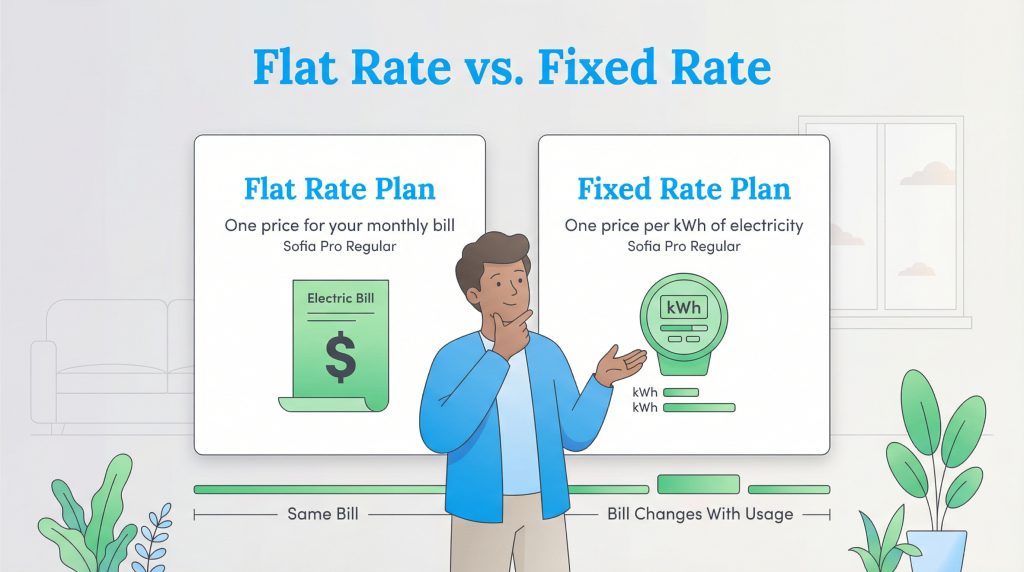
One of the most common sources of confusion for consumers is the difference between “flat rate” and “fixed rate” electricity plans. While they sound similar, they function very differently regarding how your final bill is calculated. A fixed rate plan locks in the price you pay for each unit of electricity (cents per kWh). Your rate stays the same, but your total bill will go up or down depending on how much electricity you use that month.
In contrast, a flat rate plan locks in your total bill amount. Whether you use 800 kWh or 950 kWh in a month, you pay the same total dollar amount. This offers superior budget stability but less flexibility if your lifestyle changes. Understanding this distinction is vital before signing a contract.
| Feature | Fixed Rate Plan | Flat Rate Plan |
|---|---|---|
| What is locked? | The price per kWh (e.g., 12¢/kWh). | The total monthly bill (e.g., $150/mo). |
| Bill Stability | Fluctuates with usage (high in summer/winter). | 100% predictable (within usage limits). |
| Ideal User | Budget-conscious users who conserve energy. | High-usage households seeking predictability. |
How Flat Rate Plans Compare to Other Billing Options
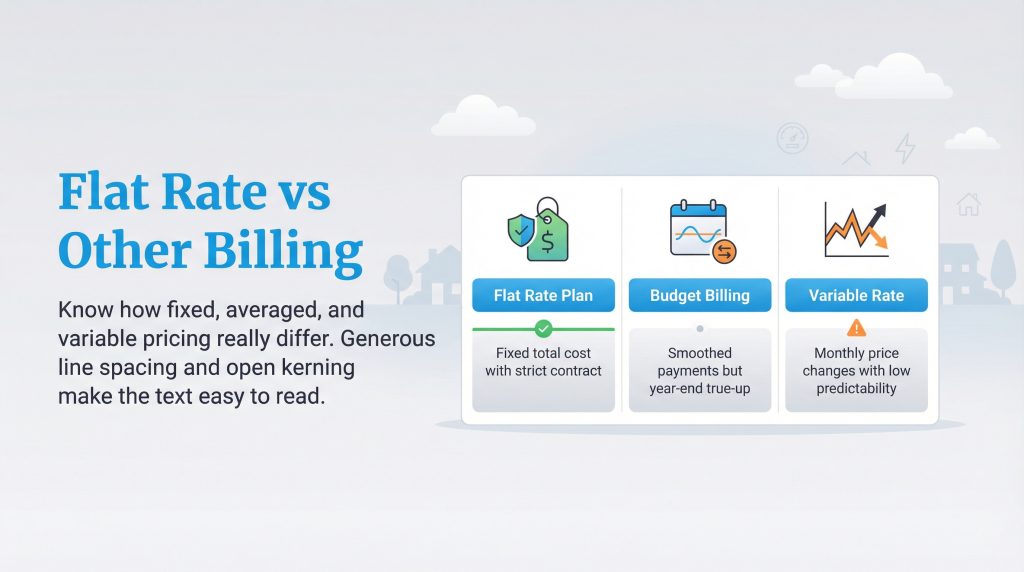
It is important not to confuse flat rate electricity with other common billing methods you might encounter. For instance, Budget Billing (or Average Billing) is a service offered by many traditional utility companies across the U.S. where your usage is averaged over 12 months to smooth out payments. However, unlike a flat rate plan, budget billing eventually reconciles your account; if you use more power than estimated, you will owe the difference at the end of the year.
You should also be aware of Variable Rate Plans, where the price per kWh can change monthly based on market conditions. These offer the least amount of predictability. While a variable plan might have no contract term, a flat rate plan offers the opposite extreme: a strict contract with a guaranteed total price, provided you stay within the lines.
The “Unlimited” Trap: Reading the Fine Print
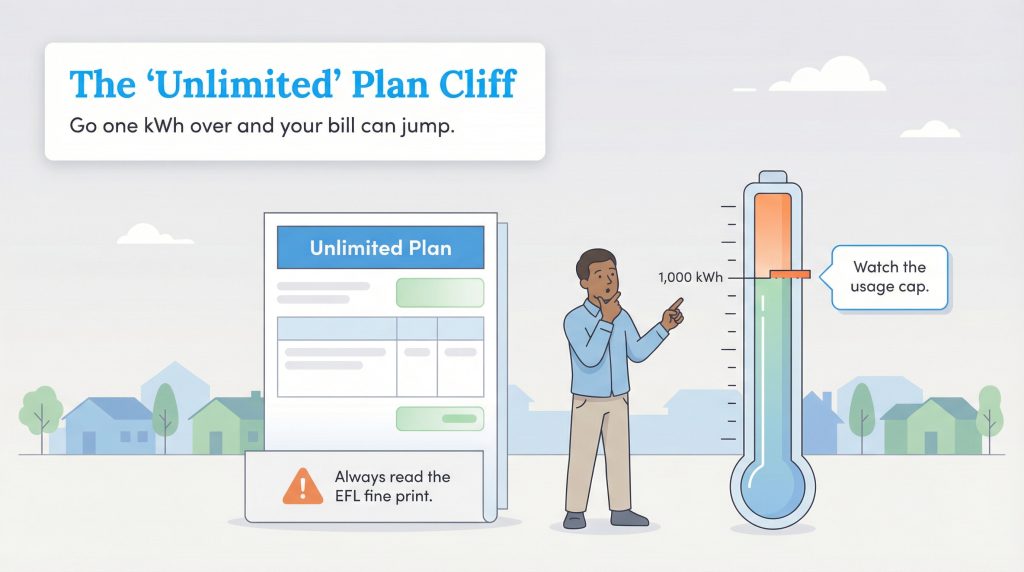
While the marketing materials often highlight “unlimited” usage, the fine print on the Electricity Facts Label (EFL) tells a different story. Most flat rate plans have a usage threshold, sometimes called a “cliff.” If your usage exceeds the agreed-upon cap, even by a single kilowatt-hour, the consequences can be expensive. Some plans will automatically bump you into a higher, much more expensive tier. Others may charge a steep overage fee or switch your entire bill to a high variable rate for that month.
For example, if your plan covers up to 1,000 kWh for $150, using 1,001 kWh could trigger a much higher bill. Some plans move you into a more expensive tier or apply high overage rates, which can easily add $50, $100, or more to your bill depending on the plan’s structure. This is the biggest risk of flat bill energy plans. You must monitor your usage carefully toward the end of the billing cycle to ensure you don’t accidentally cross the line. We recommend checking state-specific resources or consumer protection sites like PowerToChoose.org in Texas to read the EFL for any plan you are considering. These documents are legally required to disclose these penalties clearly.
Another potential downside is the lack of refund for under-usage. If you go on vacation for two weeks and only use 500 kWh on a 1,000 kWh plan, you still pay the full $150. In this scenario, your effective rate per kWh effectively doubles, making that month’s electricity incredibly expensive compared to a standard plan.
Pros and Cons of Flat Bill Energy Plans
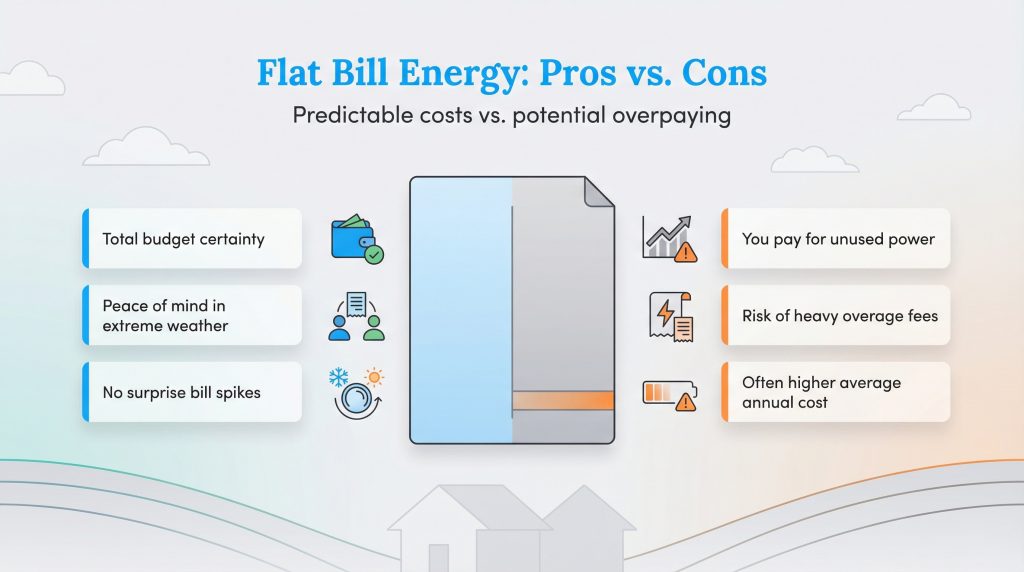
Deciding if a flat bill energy plan is worth it requires weighing the psychological benefit of predictability against the financial risk of overages. For some households, the peace of mind is worth a slightly higher average cost. For others, the lack of control over savings is a dealbreaker.
Pros:
- Total budget certainty: You know exactly what check to write every month, which is excellent for roommates splitting bills or families on fixed incomes.
- Peace of mind in extreme weather: You don’t have to stress about running the air conditioning during a heatwave or the heater during a freeze, provided you stay under the cap.
- No surprise spikes: You avoid the shock of a $400 bill in August that can wreck your monthly finances.
Cons:
- You pay for unused power: If you use less than your tier limit, you don’t save money. You pay the full price regardless of how efficient you are.
- Heavy penalties: Crossing the usage threshold can result in massive fees that erase any savings you might have gained in previous months.
- Higher average cost: Generally, you pay a premium for the convenience of a flat bill. A savvy user on a fixed-rate plan can usually achieve a lower annual cost.
Is a Flat Rate Plan Right for Your Home?
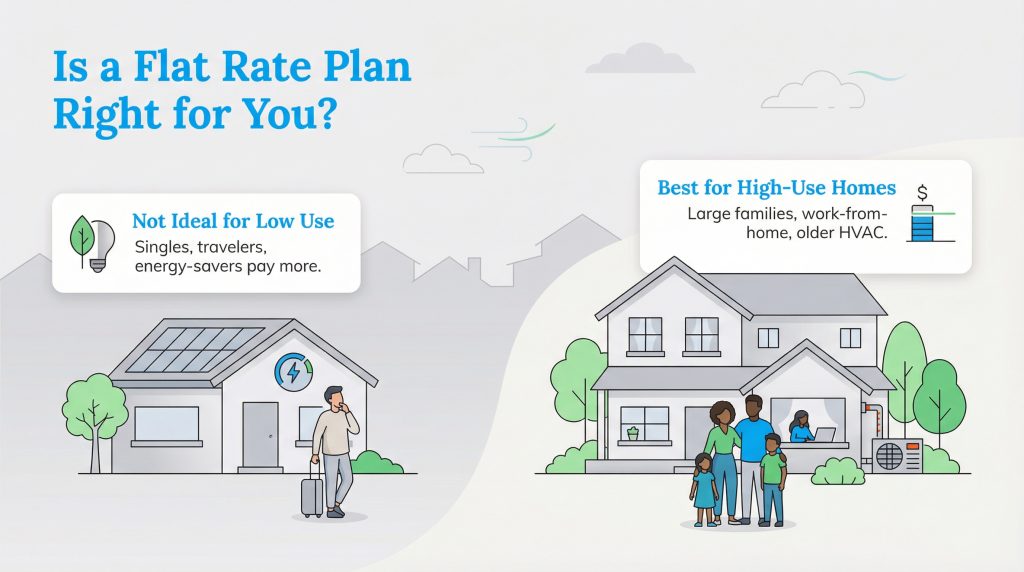
Flat rate plans are not a one-size-fits-all solution. They tend to favor specific types of households while penalizing others. You are likely a good candidate for a flat rate plan if you have a large family, work from home, or live in a house with an older, inefficient HVAC system. If you know your home consumes a lot of power and you are consistently near the upper limit of a tier without going over, you could get great value. It effectively caps your costs during the most energy-intensive months of the year.
Conversely, these plans are rarely a good deal for single occupants, frequent travelers, or people who are extremely energy-conscious. If you travel for work or take long vacations, you will be donating money to the electric company for power you didn’t use. Furthermore, if you are the type of person who turns off lights and adjusts the thermostat to save money, a flat rate plan removes the financial reward for your eco-friendly habits.
Speaking of eco-friendly habits, there is a sustainability angle to consider. Flat rate plans can accidentally discourage energy conservation because there is no financial incentive to use less power. However, we encourage you to maintain green habits regardless of your billing structure. Reducing strain on the grid helps prevent blackouts and reduces the need for carbon-intensive peaker plants to fire up during high demand. Consider visiting our sustainable living section for more ways to reduce your carbon footprint.
Why You Should Check Your Usage History First
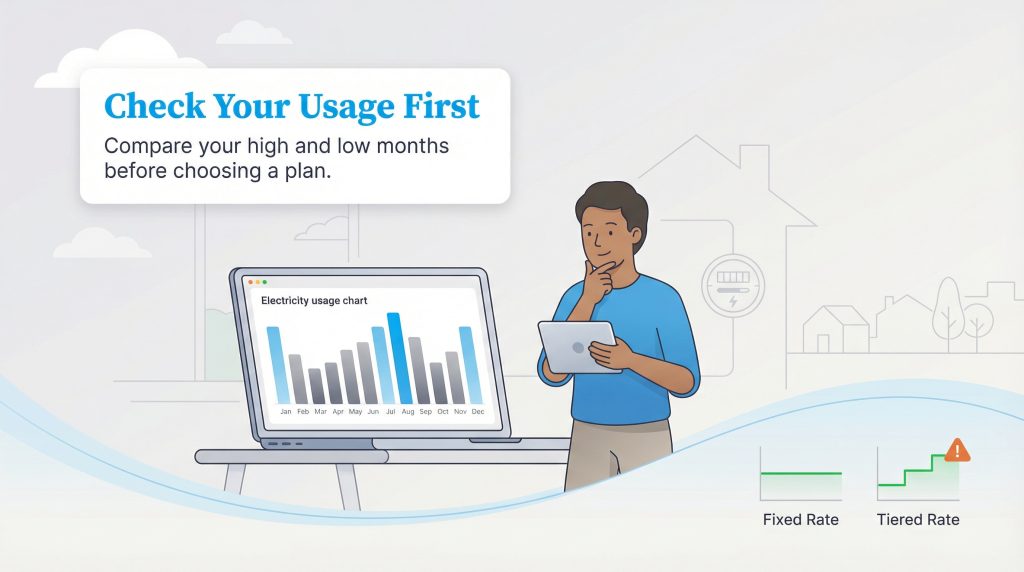
Before you commit to a contract that could last 12 to 24 months, you need to look at your data. Log in to your current electricity provider’s portal and download your usage history for the last year. Look at your highest usage month (usually August or January) and your lowest usage month (usually April or October). If your usage fluctuates wildly, for example, 500 kWh in spring and 2,500 kWh in summer, a flat rate plan might be dangerous.
You need a plan that accommodates your peak usage without forcing you to overpay during your low-usage months. If you can’t find a tier that fits your range comfortably, you are likely better off with a fixed-rate plan. If you want to lower your usage to fit into a cheaper tier, check out our guide on how to save on your electric bill by improving your home’s efficiency.
Choosing The Best Plan For Your Home
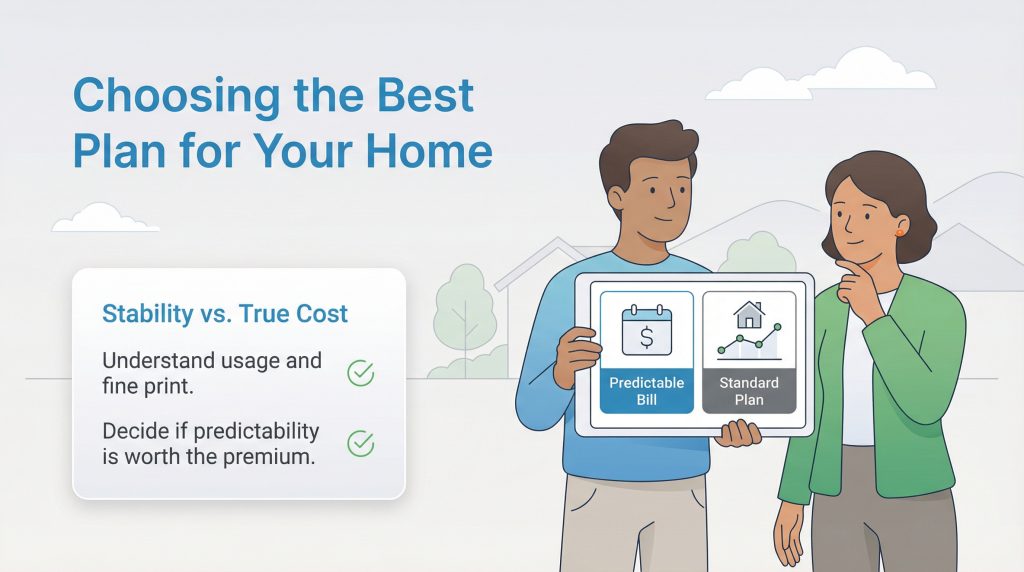
While the peace of mind of a flat bill is undeniable, it often comes at a premium price. The convenience of knowing exactly what you will pay is a luxury service in the energy market, and providers price it accordingly. If you value stability over getting the absolute lowest rock-bottom price per kWh, this could be the right choice for you. Just remember that “predictable” does not always mean “cheaper.”
The most important step you can take is to read the fine print regarding overages and tier limits. Don’t let a marketing flyer dictate your financial commitment. By understanding your own usage habits and the terms of the contract, you can take control of your utility budget and choose a plan that serves your needs, rather than one that traps you in fees. When you understand your own usage and the fine print, you can decide whether predictable bills are worth the premium — or if a fixed-rate or standard plan will serve your home better.
FAQs About Flat Rate Plans
What is the difference between flat rate and fixed rate electricity?
Are unlimited energy plans actually unlimited?
Does a flat rate plan save money?
What happens if I use less electricity than the flat rate tier?
Are flat rate plans available in every state?
What should I look for in the Electricity Facts Label (EFL)?
Can I get a flat rate electricity plan with no deposit?
About the Author

LaLeesha has a Masters degree in English and enjoys writing whenever she has the chance. She is passionate about gardening, reducing her carbon footprint, and protecting the environment.