
Smart upgrades to lower your utility bills and maximize your tax refunds this year
Key Takeaways
- Heat pumps and biomass stoves offer the highest federal tax credits, with a separate $2,000 annual limit.
- Building envelope improvements like windows, doors, and insulation share a combined $1,200 annual tax credit limit.
- Home energy audits are a cost-effective first step to identify waste and can qualify for a $150 credit.
Rising utility costs are a reality for almost every homeowner, but living in a drafty, expensive home doesn’t have to be. Thanks to the Inflation Reduction Act, the government has revamped the way you can claim money back for renovations, making 2025 an excellent time to tackle those long-awaited projects. We want to guide you through the most effective energy efficient home improvements that not only lower your monthly bills but also qualify you for the lucrative 25C tax credit when you file your taxes.
Understanding the Energy Efficient Home Improvement Credit (25C)
Before you rush to the hardware store, it helps to understand the financial incentives available to you. The Energy Efficient Home Improvement Credit, often referred to by its tax code “25C,” allows you to claim a credit for 30% of the cost of qualified projects. Unlike previous versions of this credit that had a lifetime cap, the current limits reset annually. This means you can plan your renovations over several years to maximize your returns.
There is a crucial distinction in how the money is allocated. The credit is split into two main buckets:
- The $1,200 Annual Limit: This applies to “building envelope” upgrades like exterior doors, windows, skylights, and insulation.
- The $2,000 Annual Limit: This is reserved specifically for heat pumps, heat pump water heaters, and biomass stoves.
Here is a quick look at how the main categories of improvements compare:
| Project Type | Max Annual Federal Credit | Typical Impact on Energy Use |
|---|---|---|
| Insulation, windows, doors | Up to $1,200 total | Cuts heating and cooling losses; helps every season |
| Heat pumps, heat pump water heaters, biomass stoves | Up to $2,000 total | Major reductions in heating/cooling or water heating energy |
| Home energy audit | Up to $150 | Identifies the best upgrades for your specific home |
These numbers reflect federal credits only. Local rebates may stack on top, increasing your total savings.
Top Energy Efficient Home Envelope Upgrades (The $1,200 Bucket)
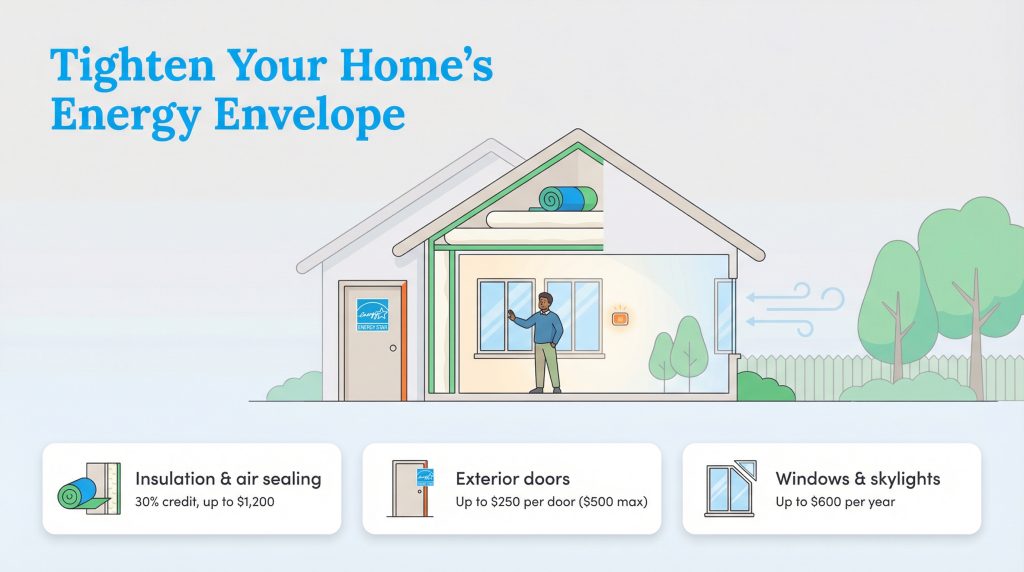
The “envelope” of your home refers to the physical barrier between the conditioned air inside and the raw elements outside. Tightening this envelope is often the most affordable way to stop wasting energy. Remember, all upgrades in this section share a combined annual tax credit cap of $1,200.
Insulation and Air Sealing
Insulation upgrades for old homes often provide the highest return on investment because they stop heat from escaping through your attic and walls. Whether you use spray foam, cellulose, or fiberglass, adding insulation keeps your home’s temperature stable so your HVAC system doesn’t have to work as hard. To qualify for the credit, the materials must meet the International Energy Conservation Code (IECC) standards currently in effect. In practice, this means buying insulation labeled as meeting or exceeding your local building code or IECC 2018/2021 standards, your contractor or product label should call this out.
Snapshot:
Estimated Cost: $1,500 – $3,000 (varies by size)
Max Credit: 30% of cost, up to $1,200
Exterior Doors
Replacing an old, warped door with a modern model can significantly reduce drafts. To claim the credit, your new doors must be ENERGY STAR certified. It is important to note that there is a specific sub-limit for doors within the $1,200 bucket. You can claim up to $250 per door, with a total maximum of $500 for all doors installed in a year.
Snapshot:
Estimated Cost: $800 – $2,500 per door
Max Credit: $250 per door ($500 total)
Energy Efficient Windows and Skylights
If you are still living with single-pane windows, upgrading them is one of the most impactful energy efficient home improvements you can make. However, the standards for the tax credit are stricter here. Windows and skylights must meet the “ENERGY STAR Most Efficient” certification requirements, not just the standard ENERGY STAR rating. There is also a specific cap of $600 per year for windows.
Snapshot:
Estimated Cost: $600 – $1,200 per window
Max Credit: $600 total per year
If your home feels drafty or your bills are unpredictable, start with these building envelope upgrades because they help every heating and cooling system work more efficiently. For more tips on managing your heating costs after sealing your home, check out our guide on natural gas efficiency.
Energy Efficient Heating and Cooling With Heat Pumps
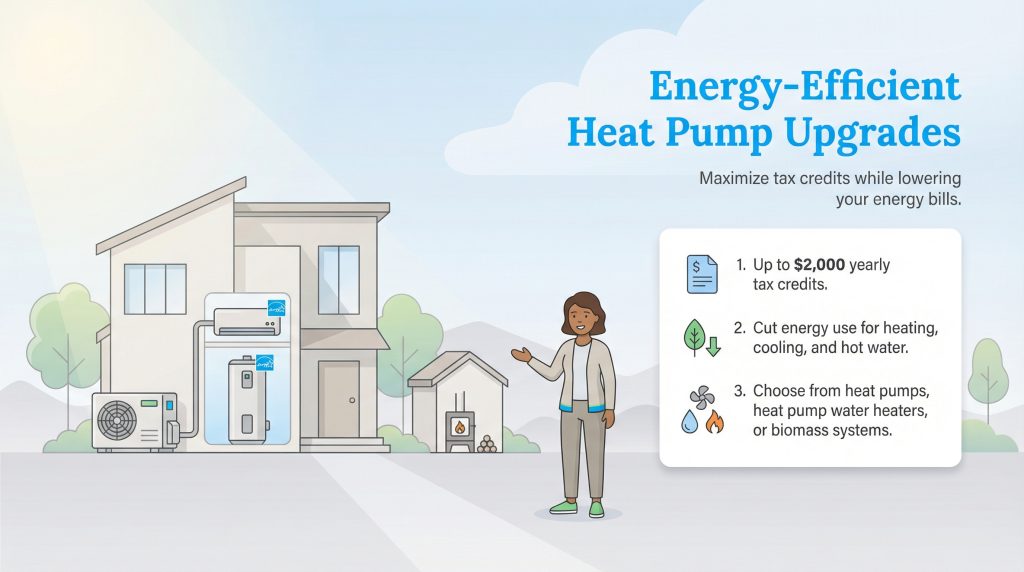
These “big ticket” items are separated into their own category because they deliver massive energy savings. The federal government encourages these upgrades by offering a higher separate credit limit of $2,000 per year. If your equipment is already old or failing, it can make more sense to start with these major systems and then tackle envelope upgrades next.
Heat Pumps for Heating and Cooling
A heat pump is the gold standard for efficient electric heating and cooling. Instead of generating heat by burning fuel, it moves heat from one place to another, making it incredibly efficient even in colder climates. Because these systems replace both your furnace and your air conditioner, they are a significant investment, but the $2,000 tax credit helps soften the upfront cost. Because they’re powered by electricity instead of burning fossil fuels, heat pumps are an eco-conscious alternative that can significantly reduce your home’s carbon footprint, especially if your electricity comes from cleaner sources or you plan on installing solar panels later.
Heat Pump Water Heaters
Water heating is typically the second-largest energy expense in a home. A heat pump water heater pulls warmth from the surrounding air to heat water, using a fraction of the electricity of a standard unit. These units fall under the same $2,000 annual cap as HVAC heat pumps, so you may want to install them in different years to maximize your tax benefits.
Biomass Stoves and Boilers
If you live in a rural area or a particularly cold climate, you might consider a biomass stove. These burn plant-derived fuel, like wood pellets, to provide heat. High-efficiency models with a thermal efficiency rating of at least 75% qualify for the $2,000 credit, offering a sustainable alternative to oil or propane. For some households, high-efficiency biomass systems can be a more environmentally mindful choice than heating oil, especially when you’re using sustainably sourced pellets or wood.
Always verify your equipment qualifies before purchasing by using the ENERGY STAR Product Finder.
Smaller Wins: DIY Energy Efficient Home Improvements
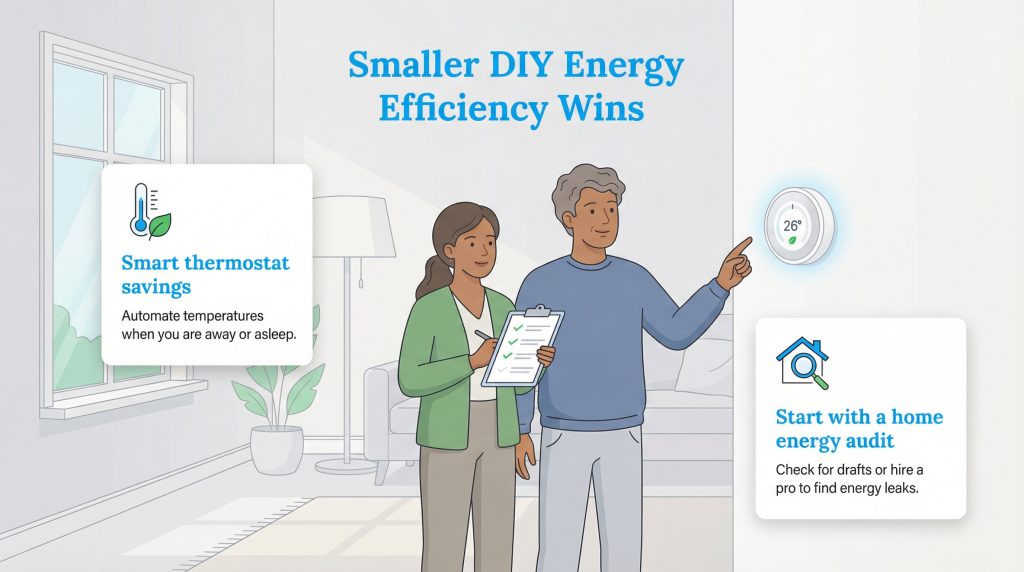
Not everyone is ready to tear down walls or replace a furnace. Fortunately, there are smaller, DIY-friendly projects that can still make a dent in your bills and help you save on your electric bill.
Smart Thermostats
Smart thermostats are excellent tools for managing your energy usage. They learn your schedule and automatically adjust temperatures when you are away or asleep, ensuring you aren’t paying to heat or cool an empty house. While smart thermostats generally do not qualify for the federal 25C tax credit, they are frequently eligible for local utility rebates that can cover a large portion of the purchase price. Check your local utility’s website for rebate details, since these are separate from federal 25C incentives.
The Home Energy Audit
If you aren’t sure where to start, a home energy audit is the best first step. A professional auditor will inspect your home to identify exactly where you are losing energy. The tax code provides a specific credit of up to $150 for a professional audit. If you prefer a DIY approach, you can check for drafts around windows and switch old bulbs to LEDs, though the professional inspection is required to claim the credit.
Before scheduling an audit, check the IRS instructions for Form 5695 to ensure your auditor meets the necessary certification requirements.
Investing in Efficiency Pays Off
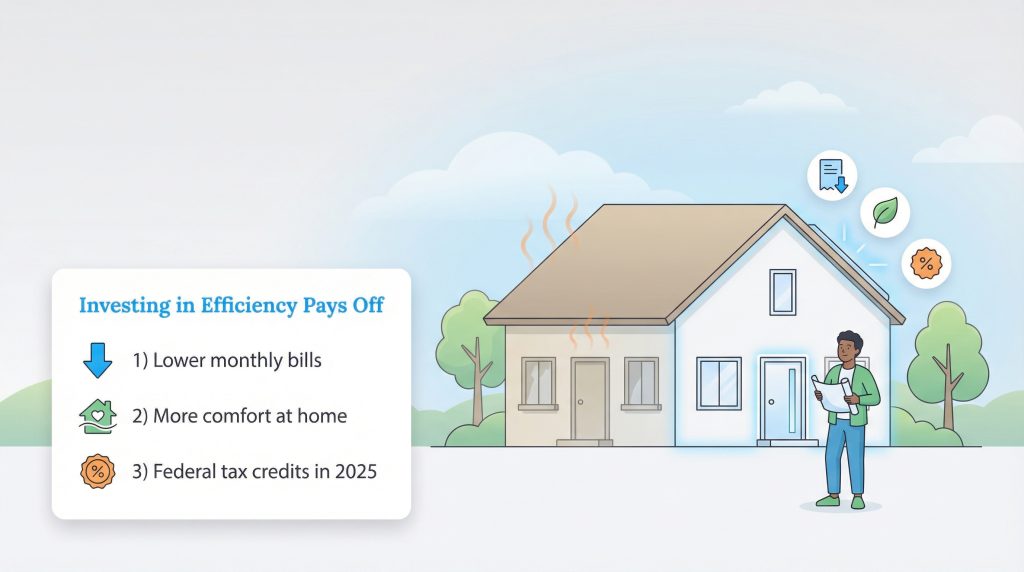
Upgrading your home for efficiency requires an upfront investment, but the long-term payoff is undeniable. Between lower monthly bills, a more comfortable living environment, and substantial federal tax credits, 2025 is the perfect time to start making changes. We recommend picking just one project to start with, perhaps upgrading your insulation or swapping out drafty doors, and seeing how much better your home feels. Beyond the tax savings, these upgrades make your home more comfortable and can dramatically cut your energy use, an environmentally mindful choice that pays off for both your wallet and the planet.
FAQs About Energy Efficient Upgrades
What is the energy efficient home improvement credit (25C)?
What is the difference between a tax credit and a rebate?
Do new homes qualify for the energy efficient home improvement credit?
Can I claim the energy efficient home improvement credit every year?
Do I need to replace all my windows to get the tax credit?
Does roofing qualify for the energy efficiency tax credit?
How much does a home energy audit cost?
Should I use my 25C credit for windows or a heat pump first?
About the Author

LaLeesha has a Masters degree in English and enjoys writing whenever she has the chance. She is passionate about gardening, reducing her carbon footprint, and protecting the environment.