

LFP Batteries Can Support Solar Storage and Backup Power, but Savings and Runtime Depend on Your System and Utility Rates
Key Takeaways
- LFP is a type of lithium-ion battery commonly used for home solar storage and backup power.
- LFP offers strong thermal stability, but safe installation still depends on certified equipment, protective controls, and local requirements.
- Your utility rates, backup needs, and installed cost determine whether an LFP system is a good fit for your home.
Setting up utilities in a new home or upgrading your current electrical setup comes with big decisions, particularly when shopping for whole-home backup power. When comparing batteries to keep your refrigerator running during a storm, store rooftop solar energy, or manage a stubborn monthly electric bill, the specifications can seem complex. You don’t need a degree in electrochemistry to protect your house from blackouts. We are breaking down how an LFP battery works so you can decide if it is the right energy-saving option for your home and budget.
How LFP Differs From Other Lithium-Ion Batteries
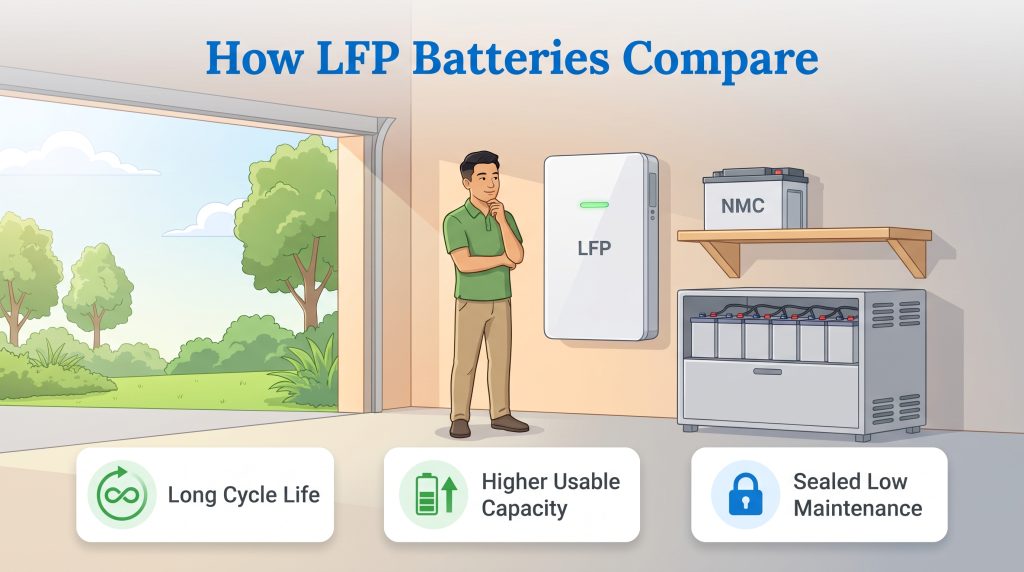
LFP stands for lithium iron phosphate, commonly written as LiFePO4. An LFP battery is a rechargeable lithium-ion battery that uses lithium iron phosphate in its cathode. Think of an LFP battery like a rechargeable water tank for your home’s electricity. When your rooftop solar panels soak up afternoon sunshine or your utility grid offers cheap overnight power, lithium ions travel from the positive side (cathode) to the negative side (anode) to store energy, then flow right back to run your appliances at night.
LFP vs. NMC for Home Energy Storage
When you compare LFP and NMC batteries, the main trade-off typically involves physical weight and lifecycle expectations. NMC batteries pack a lot of energy into a smaller, lighter footprint, which is why automakers use them in long-range electric cars. Once a battery is bolted permanently to your garage or basement wall, weight and footprint may be less important than in a vehicle, but they still affect installation constraints. LFP batteries generally provide excellent cycle life for daily residential use, often outlasting comparable NMC options when cycled heavily, though exact lifespan depends heavily on the specific product, operating temperatures, and how deeply it is discharged.
Quick Fact
LFP chemistry has become the dominant choice for stationary residential energy storage because homeowners and utilities prioritize thermal stability and cycle life over compact size.
LFP vs. Lead-Acid for Backup Power
If you are upgrading an older off-grid cabin or replacing a backup bank, looking at LFP and lead-acid batteries reveals how far storage technology has come. Traditional lead-acid batteries have a lower upfront cost, but their life depends heavily on design, discharge depth, and temperature. Here is how modern lithium iron phosphate compares to legacy lead-acid systems:
- Cycle Life: LFP batteries typically deliver thousands of deep cycles before significant degradation, while lead-acid batteries generally require replacement much sooner under similar daily use.
- Depth of Discharge (DoD): DoD measures how much of the battery’s tank you can drain before recharging. You can safely use a much higher percentage of an LFP battery’s capacity — often up to 100% depending on the manufacturer — whereas frequently draining a lead-acid battery past 50% severely shortens its service life.
- Maintenance: Unlike flooded lead-acid banks that require distilled water top-offs and specialized acid ventilation, LFP modules are completely sealed and do not need fluid checks, though they still require software updates, occasional inspections, and proper ventilation clearances.
| Feature | LFP (LiFePO4) | NMC (Nickel Manganese Cobalt) | Lead-Acid (AGM / Gel) |
|---|---|---|---|
| Average Lifespan | High cycle life (varies by product and use) | Moderate cycle life | Lower cycle life (sensitive to deep cycling) |
| Usable Capacity (Depth of Discharge) | Generally 80% to 100% | 80% to 90% | Typically limits at 50% to prevent rapid aging |
| Thermal Safety | Strong stability (requires proper BMS controls) | Moderate (requires heavy cooling/management) | High (but vents hydrogen gas if overcharged) |
| Environmental Impact | Cathode does not require cobalt or nickel | Uses mined cobalt and nickel | Contains toxic lead and sulfuric acid |
| Best Home Use Case | Whole-home solar storage and daily bill savings | Space-constrained or weight-sensitive setups | Low-budget, occasional emergency backup |
Safety Considerations for Home Installation
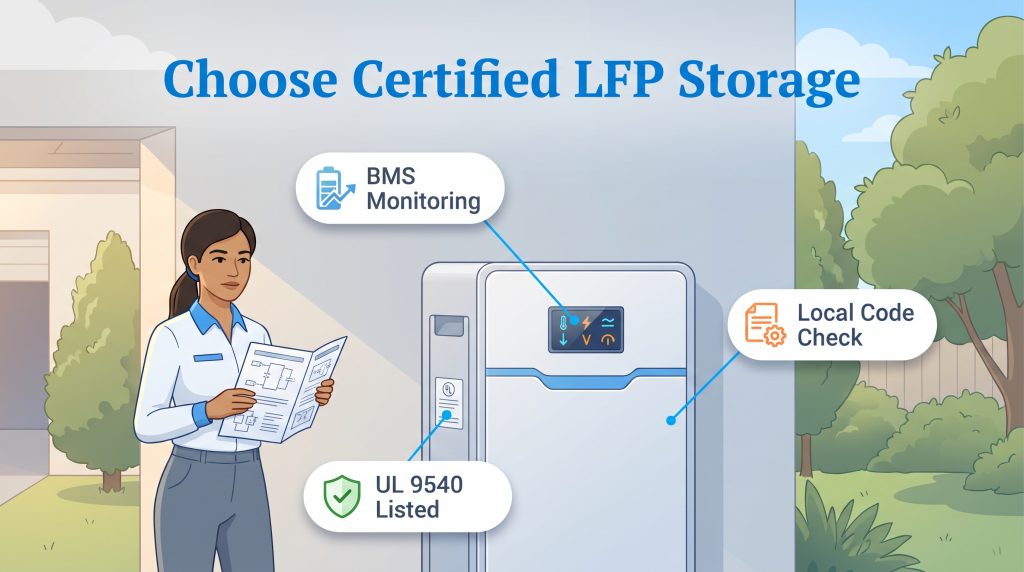
LFP generally offers greater thermal stability than nickel-rich lithium-ion chemistries, which is one reason it’s widely used in home storage. It isn’t fireproof, though. Choose a properly certified system and have it installed according to the manufacturer’s instructions and local requirements. Every reputable residential LFP unit also comes with an internal Battery Management System (BMS). Your BMS works like a smart circuit breaker that monitors cell temperatures, voltage, and electrical current, designed to shut the battery down if it detects unsafe conditions.
Understanding UL Fire Codes and Certifications
Ask whether the complete system is listed to UL 9540 and whether the installer can provide applicable UL 9540A test documentation. UL 9540 addresses safety requirements for energy storage systems, while UL 9540A is a test method used to evaluate thermal runaway fire propagation. Your local permitting authority determines which installation requirements apply to your specific home setup.
Eco Edge
Because LFP battery cathodes do not require cobalt or nickel, they offer an environmentally mindful choice that avoids some of the complex supply chain issues associated with other lithium-ion chemistries.
Evaluating LFP Batteries for Utility Savings
Installing an LFP battery for home solar gives you more control over when you use stored electricity. Instead of sending your extra midday solar power back to the electric company for pennies, you can bottle it up for your own evening use. As the U.S. Energy Information Administration’s guide to energy storage for electricity generation explains, these power sources capture and release electricity on demand. However, don’t assume a new installation automatically qualifies for a federal residential clean energy tax credit. Check current IRS guidance and your state and utility programs before including incentives in your budget, as the Section 25D Residential Clean Energy Credit is unavailable for expenditures made after Dec. 31, 2025.
Managing Time-of-Use Rates With Energy Arbitrage
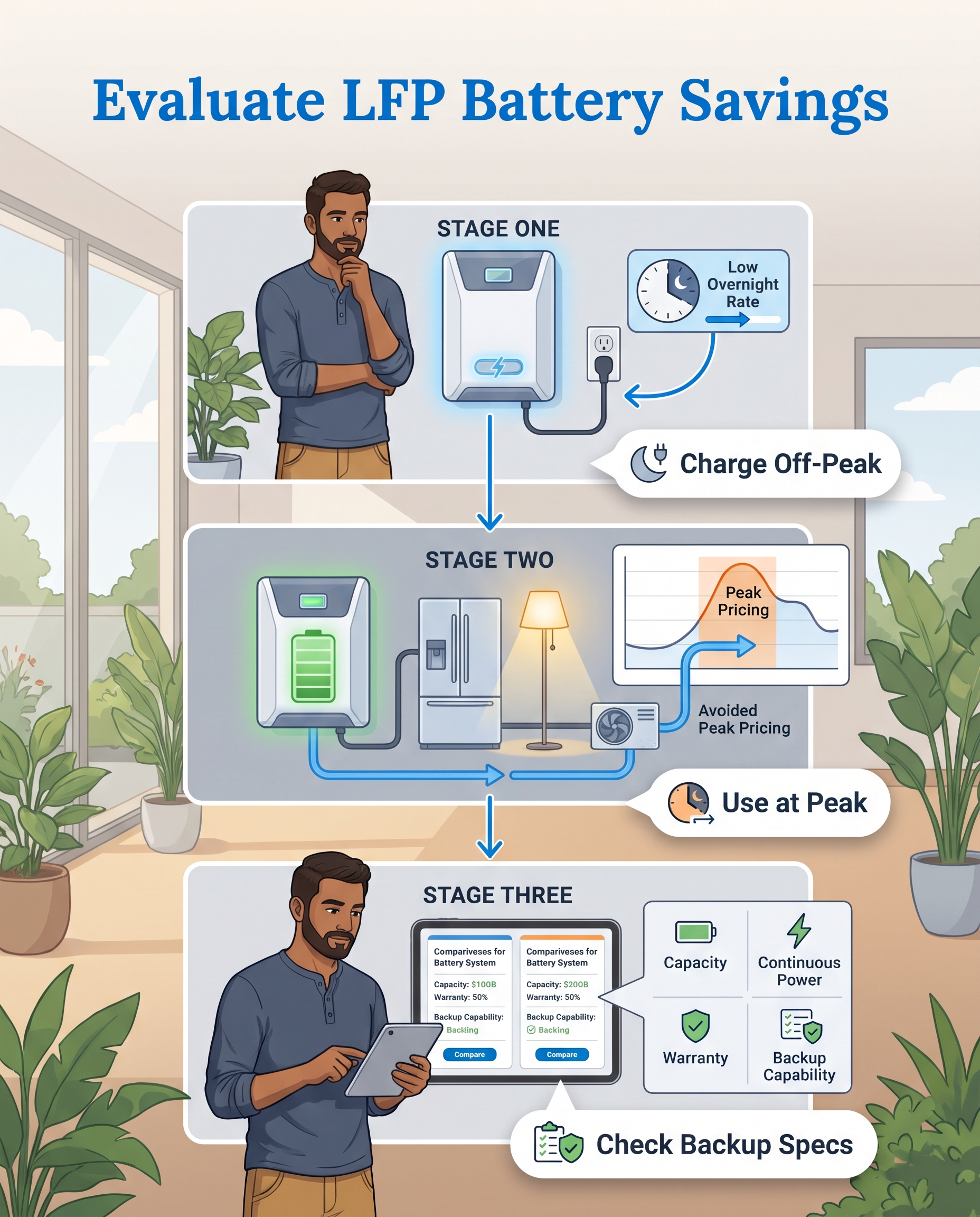
You don’t even need solar panels on your roof to lower your electric bill with an LFP battery. Across the country, electric utilities are shifting households onto Time-of-Use (TOU) rate plans where electricity is cheap overnight but surges in price between 4 p.m. and 9 p.m. An LFP system automates a money-saving strategy called time-of-use load shifting. If off-peak electricity costs $0.12/kWh and your system has 90% round-trip efficiency, delivering one stored kWh costs about $0.133 in charging electricity. Avoiding a $0.35/kWh peak rate would save about $0.217 per delivered kWh before equipment, financing, and other costs.
How to Choose an LFP Home Battery
When you’re ready to compare quotes for home battery backup, you’ll see popular whole-home systems from brands like Tesla, Enphase, and Anker. Confirm that your quote includes outage-backup capability, as some storage configurations are designed primarily for bill management and won’t power your home when the grid goes down. Pay close attention to these specifications:
- Storage Capacity (kWh): Measured in kilowatt-hours, this tells you how much electricity the tank holds. To estimate how long it will last during an outage, use this formula: Approximate runtime = energy available for backup ÷ average backed-up load. If 10 kWh is available and your selected circuits average 0.5 kW, the simple estimate is 20 hours before accounting for conversion losses and limits.
- Continuous Power Rating (kW): Measured in kilowatts, this dictates how many heavy appliances can run at the exact same time. An air conditioner or well pump may require substantial startup power, so capacity in kWh alone does not determine whether the equipment will run.
- Warranty Terms: A quality LFP battery should come with a 10-year to 15-year warranty outlining the expected capacity retention at the end of the term under specific operating conditions.
Money-Saver
Ask your local electric utility about Virtual Power Plant (VPP) or battery demand-response programs, which can pay you incentives for letting the utility draw small amounts of stored LFP battery power during extreme grid emergencies.
Installation Placement and LFP Battery Charging Guidelines
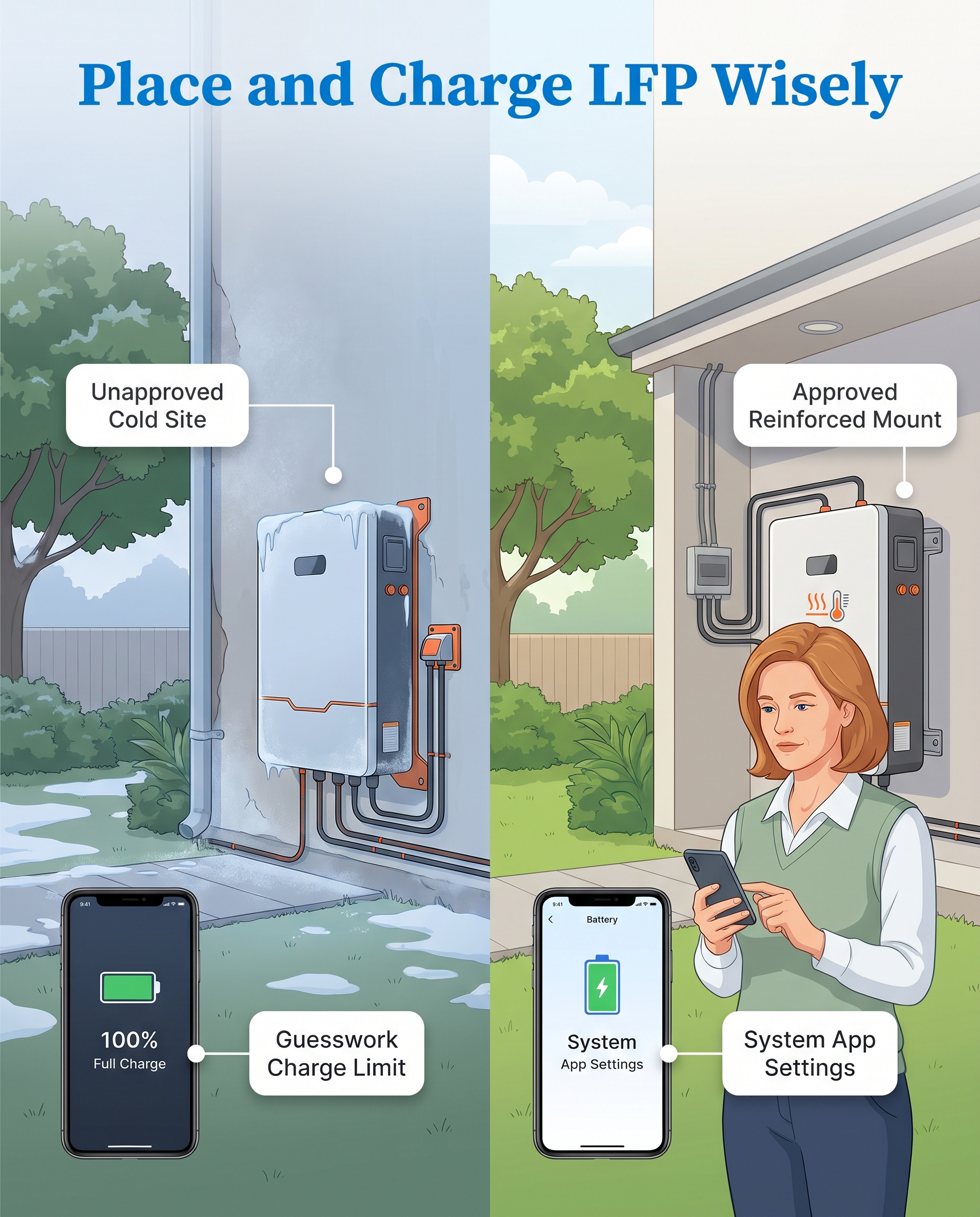
Although LFP batteries require less physical maintenance than flooded lead-acid banks, where you mount them and how you manage their software settings play a huge role in getting the maximum lifespan out of your investment.
Follow Your Manufacturer’s Charging Recommendations
Some LFP systems periodically charge fully to help estimate charge levels or balance cells. Follow your system’s operating instructions rather than applying a universal 80% or 100% rule, and choose a backup reserve that fits your outage needs. Extended storage at high charge levels can still contribute to aging, so your installer or manufacturer app is the best source for daily charging limits.
Protecting Your Battery From Freezing Winter Temperatures
Cold temperatures can reduce available power and capacity, and many unheated LFP cells restrict charging near or below freezing. However, check the complete system’s operating range and cold-weather controls rather than relying on a general chemistry rule. A complete residential system may heat its cells and operate in outdoor conditions below freezing. Follow these placement rules to protect your equipment in colder climates:
- Verify Approved Locations: Have your installer confirm approved locations, structural support, temperature limits, required clearances, and local fire-code requirements before choosing an indoor or outdoor installation.
- Look for Built-In Thermal Heaters: If your local municipal fire codes require outdoor mounting, choose an LFP home battery system equipped with internal thermal heating controls that automatically manage temperatures before soaking up morning solar power.
Heads Up
Whole-home LFP battery modules are heavy — often weighing between 150 and 300 pounds depending on the model — so wall-mounted installations require reinforced structural support and must always be wired by a licensed electrician.
Deciding if LFP Energy Storage Fits Your Home
Whether you’re setting up utilities in a brand-new house, planning a rooftop solar upgrade, or simply tired of tossing out spoiled groceries every time a summer thunderstorm knocks out the grid, LFP batteries give you greater control over your household power. By swapping out volatile heavy metals for stable iron and phosphate, LiFePO4 systems deliver reliable backup capability supported by proper installation and protective controls.
Ready to see what size battery fits your household? Grab your last few electric bills to check your average daily kilowatt-hour usage, see what time-of-use rates or storage rebates your utility offers, and reach out to certified local installers to compare custom quotes.
Frequently Asked Questions About LFP Batteries
Here are some of the most common questions homeowners ask about LFP battery systems and how they integrate into residential power setups.
Is LiFePO4 the Same Thing as an LFP Battery?
How Many Years Do LFP Home Batteries Last?
Can I Install an LFP Home Battery Backup Without Solar Panels?
What Happens to an LFP Battery During a Freezing Winter Storm?
Are LFP Batteries Better for the Environment Than Regular Lithium Batteries?
How Many LFP Batteries Do I Need to Power My Entire House?
About the Author

David has been an integral part of some of the biggest utility sites on the internet, including InMyArea.com, HighSpeedInternet.com, BroadbandNow.com, and U.S. News. He brings over 15 years of experience writing about, compiling and analyzing utility data.

Jared Evans is a licensed electrician and the owner of Full Circuit Electric in Omaha, Nebraska. As an expert reviewer for UtilitiesForMyHome.com, Jared uses his 10+ years of hands-on experience to ensure our electrical advice is safe, accurate, and easy to follow. Whether he's troubleshooting a complex wiring issue or sharing tips on green energy upgrades, Jared is dedicated to helping you power your home efficiently — and safely.