
Key Takeaways
- Rates Are Spiking: Effective for January 2026, Columbia Gas of Ohio has increased its Standard Choice Offer (SCO) rate to $0.7937 per Ccf, while CenterPoint Energy Ohio has raised its rate to $0.7215 per Ccf.
- Why Costs Are Up: The increases are driven by a rise in the wholesale cost of natural gas (settling at $4.687 per Mcf) and a sharp jump in the “Retail Price Adjustment” fees that suppliers charge to service utility accounts.
- Who Is Affected: The rate hike impacts millions of residential heating customers across the state, specifically hitting major population centers like Columbus, Toledo, and Dayton.
- How to Save: Consumers can potentially avoid these higher default rates by enrolling in municipal aggregation programs (like NOPEC) or by shopping for competitive fixed-rate plans, which are currently offering rates as low as $0.60–$0.65 per Ccf.
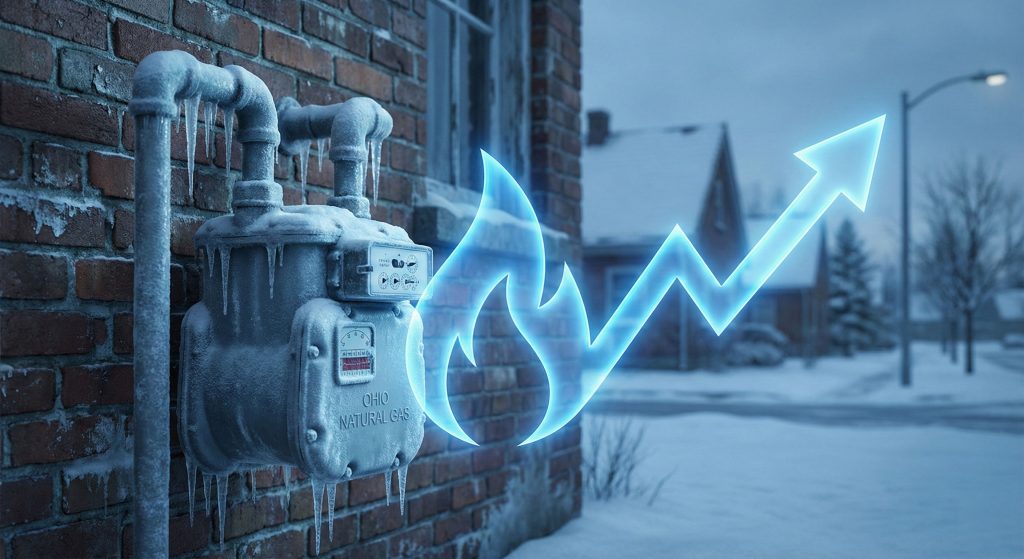
Ohio residents using natural gas for heating are facing a steep financial reality to start the new year. Effective for the January 2026 billing cycle, the state’s two largest investor-owned utilities, Columbia Gas of Ohio and CenterPoint Energy Ohio, have implemented significant rate increases for customers on the default Standard Choice Offer (SCO).
For households across the state, from Toledo to Dayton, this means higher heating bills right as winter weather settles in.
The Numbers: What You Will Pay
For customers who have not chosen a competitive supplier, the new rates for January 2026 are:
- Columbia Gas of Ohio: The rate has jumped to $0.7937 per Ccf (100 cubic feet). This represents a nearly $0.28 increase compared to January of last year.
- CenterPoint Energy Ohio (formerly Vectren): The rate has risen to $0.7215 per Ccf.
For an average home using 15-20 Mcf (150-200 Ccf) during a cold winter month, the difference in supply costs alone, excluding distribution fees, could add tens of dollars to monthly bills compared to previous lows.
Why Are Rates Rising?
The price hike is driven by a “perfect storm” of three factors affecting the energy market:
1. The “Retail Price Adjustment” (RPA) Explosion The most significant hidden driver is the Retail Price Adjustment, a fee determined by annual auctions that suppliers charge to service utility customers.
- Columbia Gas: The RPA for the current period nearly doubled, jumping from roughly 16 cents to 32.5 cents per Mcf. This means suppliers are charging significantly more just to manage the risk of serving accounts.
- CenterPoint Energy: The adjustment spiked by 70%, rising from $1.30 to $2.20 per Mcf. Uncertainty regarding the pending sale of CenterPoint’s Ohio assets may be contributing to these higher risk premiums priced in by suppliers.
2. A Bullish Wholesale Market The base cost of the gas itself, determined by the NYMEX Henry Hub market, settled at $4.687 per MMBtu for January 2026. This is notably higher than previous mild winters, driven by lower national storage levels and high demand for U.S. Liquefied Natural Gas (LNG) exports abroad.
3. Infrastructure Costs Beyond the gas rate, customers are paying more for the pipes that deliver it. Both utilities have PUCO-approved “riders” to cover pipeline replacements. For example, CenterPoint customers now pay a flat $14.30 per month for the Distribution Replacement Rider (DRR) alone, on top of their base customer charge.
Who Is Impacted?
These changes affect millions of residents across specific regions of Ohio.
Columbia Gas of Ohio ($0.7937/Ccf) serves approximately 1.5 million customers, heavily impacting:
- Central Ohio: Columbus, Westerville, Grove City, Hilliard, Dublin.
- Northwest Ohio: Toledo, Maumee, Perrysburg.
- North Central Ohio: Mansfield, Marion.
- Northeast Ohio (suburbs): Lorain, Elyria, Parma, Strongsville.
- Eastern Ohio: Springfield, Zanesville.
CenterPoint Energy Ohio ($0.7215/Ccf) serves about 333,000 customers in West Central Ohio, specifically:
- The Dayton Region: Dayton, Kettering, Centerville, Huber Heights.
- Miami Valley: Troy, Piqua, Sidney, Beavercreek, Xenia, Greenville, and Eaton.
What Can You Do?
If you are currently paying the default utility SCO rate, you are exposed to these market fluctuations. However, because the utility rates have risen so sharply, “headroom” has opened up for competitive suppliers to offer lower fixed rates.
- Check “Apples to Apples”: Recent filings on the Energy Ohio website show some competitive suppliers offering fixed rates in the $0.60 – $0.65 per Ccf range for 12-month terms. Switching to a rate of $0.62 could save a Columbia Gas customer roughly $0.17 per Ccf, or about $34.00 on a 200 Ccf winter bill.
- Look for Aggregation: Many communities, such as those in the NOPEC program, negotiate bulk rates that may beat the current utility price. Check your latest bill to see if you are already enrolled.
- Focus on Efficiency: Since a large portion of your bill is now fixed charges (like CenterPoint’s $34.55 base charge + $14.30 rider), reducing usage is the only variable you can control. Lowering your thermostat by a few degrees and sealing drafty windows remain the most effective ways to lower the total cost.
Read more about choosing a natural gas plan
Disclaimer: Rates and savings estimates are based on PUCO filings and market data for January 2026. Always read the fine print regarding early termination fees before switching suppliers.
About the Author

David has been an integral part of some of the biggest utility sites on the internet, including InMyArea.com, HighSpeedInternet.com, BroadbandNow.com, and U.S. News. He brings over 15 years of experience writing about, compiling and analyzing utility data.