

Your Gas Adjustment Factor Reflects Supply Costs, but Your Utility’s Rules Determine How It Appears on Your Bill
Key Takeaways
- A Gas Adjustment Factor, or GAF, is a utility billing rate used to recover approved natural gas supply costs, and depending on your utility, it may represent the full supply rate or an adjustment to another gas rate.
- Related charges may appear as a Purchased Gas Adjustment or Gas Cost Recovery charge, but their components and calculations vary based on your specific utility and tariff.
- While you can’t negotiate the regulated rate itself, you can shrink your exposure to winter bills by lowering your total gas consumption through energy-efficient home upgrades.
You finally finished unpacking the moving boxes, survived the first real cold snap in your new place, and opened your monthly heating statement only to find that the total due is much higher than expected. Before you panic, take a closer look at the line items on the page, where you’ll likely spot a variable fee driving up the balance. Wondering what the gas adjustment factor on your bill means? Your utility’s approved tariff determines what the charge includes, how often it changes, and whether it represents your full supply rate or an adjustment. Understanding how the Gas Adjustment Factor works will demystify what you’re actually paying for and help you protect your household budget with smart, sustainable strategies.
Gas Supply Charges vs. Delivery Charges
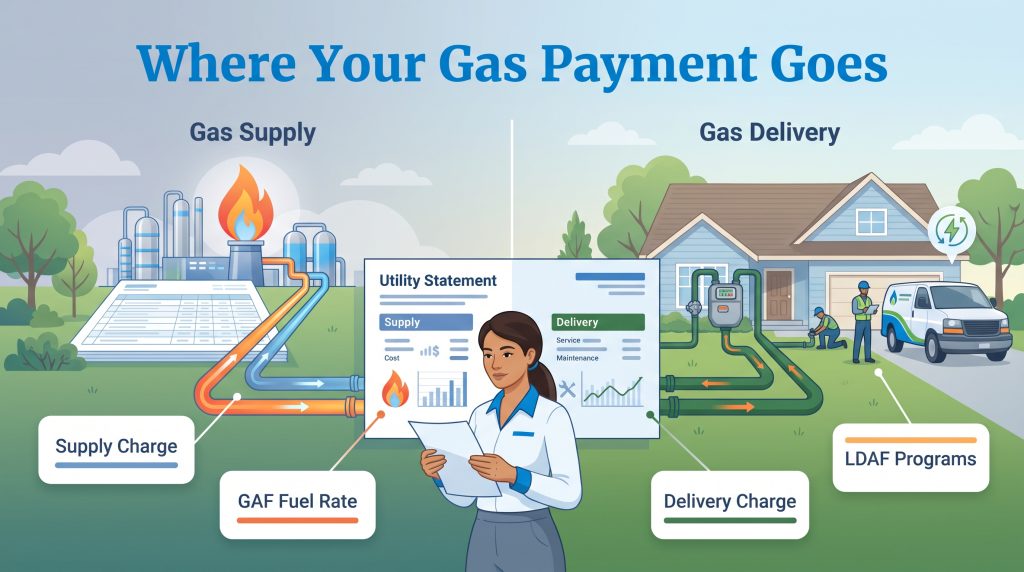
Every residential natural gas statement is divided into two primary buckets: supply and delivery. When comparing the gas supply charge vs. delivery charge on your monthly statement, think of supply as the fuel your furnace and water heater actually burn, while delivery covers the physical pipes, meters, and local crews required to push that fuel safely to your home. In many states, the gas adjustment factor (GAF) is not an extra penalty fee tacked onto your account — it is the mechanism used to calculate your supply rate.
Because utility bills are packed with acronyms, it’s easy to confuse the GAF with other charges. For example, Massachusetts customers often see a local distribution adjustment factor (LDAF). While the GAF sits strictly on the supply side of the ledger to pay for wholesale fuel, the LDAF sits on the delivery side to fund state-mandated energy efficiency programs and environmental cleanups. Always review your specific utility’s approved tariff to understand exactly what your unique bill covers. Reviewing how natural gas prices and delivery costs interact makes it much easier to see where your money goes each month.
| Bill Line Item | What It May Cover on Your Monthly Statement |
|---|---|
| Customer Charge (Delivery) | A fixed monthly fee that covers meter reading, billing systems, and account maintenance regardless of how much gas you burn. |
| Distribution Charge (Delivery) | A per-unit fee that pays for local utility pipelines, emergency response crews, and ongoing system safety upgrades in your neighborhood. |
| Local Distribution Adjustment Factor / LDAF (Delivery Example) | A delivery adjustment found on Massachusetts utility bills covering state energy efficiency programs and other state-mandated initiatives. |
| Gas Adjustment Factor / GAF (Supply) | A rate reflecting approved natural gas supply costs, which may include wholesale fuel, storage, and pipeline transportation, depending on your utility. |
How GAF, PGA, and GCR Charges Can Differ
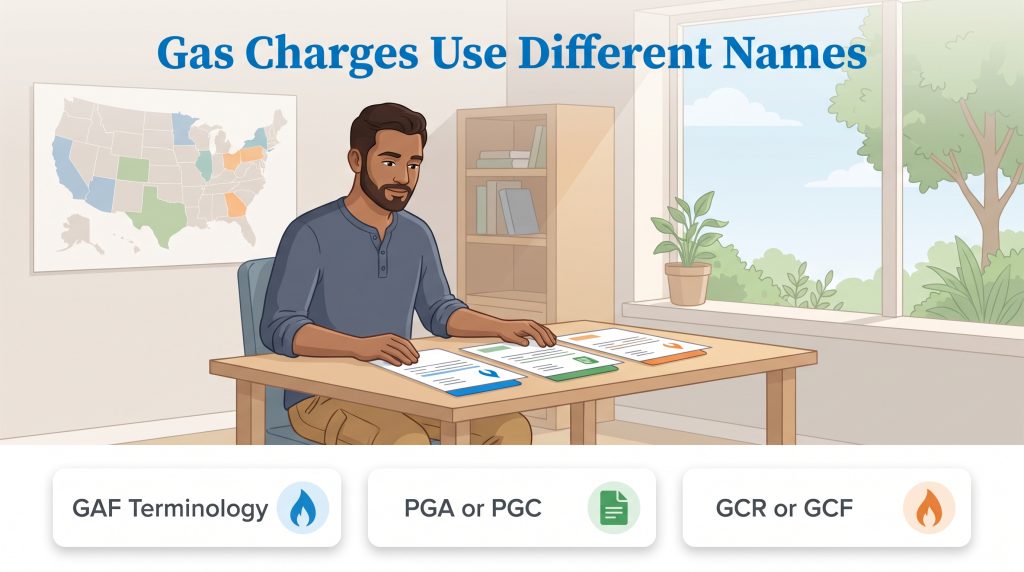
If you just moved across state lines, your new utility bill might look like it’s written in a completely different language. State public utility commissions and regional gas companies use related gas-cost recovery mechanisms. Depending on where you live, you might see different terminology on your monthly statement:
- Gas Adjustment Factor (GAF): Often seen on Massachusetts utility bills from providers like Eversource and National Grid.
- Purchased Gas Adjustment (PGA) or Purchased Gas Charge (PGC): Frequently used by providers such as Columbia Gas and Washington Gas.
- Gas Cost Recovery (GCR): Terminology utilized on residential statements by various utilities in states like Michigan and Texas.
- Gas Commodity Price Factor (GCF): Terminology historically used by specific Mid-Atlantic providers to track wholesale market shifts.
Quick Fact
Regulated utilities generally recover approved gas supply costs through these charges without a retail markup, subject to their tariff and state regulatory rules. If you want to know exactly how your utility calculates this rate, you can look up its officially approved tariff on the company’s website or through your state’s public utility commission.
How to Calculate the Charge on Your Bill
A simplified gas-cost rate calculation divides projected recoverable supply costs, adjusted for prior over-collections or under-collections and other approved items, by projected billed gas sales. Your utility’s tariff determines the exact formula.
Depending on the utility, recoverable costs may include the following:
- Wholesale Commodity Costs: The fluctuating market price of raw natural gas purchased from producers.
- Interstate Pipeline Transportation: The federally regulated pipeline tariffs required to move gas from production basins to your local utility.
- Underground Storage Costs: The expense of storing natural gas for reliability and procurement flexibility to use during high-demand periods.
- Peaking Reserves: Reserves kept on standby in local storage by some utilities so they can maintain pipeline pressure during extreme cold snaps.
- Prior-Period Reconciliation: An accounting mechanism where an over-collection or under-collection of supply costs from an earlier billing period is factored into your current rate.
Example: Calculating Your Gas Supply Charge
To see how a gas-cost rate affects your wallet, it helps to understand how your utility measures consumption. Your meter may measure gas in cubic feet, CCF, or Mcf. If your utility bills in therms, it applies a conversion factor based on the gas’s heat content and any applicable adjustments.
- Hypothetical Summer Example: You use 20 therms for water heating and cooking multiplied by an illustrative $0.45 per therm supply rate, which equals a $9 supply charge (plus delivery fees).
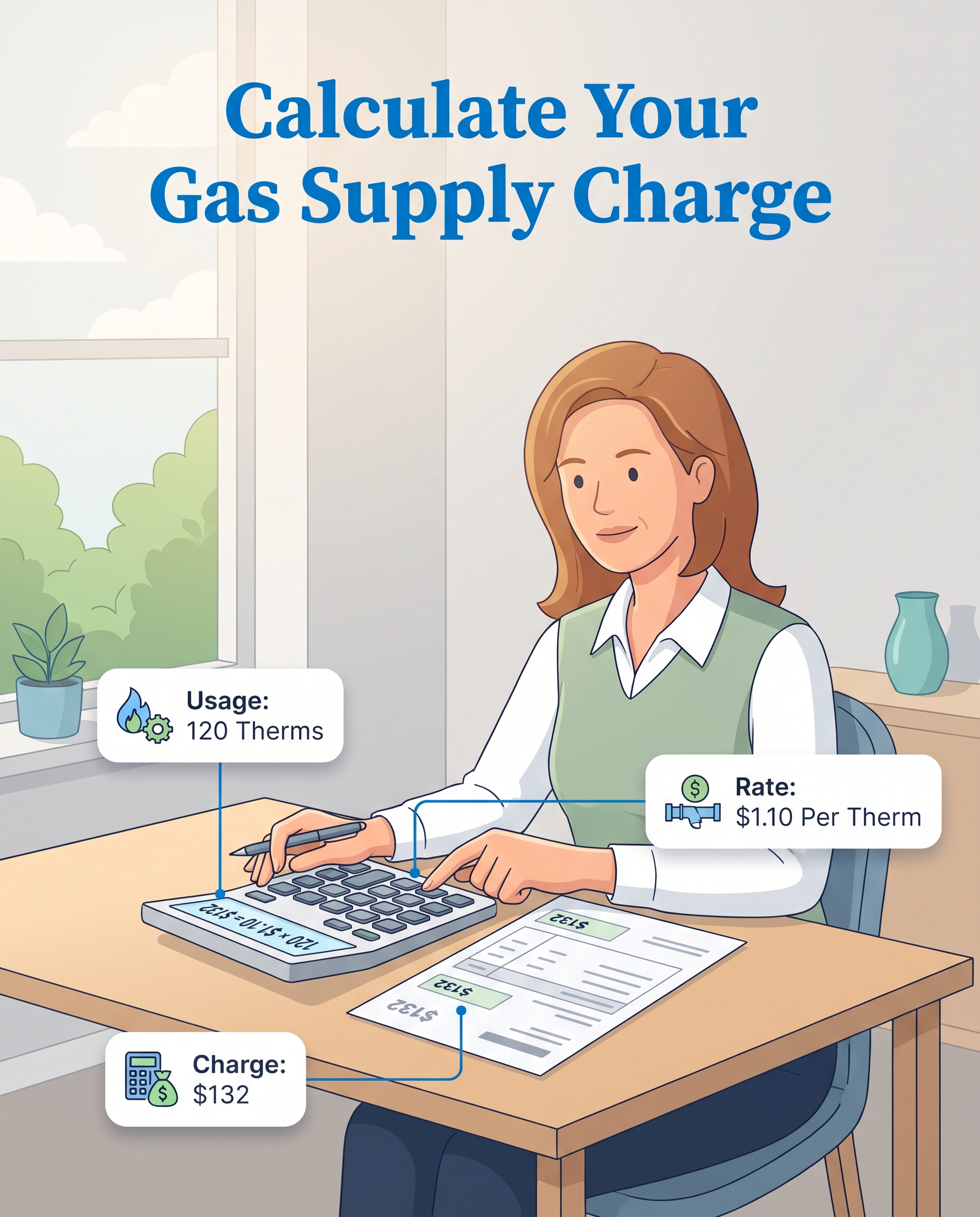
- Hypothetical Winter Example: You use 120 therms with your furnace running daily multiplied by an illustrative $1.10 per therm supply rate, which equals a $132 supply charge (plus delivery fees).
Notice how in this illustration, the usage increased by six times, yet the supply charge jumped by more than 14 times. Keep in mind that multiplying your usage by the adjustment rate gives only the adjustment charge if the factor isn’t your entire supply rate.
Why Your Winter Gas Bill May Increase
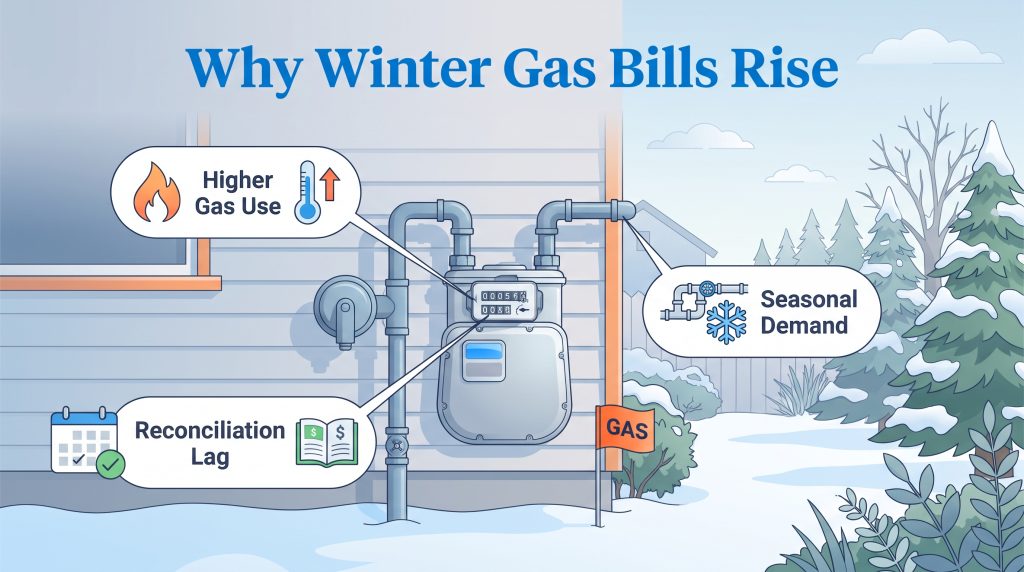
Opening a January or February utility envelope can make anyone’s stomach drop, especially if you budgeted based on your mild autumn bills. Your winter bill can rise because you use more gas, because your supply rate increases, or both. A winter rate isn’t necessarily higher than a summer rate. However, you may experience a combination of higher consumption colliding with market dynamics that push the per-unit rate upward.
- Seasonal Demand Shifts: In many regions, tapping into underground storage and firing up peaking facilities during freezing weather can cost more than pulling standard pipeline gas in warmer months. For example, Massachusetts utilities often establish distinct peak and off-peak seasons to account for these shifts.
- Simultaneous Winter Demand: Your home furnace isn’t the only system competing for fuel when temperatures plunge. In some regions, natural-gas-fired electric power plants also ramp up generation to meet winter electricity demand, creating constraints that can drive up wholesale spot prices.
- The Reconciliation Lag: Because utilities use deferred accounting to smooth out sudden price shocks, an over-collection or under-collection of supply costs from an earlier billing period can show up on your current bill.
What to Check If the Charge Looks Wrong
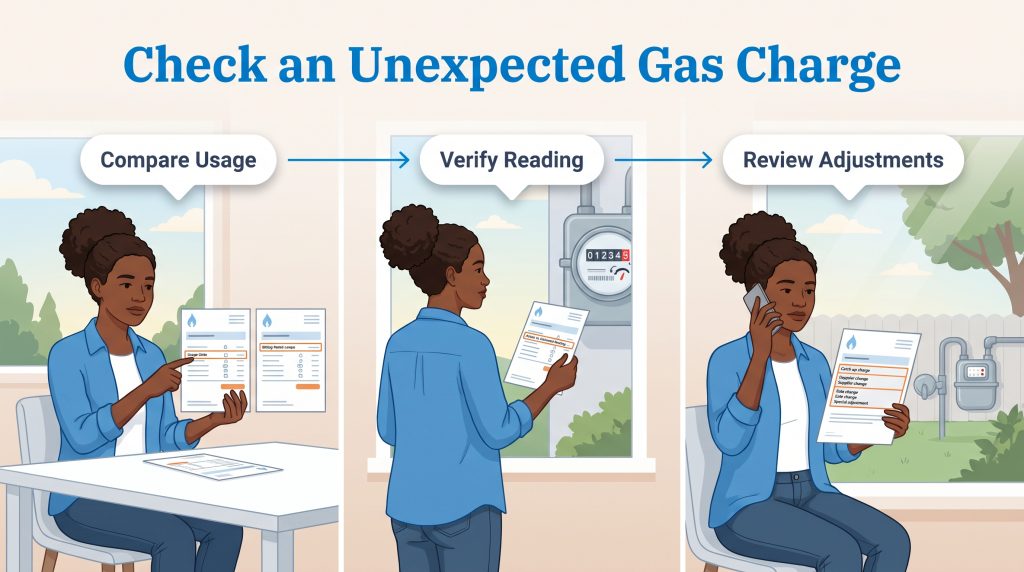
If your bill looks unusually high, a broken meter or a billing mistake isn’t out of the question. Estimated readings can be too high or too low, and a later actual reading may produce a credit or a catch-up charge. Before panicking, follow this diagnostic sequence:
- Compare your billed usage (therms or CCF), not just the total dollar amount.
- Check whether the reading on your statement is marked as “actual” or “estimated.”
- Compare the length of the billing periods, as some months may include more days.
- Compare this month’s supply rate with the previous rate to see if the price per unit changed.
- Look for a prior estimated-bill catch-up, supplier change, or special adjustment on the second page of your statement.
- Contact your utility if the calculation still doesn’t make sense or if you need assistance understanding the charges.
Heads Up
If snow or ice kept a meter reader from accessing a non-smart meter, your utility might rely on an estimated reading. Always ensure they can safely access your meter to prevent inaccurate billing.
When Supplier Choice or Budget Billing May Help
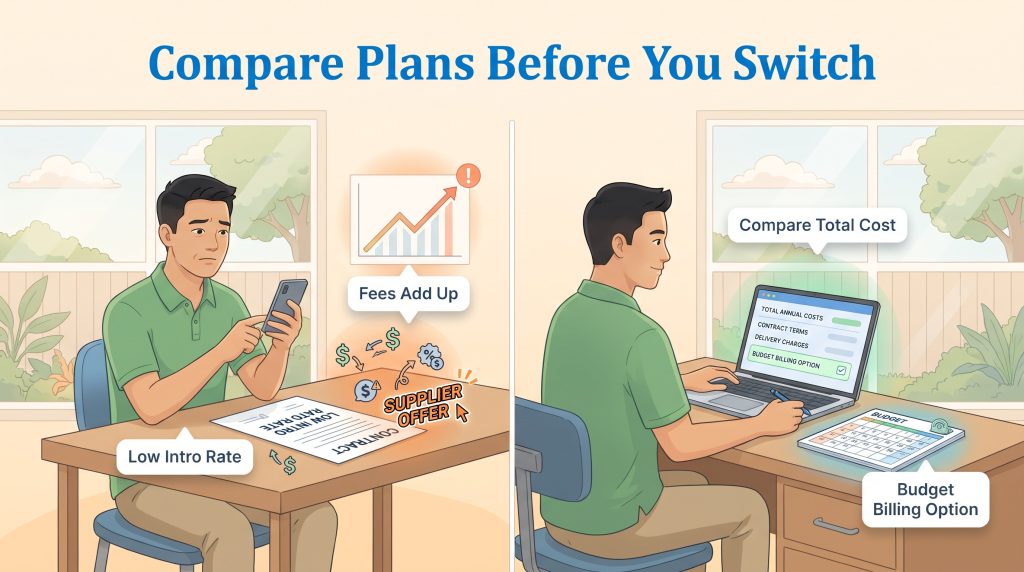
If you live in a state with deregulated energy choice, you aren’t necessarily stuck paying your utility’s default supply rate. When setting up natural gas service in your new home, you can often choose between staying on the utility’s default variable supply rate or signing a contract with a competitive third-party supplier. However, eligibility depends heavily on your utility, service territory, and customer class. In some areas, like Atlanta Gas Light territory in Georgia, customers generally purchase gas through marketers by default.
Weighing fixed vs. variable natural gas rates requires a bit of caution. Switching suppliers doesn’t eliminate utility delivery charges, may not remove every reconciliation or adjustment charge, and doesn’t guarantee savings. Consider a fixed-rate offer when its total cost and contract terms suit your budget — not simply because it is summer. Watch out for potential supplier fees, renewal terms, or cancellation charges. If you simply want predictable monthly bills without gambling on third-party contracts, look into your utility’s budget billing program.
| Comparison Feature | Utility Default Supply | Third-Party Fixed-Rate Supplier |
|---|---|---|
| Price Predictability | Variable; fluctuates based on wholesale gas markets and approved tariffs. | Fixed per-unit rate locked in for the duration of your contract. |
| Profit Markup | Generally passes approved costs through without a retail markup, subject to regulatory rules. | Includes a retail profit margin and marketing costs built into the per-unit price. |
| Cancellation Fees | None; you can switch suppliers or enroll in budget billing at any time without penalty. | Often charges early termination fees if you break the contract early. |
| Best For | Homeowners who want regulated transparency and prefer using utility budget billing to smooth out costs. | Budget-conscious households who actively track contract renewal dates and thoroughly read the terms of service. |
Keep in mind that budget billing spreads estimated annual costs across the year, but it won’t necessarily produce 12 permanently equal payments. Your utility may periodically recalculate the payment amount or reconcile a remaining balance at the end of the year.
Practical Ways to Reduce Gas Use

Here’s the silver lining to how utility billing works: every single unit of gas you don’t burn saves you both the supply rate and the variable delivery rate. Lowering your household fuel consumption isn’t just good for the planet; it’s the most reliable way to insulate your bank account from winter rate hikes. We recommend starting with immediate, affordable adjustments and working your way toward long-term sustainable home efficiency upgrades. If you rent your home or face immediate affordability challenges, look into utility payment arrangements or local assistance programs before committing to equipment upgrades.
- Install an ENERGY STAR Certified Smart Thermostat: Appropriate temperature setbacks can reduce your heating use while everyone is asleep or at work. According to the EPA, upgrading to an ENERGY STAR certified smart thermostat provides an energy-saving option that can save you about 8% on your heating and cooling bills on average. Scheduling is a convenience that helps, but always account for your household’s occupancy, health needs, and equipment compatibility.
- Seal Drafts and Weatherize Your Home: Your furnace works overtime when expensive heated air leaks out through attic hatches, basement rim joists, and aging window frames. Adding inexpensive weatherstripping around doors and caulking window trim keeps warm air inside where it belongs, making this a great renter-friendly action as well.
- Check Your Water Heater Temperature: Many water heaters may be set too high, which wastes gas keeping a tank of water scalding hot 365 days a year. Checking the setting and turning the dial down to 120 degrees cuts standby heat loss and reduces scalding risks, though some households should consult a professional about temperature settings and Legionella risk.
- Schedule an Annual Furnace Tune-Up and Swap Filters: Restricted airflow can impair performance and cause overheating or shutdowns, forcing your system to run longer cycles. Follow your equipment’s recommended filter schedule and swap the filter out whenever it looks dirty.
- Consider a Heat Pump or Heat Pump Water Heater: Pairing an electric air-source heat pump with a gas furnace creates an eco-conscious alternative known as a dual-fuel system, which can significantly reduce your gas use. Switchover to gas depends on equipment capacity, controls, outdoor temperatures, and operating costs. Additionally, installing a heat pump water heater can entirely replace gas water heating, though suitability depends on your space and electrical capacity.
Eco Edge
Before paying full price for a smart thermostat or attic insulation, check your gas utility or state’s website. Many state-mandated energy efficiency programs offer rebates, incentives, and sometimes subsidized home energy audits to help you lower your consumption.
A Clear Plan for Your Next Gas Bill
Seeing a steep supply charge on your mid-winter statement is undeniably frustrating, especially when you’re already juggling the expenses of a new home. Still, knowing that regulated utilities generally pass these costs through without retail markup allows you to focus on the variables you can actually control. Take 10 minutes this week to audit your latest gas bill, verify that your meter reading is actual rather than estimated, and consider enrolling in your utility’s budget billing plan to smooth out seasonal peaks. Tackle one or two simple weatherization projects this weekend, and you’ll feel the difference in both your home’s comfort and your next monthly statement.
Frequently Asked Questions About the Gas Adjustment Factor
If you still have questions about how these rates work, here are some helpful answers regarding utility gas supply charges.
Does My Utility Company Make a Profit on the Gas Adjustment Factor?
Can the Gas Adjustment Factor Ever Go Down or Become a Credit?
Why Is the Gas Adjustment Factor Listed in Therms When My Meter Reads CCF?
How Often Does the Gas Adjustment Factor Change on My Bill?
Is a Purchased Gas Adjustment the Same Thing as a Gas Adjustment Factor?
Will Switching to Budget Billing Lower My Gas Adjustment Factor Rate?
About the Author

David has been an integral part of some of the biggest utility sites on the internet, including InMyArea.com, HighSpeedInternet.com, BroadbandNow.com, and U.S. News. He brings over 15 years of experience writing about, compiling and analyzing utility data.

LaLeesha has a Masters degree in English and enjoys writing whenever she has the chance. She is passionate about gardening, reducing her carbon footprint, and protecting the environment. She also recently served as President of the Board for City Sprouts (a community garden).