

A Detailed Breakdown Of Pricing, Plan Terms, And Customer Experiences To Help You Confidently Select Your Next Natural Gas Provider In Georgia
Key Takeaways
- Atlanta Gas Light (AGL) always handles your home’s gas delivery and emergency service, meaning your gas delivery and emergency response come from AGL either way.
- Walton Gas is known for its community-centered customer service and straightforward pricing, appealing to homeowners who prefer a local, cooperative feel.
- Constellation brings the financial stability of a national corporation, frequently offering robust fixed-rate plans and digital account management features.

- $0.599 /THM
- $6.95-7.95
- 90 days
- 12-36 Months

- $0.779 /THM
- $5.95
- None
- 1-24 Months
*rates may vary by location and household usage
Are you moving into a new Georgia home or finally fed up with unexpectedly high winter utility bills? We know comparing natural gas providers often feels like a frustrating guessing game, which is why this guide breaks down everything from rates to hidden fees to help you decide between Constellation vs. Walton Gas. Use the jump links below to skip straight to our side-by-side provider comparison or dive directly into the details on pricing and rate structures.
Key Differences Between Constellation And Walton Gas
When evaluating options within the deregulated gas market Georgia manages, you are essentially picking the business model that best fits your household needs. Constellation and Walton Gas take distinct approaches to how they acquire fuel and support their customers.
Constellation Energy Pros and Cons:
- Pro: Massive national scale allows them to secure heavily discounted, long-term promotional rates.
- Pro: Highly rated digital apps and robust online account management features.
- Con: Larger corporate structure means navigating automated phone systems for customer service.
Walton Gas Pros and Cons:
- Pro: A local cooperative affiliate of Walton EMC that prioritizes community-centered support.
- Pro: Straightforward pricing models without confusing promotional gimmicks.
- Con: Limited availability of specialized green energy add-ons or advanced digital tools.
Side-By-Side Provider Comparison
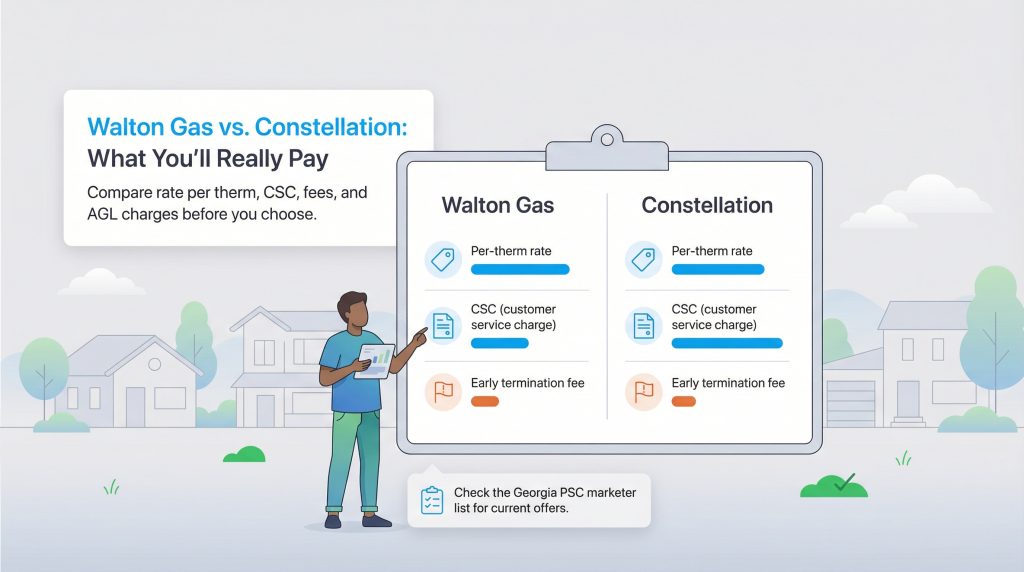
To capture the full picture of your future utility bills and understand your natural gas bill, you need to look beyond the advertised rate per therm. Review this skimmable matrix to see exactly how these two Georgia natural gas marketers stack up across crucial billing categories.
| Feature | Constellation Energy | Walton Gas |
|---|---|---|
| Average Rate per Therm | Highly competitive long-term fixed promotional rates | Transparent, locally-focused baseline rates |
| Monthly Customer Service Fee | Typically $5.95 to $7.95 per month | Typically $4.95 to $6.95 per month |
| Contract Requirement | Standard 12-, 24-, and 36-month terms | Flexible options, often no contract for standard plans |
| Early Termination Fee | $50 to $150 (frequently sliding scale) | Usually $0 on standard; $100 to $150 on fixed plans |
| Green Energy Options | Carbon-offset programs and RECs widely available | Currently limited or unavailable |
Rate Structures: Fixed Vs Variable Plans
When weighing fixed vs variable gas rates Georgia, we strongly recommend locking in a fixed rate to protect your household budget from unpredictable winter price spikes. Your actual usage cost is calculated by multiplying your total therms used by the marketer’s price per therm.
Constellation energy plans shine here by leveraging massive national buying power to offer heavily discounted promotional locked rates, particularly on 24- or 36-month contracts. Walton Gas, however, appeals to consumers who prefer transparent pricing models. They keep per-therm pricing highly competitive without relying on flashy, short-term promotional gimmicks that automatically roll over into expensive variable rates if you forget to renew.
Constellation Plans & Pricing
| Plan Name | Rate | Plan Type | Base Charge | Cancellation Fee | |
|---|---|---|---|---|---|
| 12 Month Home Natural Gas Plan | $0.599 /THM | 12 Months fixed rate Rate | $6.95 MRC (Monthly Recurring Charge) is a fixed monthly fee charged by the energy provider, separate from the cost of the energy you use. | $150 | Check Availability |
| 24 Month Home Natural Gas Plan | $0.629 /THM | 24 Months fixed rate Rate | $7.95 MRC (Monthly Recurring Charge) is a fixed monthly fee charged by the energy provider, separate from the cost of the energy you use. | $150 | Check Availability |
| 36 Month Home Natural Gas Plan | $0.639 /THM | 36 Months fixed rate Rate | $7.95 MRC (Monthly Recurring Charge) is a fixed monthly fee charged by the energy provider, separate from the cost of the energy you use. | $150 | Check Availability |
Walton Gas Plans & Pricing
| Plan Name | Rate | Plan Type | Base Charge | Cancellation Fee | |
|---|---|---|---|---|---|
| 12 Month Fixed Rate | $0.729 /THM | 12 Months Fixed Rate | $5.95 | Check Availability | |
| 6 Month Fixed Rate | $0.745 /THM | 6 Months Fixed Rate | $5.95 | Check Availability | |
| 24 Month Fixed Rate | $0.745 /THM | 24 Months Fixed Rate | $5.95 | Check Availability | |
| Variable Rate | $2.089 /THM | 1 Month Months Month to Month Rate | $5.95 | Check Availability |
Monthly Fees And Early Termination Penalties
Beyond the fuel cost, your bill includes a natural gas customer service charge (CSC). Walton Gas typically keeps their CSC slightly lower — often hovering between $4.95 and $6.95 a month. Constellation’s base charge usually ranges from $5.95 to $7.95. A provider with a slightly higher per-therm rate but a lower CSC might actually be cheaper for a smaller household.
You also need to establish trust by reviewing early termination fees natural gas providers charge. Constellation frequently structures their cancellation fees on a sliding scale. This means you might pay a $150 penalty if you break a 36-month plan early on, but the fee shrinks as you get closer to your end date. In contrast, Walton Gas typically does not require contracts or exit fees for their standard standard variable plans. If you do choose a fixed-rate Walton Gas plan, they generally apply a flat early termination fee ranging from $100 to $150.
Customer Service And PSC Satisfaction Ratings
The latest Georgia Public Service Commission (PSC) natural gas scorecards provide authoritative, third-party data on marketer reliability. When checking PSC natural gas rates and service reports, Walton Gas customer service historically ranks in the absolute top tier for satisfaction and low complaint ratios. People appreciate calling a service line and speaking directly to a representative based right here in Georgia.
Digital Convenience And Billing Options
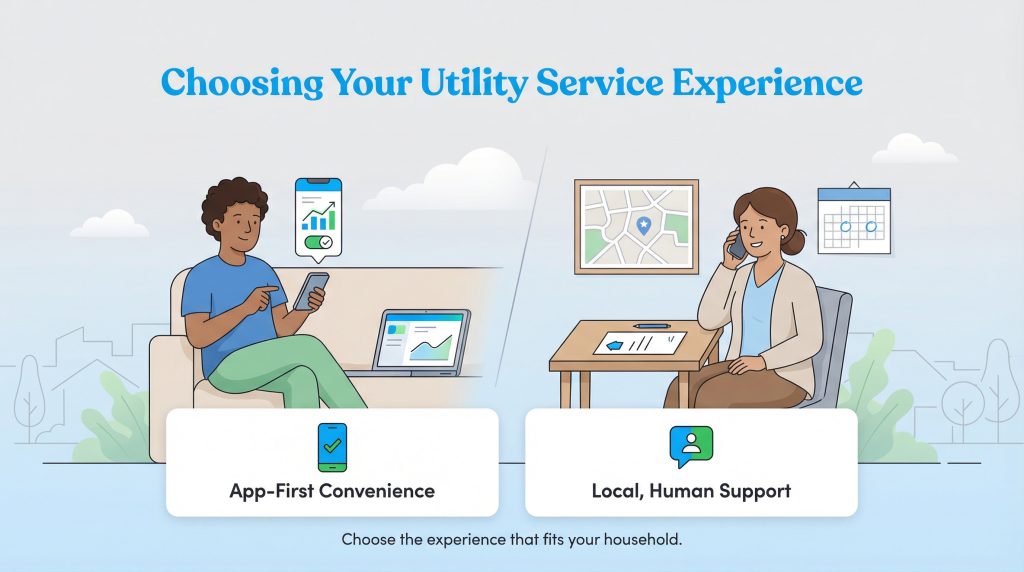
Constellation also maintains respectable PSC standings, but their true strength lies in digital self-service. Even with the best rate in the state, a clunky website can cause major headaches. Constellation’s mobile app and desktop portal make setting up auto-pay, analyzing seasonal usage graphs, and renewing contracts incredibly easy.
Constellation Accepted Payment Methods:
- Online via credit/debit card or bank draft
- Digital wallets (Apple Pay, Google Pay) via their mobile app
- Automated phone system and check by mail
Walton Gas Accepted Payment Methods:
- Online portal via credit/debit card or bank draft
- Check by mail or automated phone payments
- In-person payments at select local Walton EMC offices
Eco-Friendly Plans And Sustainability Efforts
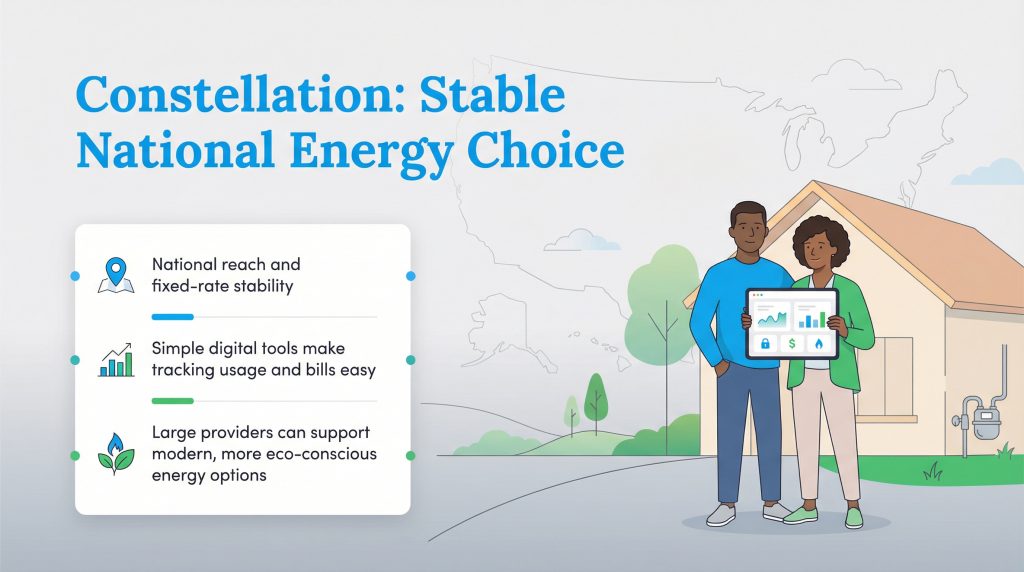
If you prioritize an environmentally mindful choice for your home, Constellation easily pulls ahead in this category. Because of their massive financial backing, they invest heavily in eco-friendly natural gas plans and sustainability efforts. Constellation allows customers to participate in carbon offset programs and purchase renewable energy certificates (RECs).
By opting into these programs, you can neutralize the emissions produced by your furnace, water heater, and stove. To learn more about how household consumption works, the U.S. Energy Information Administration explains exactly how natural gas energy works.
🌱 Eco Edge: Constellation often offers carbon offset add-ons that actively minimize your carbon footprint. Availability varies by ZIP code, so always check current options in your service area if you are hoping to reduce your home’s emissions.
How Atlanta Gas Light (AGL) Base Charges Affect Your Bill
Before finalizing your choice, you must understand a common point of confusion for residents hunting for the cheapest gas rates in GA. Unlike traditional utility setups where one single company manages everything, Georgia splits the responsibilities. Atlanta Gas Light (AGL) owns and maintains all the physical infrastructure — the underground pipes, the meters on the side of your house, and the emergency response teams.
When you look at Atlanta Gas Light pass-through charges on your monthly statement, you are looking at regulated maintenance fees. These specific AGL base charges apply regardless of whether you choose Constellation, Walton Gas, or any other certified marketer. You cannot escape them by switching companies, meaning you should focus strictly on the marketer’s supply rate and customer service charge when comparing costs.
🚩 Heads Up: Because AGL handles all physical delivery, your actual gas flow remains incredibly reliable regardless of who you sign up with today. Your new marketer just buys the fuel and handles the billing.
Locking In Your New Georgia Gas Provider
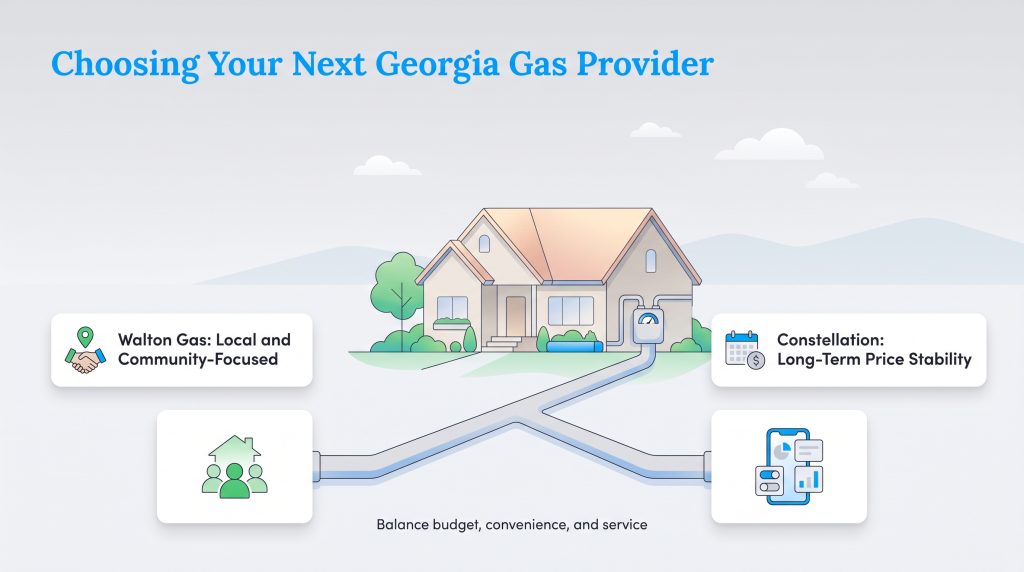
Selecting the right natural gas provider ultimately depends on how you balance your household budget, your desire for digital convenience, and your customer service preferences. Walton Gas stands out as a strong option if you value community-focused operations, transparent rates, and local representatives who treat you like a neighbor. On the flip side, Constellation remains an exceptional choice if you want the long-term price security of a 36-month fixed contract and excellent eco-friendly natural gas plans. By assessing your specific priorities and verifying current market rates, you can confidently lock in a provider that keeps your home warm without breaking the bank.
Frequently Asked Questions About Constellation And Walton Gas
Do Constellation and Walton Gas charge the same AGL pass-through fees?
Yes. Atlanta Gas Light (AGL) pass-through charges are standardized, regulated fees that cover pipeline maintenance and physical gas delivery. Because AGL owns the infrastructure across the deregulated territory, these exact same baseline charges appear on your monthly bill regardless of which marketer you choose.
What is the average monthly customer service charge for Constellation versus Walton Gas?
The monthly customer service charge typically ranges from $5.95 to $7.95 for Constellation, while Walton Gas generally keeps their base charges slightly lower, often between $4.95 and $6.95. Always verify the exact CSC listed on your specific plan document before signing up.
Which provider is the cheapest gas company in Georgia?
Because natural gas rates fluctuate monthly based on wholesale market conditions, there isn’t a permanently “cheapest” provider. Finding the lowest price requires you to compare current fixed-rate offers, factor in the monthly customer service charges, and calculate your estimated seasonal usage.
How do I switch my Georgia natural gas provider without losing service?
To switch providers, simply sign up for a new plan with your chosen marketer. Your new supplier handles all the necessary backend communication with Atlanta Gas Light and your previous provider to ensure a seamless transition. Your physical gas flow will never be interrupted during this changeover.
What are the early termination fees for Constellation and Walton Gas?
In the Georgia market, early termination fees vary widely by marketer and specific plan length. Constellation frequently scales their fees based on how much time remains on the contract (often ranging from $50 to $150), while Walton Gas typically utilizes a flat cancellation fee between $100 and $150 for fixed plans.
Can I get green or renewable natural gas plans in Georgia?
Yes, some marketers offer environmentally mindful options in specific ZIP codes. Constellation frequently provides plans that include carbon offsets or renewable energy credits, allowing eco-conscious consumers to mitigate the environmental impact of their home heating and cooking usage.
Does Walton Gas or Constellation require a credit check or deposit?
Yes, running a soft credit check during sign-up is standard practice for all Georgia natural gas marketers. Depending on your credit score, both Constellation and Walton Gas might require an upfront security deposit to begin service. However, this deposit can frequently be waived if you provide a letter of excellent credit history from your previous utility provider.
How long does it take to switch natural gas marketers in Georgia?
Switching your natural gas supplier typically takes one to two billing cycles to finalize on paper. The speed of the transition relies on Atlanta Gas Light processing the administrative changeover, but you do not have to worry about scheduling any downtime; your home will continuously receive gas throughout the process.
Can I avoid Atlanta Gas Light pass-through charges by switching providers?
No, you absolutely cannot avoid Atlanta Gas Light pass-through charges. Because AGL physically owns and maintains the pipeline infrastructure that delivers gas to your home, these regulated base charges apply identically to every single household in the deregulated territory, regardless of which retail marketer you pay for the fuel.
About the Author

David has been an integral part of some of the biggest utility sites on the internet, including InMyArea.com, HighSpeedInternet.com, BroadbandNow.com, and U.S. News. He brings over 15 years of experience writing about, compiling and analyzing utility data.

Claudio is a sustainability-focused writer with a background in Anthropology and Psychology from NC State University. He has spent over 15 years working in writing, interpretation, and translation, driven by a deep interest in how human culture shapes the environment. Today, he shares his curiosity with readers by writing about sustainable living solutions and the connection between everyday choices and environmental impact.