

Finding The Right Natural Gas Provider Comes Down To Comparing Total Costs, Contract Terms, And Customer Service Reliability
Key Takeaways
- Gas South offers more flexibility for customers with lower credit scores through their “no deposit” options, while Constellation often provides more competitive long-term fixed rates.
- Constellation generally has a simpler fee structure with a flat customer service charge, whereas Gas South’s fees can vary based on your specific plan and location.
- Both providers serve the Atlanta Gas Light territory, meaning your actual gas delivery remains the same, but your billing, perks, and contract terms will differ significantly.

- $0.599 /THM
- $6.95-7.95
- 90 days
- 12-36 Months

- $0.390 /THM
- $6.95-9.95
- None
- 1-24 Months
*rates may vary by location and household usage
Choosing the best natural gas provider in Georgia is much easier once you realize a fundamental truth: both Constellation and Gas South operate on the exact same Atlanta Gas Light (AGL) infrastructure, meaning your physical delivery reliability is identical. Whether you are setting up service in a new home or switching marketers to lower your bills, your decision ultimately comes down to the stark differences in their administrative fees and credit requirements. This comprehensive Constellation vs. Gas South comparison breaks down 2026 market rates, strict fee ranges, and deposit rules to help you confidently select the perfect fit for your household budget.
At A Glance: Constellation Versus Gas South Core Differences
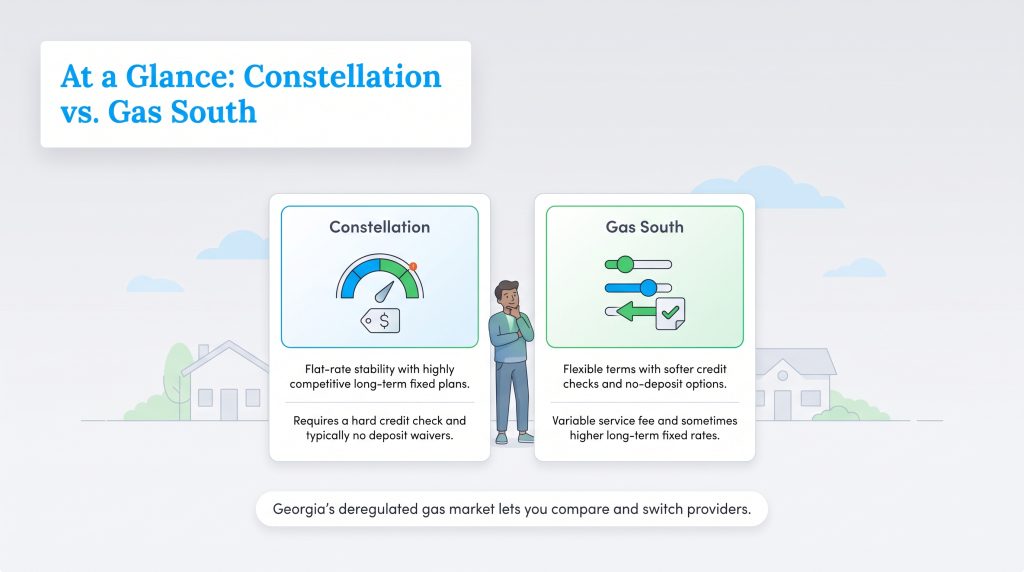
Before diving into the fine print, if you are browsing different natural gas plans, placing Constellation vs Gas South rates side-by-side reveals clear philosophical differences in how they package their services. Below is a factual breakdown of the pros and cons for each energy supplier to guide your decision-making.
Constellation Overview
- Pros: Offers highly predictable pricing with a flat-rate customer service charge, routinely features highly competitive long-term fixed rates (24-month or 36-month options), and provides an exceptional digital account management experience.
- Cons: Requires a traditional hard credit check during enrollment and rarely provides deposit waivers for customers with lower credit scores.
Gas South Overview
- Pros: Features a robust selection of flexible month-to-month and 12-month plans, heavily promotes accessible no-deposit options using soft credit checks, and offers outstanding localized customer support.
- Cons: Utilizes a variable customer service fee that can increase your monthly overhead, and long-term fixed rates may occasionally sit slightly higher than national competitors.
| Provider | Average Fixed Rate Focus | Customer Service Charge (CSC) | Early Termination Fee |
|---|---|---|---|
| Constellation | Highly competitive on long-term 24-month and 36-month plans | Flat fee, guaranteed at $7.95 per month | Typically $150 on standard fixed-term plans |
| Gas South | Strong introductory offers and solid 12-month terms | Variable fee, ranging from $6.95 to $9.95 per month | Typically $150 on standard fixed-term plans |
💡 Pro Tip: A Georgia deregulated natural gas comparison is only possible because the state separated the entity that delivers your gas from the company that sells it to you. This gives you the power to switch retail marketers to secure a cheaper rate per therm without ever sacrificing the safety or reliability of your pipeline connection.
Understanding Your Bill: AGL Base Fees Versus Marketer Rates
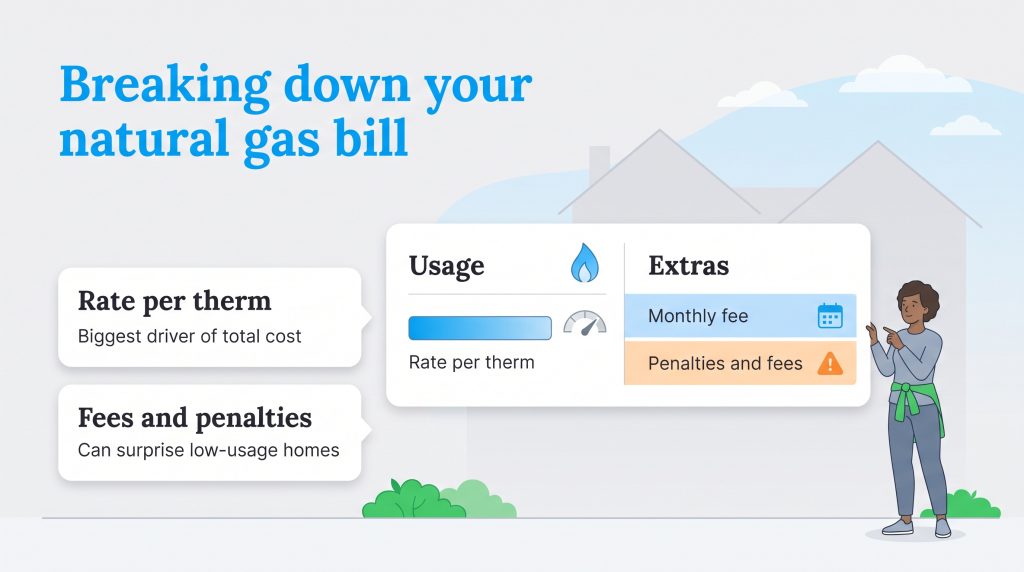
One of the most frequent complaints from homeowners is receiving a surprisingly high utility invoice during the summer months when the furnace is completely turned off. Understanding your natural gas bill requires separating the charges you actively control from the mandatory infrastructure costs you cannot avoid.
Every natural gas customer in this territory must pay an AGL Pass-Through Charge (often called the Atlanta Gas Light base charge). This mandatory fee generally ranges from $30 to $40 per month and directly funds the physical maintenance of the pipeline grid, meter readings, and rapid emergency response services. Retail marketers only control your per-therm usage rate and your administrative Customer Service Charge. You will pay the exact same AGL base charge regardless of whether you choose Constellation or Gas South.
Rate Plans And Pricing Breakdown
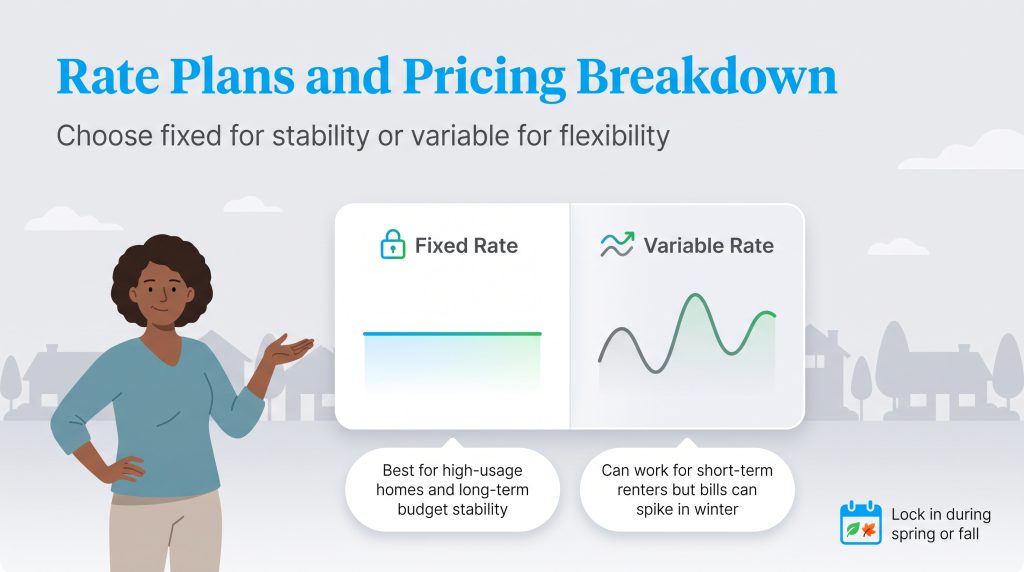
When comparing fixed vs variable gas rates Georgia residents must weigh long-term budget stability against short-term flexibility. The rate per therm is the actual price you pay for the raw fuel consumed to heat your water or warm your home. Constellation and Gas South both offer certified plans through the Georgia Public Service Commission (PSC), ensuring strict consumer protections.
If you are exploring fixed-rate and variable-rate plans, a fixed-rate contract locks in your price per therm for the entire length of your term (usually 12 to 36 months). This is universally the safest choice for heavy-usage households to prevent devastating winter bill spikes. Variable rates fluctuate month-to-month based on market wholesale costs, offering agility for renters moving soon but carrying the severe risk of dramatic seasonal cost increases.
Gas South Plans And Pricing
| Plan Name | Rate | Plan Type | Base Charge | Cancellation Fee | |
|---|---|---|---|---|---|
| Intro Variable | $0.390 /THM | 1 Months Month to Month Rate | $6.95 to 9.95 MRC (Monthly Recurring Charge) is a fixed monthly fee charged by the energy provider, separate from the cost of the energy you use. | $150.00 | Check Availability |
| 12 Month Fixed plus $50 in Bill Credits | $0.670 /THM | 12 Months fixed rate Rate | $6.95 to 9.95 MRC (Monthly Recurring Charge) is a fixed monthly fee charged by the energy provider, separate from the cost of the energy you use. | $150.00 | Check Availability |
| 6 Month Fixed plus $50 in Bill Credits | $0.690 /THM | 6 Months fixed rate Rate | $6.95 to 9.95 MRC (Monthly Recurring Charge) is a fixed monthly fee charged by the energy provider, separate from the cost of the energy you use. | $150.00 | Check Availability |
| 24 Month Fixed plus $50 in Bill Credits | $0.770 /THM | 24 Months fixed rate Rate | $6.95 to 9.95 MRC (Monthly Recurring Charge) is a fixed monthly fee charged by the energy provider, separate from the cost of the energy you use. | $150.00 | Check Availability |
| Variable | $2.090 /THM | 1 Months Month to Month Rate | $6.95 to 9.95 MRC (Monthly Recurring Charge) is a fixed monthly fee charged by the energy provider, separate from the cost of the energy you use. | $150.00 | Check Availability |
Constellation Plans And Pricing
| Plan Name | Rate | Plan Type | Base Charge | Cancellation Fee | |
|---|---|---|---|---|---|
| 12 Month Home Natural Gas Plan | $0.599 /THM | 12 Months fixed rate Rate | $6.95 MRC (Monthly Recurring Charge) is a fixed monthly fee charged by the energy provider, separate from the cost of the energy you use. | $150 | Check Availability |
| 24 Month Home Natural Gas Plan | $0.629 /THM | 24 Months fixed rate Rate | $7.95 MRC (Monthly Recurring Charge) is a fixed monthly fee charged by the energy provider, separate from the cost of the energy you use. | $150 | Check Availability |
| 36 Month Home Natural Gas Plan | $0.639 /THM | 36 Months fixed rate Rate | $7.95 MRC (Monthly Recurring Charge) is a fixed monthly fee charged by the energy provider, separate from the cost of the energy you use. | $150 | Check Availability |
💸 Money-Saver: Natural gas prices typically drop during the “shoulder months” of spring and fall when demand is low. Locking in a 12-month or 24-month fixed rate during April or October can secure a much cheaper price per therm than waiting to sign up in the dead of winter.
Comparing Customer Service Charges And Hidden Fees
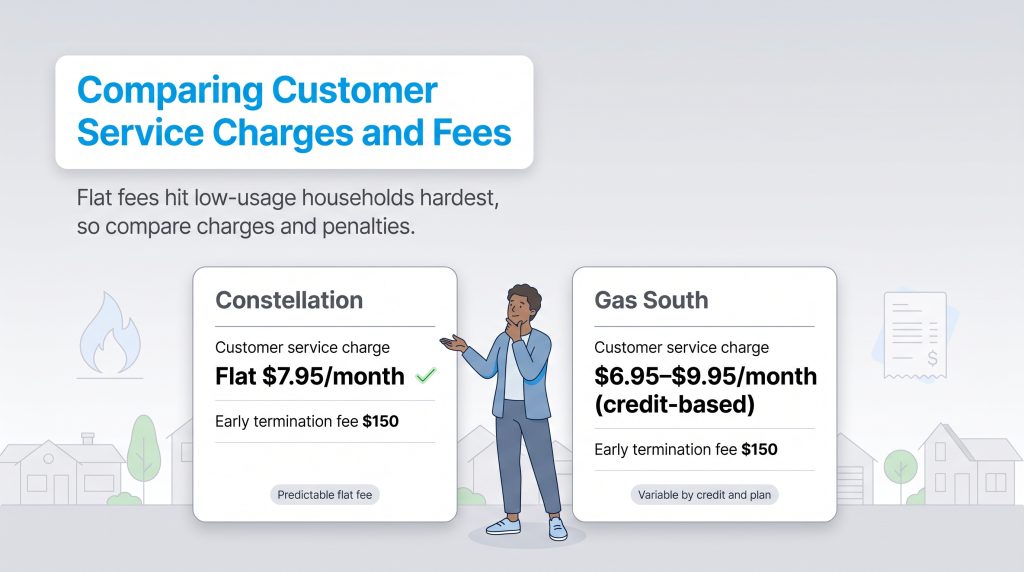
The monthly customer service charge is a recurring administrative fee applied simply to keep your account active and manage your digital billing. This is an area where finding the cheapest gas marketer Atlanta has to offer becomes highly competitive, as these flat fees directly impact low-usage households the most.
- Constellation Customer Service Charge: Constellation utilizes a strictly predictable, flat-rate model. You will pay a guaranteed $7.95 per month for your CSC on their standard fixed plans, ignoring credit thresholds.
- Gas South Customer Service Charge: Gas South utilizes a variable CSC model heavily influenced by your specific credit profile and chosen rate plan. Their fees generally sit on a sliding scale from $6.95 up to $9.95 per month.
Another major financial factor is comparing the Constellation early termination fee against the Gas South cancellation penalty. If you break an active fixed-rate contract mid-cycle, both providers are surprisingly standardized. You will typically face a $150 penalty for breaking a standard fixed agreement, though you should always review your specific contract details to confirm this figure before scheduling a cutoff date.
Credit Requirements And Deposit Policies
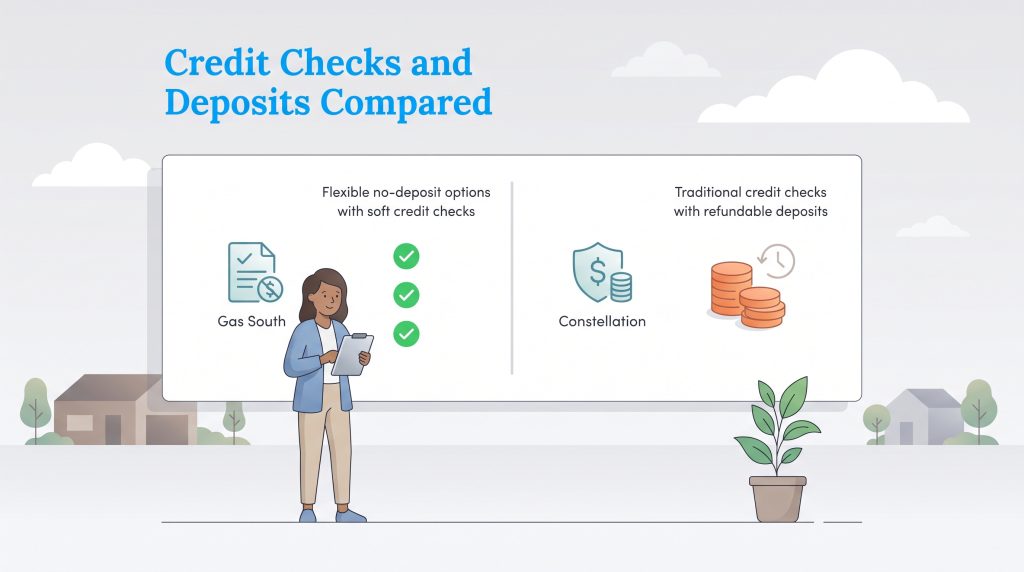
Avoiding hefty upfront cash deposits is a massive priority for renters, students, and first-time homeowners. The way these two companies handle customer enrollment and risk assessment is a significant differentiator.
Gas South No Deposit Options
Gas South actively targets customers looking for financial flexibility. When applying for Gas South no deposit natural gas plans, the company frequently relies on a quick soft credit check that will not leave a hard inquiry on your report. If your credit score is satisfactory (usually 600 or higher), they routinely waive the upfront deposit altogether. Additionally, they offer deposit waivers for active-duty military personnel, seniors, and those capable of supplying a letter of good standing from a previous utility proving 12 months of flawless payments.
Constellation Credit Checks
Constellation takes a more traditional corporate approach to establishing new residential accounts. They perform a standard hard credit check during enrollment. If your financial history does not meet their internal risk threshold, you will be required to pay an upfront deposit — usually ranging from $50 to $150. Fortunately, if you maintain a perfectly clean payment record for 12 months, Constellation typically refunds this deposit directly back to your account balance.
Evaluating Provider Perks And Bill Credits
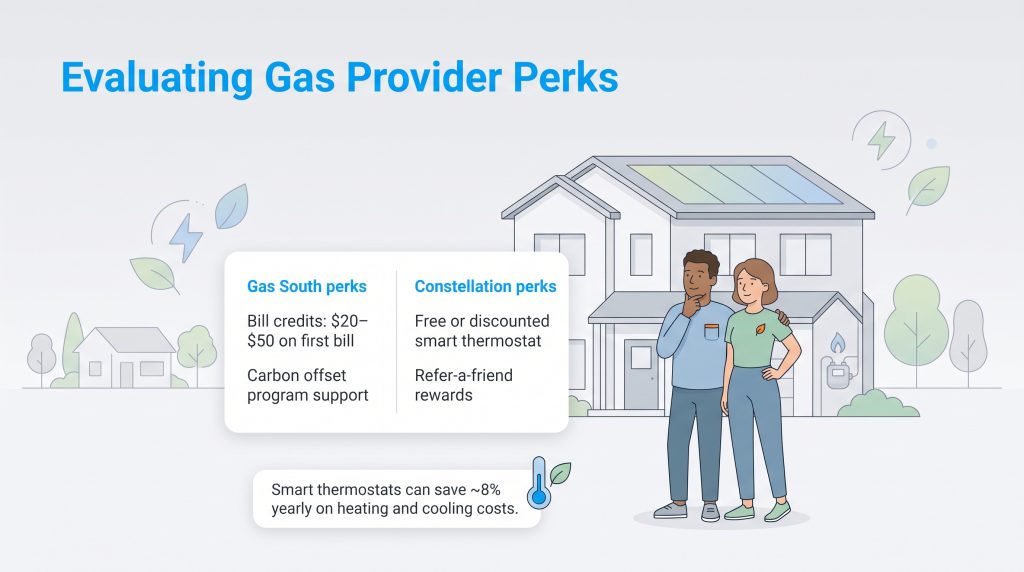
In a competitive deregulated market, natural gas marketers frequently roll out aggressive signing bonuses and digital perks to win your long-term business. Gas South bill credits are a highly popular standard promotion for new customers. Depending on the season and the specific fixed-rate term length you secure, Gas South routinely offers $20 to $50 in instant bill credits applied directly to your first statement, creating immediate relief on your moving costs.
Constellation counters these incentives through robust refer-a-friend programs and bundled smart home packages. As an environmentally mindful choice, Constellation periodically includes a free or heavily discounted smart thermostat when you sign a multi-year agreement. Similarly, Gas South actively supports carbon offset programs that fund green energy initiatives, aligning seamlessly with their community-focused brand identity.
🌱 Eco Edge: According to ENERGY STAR, installing a smart thermostat can lower your heating and cooling costs by roughly 8% annually. Check out our comprehensive guide on how to save on your gas bill to see how small tech upgrades can make a massive difference in your carbon footprint.
Choosing The Right Provider For Your Household
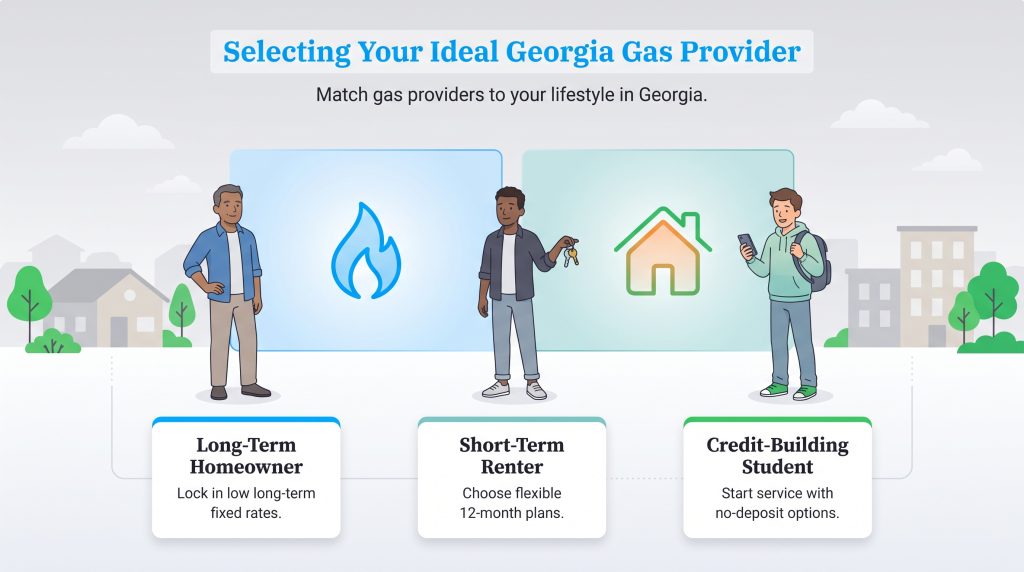
There is rarely a single flawless energy supplier for every resident in Georgia. To find the absolute best natural gas option for your daily needs, you must align a company’s unique strengths with your personal living situation. We strongly recommend making your choice based on these three distinct scenarios:
- The Long-Term Homeowner: If you plan to stay put for the foreseeable future, billing stability is your primary objective. Winner: Constellation. With highly competitive 24-month and 36-month fixed plans and a completely flat $7.95 monthly customer service charge, they offer unparalleled predictability. Sign up for a Constellation plan today.
- The Short-Term Renter: If you are signing a standard 12-month lease and want agility, you need a provider that will not trap you with complex terms. Winner: Gas South. Their flexible 12-month fixed plans and excellent localized support make them a fantastic partner. Sign up for a Gas South plan today.
- The Credit-Building Resident: When you are rebuilding your financial history, passing strict corporate credit checks is deeply frustrating. Winner: Gas South. Their robust no-deposit options and willingness to evaluate soft credit pulls make them the clear choice to secure fast, affordable service. Secure a Gas South no-deposit plan today.
Reviewing Your Natural Gas Provider Checklist
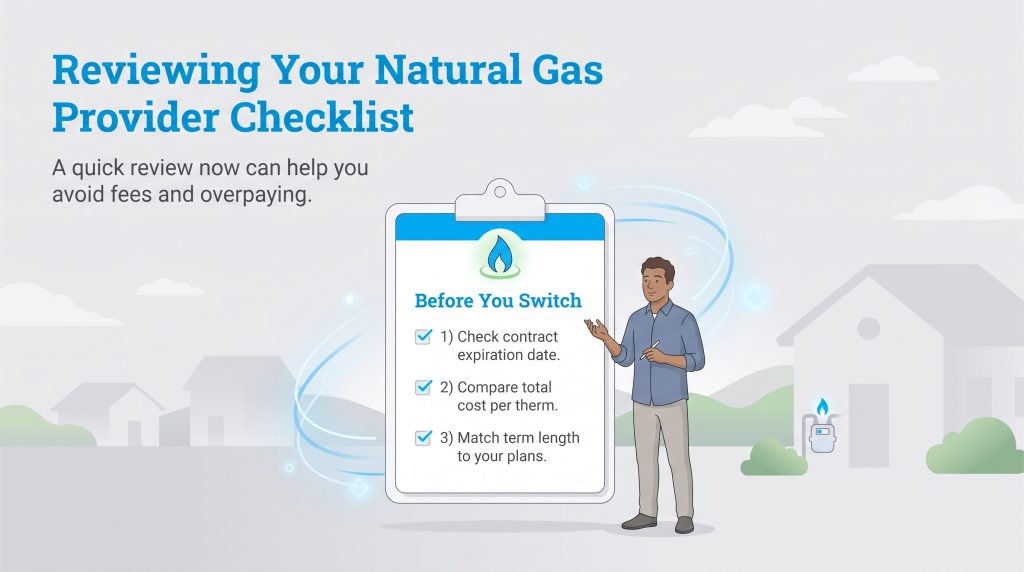
Taking just a few minutes to review your options thoroughly can save you hundreds of dollars over the coming year. Always double-check your current contract expiration date to ensure you will not trigger an early cancellation fee, and rigorously compare the total estimated cost per therm rather than just glancing at a flashy promotional headline.
Securing The Best Natural Gas Fit For Your Home
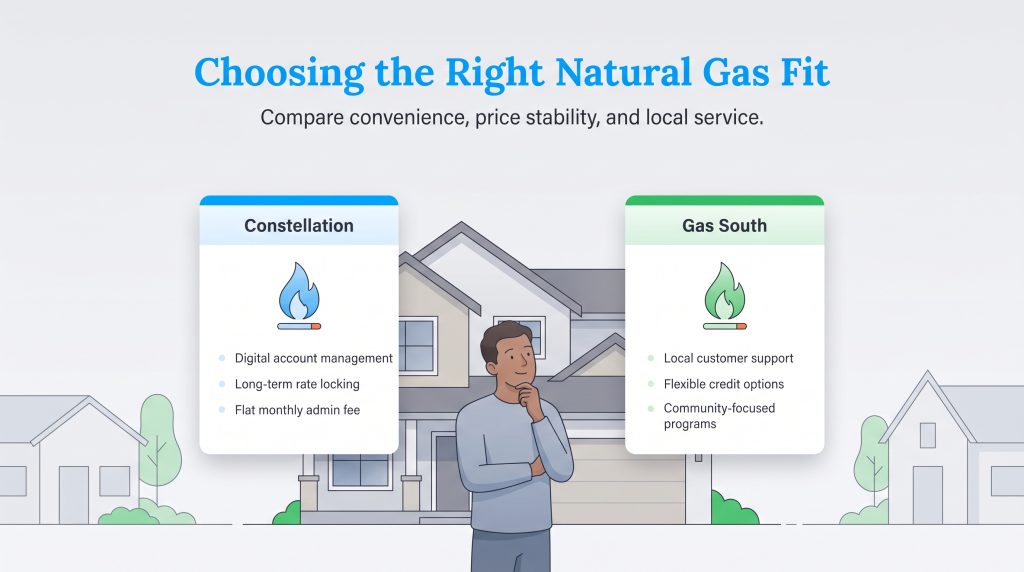
Ultimately, both Constellation and Gas South are highly reputable, strictly regulated entities fully equipped to keep your home warm and secure. If you value robust digital tools, a completely flat monthly administrative fee, and long-term rate locking, Constellation remains a remarkably strong contender. Conversely, if you prioritize local customer service, initial bill credits, and highly flexible credit requirements, Gas South stands ready to meet your needs perfectly.
Frequently Asked Questions About Constellation And Gas South
Does Constellation or Gas South charge a higher customer service fee?
It depends entirely on your specific credit profile and the exact plan you select. Constellation charges a highly predictable, flat customer service fee of $7.95 every single month. By contrast, Gas South utilizes a variable fee model that can range anywhere from $6.95 to $9.95. If you qualify for Gas South’s lowest tier, it will be cheaper, but their maximum penalty tier is higher than Constellation’s flat rate.
Do I have to pay the Atlanta Gas Light base charge with both providers?
Yes, the Atlanta Gas Light (AGL) base charge is completely unavoidable for all residential customers residing in the territory. This mandatory infrastructure pass-through fee generally ranges from $30 to $40 a month and is charged directly by AGL for maintaining the physical pipeline grid, regardless of whether you choose Constellation, Gas South, or any other retail marketer.
Will my gas service be interrupted if I switch from Gas South to Constellation?
No, your physical natural gas service will never be interrupted simply because you changed marketers. Because Atlanta Gas Light continually manages the underground pipes and meters for both Constellation and Gas South, the transition is strictly a billing change that happens entirely behind the scenes.
Which natural gas provider in Georgia is best for renters with low usage?
For renters with exceptionally low natural gas usage, securing the lowest possible monthly Customer Service Charge is actually more important than finding a slightly cheaper rate per therm. If you qualify for Gas South’s $6.95 minimum fee, they are generally the cheapest option. However, if your credit score places you in their $9.95 tier, Constellation’s flat $7.95 fee becomes much more budget-friendly.
Is Gas South or Constellation cheaper in Georgia?
Base rates fluctuate daily depending on national market conditions, but as of 2026, Constellation is frequently cited for holding highly competitive fixed rates on long-term contracts. The genuinely cheapest provider heavily depends on your total gas usage volume, as Gas South’s variable monthly service fees can occasionally offset a low per-therm rate if you live in a smaller apartment.
How much is the cancellation fee for Constellation vs. Gas South?
Both energy suppliers generally issue an Early Termination Fee (ETF) if you break an active fixed-rate contract before the scheduled expiration date. For both Constellation and Gas South, this standard cancellation penalty usually sits exactly at $150, though you should always verify the explicit terms outlined in your specific agreement.
Does Constellation require a deposit?
Constellation performs a standard hard credit check during enrollment and may mandate an upfront deposit (usually between $50 to $150) if your score falls below their minimum requirement. Unlike Gas South, they rarely offer broad no-deposit waivers for new applicants, though they typically refund any paid deposit as a direct bill credit after 12 months of consistent, on-time payments.
About the Author

David has been an integral part of some of the biggest utility sites on the internet, including InMyArea.com, HighSpeedInternet.com, BroadbandNow.com, and U.S. News. He brings over 15 years of experience writing about, compiling and analyzing utility data.

Claudio is a sustainability-focused writer with a background in Anthropology and Psychology from NC State University. He has spent over 15 years working in writing, interpretation, and translation, driven by a deep interest in how human culture shapes the environment. Today, he shares his curiosity with readers by writing about sustainable living solutions and the connection between everyday choices and environmental impact.