

Correct carbon monoxide detector placement helps your family get an early warning before dangerous carbon monoxide buildup becomes life-threatening.
Key Takeaways
- Place at least one carbon monoxide detector on every level of your home, including the basement.
- Install detectors about five feet above the floor or at eye level, unless the manufacturer specifies ceiling mounting.
- Keep alarms a safe distance from fuel-burning appliances, following your model’s instructions to reduce nuisance alarms.
Moving into a new home or upgrading your major appliances demands a fresh look at safety, especially when it comes to invisible hazards. Proper carbon monoxide detector placement is critical because this odorless, colorless gas produced by incomplete combustion is impossible to detect on your own. Carbon monoxide detectors don’t detect natural gas leaks. If you smell rotten eggs or suspect a gas leak, leave the home immediately and call your gas utility or 911 from a safe location. If you’re setting up utilities in a new home, we know that the process can feel overwhelming, but securing your home against carbon monoxide (CO) only takes a few minutes. As your guide to home utilities and safety, we want to help you confidently protect your household with an early warning system that catches leaks long before they become a threat.
Why Carbon Monoxide Detector Placement Matters
People often assume carbon monoxide is a heavy gas that sinks to the floor, but that is actually a dangerous myth. CO is slightly lighter than air, meaning it diffuses and mixes evenly throughout the room rather than settling heavily at the bottom. Because of how the gas spreads, knowing exactly where to put carbon monoxide detectors is one of the most important ways to help ensure the alarm triggers before toxic levels reach human breathing zones. If you plug a device into an outlet that is hidden behind a heavy dresser, the sensor might not register the danger in time to warn you.
📌 Quick Fact: Carbon monoxide is frequently called the “silent killer” because it is completely invisible, tasteless, and odorless. You cannot rely on your senses to detect a leak, making properly placed alarms your only reliable line of defense.
Quick Recap: General Rules for CO Detector Placement
When you need to set up your defenses quickly, following a few established guidelines will keep you on the right track. The National Fire Protection Association’s carbon monoxide safety guidelines recommend placing CO alarms in a central location outside each sleeping area and on every level of the home. For exact mounting height and distance from appliances, follow your alarm manufacturer’s instructions. Keep these general best practices in mind as you map out your alarm network:
- Install an alarm on every single floor of the house, including basements.
- Mount wall detectors roughly five feet from the floor (around breathing height), unless your unit’s instructions say otherwise.
- Keep sensors at least 15 feet away from fuel-burning appliances to reduce nuisance alarms.
- Position alarms inside the home, a minimum of 10 feet away from attached garage doors.
- Place an alarm in the hallway directly outside of all sleeping areas.
| Location | Best Placement | Avoid |
|---|---|---|
| Bedrooms | In the hallway outside sleeping areas; inside bedrooms if doors stay closed | Behind furniture or curtains |
| Basement | On the basement level, away from furnace startup airflow | Directly beside the furnace or water heater |
| Attached Garage Entry | Inside the home near the door to the garage | Inside the garage unless the model is rated for it |
| Kitchen | Nearby, but not directly beside the stove | Above the stove, near steam, or in grease-prone areas |
Room-by-Room Carbon Monoxide Detector Placement Guide
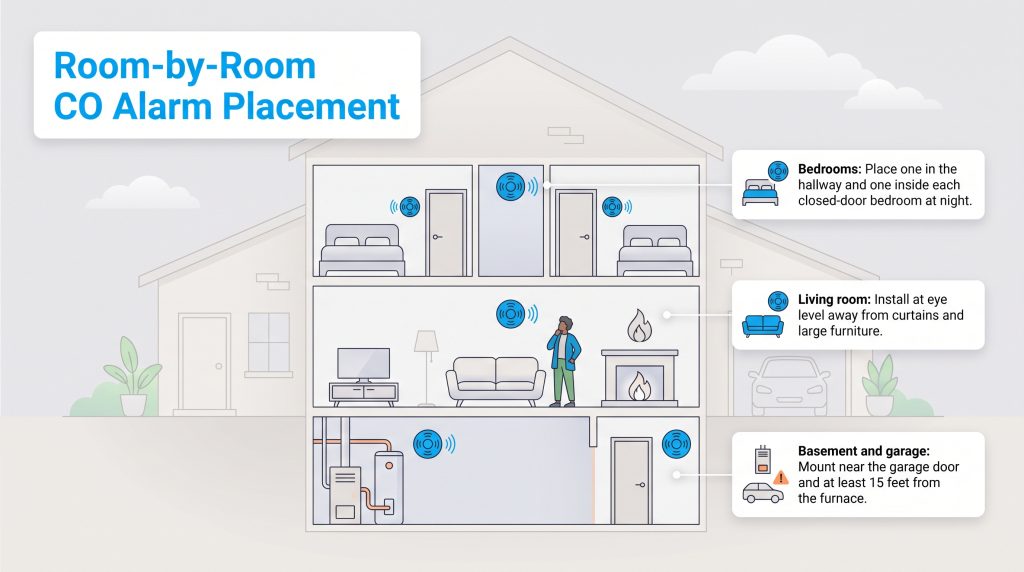
Walking through your home space-by-space is the easiest way to plan an effective alarm network. Tackling the placement strategy room by room ensures you cover all your bases without second-guessing your layout.
Bedrooms and Sleeping Areas
The most vulnerable time for CO poisoning is while you and your family are sleeping. Nighttime exposure is especially dangerous because CO poisoning can cause drowsiness, confusion, and unconsciousness, making it harder to recognize symptoms or respond quickly. Your detectors need to be loud enough to wake you as soon as the alarm’s sensor detects a dangerous CO level.
When determining the best place for carbon monoxide detector in bedroom settings, start with the hallway immediately outside the sleeping area. If your home has multiple bedroom wings, you need a separate detector for each hallway.
Additionally, if you keep your bedroom doors closed at night, you should install an alarm inside each individual bedroom. A closed solid-core door can muffle the sound of a hallway alarm, drastically delaying your reaction time when every second counts.
Living Rooms and Shared Spaces
Families spend significant amounts of time in living rooms, dens, and playrooms. Securing these shared spaces ensures that daytime leaks are caught while everyone is awake and active. In these common areas, try to keep the detectors at eye level, roughly five feet off the ground, where the air naturally circulates freely.
This placement is particularly crucial for homes that use natural gas for heating, as living rooms often feature gas fireplaces or sit directly above basement ductwork. Make sure the sensor isn’t tucked behind heavy curtains, tall bookshelves, or bulky entertainment centers that could block airflow.
Garages and Basements
Utility spaces generate unique risks, primarily from vehicle exhaust and heavy-duty appliances like water heaters and boilers. While you definitely want a carbon monoxide detector near furnace equipment, putting it too close can cause nuisance alarms.
You should place the detector at least 15 feet away from the furnace to avoid false alarms triggered by the initial, harmless combustion burst that happens when the system kicks on. Avoid placing standard CO alarms inside the garage unless the manufacturer says the unit is rated for that space. Instead, place an alarm inside the home near the door to the attached garage, while keeping it far enough from direct drafts and exhaust to prevent nuisance alarms when you open the interior door.
🚩 Heads Up: Never leave a car running inside an attached garage, even if the exterior overhead door is wide open. Dangerous exhaust fumes can still rapidly seep into the home’s living spaces.
Ceiling vs. Wall: What Is the Ideal Carbon Monoxide Detector Height?
Homeowners frequently wonder about the ceiling vs wall carbon monoxide detector debate, especially since smoke alarms are always mounted as high as possible. Smoke rises rapidly to the ceiling, but carbon monoxide mixes evenly with the air in your home. According to EPA guidance on carbon monoxide and indoor air quality, this even diffusion means that CO levels will be relatively consistent throughout the room once the gas spreads.
Because designs vary, the best mounting height is the one listed in your alarm’s manual. Wall-mounted units are often placed around eye level, while combination smoke/CO alarms are commonly ceiling-mounted. For standalone units, the optimal carbon monoxide detector height is usually on the wall at breathing level, roughly five feet from the ground. Placing it here makes it easy to read the digital display, test the unit regularly, and swap out the batteries without needing a stepladder.
However, there is one major exception. If you purchase a combination smoke and carbon monoxide detector, the device is explicitly engineered for ceiling placement to catch rising smoke. You must always follow the manufacturer’s specific instructions, as the internal sensors are calibrated based on their intended mounting position.
Where Not to Put Carbon Monoxide Detectors
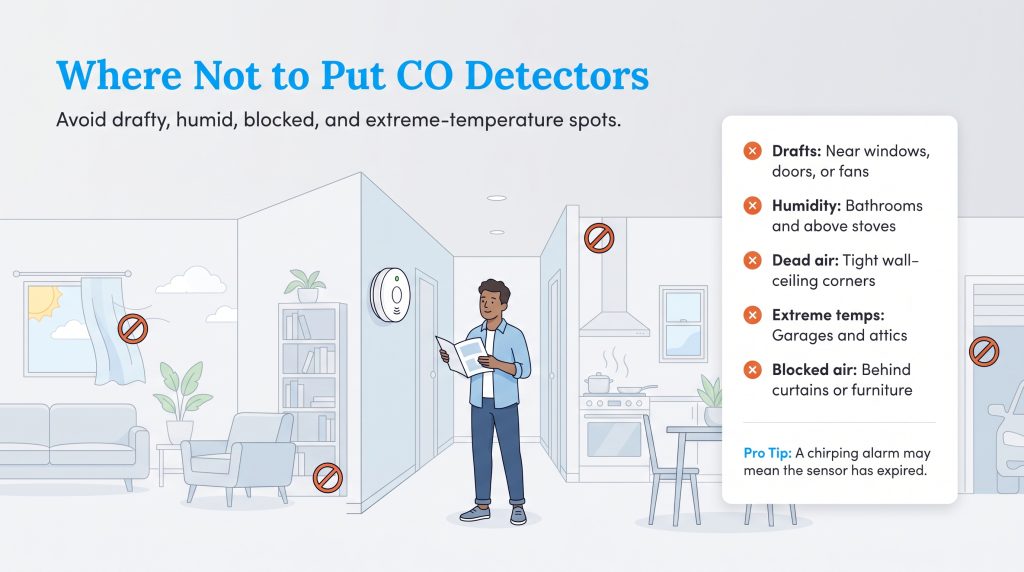
Incorrect placement leads to constant beeping, which inadvertently trains homeowners to ignore the sound or completely unplug their devices out of frustration. Avoiding carbon monoxide detector false alarm locations is just as important as finding the right spot. To keep your sensors operating accurately without driving you crazy, avoid placing them in these problematic areas:
- Direct sunlight or drafty areas near open windows, exterior doors, and ceiling fans, which can blow CO away from the sensor.
- Humid areas like inside bathrooms with showers or directly above kitchen stoves, as moisture and grease can damage the unit.
- Dead air spaces, such as the exact corners where the ceiling meets the wall, where air doesn’t actively circulate.
- Unfinished attics, garages, or crawlspaces where extreme hot and cold temperatures interfere with the sensor, unless the device is specifically rated for those conditions.
- Behind heavy curtains, tall furniture, or inside cabinets where the restricted airflow will stop the sensor from picking up a leak.
💡 Pro Tip: If your alarm starts chirping randomly, check the expiration date printed on the back. False alarms often happen because the sensor has simply expired, which usually occurs after five to 10 years, depending on the model.
How Many Carbon Monoxide Detectors Do I Need?
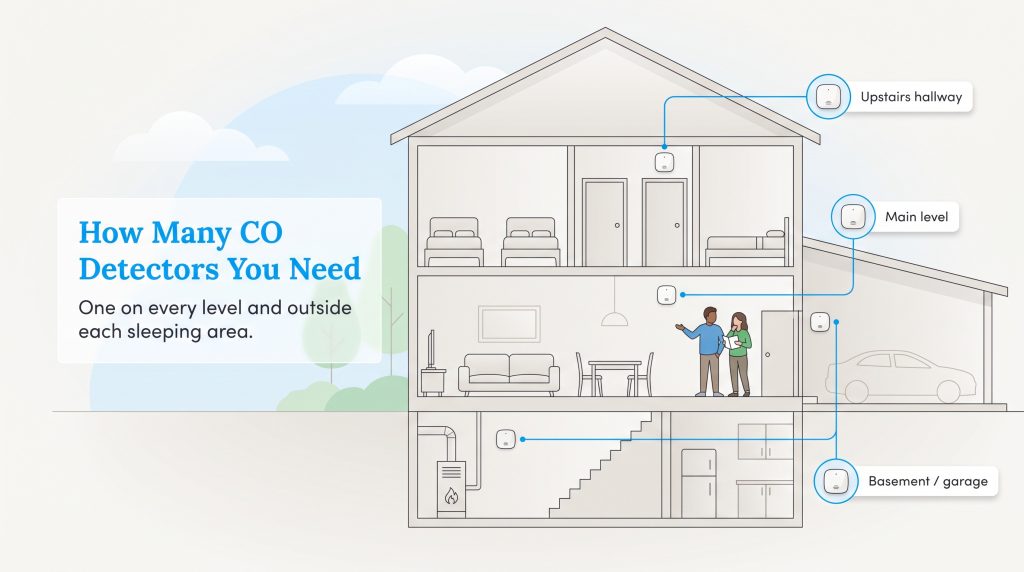
If you’re asking, “How many carbon monoxide detectors do I need?” start with one on every level and one outside each sleeping area. Add more alarms if your home has a long hallway, closed bedroom doors, a finished basement, an attached garage, or multiple fuel-burning appliances. A compact, single-story home typically needs at least one alarm near the sleeping area and another near the living spaces or attached garage.
If you’re wondering where carbon monoxide detectors should be placed in a two-story house, start with one alarm on each level, including the basement. In a two-story home with bedrooms upstairs, a gas furnace in the basement, and an attached garage, you’d typically place one alarm in the upstairs hallway near bedrooms, one on the main level, and one in the basement away from the furnace. If you are sketching out a carbon monoxide detector placement diagram for your home, make sure to include alarms on every level, outside sleeping areas, and near an attached garage entry.
Smart Home Integration and Interconnected Alarms
Modern, Wi-Fi-enabled smart detectors offer a helpful upgrade over traditional battery-operated units. The biggest safety benefit is interconnectivity. When one alarm detects a threat in the basement, every single alarm in the house sounds simultaneously, alerting you in the second-floor bedroom instantly. This is especially useful in larger homes, though some hardwired systems may require an electrician for installation. Remember that while smartphone alerts are helpful, they don’t replace the need to evacuate immediately when an alarm sounds.
Opting for smart detectors that integrate with your larger energy-saving smart home ecosystem is also an environmentally mindful choice. Upgrading your home’s electrical setup to include hardwired interconnected alarms with long-lasting lithium backup batteries can reduce the number of battery swaps over the alarm’s lifespan. This may be a more convenient and potentially less wasteful option than tossing out traditional alkaline batteries year after year, minimizing overall battery waste.
What to Do If Your Carbon Monoxide Alarm Goes Off
Knowing exactly how to react when your alarm sounds is just as important as placing the sensors correctly. According to CDC carbon monoxide poisoning prevention guidance, you should treat every alarm as a real emergency. If your detector starts beeping, follow these steps immediately:
- Evacuate immediately: Get everyone outside to fresh air right away, including your pets.
- Call for help: Dial 911 or your local fire department from safely outside the home.
- Stay outside: Do not re-enter the building until emergency responders have inspected the property and explicitly told you it is safe.
- Seek medical attention: Get help if anyone experiences symptoms like headaches, dizziness, nausea, weakness, confusion, chest pain, or loss of consciousness.
- Never ignore the alarm: Do not disable the device or assume it is a false alarm, even if your symptoms are mild or non-existent.
Protect Your Home With Smarter Carbon Monoxide Alarm Placement
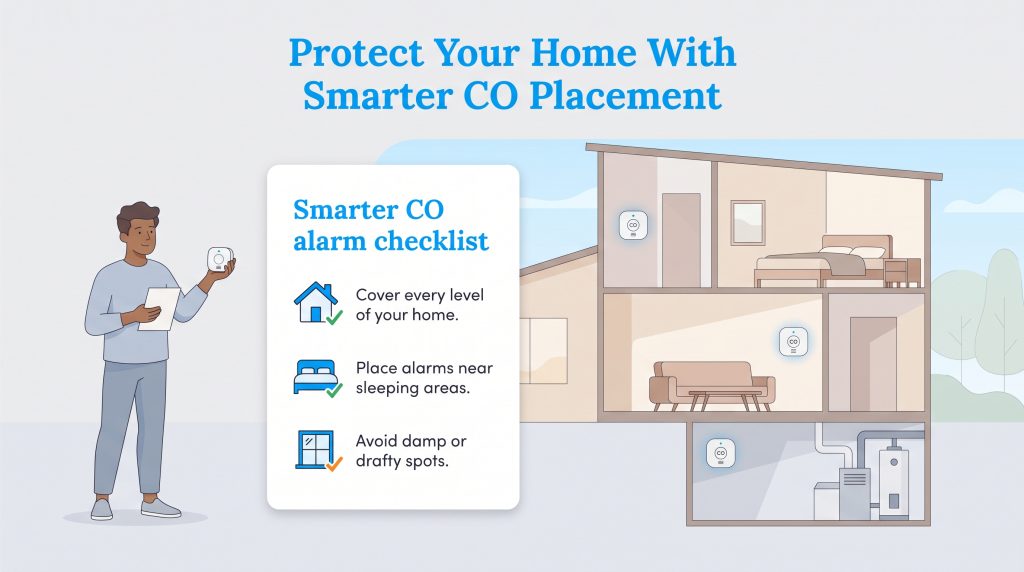
Creating a secure environment doesn’t require tearing down walls or hiring expensive professionals. By following a few straightforward placement rules, keeping alarms away from damp or drafty areas, and ensuring every level of your home is covered, you provide your household with reliable early-warning protection.
A quick walk-through today can make your home safer tonight: check each level, confirm alarms are near sleeping areas, move blocked units into open air, and replace any expired detectors. Securing your new or updated home grants incredible peace of mind, letting you rest easy knowing you are fully protected.
Frequently Asked Questions About Carbon Monoxide Detector Placement
You probably have a few specific scenarios in mind when planning out your home’s safety system. We have gathered the most common questions homeowners ask when finalizing their alarm layout.
Do Carbon Monoxide Detectors Plug Into the Wall?
The main thing to watch out for with plug-in models is obstruction. Ensure they aren’t blocked by heavy furniture, long curtains, or pushed behind a bookshelf, as the restricted airflow will stop the sensor from picking up a leak.
Can I Place a Carbon Monoxide Detector on a Table or Shelf?
Do I Need a Carbon Monoxide Detector If My Home Is All-Electric?
For homes without gas appliances, we strongly suggest placing at least one detector near the interior garage door and another near any wood-burning stoves or fireplaces to cover these alternative risks.
How Far Should a Carbon Monoxide Detector Be From a Gas Stove?
What Is the Building Code for Carbon Monoxide Detector Placement?
The NFPA requires an alarm placed outside each separate sleeping area and on every functional level of the dwelling. We always encourage you to check your specific local residential code, especially if you are renovating or preparing a home for sale, to ensure you are fully compliant.
How Often Should I Test a Carbon Monoxide Detector?
Can One Carbon Monoxide Detector Cover the Whole House?
Should Carbon Monoxide Detectors Be Near the Floor or Ceiling?
About the Author

LaLeesha has a Masters degree in English and enjoys writing whenever she has the chance. She is passionate about gardening, reducing her carbon footprint, and protecting the environment. She also recently served as President of the Board for City Sprouts (a community garden).

David has been an integral part of some of the biggest utility sites on the internet, including InMyArea.com, HighSpeedInternet.com, BroadbandNow.com, and U.S. News. He brings over 15 years of experience writing about, compiling and analyzing utility data.