

Finding the Right Radon Detector Helps You Monitor Your Indoor Air Quality and Decide When Action Is Needed to Reduce Invisible, Harmful Gases
Key Takeaways
- Continuous radon monitors provide real-time data, making them the most effective way to track long-term radon fluctuations in your home.
- You should place your detector on the lowest livable level of your home, away from direct drafts, exterior walls, and sump pumps.
- If your long-term average is at or above the EPA action level of 4 pCi/L, the EPA recommends fixing your home, usually with help from a qualified radon mitigation professional.
Radon testing is one of those crucial home maintenance tasks that can literally save lives. Because radon is an invisible, odorless, and naturally occurring radioactive gas, the only way to know if your family is at risk is to test your indoor air quality. Prolonged exposure to high levels of this gas is the leading cause of lung cancer among non-smokers, resulting in an estimated 21,000 lung cancer deaths each year in the United States. A reliable, accurate indoor radon detector helps you track hazardous fluctuations over time, decide when professional mitigation is necessary, and protect the air you breathe every single day. Tracking this gas is straightforward once you have the right real time radon testing device, allowing you to make confident, health-conscious decisions for your household. Jump to Top Picks.
Top Radon Detectors at a Glance
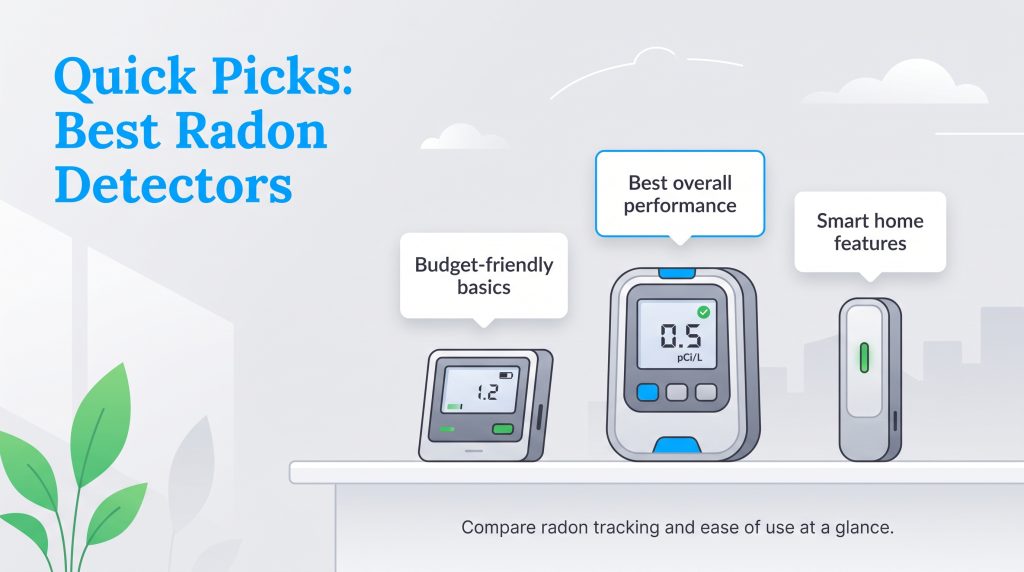
If you need immediate guidance on the best radon detectors available, use this quick comparison to find the perfect fit for your home. We categorized these top-rated devices by their ideal use case, detection style, and general price point so you can easily weigh your options.
| Model Name | Best For | Detection Type | Average Price |
|---|---|---|---|
| Airthings Corentium Home | Best Overall Radon Detector | Digital Continuous | $149.99 |
| Passive Charcoal Test Kits | Best Budget Option | Passive Lab Test | $19.95 |
| EcoSense RadonEye RD200 | Best Smart Air Monitor | Digital Continuous | $189.00 |
| Airthings View Plus | Long-Term Tracking | Digital Continuous | $329.99 |
| Ecosense EcoQube | Fastest Wi-Fi Results | Digital Continuous | $149.00 |
| Airthings Wave Radon | Portable Battery Use | Digital Continuous | $249 |
| Safety Siren Pro Series4 | Audible Alarms | Digital Continuous | $149 |
Why You Need a Radon Detector (The Invisible Threat)
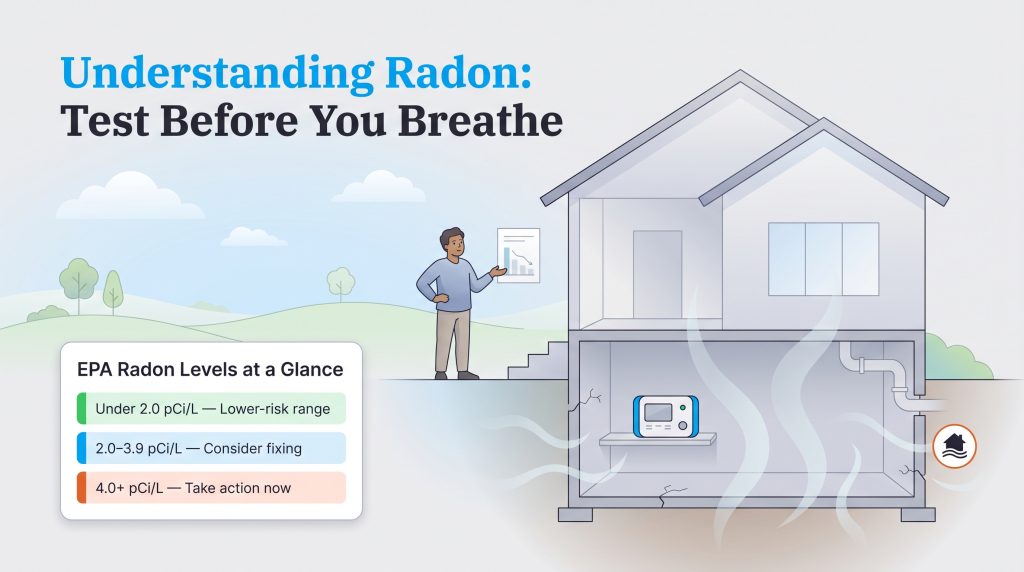
Radon is a naturally occurring radioactive gas produced by the breakdown of uranium in soil, rock, and water. Because your home functions like a low-pressure vacuum compared to the soil beneath it, a process known as the stack effect continuously pulls this harmful gas indoors. It easily seeps through foundational cracks, gaps around service pipes, construction joints, and even the tiny microscopic pores found in solid concrete. This is why thorough radon testing is a smart, non-negotiable step when moving into a new residence, particularly if the home has a basement, crawl space, slab foundation, or is located in a known high-radon geographic area.
Unlike carbon monoxide or smoke, you cannot see, smell, or taste radon gas. Left unmonitored, prolonged exposure quietly damages the DNA in your lung tissue. The federal government takes this threat incredibly seriously, establishing the EPA action level of 4.0 pCi/L as the threshold where immediate intervention is recommended. However, health agencies caution that no level of radon is entirely risk-free. For a deeper understanding of how exposure impacts long-term respiratory health, you can review the EPA’s detailed health risk breakdown.
| Radon Level (pCi/L) | EPA Guidance | What You Should Do |
|---|---|---|
| Under 2.0 | Lower-risk range | Continue periodic testing or long-term monitoring. |
| 2.0 to 3.9 | Consider fixing | Consider mitigation, especially if lower-level rooms are used often. |
| 4.0 or Higher | EPA action level | Confirm results if needed, then fix the home with help from a qualified radon professional. |
🚩 Heads Up: Radon levels are constantly fluctuating. A reading of 1.5 pCi/L in the summer could easily spike to an EPA action level of 4.0 pCi/L or higher during the winter as you winterize your home and the heating system alters internal air pressure.
Best Overall Radon Detector
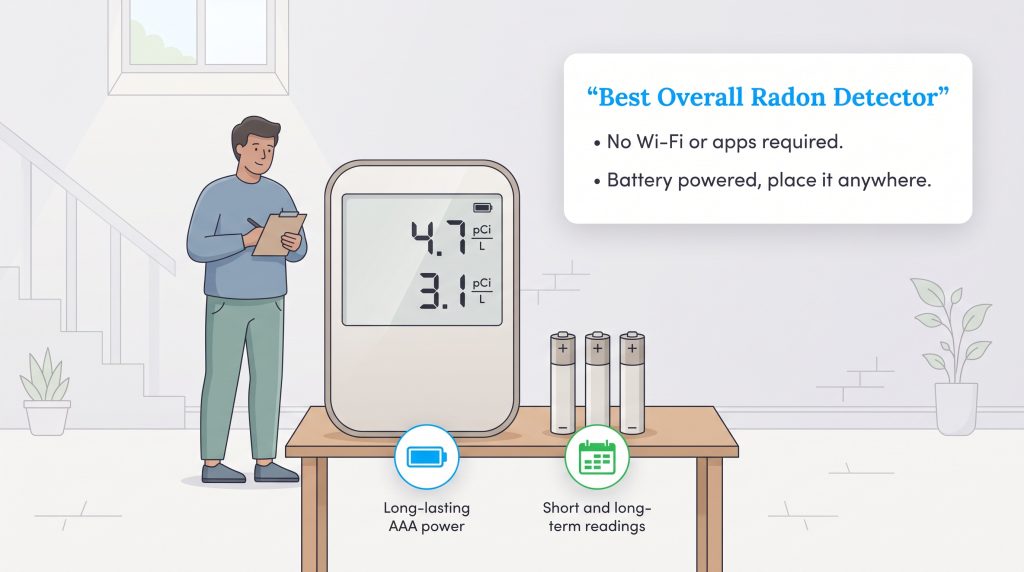
Time to First Reading: 24 hours | Power Source: 3 AAA batteries | Connectivity: None (On-screen display only) | NRPP Certification: Yes (Device components)
For the vast majority of households, the Airthings Corentium Home is undeniably the best radon detector for home use. It secures our top recommendation because it flawlessly balances long-term reliability with incredible user-friendliness. Operating entirely on three standard AAA batteries, you can place this lightweight device anywhere in your home without fussing over tangled power cords or searching for an available outlet. Furthermore, it completely bypasses the need for complex smartphone setups, Wi-Fi pairing, or frustrating subscription fees.
The Corentium actively samples your indoor air and calculates both short-term (1-day and 7-day) and long-term averages, displaying them clearly on an easy-to-read digital LCD screen. This continuous radon monitor empowers homeowners to track dangerous gas fluctuations daily. While it intentionally skips the smart home connectivity features found in flashier gadgets, its rock-solid accuracy and straightforward interface make it the most dependable tool for tracking your home’s baseline air quality.
- Pros: Exceptional battery life (often lasting over a year), highly portable cord-free design, provides simultaneous short and long-term data, and requires zero ongoing subscription costs.
- Cons: Lacks smartphone app connectivity, and the digital display does not feature a backlight, which can make it slightly difficult to read in dimly lit basements.
Best Budget Radon Test Kit
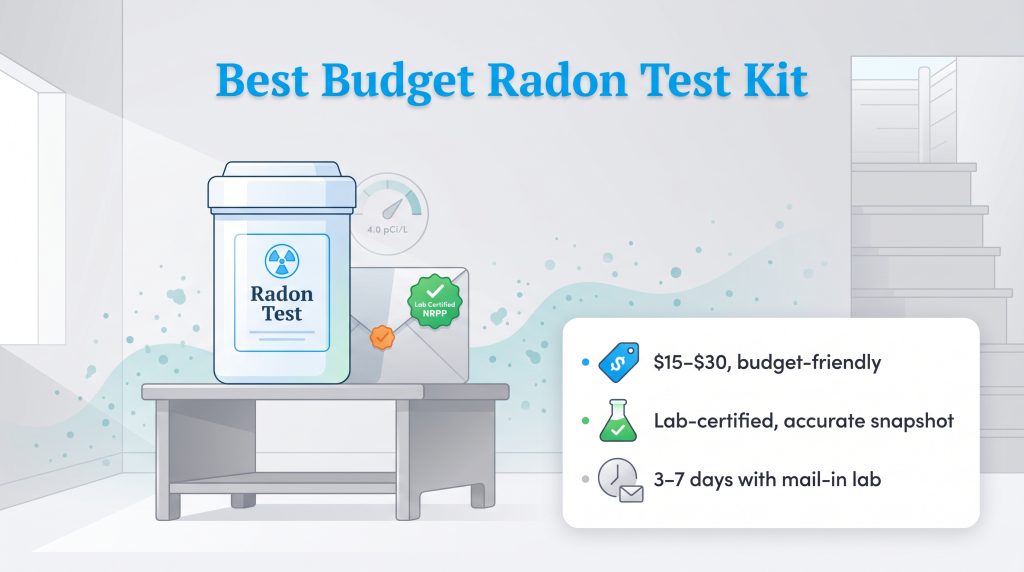
Time to First Reading: 3 to 7 days (Pending lab processing) | Power Source: None | Connectivity: None | NRPP Certification: Yes (Lab processing)
Securing your home’s air quality is a critical step in your home safety plan, and it does not have to drain your wallet. While digital hardware requires a larger upfront investment, a passive charcoal test kit remains the ultimate budget-friendly entry point. These kits generally cost between $15 and $30 and are excellent for grabbing a quick, highly accurate snapshot of your radon levels. Although they are not continuous monitors and only capture short-term data (usually deployed for 48 to 96 hours), they provide budget-conscious families with the crucial initial information they need.
When you purchase a passive kit, the price usually includes the physical activated charcoal canister and the laboratory processing fee. You simply leave the kit open in your lowest livable space for the specified timeframe, seal it tightly, and mail it to the certified lab. If the lab results show levels hovering near the EPA action level of 4.0 pCi/L, you can confidently decide whether it is time to invest in a continuous monitor for deeper tracking or immediately contact a mitigation professional.
- Pros: Extremely affordable, highly accurate lab-certified results, perfect for fast real estate transactions, and easy to deploy.
- Cons: Provides only a one-time snapshot rather than ongoing monitoring, requires mailing physical materials, and lab processing times can delay your final results.
Best Smart Radon and Air Quality Monitor
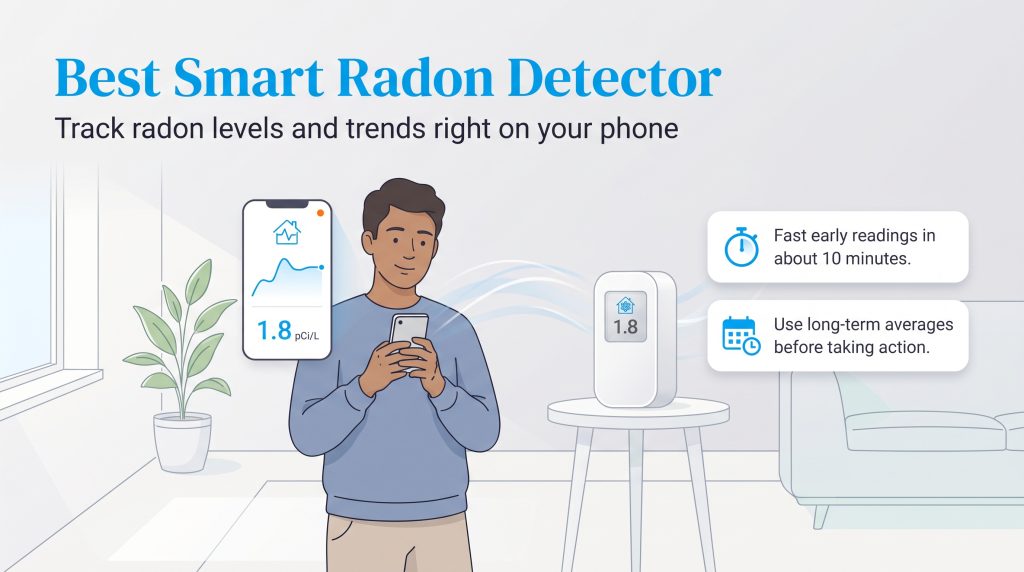
Time to First Reading: 10 minutes | Power Source: 12V DC Adapter (Plug-in) | Connectivity: Bluetooth | NRPP Certification: No (Consumer version)
If you prefer managing your home’s safety metrics right from your smartphone, the EcoSense RadonEye RD200 is a powerhouse option. This smart radon monitor with app integration utilizes Bluetooth to send high-resolution data straight to your mobile device, generating highly detailed visual charts of your home’s air quality over time. We particularly appreciate its incredibly fast reading times. Thanks to its patented pulsed ion chamber technology, it can begin displaying highly accurate early readings in just ten minutes, giving you an unparalleled first glimpse of your indoor levels.
While this speed is impressive, you should always rely on the device’s longer-term averages before making any permanent mitigation decisions. Because it relies on Bluetooth technology, you will need to be relatively close to the device to sync the newest data points to your phone. However, the immediate feedback loop, the intuitive app interface, and the ability to export detailed historical tracking logs make it an exceptional tool for proactive, tech-savvy homeowners.
- Pros: Industry-leading reading speed (10 minutes), beautiful in-app data visualization, highly sensitive sensor, and straightforward setup process.
- Cons: Requires a wall outlet for continuous power, and Bluetooth limits remote data syncing when you are away from the house.
💡 Pro Tip: Smart detectors are fantastic for tracking daily averages on your phone, but remember that Bluetooth models require you to be within range to sync your data. If you want updates while away from home, you will need a Wi-Fi-enabled model instead.
Best Continuous Radon Monitor for Long-Term Tracking
Time to First Reading: 24 hours | Power Source: 6 AA batteries or USB cable | Connectivity: Wi-Fi | NRPP Certification: No (Consumer version)
When measuring dangerous gas, long-term data reigns supreme. The Airthings View Plus serves as the ultimate premium hub for homeowners wanting a holistic understanding of their environment. Beyond being an incredibly accurate indoor radon detector, the View Plus actively monitors particulate matter (PM2.5), carbon dioxide, humidity, temperature, airborne chemicals (VOCs), and air pressure. This comprehensive air quality and radon monitor provides the most well-rounded picture of exactly what you are inhaling daily.
Because it connects directly to your home’s Wi-Fi network, you can access your home’s safety metrics from anywhere in the world. The sleek e-paper display customizable dashboard allows you to wave your hand in front of the unit for a quick visual color-coded alert regarding your current air status. If your long-term averages slowly creep toward the EPA action level of 4.0 pCi/L, the connected app will ensure you are well-informed long before it becomes an emergency.
- Pros: Monitors seven different air quality factors, Wi-Fi connectivity allows for remote viewing anywhere, customizable display, and acts as a smart home hub.
- Cons: Carries a premium price tag, and the wealth of data can be slightly overwhelming for users who only want a basic radon reading.
Best Portable Battery-Powered Radon Detector
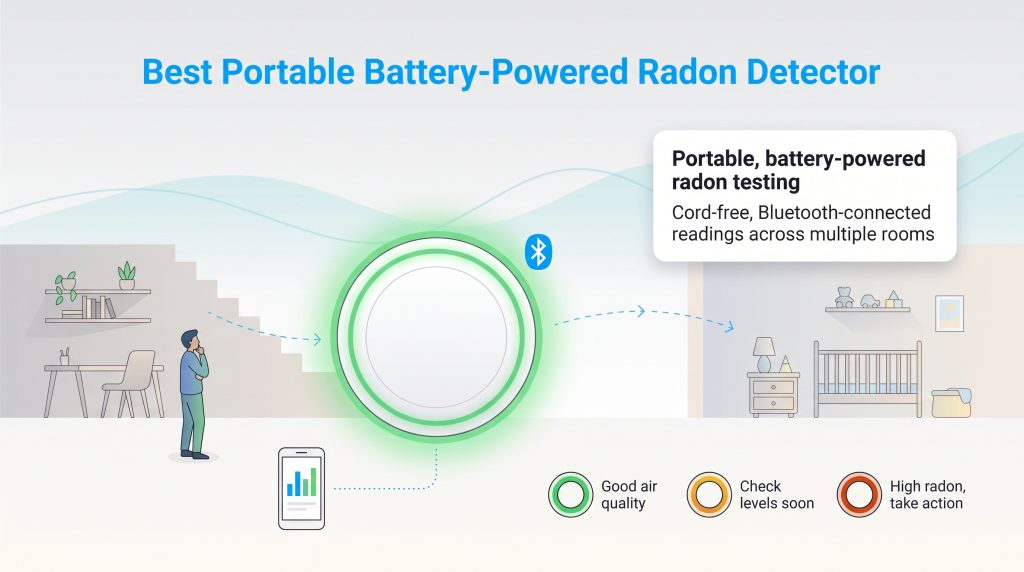
Time to First Reading: 24 hours | Power Source: 2 AA batteries | Connectivity: Bluetooth | NRPP Certification: No
For homeowners who need to test multiple areas of their property—such as a basement office, a ground-floor living room, and a newly renovated crawlspace—the Airthings Wave Radon is an outstanding best battery powered radon detector. Powered seamlessly by two standard AA batteries, you do not have to worry about routing cables or finding a spare electrical outlet. You can simply mount it to the wall or set it on a sturdy shelf and let it work quietly in the background.
The Wave Radon uses Bluetooth to send its long-term average logs directly to your smartphone. One of its most appealing features is the visual indicator ring; simply waving your hand in front of the device illuminates a green, yellow, or red ring to instantly convey your current air quality status. This portability makes it the perfect choice if you want to run a 30-day test in your basement before effortlessly moving it up to the nursery for another testing cycle.
- Pros: Completely cord-free operation, highly intuitive wave-to-check visual light ring, compact aesthetic design, and measures humidity and temperature alongside radon.
- Cons: No built-in digital screen for immediate numerical readings, requiring you to open the app to see specific data points.
Short-Term Test Kits Versus Continuous Digital Monitors
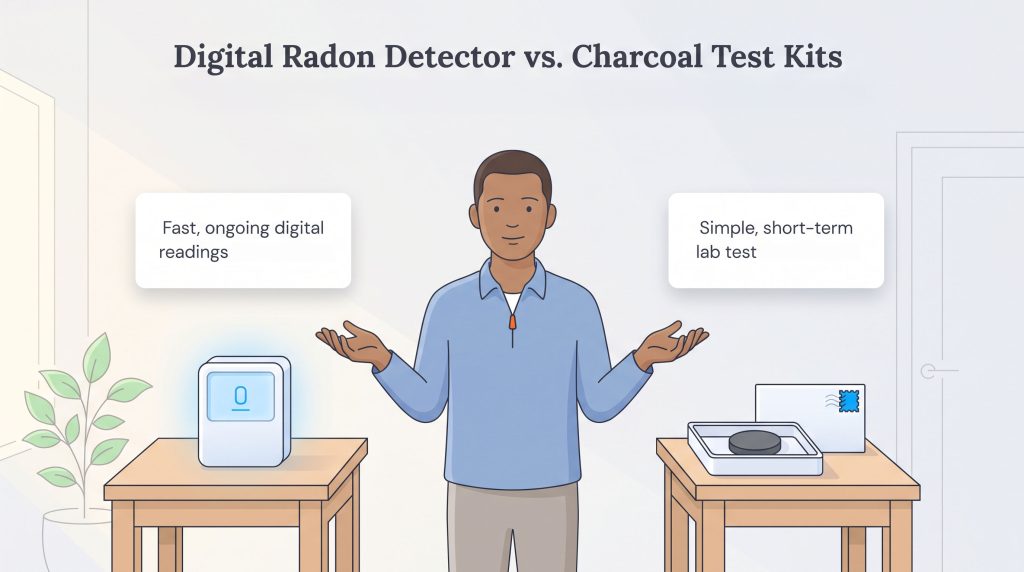
When you begin researching how to test your home, you will quickly encounter the debate between quick charcoal snapshots and robust digital systems. Understanding the nuanced differences between a short term vs long term radon test is crucial for accurately assessing your property. While both tools are valuable for identifying harmful gases, they serve distinctly different purposes.
Short-Term Passive Test Kits
- Typical Duration: 2 to 90 days (most often 48 to 96 hours).
- Best Use Case: Real estate transactions, post-mitigation confirmation, or a fast baseline check.
- How It Works: Activated charcoal passively absorbs the gas. The canister is sealed and mailed to a lab for professional analysis.
- The Drawback: It cannot track extreme daily fluctuations caused by heavy rain, shifting barometric pressure, or changes in your indoor ventilation habits.
Continuous Digital Monitors
- Typical Duration: Infinite ongoing tracking.
- Best Use Case: Long-term health monitoring, seasonal tracking, and personal peace of mind.
- How It Works: Digital sensors actively sample the air, providing a real time radon testing device experience with daily and long-term averages.
- The Drawback: Requires a much higher initial financial investment compared to single-use kits, and consumer models are typically not valid for real estate sales.
Because of extreme environmental fluctuations, a quick charcoal test might completely miss a significant gas spike that happens just a week later following a heavy storm. By tracking the air day in and day out, continuous monitors provide an accurate long-term average that truly reflects your exposure over months or years. You simply cannot get that kind of detailed, ongoing assurance from a single-use passive kit sitting on a basement shelf.
💸 Money-Saver: Investing in a digital monitor is a practical, one-time purchase that actually saves you money over a 10-year period compared to constantly buying and mailing replacement passive kits every single year.
How We Tested and Ranked the Best Radon Detectors
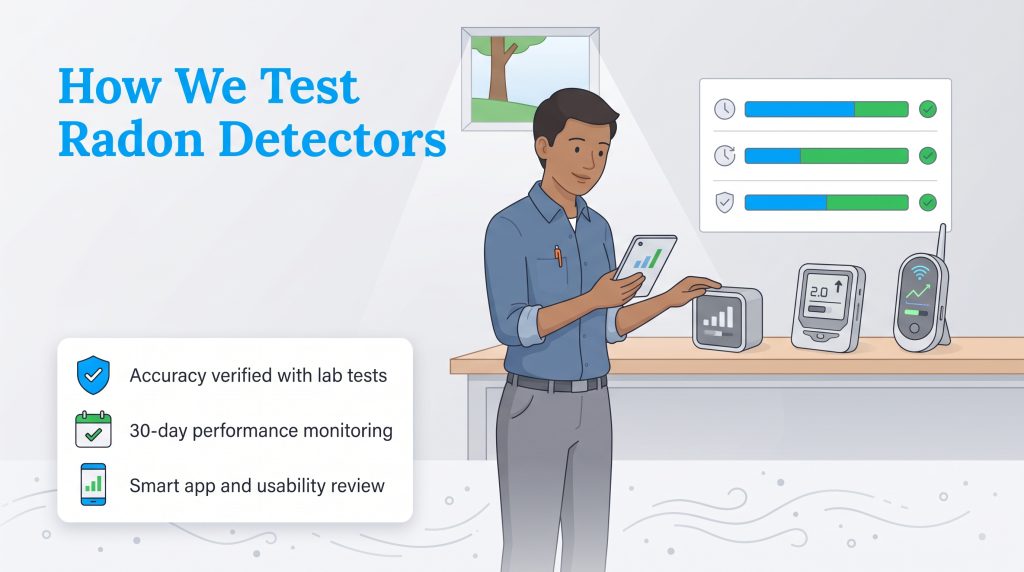
To ensure we provide the most reliable, actionable recommendations for our readers, we put these digital gas detectors through a rigorous evaluation process. Because this is a critical health and safety topic, we prioritized establishing real-world evidence. Our methodology for determining the best options included the following strict criteria:
- Sensor Calibration Checks: We researched the underlying sensor technology (such as pulsed ion chambers versus alpha spectrometry) to ensure each device relies on proven, industry-standard detection methods that resist environmental drift.
- Long-Term Baseline Testing: Devices were run simultaneously in active basement environments over an extended 30-day period to evaluate how effectively they calculated and stabilized their long-term averages.
- Cross-Referencing Accuracy: We compared the continuous digital readings against an EPA approved radon test kit processed by a certified third-party laboratory to verify overall consumer accuracy.
- App Usability and UX Testing: For smart models, we tested Bluetooth and Wi-Fi connectivity ranges, analyzed the historical charting features, and evaluated how easily the average user could export their data for a mitigation professional.
- Power and Hardware Durability: We scrutinized battery life claims, screen readability in low-light environments, and the physical footprint of each device to ensure they fit seamlessly into an everyday home.
Verdict: Choosing the Right Radon Solution
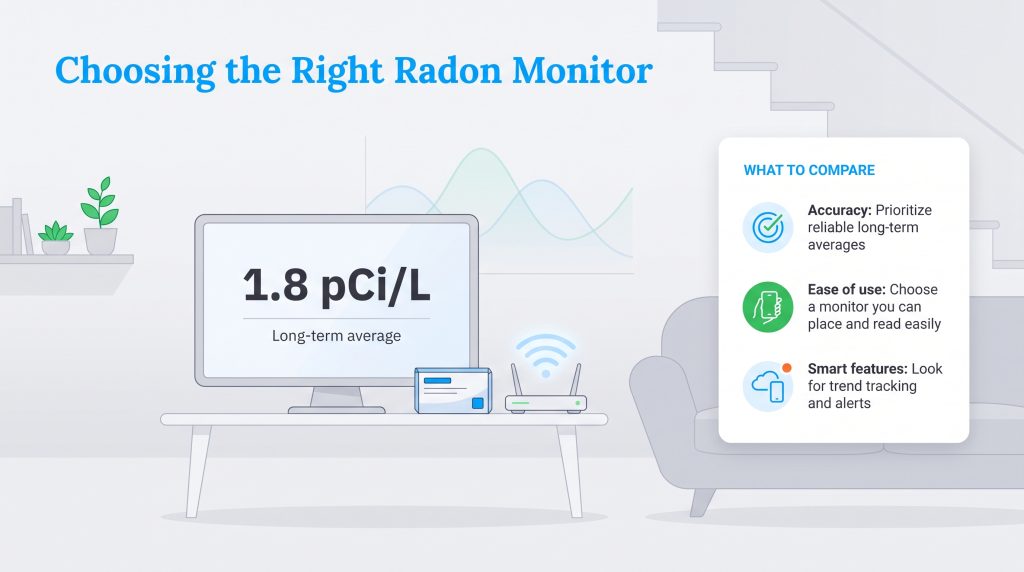
Finding the right fit depends largely on your budget, your technological comfort level, and your overall testing timeline. Whether your readings stay comfortably low or occasionally push past the EPA action level of 4.0 pCi/L, having the right tool eliminates the guesswork. As you finalize your decision, keep these core evaluation criteria and operational best practices in mind.
Accuracy
Accuracy is paramount when dealing with radioactive gases. The most accurate indoor radon detectors utilize highly sensitive internal chambers that count alpha particle strikes. While passive lab kits are highly accurate for short windows, digital continuous monitors offer the superior advantage of tracking exact seasonal shifts. Always trust devices that provide a verifiable long-term average, as this is the only reliable metric for assessing your true health risk.
Ease of Use
The best technology is the kind you actually utilize. If you despise troubleshooting connectivity issues, opt for a purely digital battery-operated unit with a clear LCD screen. Proper placement is also critical for usability. To get the best data, place the device in the lowest livable space of your home (like a finished basement), elevate it at least 20 inches off the floor, and keep it away from exterior walls, humid bathrooms, drafty windows, and open sump pumps.
Smart Features
Smart connectivity transforms raw data into actionable insights. A digital radon gas detector with an integrated app allows you to visualize long-term trends, receive push notifications when levels unexpectedly spike, and seamlessly share comprehensive spreadsheets directly with professional mitigation contractors. Consider Wi-Fi models if you travel frequently and want remote access, or stick to Bluetooth models if you simply want to view deeper metrics while relaxing in your living room.
What to Do If Your Detector Shows High Radon Levels
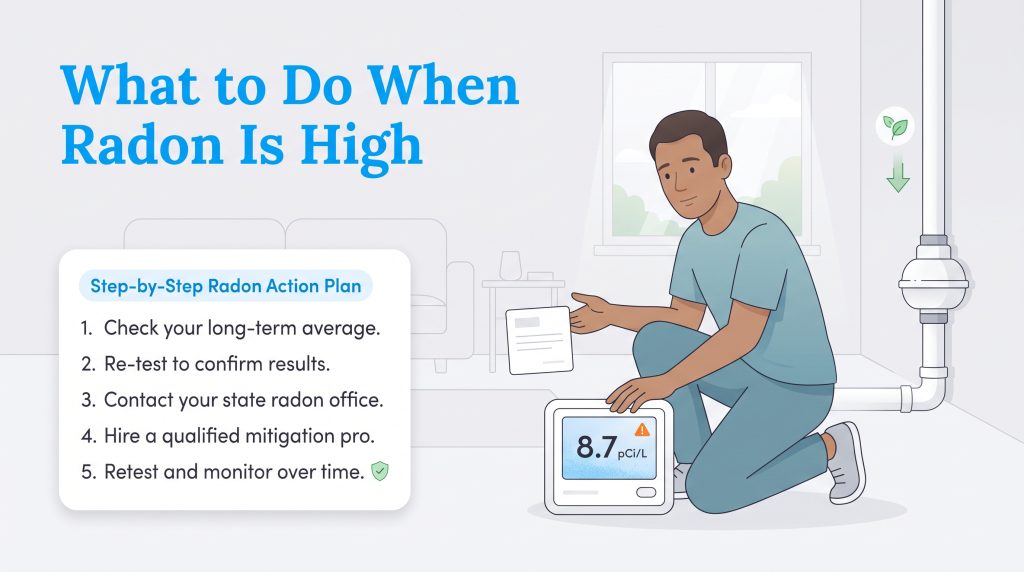
Discovering high numbers on your monitor’s display can spark anxiety, but there is no need to panic. Elevated levels are extremely common across the country, and more importantly, they are completely fixable with standard professional intervention. If you see a concerning reading, first ensure you are looking at a long-term average rather than a temporary daily spike. Confirm the result with a follow-up passive lab test or continue monitoring. If the high levels persist, contact your state radon office or utilize the NRPP search tool to hire a certified mitigation contractor.
Advice for Homeowners and Renters
If you are a homeowner facing a reading at or above the EPA action level of 4.0 pCi/L, the EPA recommends immediately fixing your home. Contractors typically install a sub-slab depressurization system, which utilizes PVC piping and a specialized fan to quietly draw the harmful gas from beneath your foundation and safely vent it outside. Taking this action provides a unique opportunity to pursue an environmentally mindful choice for your property. By sealing up drafty foundation leaks during installation, you prevent conditioned air from escaping, which improves your HVAC efficiency and complements other energy-efficient home improvements.
If you are a renter, you cannot install a system yourself, but you still have clear avenues for action. Document your digital monitor’s long-term readings meticulously over a 30-day period. Submit these findings formally to your landlord or property management company in writing, requesting that they hire a professional to address the indoor air quality issue as soon as possible.
Securing Your Indoor Air Quality for the Long Haul
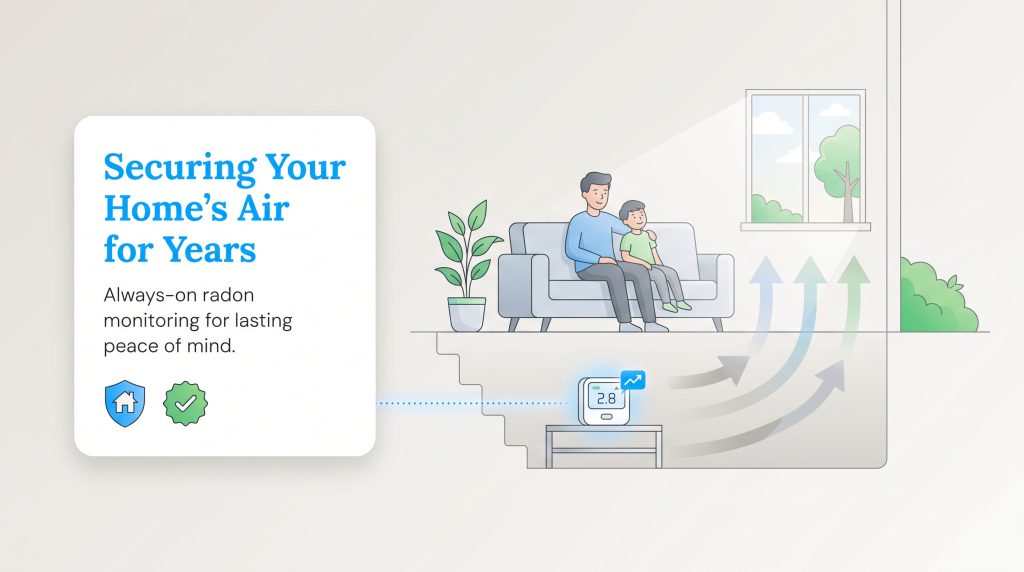
Taking the initiative to monitor the unseen elements in your living space is one of the smartest, most health-conscious decisions you can make. Investing in a quality detection system transforms an invisible, terrifying threat into a trackable, easily manageable data point. Once you have a reliable device actively sampling the air in your basement, you completely eliminate the stressful guesswork, ensuring your home remains a safer, healthier sanctuary for years to come.
Frequently Asked Questions About Radon Detectors
We know that navigating indoor air quality testing can bring up a host of specific concerns. Here are some of the most common questions we hear regarding digital monitors and home testing strategies.
What is the most accurate radon detector for home use?
Where is the best place to put a radon detector in a house?
How do I know if my radon levels are too high?
Do I need a continuous radon monitor or just a one-time test kit?
Do I need a radon detector if I don’t have a basement?
Can I use a digital radon detector for a home sale?
Do radon levels change by season?
Should renters test for radon?
Are continuous radon monitors EPA approved?
About the Author

LaLeesha has a Masters degree in English and enjoys writing whenever she has the chance. She is passionate about gardening, reducing her carbon footprint, and protecting the environment. She also recently served as President of the Board for City Sprouts (a community garden).

David has been an integral part of some of the biggest utility sites on the internet, including InMyArea.com, HighSpeedInternet.com, BroadbandNow.com, and U.S. News. He brings over 15 years of experience writing about, compiling and analyzing utility data.