

Relocating to the Badger State offers affordable housing and four-season beauty, provided you plan ahead for utility setup and winter heating bills
Key Takeaways
- Housing costs in Wisconsin sit well below the national average, with a median home price of $266,500 compared to the $416,100 national median.
- Setting up utilities in Wisconsin requires advance planning, especially in rural areas where you may need to schedule propane deliveries and certified private well water testing.
- Statewide efficiency incentives through Focus on Energy help reduce energy use and upgrade costs by offering qualifying discounts on smart thermostats, insulation, and ENERGY STAR appliances.
From Friday night fish fries at classic supper clubs to 15,000 inland lakes and genuinely welcoming neighborhoods, it’s easy to see why moving to Wisconsin appeals to so many families and remote workers. Still, relocating to Wisconsin takes more than packing a warm coat and developing a taste for cheese curds. Between figuring out your new household budget, setting up utilities in a regulated energy market, and prepping your home for sub-zero January nights, a little preparation goes a long way. We’ve put together the comparable costs, lifestyle considerations, utility providers, and a step-by-step moving checklist so you can settle in while saving time, money, and energy.
The Honest Pros and Cons of Living in Wisconsin
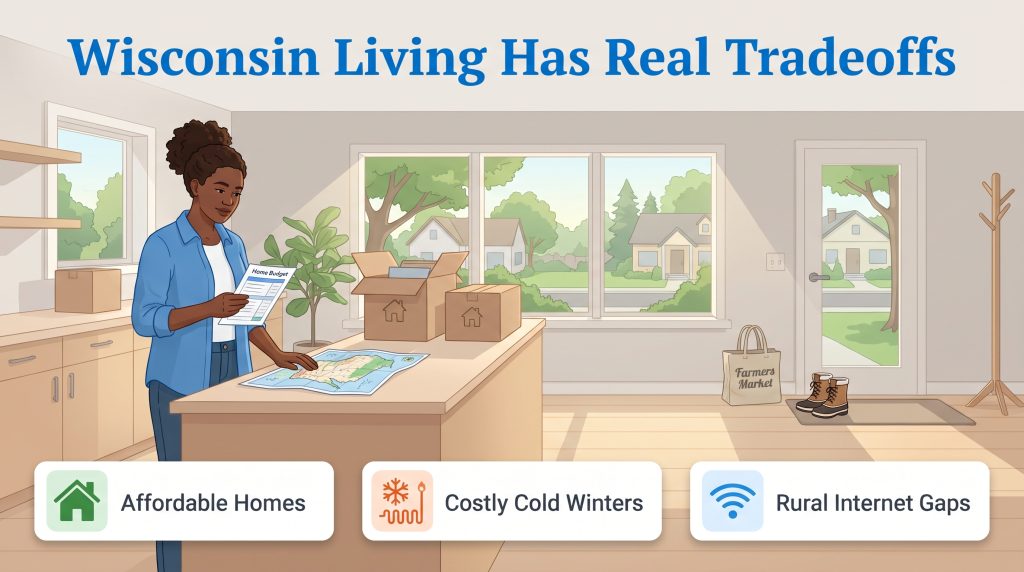
State tourism boards and real estate agents love to paint a picture-perfect postcard of life in the Midwest, but every state comes with trade-offs. Before moving to Wisconsin, you deserve a transparent look at the daily perks and practical headaches you’ll experience once the moving boxes are unpacked. Weighing the pros and cons of living in Wisconsin upfront helps you pick the right town and budget accurately for all four seasons.
Why People Love Calling the Badger State Home
- Attainable housing prices: Whether you’re buying a historic bungalow in Milwaukee or a suburban ranch near Appleton, your housing dollars stretch significantly further here than on the coasts or in neighboring Illinois.
- Public education: Wisconsin takes pride in its schools, anchored by the Universities of Wisconsin system and dozens of highly rated public school districts.
- Safe, tight-knit communities: The state offers a relaxed, neighborly feel, though you should always research neighborhood-level crime data before choosing a home.
- Unique local culture: Saturdays revolve around sprawling farmers markets, craft breweries, Green Bay Packers tailgates, and old-school supper clubs.
- Four-season outdoor access: You get direct access to two Great Lakes (Lake Michigan and Lake Superior) alongside more than 1,200 miles of the Ice Age National Scenic Trail and extensive hiking, biking, and cross-country ski trails.
Real Challenges New Residents Should Expect
- Long, freezing winters: Sub-zero wind chills from December through March are a reality, driving up seasonal natural gas and propane heating bills.
- Above-average property taxes: Local municipalities rely heavily on property taxes to fund public schools and snowplows, which adds to your monthly mortgage escrow.
- Rural broadband gaps: While cities enjoy fast fiber internet, remote properties in the northern woods and hilly Driftless Area often face limited high-speed wiring.
- Regulated energy territories: Unlike Illinois or Texas, Wisconsin does not have a deregulated retail electricity market, meaning you cannot shop around for a competing power supplier.
Breaking Down the Cost of Living in Wisconsin
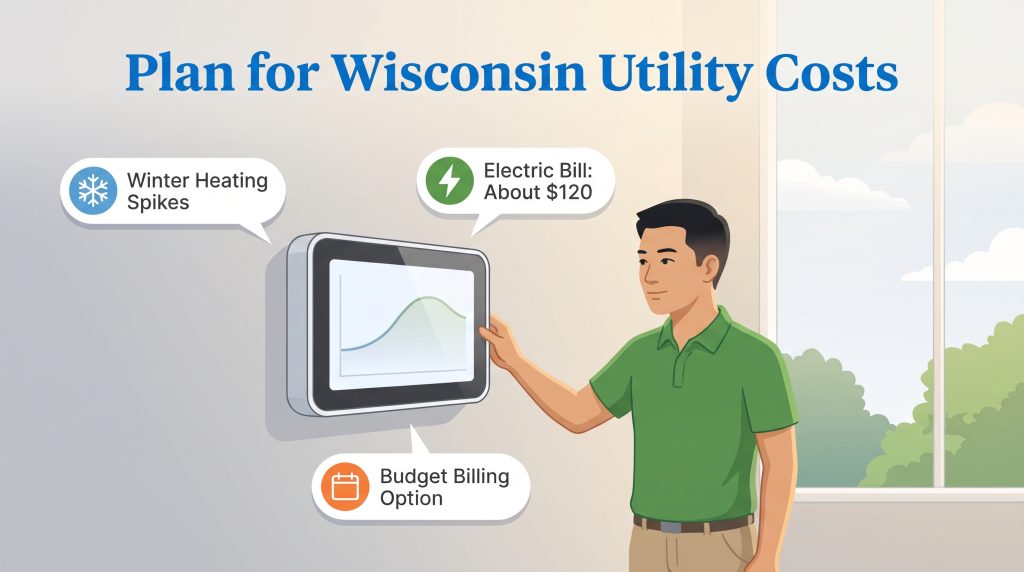
Overall, the cost of living in Wisconsin sits slightly below the national average, making it a strong financial move for most households. While you’ll save on a down payment or monthly rent, you still need to account for local tax structures and seasonal heating shifts. According to the U.S. Energy Information Administration (EIA) Wisconsin State Energy Profile, roughly two-thirds of Wisconsin households rely on imported natural gas for winter heating, which directly shapes how you budget from month to month.
| Expense Category | Wisconsin Average | National / Neighbor Comparison | Source and Period |
|---|---|---|---|
| Median Home Price | $266,500 | $416,100 U.S. median | U.S. Census Bureau (2024) |
| Median Monthly Rent | $1,087 | $1,372 U.S. median | U.S. Census Bureau (2024) |
| Median Household Income | $77,500 | $80,610 U.S. median | U.S. Census Bureau (2024) |
| Base State Sales Tax Rate | 5% | 6.25% in Illinois | WI Dept. of Revenue (2024) |
| Effective Property Tax Rate | 1.32% | 1.59% in Illinois | Tax Foundation (2024) |
Housing, Taxes, and Everyday Expenses
When calculating your monthly housing costs, pay close attention to the relationship between home prices and property taxes. Because home values are lower, the average annual property tax bill looks modest in many areas, yet Wisconsin’s effective property tax rate is around 1.32%. Make sure your lender calculates your exact local mill rate into your monthly mortgage escrow so you’re not surprised at closing. Fortunately, everyday expenses stay manageable thanks to a low 5% base state sales tax (though local municipalities can add to this rate) and qualifying food items that are exempt from sales tax.
What to Expect on Your Average Utility Bill in Wisconsin
Your energy bills will fluctuate dramatically by season. An illustrative combined utility budget in Wisconsin runs between $300 and $400 per month when you bundle electricity, natural gas, municipal water, sewer, trash pickup, and internet. Specifically, the average monthly residential electric bill is roughly $120, though electricity and heating fuel bills overlap depending on your system’s configuration. We recommend requesting 12 months of address-specific usage history, where available. Spring and autumn bring mild weather and remarkably low electric and gas bills, while November through March triggers sharp spikes in natural gas or propane consumption.
Money-Saver
Ask your new utility provider about Budget Billing when you open your account. This averages your estimated annual usage into 12 predictable payments, though amounts can change and balances require reconciliation. It smooths payments out over the year rather than lowering your total annual costs.
Best Places to Live in Wisconsin Based on Your Lifestyle
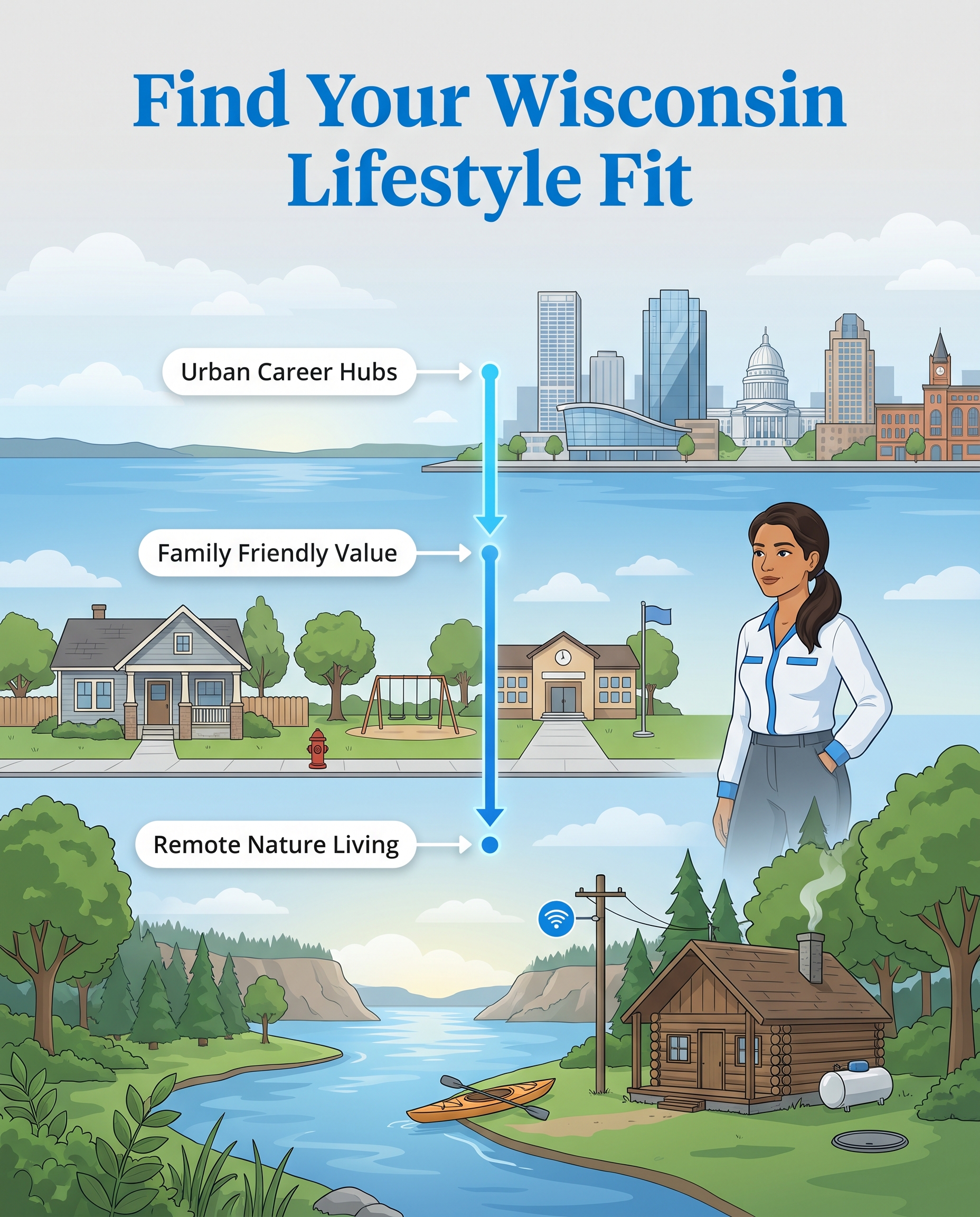
Choosing among the best places to live in Wisconsin comes down to balancing your career goals, housing budget, and preferred pace of life. The state’s regions vary wildly in both culture and utility infrastructure. Moving to a historic brick home along Lake Michigan requires a very different setup than relocating to Wisconsin’s northern lake country.
Madison and Milwaukee for Urban Amenities and Career Growth
Madison and Milwaukee anchor the state’s economy, though they offer distinct living experiences. Built on an isthmus between Lake Mendota and Lake Monona, Madison thrives on state government, UW-Madison research, and a booming Madison-area healthcare tech sector led by Epic Systems in nearby Verona. Madison pushes ambitious municipal sustainability goals, though high demand pushes median home prices above the state average. Ninety miles east on Lake Michigan, Milwaukee offers big-city cultural perks and employers like Northwestern Mutual and Harley-Davidson at a much lower entry price. If you buy one of Milwaukee’s charming Victorian or craftsman bungalows, schedule a home energy audit early on — older historic housing stock often needs attic insulation and air sealing to keep winter drafts at bay.
The Fox Cities and Green Bay for Family-Friendly Affordability
Stretching along the Fox River and Lake Winnebago, the Fox Cities (including Appleton, Neenah, and Menasha) along with Oshkosh and Green Bay deliver a sweet spot for growing families. The regional economy runs on advanced manufacturing, healthcare, and paper products, offering stable jobs and short commutes. Suburbs here feature top-rated public schools, well-maintained parks, and reliable municipal water and electric systems.
Eau Claire, the Driftless Area, and “Up North” for Remote Workers and Nature Lovers
If your ideal weekend involves fly-fishing or kayaking, look toward western and northern Wisconsin. Western hubs like Eau Claire and La Crosse blend indie music scenes and university energy. La Crosse offers immediate access to the Driftless Area — a stunning region of steep, unglaciated river bluffs that ancient glaciers missed, while Eau Claire anchors the Chippewa Valley. Further north, towns like Minocqua, Rhinelander, and the coastal villages of Door County offer quiet woodland living. If you’re a remote worker eyeing a cabin or farmhouse in these areas, verify fiber internet availability at the exact street address before making an offer, and budget for rural utility setups like private septic systems and liquid propane (LP) tanks.
Setting Up Utilities in Wisconsin: Providers and How It Works
When setting up utilities in Wisconsin, you’ll deal with a regulated energy market. Instead of shopping dozens of competing retail suppliers, your electric and natural gas utilities are assigned strictly by your home’s street address. You can look up your exact electric, natural gas, and water service territories before closing day using the Public Service Commission of Wisconsin Interactive Service Area Maps.
Major Wisconsin Electric and Gas Providers by Region
Five major investor-owned utilities serve the bulk of Wisconsin’s population, supplemented by member-owned rural electric cooperatives and more than 80 community-owned municipal power utilities. Here is how Wisconsin electric and gas providers break down across the state:
| Utility Provider | Example Service Territories | Services Offered |
|---|---|---|
| We Energies | Southeast Wisconsin (Milwaukee, Waukesha, Racine, Kenosha) and parts of the Fox Valley | Electricity and Natural Gas |
| Alliant Energy (Wisconsin Power and Light) | South-central and central Wisconsin (Janesville, Beloit, Sheboygan, Fond du Lac, Baraboo) | Electricity and Natural Gas |
| Madison Gas and Electric (MGE) | Greater Madison and surrounding Dane County communities | Electricity and Natural Gas |
| Wisconsin Public Service (WPS) | Northeast and north-central Wisconsin (Green Bay, Oshkosh, Wausau, Rhinelander) | Electricity and Natural Gas |
| Xcel Energy | Western and northwestern Wisconsin (Eau Claire, La Crosse, Hudson, Menomonie) | Electricity and Natural Gas |
| Municipal Utilities & Electric Co-ops | 80+ public power towns (Sun Prairie, Kaukauna, Manitowoc) and rural local distribution cooperatives | Primarily Electricity (some municipal water) |
Connecting Water, Sewer, and Waste Services
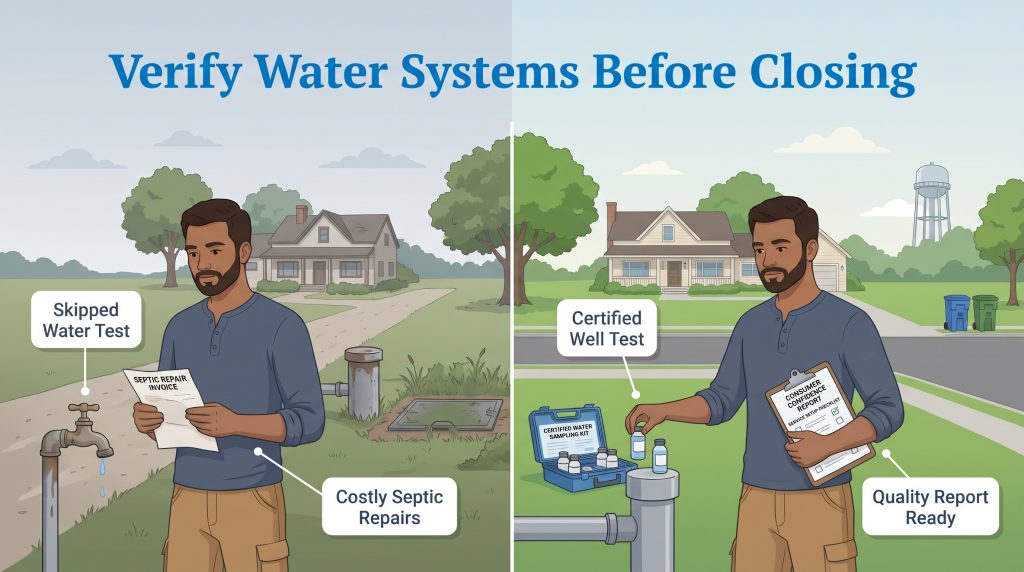
In cities and villages, your water and sewer service as well as curbside trash and recycling pickup are handled directly through your local municipal clerk’s office, public works department, sanitary district, or a private hauler, typically billed either monthly or quarterly. Once you open your municipal water account, you can request the city’s annual Consumer Confidence Report to review local water quality. If you’re buying a rural home outside municipal boundaries, your property may rely on a private well and septic system. Always schedule a certified private well water test by an appropriately certified laboratory following Wisconsin Department of Natural Resources (DNR) guidance before finalizing your home purchase.
Finding Reliable High-Speed Internet Across the State
In metro areas and mid-sized suburbs, setting up high-speed internet is straightforward, with coverage from AT&T Fiber, Spectrum, and Madison-based TDS Telecom. Thanks to ongoing state broadband expansion grants, fiber-optic lines are steadily reaching smaller rural townships as well. However, if you’re moving to an “Up North” lake property or a tucked-away Driftless valley where cable lines do not reach, you’ll need to compare fixed wireless providers or low-earth orbit satellite internet. Require address-level confirmation, including upload speeds, installation lead times, and equipment requirements, before signing a lease or purchase contract.
Heads Up
If you are buying a home in a rural Wisconsin county, ask the seller whether the propane tank is owned or leased. If the tank is leased, it may come with a contract requiring you to buy fuel from its owner. Ask for the lease, delivery terms, fees, and transfer requirements before closing.
Address-Specific Setup Checklist
Before finalizing your move, take time to verify utility details for your exact address to ensure a smooth transition:
- Confirm which services you must open directly and which the landlord or homeowners association handles.
- Ask about deposits, identification requirements, activation fees, and whether you need an in-person appointment for connections.
- Coordinate start and stop dates with your lease or closing responsibilities.
- Check your heating fuel type, the condition of the HVAC equipment, and whether a leased propane tank involves an exclusive delivery contract.
- Confirm broadband serviceability, upload speeds, and installation lead times.
Utility Considerations for Renters
Renters need to approach utility setup a little differently. Always review your lease agreement to see which utilities are included in your monthly rent. Before replacing thermostats or altering plumbing fixtures with energy-saving upgrades, get written permission from your landlord. You should also ask your landlord about routine heating maintenance, draft sealing, and your eligibility for state efficiency incentives before ordering any green products for the unit.
Winterizing a Home in Wisconsin and Saving with Green Rebates
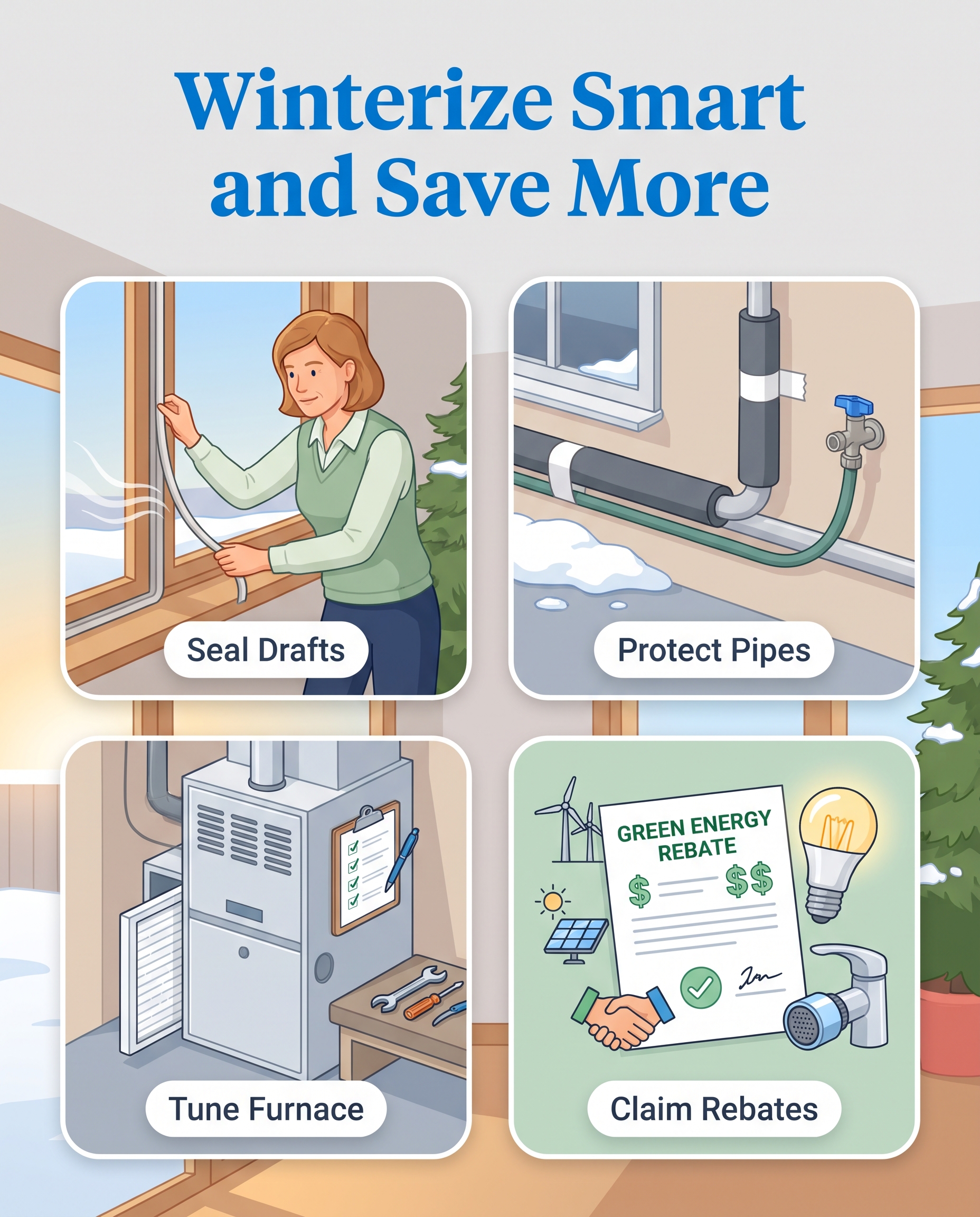
Preparing your house for a Midwest winter is about more than staying cozy when the snow flies — it is the single biggest opportunity to shrink your carbon footprint and save hundreds of dollars a year on utility bills. Taking an eco-conscious approach to home efficiency keeps furnaces from working overtime during polar vortexes. Better yet, Wisconsin utilities fund one of the strongest statewide efficiency programs in the country to help you pay for upgrades.
Focus on Energy Rebates and Eligibility
Focus on Energy is Wisconsin’s statewide energy efficiency and renewable resource program, funded by participating electric and natural gas utilities. If your utility participates in Focus on Energy, you may qualify for energy-saving products or equipment incentives. Check current eligibility rules, available products, and any application requirements before ordering or buying equipment through the Focus on Energy Residential Rebates and Discounts portal.
Essential Steps for Winterizing a Home in Wisconsin
If this is your first experience winterizing a home in Wisconsin, knock out these five preventative tasks before the first hard freeze arrives:
- Seal window and rim-joist drafts: Apply fresh weatherstripping around exterior doors, caulk drafty window trim, and seal basement rim joists (following applicable moisture and fire-protection guidelines) with rigid foam and spray foam.
- Reverse your ceiling fans: Flip the directional switch on your ceiling fans so the blades spin clockwise on low speed, which gently pushes rising warm air back down into your living space.
- Insulate exposed water pipes: Wrap foam pipe sleeves around exposed hot and cold water lines in unheated basements or crawl spaces to reduce freezing risk.
- Disconnect exterior garden hoses: Shut off interior valves feeding outdoor hose bibs and drain the lines before local freezing conditions arrive.
- Schedule an autumn furnace tune-up: Have an HVAC technician clean and inspect your furnace or boiler early in the fall, and stock up on clean air filters to swap out following your equipment’s guidance.
Green Power Programs
You do not have to install rooftop solar panels to run your household on clean energy. Most major Wisconsin utilities offer green power programs that serve as an easy, environmentally mindful choice for both homeowners and renters. Programs like MGE’s “Green Power Tomorrow,” We Energies’ “Energy for Tomorrow,” and Xcel Energy’s “Windsource” let you match a portion or 100% of your monthly electricity usage with regional wind and solar power for just a few extra dollars a month. These subscriptions support renewable electricity through procurement and accounting arrangements, though they don’t guarantee that only renewable-generated electricity physically reaches your home.
Eco Edge
Check current program rules; if eligible as a renter, you can order a free Energy Savings Pack with LED bulbs and water-saving aerators delivered straight to your new Wisconsin address.
Your Step-by-Step Moving to Wisconsin Checklist
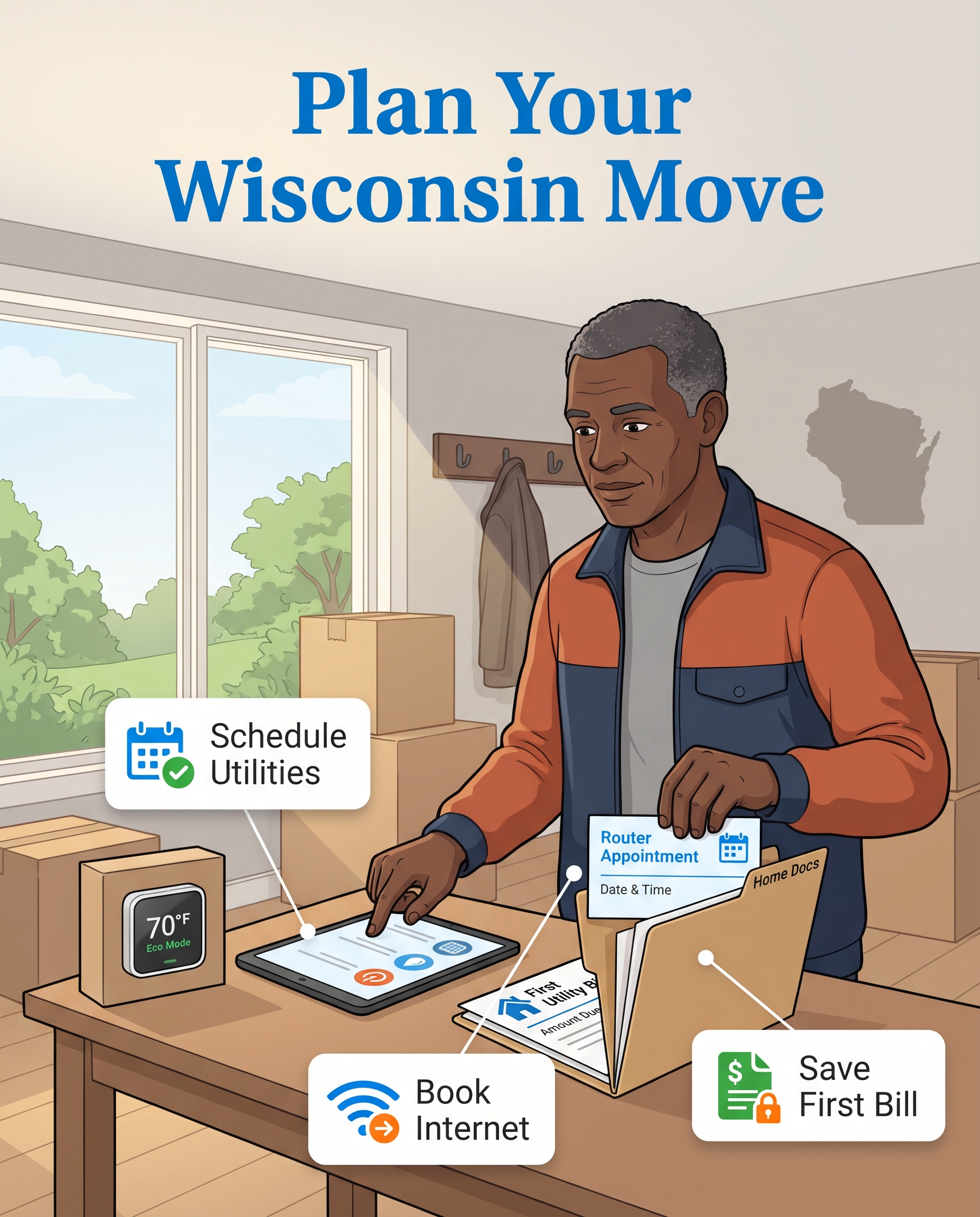
Relocating across state lines involves dozens of small details that are easy to overlook in the rush of packing. Following a structured moving to Wisconsin checklist ensures your heat and internet are running the moment you unlock your front door.
Four Weeks Before Moving Day: Research Providers and Schedule Transfers
- Identify your local utilities: Check the Public Service Commission map or ask your landlord or real estate agent to confirm your electric, gas, water, and trash providers.
- Schedule disconnect dates: Contact your current utility companies to set final meter readings and service shut-offs for the day after you vacate your old home.
- Book your moving company: Reserve your moving truck or professional movers early, especially if you’re moving between May and August or around university move-in dates in late August.
- Order smart home upgrades: Purchase an ENERGY STAR smart thermostat through the Focus on Energy marketplace if eligible so it is ready to install on move-in day.
Two Weeks Before Moving Day: Confirm Connections and Forward Mail
- Activate new electric, gas, and water accounts: Set your new Wisconsin utility start dates based on your possession or lease terms so the lights, water, and furnace are working when the moving truck pulls up.
- Book your internet installation window: If your home requires a technician visit for fiber or cable setup, lock in an appointment for your first 48 hours in town.
- Submit your address change: File an official mail-forwarding request with the U.S. Postal Service and update your address with banks, insurance carriers, and subscription services.
First 60 Days in Wisconsin: DMV Deadlines, Voter Registration, and Home Audits
- Transfer your driver’s license within 60 days: New residents must apply for a Wisconsin driver’s license at a Wisconsin Department of Transportation (WisDOT) DMV service center within 60 days of establishing residency (check rules for commercial drivers and REAL ID requirements).
- Title and register your vehicles: Apply for Wisconsin license plates and vehicle titles right away using the WisDOT online eMV Public system (if your transaction qualifies) or in person at the DMV.
- Register to vote: Once you meet the 28-day residency requirement, register to vote online at MyVote.wi.gov or at your local municipal clerk’s office.
- Complete a home energy assessment: Log into your new utility account to take a free online home energy audit and spot easy ways to trim your upcoming winter heating costs.
Pro Tip
Save your first Wisconsin electric or gas statement! A utility bill is one of the accepted official proofs of address required at the Wisconsin DMV for a REAL ID driver’s license, provided it meets current document requirements.
Settling Into Your New Badger State Home With Confidence
Moving to Wisconsin gives you a rare blend of affordable housing, four-season outdoor adventure, and communities where neighbors still wave from the front porch. While the winter wind off Lake Michigan or across the northern pines takes some getting used to, taking a proactive approach to setting up your utilities and weatherizing your home will keep your living rooms warm and your monthly bills predictable. Grab a Friday night fish fry, explore your local farmers market, and enjoy everything your new Badger State home has to offer.
Frequently Asked Questions About Moving to Wisconsin
We’ve gathered some of the most common questions new residents have about relocation costs, utility rules, and setting up their household in the Badger State.
How Much Money Do You Need to Live Comfortably in Wisconsin?
Can I Choose My Own Electricity or Natural Gas Company When Moving to Wisconsin?
Can My Utility Company Shut Off My Heat During a Wisconsin Winter?
How Soon After Moving to Wisconsin Do I Need to Get a New Driver’s License and License Plates?
Is It Cheaper to Live in Wisconsin or Illinois?
What Is the Most Energy-Efficient Way to Heat a Home in Wisconsin?
About the Author

LaLeesha has a Masters degree in English and enjoys writing whenever she has the chance. She is passionate about gardening, reducing her carbon footprint, and protecting the environment. She also recently served as President of the Board for City Sprouts (a community garden).

David has been an integral part of some of the biggest utility sites on the internet, including InMyArea.com, HighSpeedInternet.com, BroadbandNow.com, and U.S. News. He brings over 15 years of experience writing about, compiling and analyzing utility data.