

Trading Income and Sales Taxes for Mountain Views Is a Great Deal if You Prepare for Property Taxes and Winter Utility Bills
Key Takeaways
- New Hampshire has no general sales tax or broad-based individual income tax, but property taxes and housing costs still matter to your budget.
- Before choosing a home, review its heating history, utility connections, and internet availability at the exact address.
- After establishing residency, check the deadlines for your license and vehicle registration, and confirm your town’s registration process.
Moving to New Hampshire can change your household budget in ways a home price alone won’t show. Property taxes, winter heating, and address-specific utility access all deserve a close look before you sign a lease or purchase agreement. We will help you compare regions, check a home’s infrastructure, and plan your electricity, internet, and heating setup.
What It Costs to Live in New Hampshire
Evaluating the true cost of living in New Hampshire comes down to how your household earns money, how much house you are buying, and how you prepare for winter utility bills. Before you pack up the moving truck, it helps to look at the Granite State’s actual financial picture rather than relying on a vacation brochure.
| Granite State Benchmark | What Newcomers Can Expect |
|---|---|
| State Income Tax | 0% on general wages (Interest and Dividends tax repealed for tax periods beginning Jan. 1, 2025; federal and other state taxes may apply) |
| State Sales Tax | 0% general sales tax |
| Average Property Tax Rate | Varies locally by town budget and commercial tax base |
| Average Electricity Rate | ~26.6 cents per kWh (EIA average, July 2026) |
| Average Annual Snowfall | Varies substantially by elevation and location |
Why Newcomers Love the Granite State
Financial breathing room tops the list for most new arrivals. Keeping your paycheck free from broad-based state income collectors and buying everything from groceries to cars without a general sales tax adds up fast. Beyond your wallet, New Hampshire historically ranks among the safest states in the country, alongside public schools funded locally by their communities.
You also get unmatched four-season outdoor access right outside your back door. Within a single day, you could hike in the White Mountains, kayak across local lakes, or catch ocean breezes along the Atlantic coastline.
The Realistic Tradeoffs to Expect
The biggest hurdle newcomers face is a tight housing inventory paired with high property taxes. Rural towns also frequently lack municipal gas lines, meaning you have to manage delivered heating fuels and prepare for long, dark winters stretching from November into April.
If you are moving to New Hampshire from Massachusetts, pay close attention to how your job is structured. Wages for work physically performed in Massachusetts are generally subject to Massachusetts income tax. Hybrid workers may need to allocate wages by work location. If you work 100% remotely from a home office in New Hampshire, you generally avoid Massachusetts state income tax on those wages, but readers with multistate work arrangements should consult current Massachusetts Department of Revenue guidance.
Quick Fact
New Hampshire doesn’t impose a broad-based individual income tax on wages, and its Interest and Dividends Tax was repealed for tax periods beginning Jan. 1, 2025. However, federal taxes and taxes owed to other states may still apply.
Budgeting for Your Monthly Home Expenses
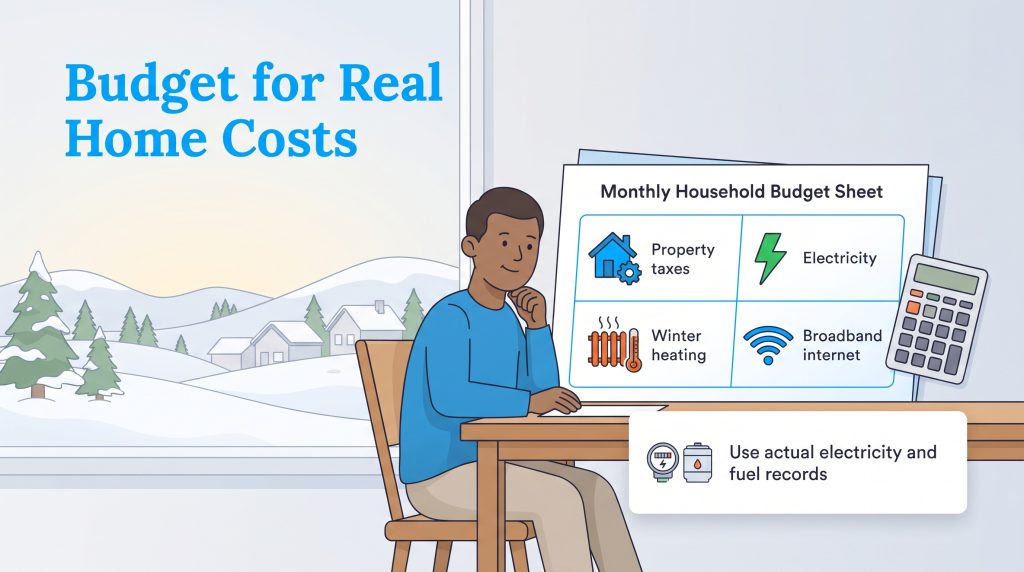
When you compare the cost of living in New Hampshire against the national average, housing and energy are often the most significant factors in a new resident’s budget. Rather than relying on statewide averages, ask for the home’s actual electricity and fuel records before setting your budget.
The Tax Picture: What You Pay vs. What You Save
Without state sales or general income tax revenue, property taxes are an important part of how local cities and towns fund their schools, police departments, and winter snowplows. Because taxes are assessed locally, your bill depends heavily on your town’s budget and commercial tax base. As an illustration, a 2.05% effective tax rate on a $499,000 home yields about $10,200 annually, though this is a calculation example, not a guaranteed statewide bill.
Budgeting for Your Monthly Utilities
Factoring in your utility costs is where smart budgeting really pays off. Many movers coming from urban apartments are caught off guard by New England energy bills, which are driven by older historic housing stock and sub-zero January nights. Depending on the size and age of your home, here is what to expect for your core monthly services:
- Electricity: Estimate your electricity costs using expected monthly consumption and your utility’s applicable charges. For illustration, 600 kWh at an assumed all-in price of 26.6 cents per kWh — which the U.S. Energy Information Administration (EIA) reported as the average residential rate in July 2026 — equals about $160. That is a calculation example, not a current New Hampshire rate quote.
- Winter Heating: From November through March, heating with fuel oil, propane, or natural gas represents your largest variable household expense, which will spike significantly during peak winter months.
- Broadband Internet: Prices typically range from $65 to $100 per month, depending on whether you have access to competitive fiber lines, standard cable, or rural satellite service.
Best Places to Live in New Hampshire by Region
Despite its compact size, New Hampshire packs drastically different lifestyles, climates, and utility setups. The following sections represent practical relocation groupings rather than an official regional taxonomy. Finding the best places to live in New Hampshire means matching your daily commute and housing tradeoff with the right local infrastructure. If you are renting, always ask your landlord which utilities are included in the rent, who controls the winter fuel delivery, and who is responsible for servicing heating equipment.
Southern New Hampshire
Centered along the I-93 and Route 3 corridors, this region includes communities like Manchester, Nashua, Bedford, and Derry. It serves as the state’s economic powerhouse and the most popular landing spot for Boston commuters. You will find bustling shopping centers, Manchester-Boston Regional Airport, and plenty of suburban neighborhoods. From a utility standpoint, this region is the easiest transition for city movers, offering widespread municipal water and sewer service, underground natural gas lines, and fast fiber internet.
The Seacoast
If you want brick sidewalks, thriving independent restaurants, and salty ocean air, the Seacoast delivers classic maritime charm in towns like Portsmouth, Dover, Exeter, and Hampton. Home prices along the coast rival Boston’s upscale suburbs, though fast-growing Dover and Rochester offer slightly more accessible entry points. Most Seacoast town centers feature reliable municipal water, public sewer, and natural gas service through Unitil.
The Lakes Region and Concord
Just north of Manchester, the state capital of Concord offers a steady, year-round economy anchored by state government and healthcare, complete with affordable historic neighborhoods and full city utilities. Drive 30 minutes further north and you hit the Lakes Region, centered around 72-square-mile Lake Winnipesaukee. Towns like Meredith and Wolfeboro revolve around boating and seasonal tourism, where lakefront cottages and hillside homes frequently transition to private wells, septic systems, and delivered propane.
The Monadnock Region and Upper Valley
Along the western side of the state, the Monadnock Region and the Upper Valley blend intellectual college-town energy with rolling farmland and historic brick villages. Anchored by Dartmouth College and Dartmouth Hitchcock Medical Center in Hanover and Lebanon, and Keene State College further south, these communities care deeply about local agriculture and sustainability. Many towns here lead the charge in municipal solar arrays and community power programs, though historic farmhouses outside downtown areas still rely on well water and fuel oil.
The White Mountains and Great North Woods
Heading north of the notches puts you right in the heart of rugged mountain living. Towns like Littleton and North Conway offer vibrant main streets, dramatic mountain views, and lower home prices once you step outside prime ski resort condos. Up here, winter brings heavy snow depending on your elevation, and off-grid utility readiness is a way of life. Expect private drilled wells, onsite septic systems, oil or wood-pellet heating, and the need to verify broadband speeds at your exact street address before making an offer on a house.
How to Set Up Electricity, Water, and Internet
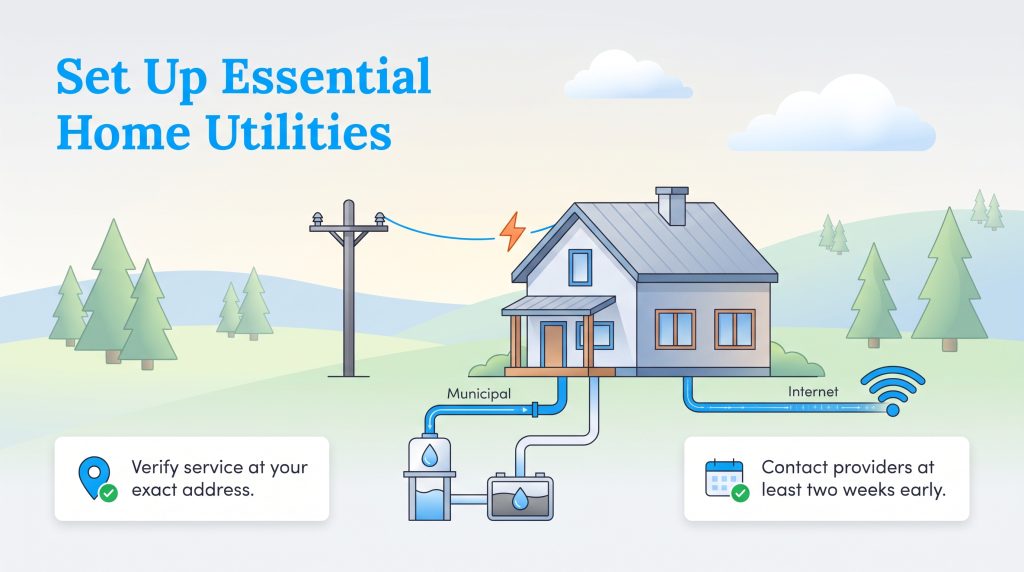
Getting your power, water, and internet running smoothly requires a little extra homework in a state where town lines dictate your service options. When you start setting up utilities in New Hampshire, your first step is identifying whether your new address relies on municipal grids or private property systems.
Navigating New Hampshire Electricity Rates and Providers
When you set up your home electricity service, your default utility provider — the company that maintains the poles, wires, and meters — is determined by the service territory covering your exact address. Four primary utilities serve the state:
- Eversource: The state’s largest electric utility, serving approximately 70% of New Hampshire’s electric customers, including Manchester, Nashua, Keene, Portsmouth, and much of the Lakes Region and North Country.
- Liberty Utilities: Serves southern border towns like Salem and Pelham, as well as western communities around Lebanon and Hanover.
- Unitil: Covers the greater Concord capital region and substantial portions of the Seacoast, including Exeter and Hampton.
- New Hampshire Electric Cooperative (NHEC): A member-owned rural cooperative serving more than 85,000 accounts across central and northern mountain towns.
While you cannot change the utility that delivers your power, New Hampshire operates a deregulated electricity supply market. Even better, many municipalities offer Community Power programs that negotiate default supply rates or higher renewable energy mixes for local residents. Municipal aggregation does not automatically guarantee the lowest price or a higher renewable share, so you should always review your options. When researching New Hampshire electricity rates and providers, you can visit the state’s official energy portal to compare electricity suppliers and evaluate contract lengths, renewal terms, and monthly fees.
Water, Sewer, and Trash: Municipal Services vs. Private Wells and Septic
Unless you are moving into a downtown neighborhood in Manchester, Nashua, Concord, or Dover, there is a high probability your home will not have a monthly water utility bill. Instead, many New Hampshire homes rely on private drilled wells and underground septic systems. A private well usually means no municipal water bill, but you will still pay for electricity to run the pump, regular water testing, treatment, maintenance, and eventual equipment replacement. Before closing, we strongly recommend a well-water testing plan based on current New Hampshire environmental guidance, an inspection of the septic system by a qualified professional, and a review of service records for any known system issues.
Many New Hampshire towns don’t offer municipal curbside trash pickup. Instead, you can hire a private weekly hauler or embrace a beloved local ritual: driving your sorted recyclables and bagged trash to the town Transfer Station. Permit requirements, fees, recycling rules, and pickup options vary heavily by municipality.
Checking Rural Broadband and Fiber Internet Availability
If you work from home, never assume a rural property has high-speed cable just because a neighbor half a mile down the road has it. Before signing a lease or purchase agreement, verify high-speed internet providers by plugging the exact street address into carrier availability maps. Xfinity dominates cable internet across Southern and Central New Hampshire, while Breezeline covers several eastern and Seacoast towns. Fidium Fiber has expanded symmetrical fiber across several cities like Keene, Peterborough, and Littleton. If you fall in love with a secluded cabin where wired lines stop at the main road, consider fixed wireless or satellite internet, keeping in mind that satellite performance depends on tree obstructions, weather conditions, and network capability.
Pro Tip
Call your electric and internet providers at least two weeks before your closing or lease start date to schedule service transfers or technician visits. If you are buying a house, ask the seller for the past 12 months of electric and heating fuel bills during your inspection period so you can budget accurately for winter.
Heating Oil, Propane, and Heat Pumps Compared
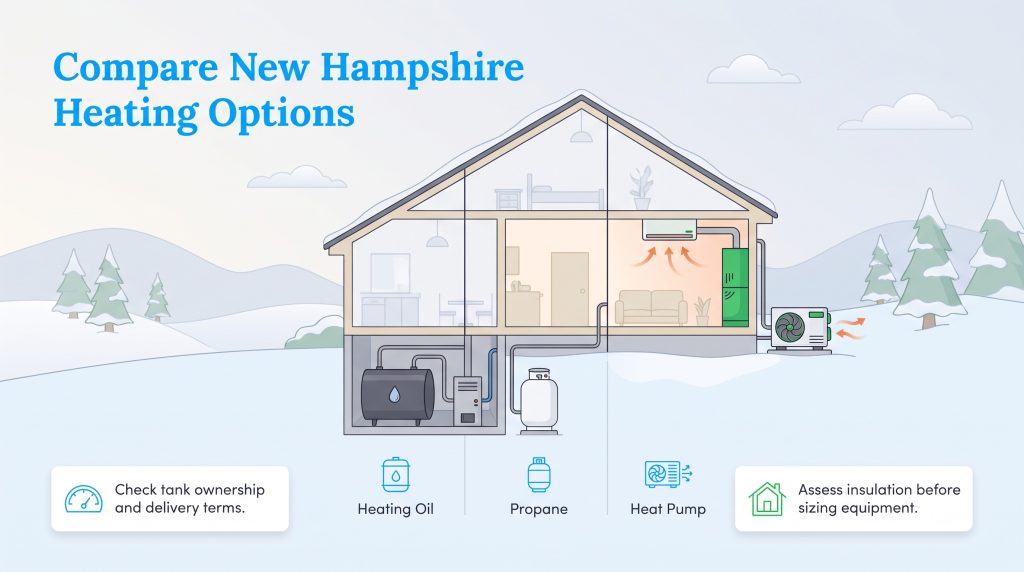
Home heating is the single biggest variable in a New Hampshire household budget, often dictating how comfortable both your living room and your bank account feel between November and April. Because underground natural gas utility lines serviced by Liberty Utilities and Unitil only reach dense corridors like Manchester, Nashua, Concord, and Portsmouth, most Granite Staters heat their homes with delivered fuels or electric heat pumps.
What to Know About Your New Heating System
Many homes in the state rely on No. 2 heating oil stored in a basement tank or liquid propane stored in exterior tanks. When weighing your options, it helps to understand what to verify before you move:
| Heating System Type | What to Verify Before Moving |
|---|---|
| Heating Oil | Tank condition, service records, delivery access, and past gallons used |
| Propane | Tank ownership, supplier restrictions, contract terms, and annual usage |
| Natural Gas | Existing utility connection, meter status, and equipment condition |
| Cold-Climate Heat Pumps | Design heating capacity, household electrical needs, installation scope, and backup heating strategy |
If your new home uses oil or propane, you will need to choose between “automatic delivery” (where one dealer tracks winter temperatures and refills your tank automatically) and “will-call” (where you monitor your own tank gauge and call around for the lowest cash price whenever you hit 25% full). Many dealers also let you lock in a fixed-price pre-buy contract in August before winter demand spikes. If your house uses propane, always check whether the outdoor tank is owned by the homeowner or leased from a fuel company; owning the tank lets you shop around for the cheapest propane supplier, whereas a leased tank legally locks you into buying fuel strictly from the company that owns the tank.
Lowering Your Bills With Cold-Climate Heat Pumps and NHSaves
You don’t have to stay at the mercy of fossil fuel delivery trucks to stay warm. Exploring sustainable home energy upgrades is the smartest way to slash winter heating bills while shrinking your carbon footprint. Today’s ENERGY STAR certified cold-climate air-source heat pumps are engineered specifically for New England winters, extracting heat from outside air efficiently even when temperatures plunge below zero degrees Fahrenheit. A cold-climate air-source heat pump can heat and cool your home. Alternatively, a heat pump water heater efficiently heats your domestic water; just keep in mind that it doesn’t replace a whole-home space cooling system.
Before upgrading equipment, every new homeowner should explore statewide energy efficiency rebates and weatherization incentives through NHSaves. Funded jointly by Eversource, Liberty, Unitil, and NHEC, NHSaves offers comprehensive home energy assessments. Qualifying homeowners may be eligible for significant incentives toward upgrades like insulation and air sealing, depending on utility funding and program rules. Tightening up your home’s thermal envelope is an eco-conscious alternative to burning extra gallons of oil every winter. Be sure to distinguish between utility rebates, federal tax credits, and income-qualified assistance when planning your project.
Eco Edge
An energy assessment can help you prioritize air sealing and insulation before sizing new heating equipment. Your savings will depend on your home, current fuel use, and the improvements you complete.
Your New Hampshire Moving Checklist
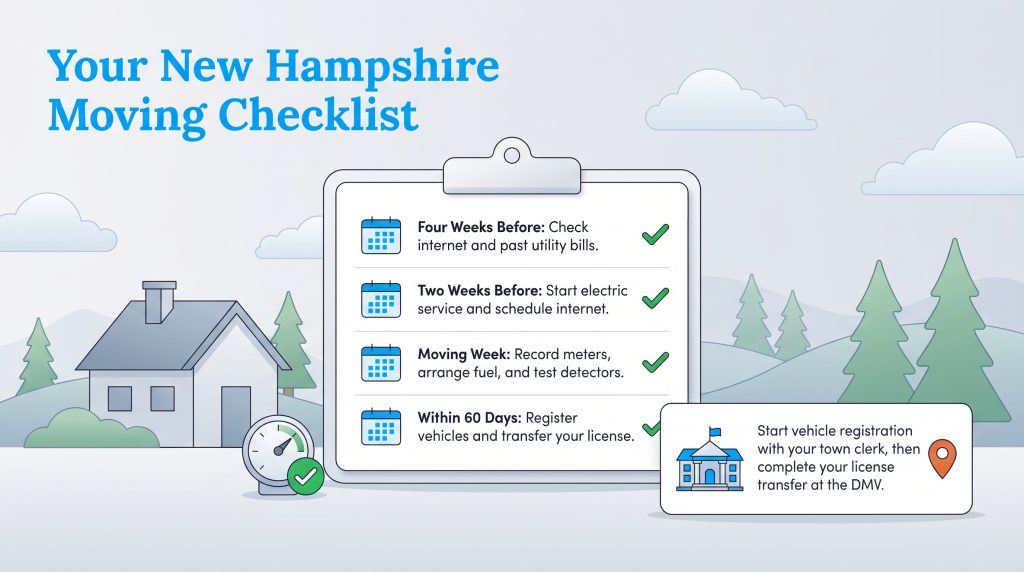
Once the moving boxes are unpacked and the Wi-Fi is humming, you enter the final administrative stretch of becoming an official Granite Stater. Using our home moving guides alongside a localized moving to New Hampshire checklist keeps your transition organized from closing day through your first trip to town hall.
Managing Your License and Registration Deadlines
Residency is not created merely by a town clerk’s approval. After you establish residency, check New Hampshire’s deadlines for transferring your driver’s license and registering your vehicles. Vehicle registration generally begins with your town or city clerk, while license transfers are handled through the DMV.
- Understand Your Town’s Process: Because vehicle registration generally begins with your municipality, check your specific town or city clerk’s website for their required forms and acceptable proof of residency.
- Register Your Vehicles: Visit the clerk with your current vehicle title or registration, a photo ID, and your local proofs of address to pay the municipal fee. In many cases, the clerk can also process the state registration and issue plates, but procedures vary by town.
- Transfer Your Driver’s License: Review the official New Hampshire DMV new resident requirements to book an appointment at a regional DMV office. You will need your completed Application for Driver License, out-of-state license, and necessary documents, separating standard license requirements from REAL ID requirements if you choose to upgrade.
Timeline Checklist for a Smooth Utility and Home Transition
- Four Weeks Before Moving: Confirm internet availability at your new address, request 12 months of past utility and fuel bills from the seller or landlord, and verify whether any propane tanks on the property are owned or leased.
- Two Weeks Before Moving: Contact Eversource, Liberty, Unitil, or NHEC to set up electric service starting on your closing or lease date, and book your fiber or cable internet installation appointment.
- Moving Week: Record electric, water, and gas meter readings on move-in day, set up a delivery account with a local heating oil or propane provider, and test all smoke and carbon monoxide detectors.
- Within 60 Days of Establishing Residency: Register your vehicles and complete your driver’s license transfer at the NH DMV. Check separately with your town clerk for rules regarding voluntary voter registration, dog licensing, and transfer station permits, as these follow different municipal guidelines.
Heads Up
If you buy a house heated by oil or propane, the fuel sitting in the tank on closing day belongs to the seller. Their fuel company will take a tank gauge reading right before closing, and you will likely reimburse the seller for that remaining fuel at current market prices. Be sure to budget an extra amount at the closing table and confirm the contract terms regarding leftover fuel.
Planning Your New Hampshire Relocation and Utility Setup
Your best guide to a New Hampshire home’s running costs is its actual utility history — not a statewide average. Before moving, confirm the service providers, heating arrangement, and maintenance responsibilities, then build a budget that accounts for winter. By taking control of your home’s utility setup and weatherizing through programs like NHSaves, you can settle into the Granite State with confidence.
Frequently Asked Questions About Moving to New Hampshire
If you are preparing for a move to the Granite State, it is natural to have questions about costs, taxes, and home services. Here are answers to some of the most common questions newcomers ask.
How Much Do Utilities Cost in New Hampshire on Average?
If I Move to New Hampshire but Still Work in Massachusetts, Do I Pay Income Tax?
Is Heating Oil or Propane Better for a New Hampshire Winter?
How Do I Establish Legal Residency in New Hampshire?
Can I Choose My Own Electricity Supplier in New Hampshire?
Do I Need a Standby Generator When Living in New Hampshire?
About the Author

LaLeesha has a Masters degree in English and enjoys writing whenever she has the chance. She is passionate about gardening, reducing her carbon footprint, and protecting the environment. She also recently served as President of the Board for City Sprouts (a community garden).

David has been an integral part of some of the biggest utility sites on the internet, including InMyArea.com, HighSpeedInternet.com, BroadbandNow.com, and U.S. News. He brings over 15 years of experience writing about, compiling and analyzing utility data.