

Understanding How Synthetic Gas Could Bridge The Gap Between Fossil Fuels And A Greener Future
Key Takeaways
- Synthetic natural gas (SNG) is a man-made fuel chemically similar to the natural gas drilled from the ground.
- SNG can be produced from various sources, ranging from sustainable biomass and hydrogen to precise mixtures of propane and air.
- Because it works seamlessly with existing pipelines and appliances, SNG is heavily utilized as a “drop-in” backup fuel that doesn’t require expensive home upgrades.
Substitute natural gas — the primary industry synonym for synthetic natural gas (SNG) — is a highly engineered, manufactured fuel meticulously designed to mimic the conventional fossil gas flowing directly to your home’s stove, furnace, or water heater. While traditional natural gas is extracted from deep underground rock formations across the globe, this powerful drop-in replacement is created locally using advanced chemical reactors or carefully blended liquid petroleum gas (LPG) to offer a completely seamless transition for everyday appliances. In this comprehensive guide, we will thoroughly explain how SNG compares to regular fossil gas, break down the fascinating chemical science and mechanical blending processes used to create it, and help you determine whether this evolving fuel is a truly sustainable energy solution for your home or simply another fossil fuel variant in disguise.
Substitute Natural Gas Versus Fossil Natural Gas
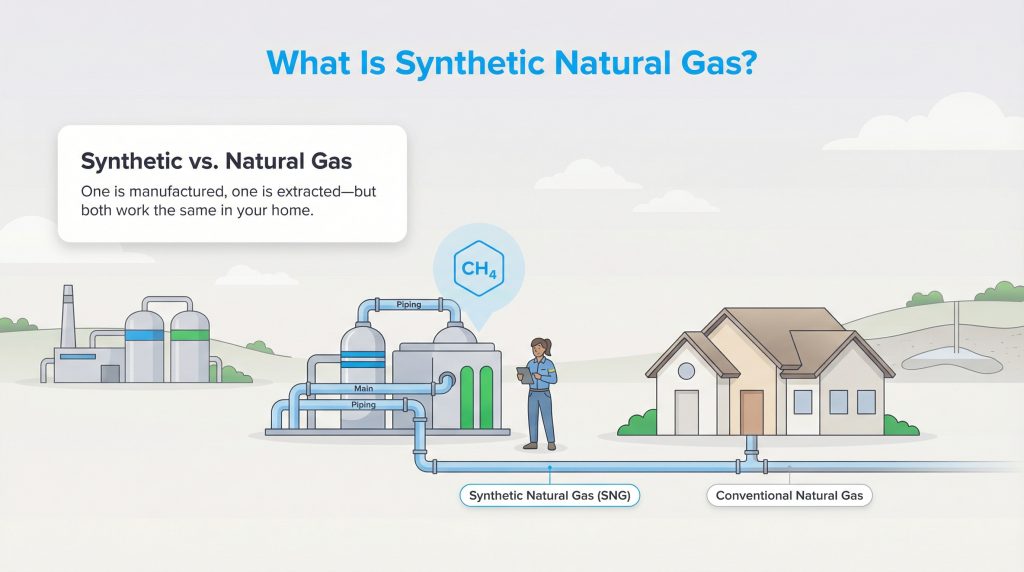
When comparing these two prevalent fuels, the primary distinction is their foundational origin and how they are brought to market. Conventional natural gas is aggressively drilled from the earth, heavily processed at industrial refineries to remove naturally occurring impurities like water and sulfur, and transported across the continent via massive high-pressure pipeline networks. Conversely, synthetic gas is a distinctly manufactured product crafted locally in dedicated engineering facilities or highly specialized blending plants. It is vital to clearly distinguish SNG from raw syngas (a highly toxic, unrefined precursor) and traditional liquid natural gas (LNG), which is simply conventional fossil gas super-cooled for ocean transport. Because substitute natural gas is heavily refined to pure methane — or meticulously blended to mimic methane’s exact properties — it is completely indistinguishable from fossil gas once it enters the municipal utility network.
Once successfully injected into the underground grid, the molecular structure and thermal behavior of the synthetic variant behave exactly like the fuel your home is already perfectly accustomed to burning. This incredible level of physical compatibility means utility companies can actively utilize SNG to balance energy loads, provide emergency relief, or slowly phase out traditional fossil fuels without ever disrupting local neighborhood energy networks or tearing up city streets to lay new pipes.
| Feature | Fossil Natural Gas | Substitute Natural Gas (Bio / Power-to-Gas) | Propane-Air SNG |
|---|---|---|---|
| Origin | Extracted from deep geological formations | Manufactured locally in dedicated chemical facilities | Blended locally using LPG and compressed air |
| Carbon Footprint | High (Releases new fossil carbon into the atmosphere) | Varies heavily (Low to Carbon-Neutral for true Bio-SNG) | Moderate (Relies on fossil derivatives but burns cleanly) |
| Wobbe Index | Serves as the baseline standard | Matches the baseline exactly for seamless combustion | Matches the baseline exactly via calculated air dilution |
| Grid Injection Compatibility | 100% compatible natively | 100% drop-in replacement | 100% drop-in replacement |
| Energy Storage Capability | Requires massive underground pressure tanks or caverns | Can act as a massive chemical battery for renewable surplus | Easily stored as a dense liquid in standard above-ground tanks |
| Average Production Cost | Low (Relies on established legacy drilling infrastructure) | High (Requires investing in new, expensive methanation reactors) | Moderate (Highly cost-effective for localized off-grid communities) |
Rather than forcing municipalities into overhauling the global energy infrastructure and replacing millions of household furnaces, this manufactured alternative operates as a direct, uncompromising substitute. Here is exactly how SNG seamlessly integrates into the modern utility system to keep your household running:
- Acts as a complete drop-in replacement with 100% grid injection compatibility, securely utilizing the aging metal and plastic pipes already buried deep beneath your street.
- Requires absolutely no internal modifications, burner changes, or expensive conversions for your existing home appliances.
- Receives the exact same mandated safety odorant (mercaptan) from utility companies at the gate station, offering the identical safety profile as traditional natural gas.
The Core SNG Production Processes
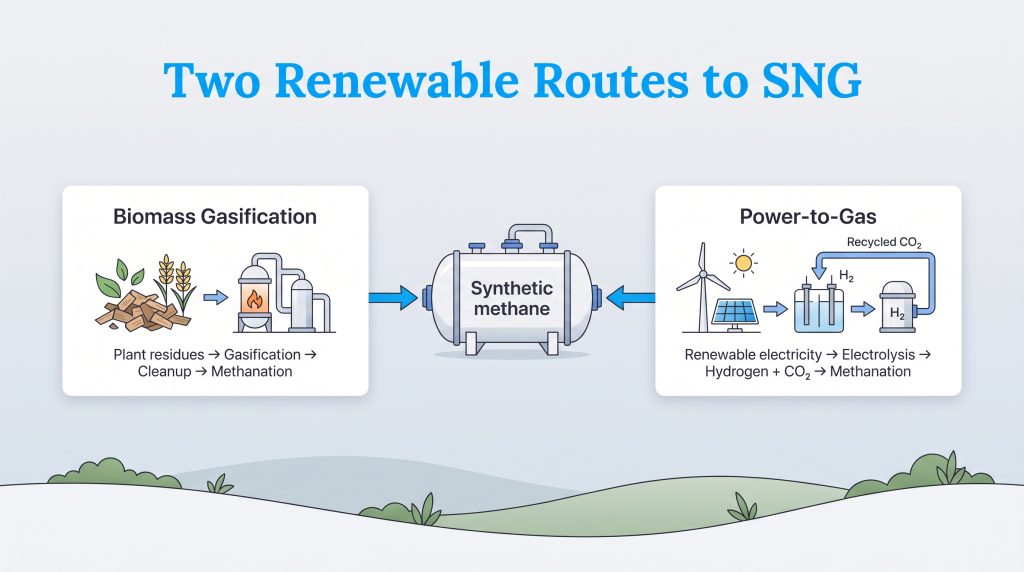
Creating this fuel requires a sophisticated SNG production process that adapts heavily based on the available raw materials and the specific needs of the region. Instead of relying on a single geological extraction method, engineering facilities can manufacture robust energy through several completely distinct pathways. These pathways showcase exactly how advanced our modern grid has become, ranging from sustainable biomass gasification and cutting-edge power-to-gas technologies to the immediate, practical reliability of localized LPG blending.
Biomass Gasification (Bio-SNG)
The manufacturing process frequently utilizes biomass gasification to efficiently create Bio-SNG. Instead of using carbon-heavy coal, which was the historical standard, modern engineers use renewable feedstocks like leftover forestry residue, dense agricultural plant waste, or carefully sorted municipal solid waste. These rough organic materials are collected and subjected to immense heat and extreme pressure inside an oxygen-starved environment. By aggressively capturing the vital energy stored in organic materials that would otherwise decompose uselessly in a local landfill, this specific process effectively recycles existing carbon to power your neighborhood securely.
When organic matter decays naturally in the wild, it inherently releases raw methane straight into the atmosphere, which severely accelerates the global greenhouse effect. Gasification responsibly intercepts and captures this energy potential before it can ever escape. The resulting raw synthetic gas is then meticulously scrubbed of toxins, tars, and heavy particulates. Finally, it is heavily refined until it perfectly matches the strict chemical purity required by residential pipeline standards across the country.
Power-To-Gas And The Methanation Reactor
Even more innovative for our eco-conscious future is power-to-gas technology, a cutting-edge approach specifically designed to stabilize modern renewable energy grids. This method physically stores highly intermittent renewable energy in a reliable, transportable gas form through a remarkably precise sequence:
- Electrolysis: Excess electricity generated by wind turbines or massive solar farms during peak midday hours is used to power massive industrial electrolyzers, which aggressively split ordinary water molecules into pure oxygen and pure hydrogen.
- Green hydrogen to methane: The newly captured hydrogen is safely transported to a dedicated chemical facility to begin the vital carbon synthesis process.
- The methanation reactor: Inside the methanation reactor, the pure hydrogen is introduced to a catalyst and combined with recycled carbon dioxide using a historic chemical equation known as the Sabatier reaction.
- Refining the fuel: Through this intense thermal reaction, the carbon and hydrogen molecules bond forcefully together to form pure synthetic methane and water vapor, ultimately yielding a finalized, eco-friendly fuel that works perfectly in your existing residential equipment.
📌 Quick Fact: The Sabatier reaction isn’t just used by utility companies on Earth. NASA actively uses this exact chemical process on the International Space Station to recycle carbon dioxide exhaled by astronauts into life-sustaining water!
Propane-Air SNG Systems (LPG-Based SNG)
While biological and chemical synthesis dominate the sustainability conversation, the global utility industry relies heavily on an incredibly effective, immediate method for creating synthetic natural gas: blending liquid petroleum gas (LPG) with air. Unlike the complex molecular reconstruction required for Bio-SNG, a propane-air SNG system relies entirely on precise mechanical mixing. Propane naturally holds significantly more energy than conventional natural gas — roughly 2,500 BTUs per cubic foot compared to natural gas’s standard 1,000 BTUs. If you were to accidentally pipe pure, undiluted propane straight into a standard natural gas appliance, it would create an overly rich, highly unstable, and incredibly dangerous flame.
To safely solve this physical imbalance, specialized LPG to SNG conversion facilities intentionally inject a calculated ratio of highly compressed air into vaporized propane. This carefully dilutes the overall energy density of the gas until it perfectly matches the combustion profile and thermal output of standard pipeline gas. This creates an immediate, identical drop-in substitute. For sprawling off-grid homes, rural planned communities, or massive industrial parks situated miles away from the nearest main utility line, localized propane-air systems offer a staggering advantage. Instead of waiting years and spending tens of millions of dollars to trench heavy steel pipelines across rugged terrain, municipal developers can easily install a self-contained LPG-to-SNG plant on site. This brilliantly provides off-grid residents with the exact same reliable baseload energy, allowing them to confidently utilize standard natural gas furnaces, high-efficiency water heaters, and chef-grade stovetops without ever being connected to the traditional municipal grid.
SNG System Components And How Propane Becomes SNG
Understanding how a localized propane-air facility successfully mimics millions of years of geological gas formation requires looking closely at the machinery involved. Transforming raw liquid petroleum gas into a breathable, interchangeable synthetic natural gas relies on a highly choreographed mechanical sequence. Whether the system is powering a small off-grid neighborhood or acting as an emergency backup for a massive municipal hospital, every modern propane-air SNG system utilizes four foundational components to execute the conversion flawlessly:
- LPG Storage Tanks: The entire process begins in massive, highly pressurized steel bullet tanks. Here, the raw propane is securely stored in a dense liquid state. Storing the fuel as a liquid is incredibly efficient, as propane expands 270 times its volume when it converts back into a usable gas, allowing a relatively small physical footprint to hold a massive amount of potential energy for the community.
- High-Pressure Liquid Pumps: To keep the system moving, specialized industrial pumps actively draw the dense liquid propane directly out of the storage tanks. These heavy-duty pumps are specifically designed to maintain constant, unwavering pressure within the pipeline, preventing the liquid propane from accidentally boiling or “flashing” into a vapor prematurely before it reaches the heating stage.
- The Vaporizer Unit: Once the liquid propane is moved by the pumps, it enters the vaporizer. This vital heat exchanger applies intense, controlled thermal energy — usually via a direct-fired burner or a heated water bath — directly to the pressurized liquid. This rapid infusion of heat forcefully boils the liquid propane, converting it entirely into a dry, highly combustible superheated vapor ready for the final blending phase.
- The Gas Blender (Mixing Unit): In the final and most critical step, the superheated propane vapor enters the blending unit. Utilizing either mechanical Venturi valves or highly advanced digital mass flow controllers, the blender precisely injects a massive volume of compressed atmospheric air into the propane stream. The system constantly monitors the specific gravity and BTU content of the resulting mixture to ensure it perfectly hits the necessary Wobbe Index target. Once the air and propane are mixed to the exact specifications, the resulting synthetic natural gas is immediately dispatched into the local pipeline network.
SNG As A Renewable Energy Storage Solution
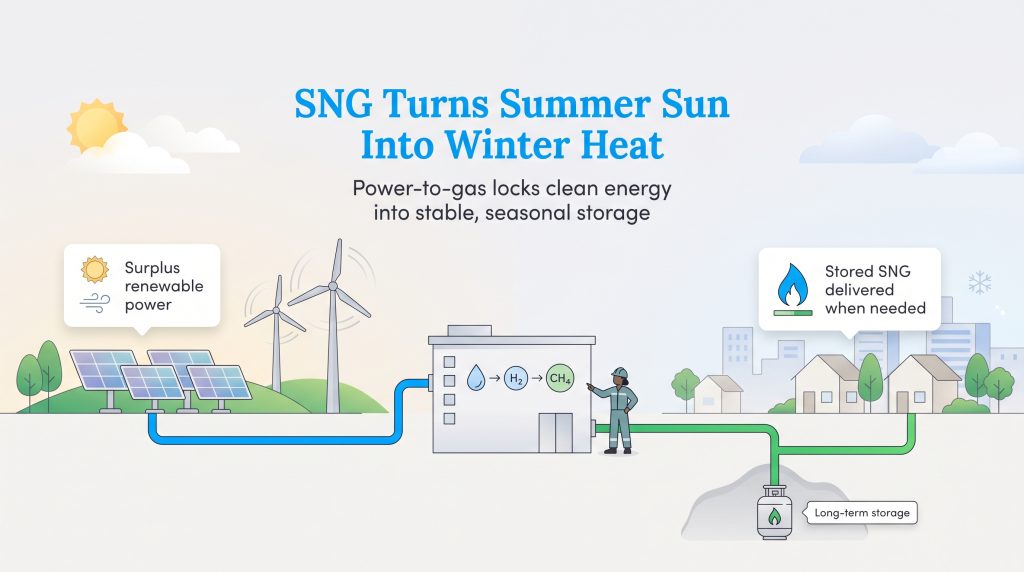
As massive utility networks aggressively integrate more wind and solar farms across the nation, they face a staggering logistical challenge: renewable energy is notoriously intermittent and highly unpredictable. The sun doesn’t shine in the middle of the night, and the wind certainly doesn’t always blow heavily during peak evening heating hours when families return home. When these sprawling green sources generate a massive surplus of power on a particularly bright or breezy afternoon, grid operators often have absolutely nowhere to put it. Current industrial lithium-ion battery technology remains incredibly expensive, degrades over time, and is severely limited in its long-term seasonal capacity. This is exactly where synthetic natural gas steps in to act as a massive, virtually limitless chemical battery.
Using power-to-gas technology, utility companies can seamlessly take that fleeting surplus renewable electricity and run it directly through commercial electrolyzers to create green hydrogen. Once that raw hydrogen successfully undergoes the rigorous methanation process to become pure synthetic methane, the previously unusable solar energy is successfully locked into a highly stable, completely transportable gaseous form. Unlike raw electricity — which degrades exceptionally quickly and must be balanced instantly on the grid if it isn’t utilized right away — this manufactured gas can be injected directly into the existing pipeline grid without a second thought.
Even more impressively for our long-term infrastructure, utility providers can actively pump this substitute natural gas deep into massive underground geological salt caverns or heavily depleted fossil fuel wells for long-term seasonal storage. By safely holding the synthetic gas underground for months at a time, major cities can actively rely on the excess solar energy they captured during a sweltering July afternoon to successfully heat local homes during a bitter, freezing December blizzard. This brilliant, large-scale renewable energy storage capability solves one of the single biggest hurdles of the green transition, effectively bridging the gap between unpredictable global weather patterns and consistent household comfort.
Emergency Backup And Peak Shaving Uses
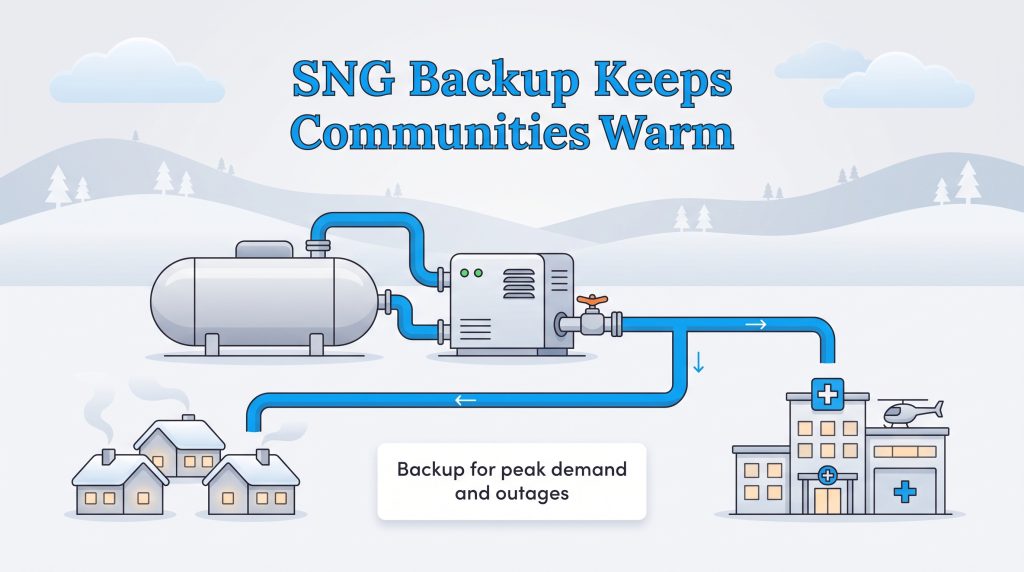
Beyond acting as a tool for sustainable energy storage, synthetic natural gas serves as a critical lifeline during extreme weather events and severe utility shortages. One of the most prevalent uses of peak shaving synthetic gas occurs during massive winter storms or sudden polar vortexes. Think of the natural gas pipeline grid like a massive interstate highway. On a normal autumn day, the gas flows freely. However, when temperatures drastically plummet, millions of households simultaneously turn their furnaces up to maximum capacity. This sudden, immense draw acts like rush-hour traffic, clogging the pipeline and causing system-wide pressure to drop dangerously low. To prevent the entire regional grid from stalling or failing, utilities activate localized propane-air peak shaving plants. These facilities rapidly manufacture and inject massive volumes of SNG directly into the local lines, effectively acting as an emergency express lane that props up the falling pressure and ensures every home stays warm without the utility facing massive financial overrun penalties.
On a more localized scale, LPG to SNG conversion systems act as the ultimate fail-safe for critical infrastructure. Sprawling municipal hospitals, massive server data centers, and essential emergency response facilities cannot afford even a momentary disruption in their heating or power generation capabilities. Because a carefully balanced propane-air mixture behaves identically to fossil gas, these vital institutions frequently install massive SNG standby systems right on their property. If a severe earthquake, deep freeze, or unexpected construction accident suddenly severs the main natural gas line supplying the facility, the on-site SNG system instantly detects the pressure drop and takes over. This allows their industrial boilers, sterilization equipment, and commercial generators to continue operating flawlessly without ever realizing the primary fuel source was completely disconnected.
Assessing The Environmental Impact And Carbon Footprint

For highly eco-conscious homeowners diligently evaluating their neighborhood energy choices, substitute natural gas occupies a somewhat complicated and heavily debated position. Its overarching environmental footprint spans a massive spectrum depending entirely on the specific feedstock used. As a comprehensive decarbonization strategy, SNG is truly only as clean as the raw materials and intensive manufacturing methods used to create it. Assessing the complete lifecycle synthetic natural gas carbon footprint of this fuel is absolutely crucial to understanding whether it genuinely supports a greener, cleaner future or simply extends our societal reliance on aging, carbon-heavy infrastructure.
At the absolute cleanest end of the energy spectrum is Bio-SNG. By proactively capturing the immense energy naturally stored in organic plant waste, dense forestry residue, or agricultural runoff that would otherwise decompose and release highly harmful raw methane straight into the atmosphere, this specific process effectively intercepts and recycles existing carbon. When the heavy manufacturing facility is additionally powered by renewable wind or solar electricity, Bio-SNG acts as a truly carbon-neutral fuel source. In fact, comprehensive industry studies demonstrate that aggressively utilizing Bio-SNG can successfully reduce lifecycle carbon emissions by upwards of 80% when compared directly to burning standard fossil gas. It offers an environmentally mindful choice that displaces conventional underground drilling and actively lowers a modern household’s overarching carbon footprint.
Conversely, historically rooted industrial production methods like coal gasification are incredibly carbon-intensive and offer virtually zero environmental benefits to the community. Converting solid, unrefined coal into a breathable substitute natural gas requires extreme temperatures and inherently releases massive amounts of thick greenhouse gas emissions throughout the entire chemical process. Even when forward-thinking utility companies attempt to implement modern carbon capture and storage technology at the plant level, coal-derived SNG routinely produces a massive carbon footprint equal to — or sometimes even greater than — simply burning traditional fossil fuels straight out of the ground. For many vocal sustainability advocates, coal-based SNG-merely prolongs dirty extraction methods rather than accelerating a meaningful, lasting transition toward a truly clean energy grid.
🌱 Eco Edge: Bio-SNG can approach carbon-neutral or even become completely carbon-negative in some advanced systems. By intentionally capturing organic waste that would otherwise rot and release raw methane directly into the air, Bio-SNG successfully recycles existing carbon rather than adding new fossil carbon to the atmosphere.
The Economics Of SNG Production Costs Versus Traditional Gas
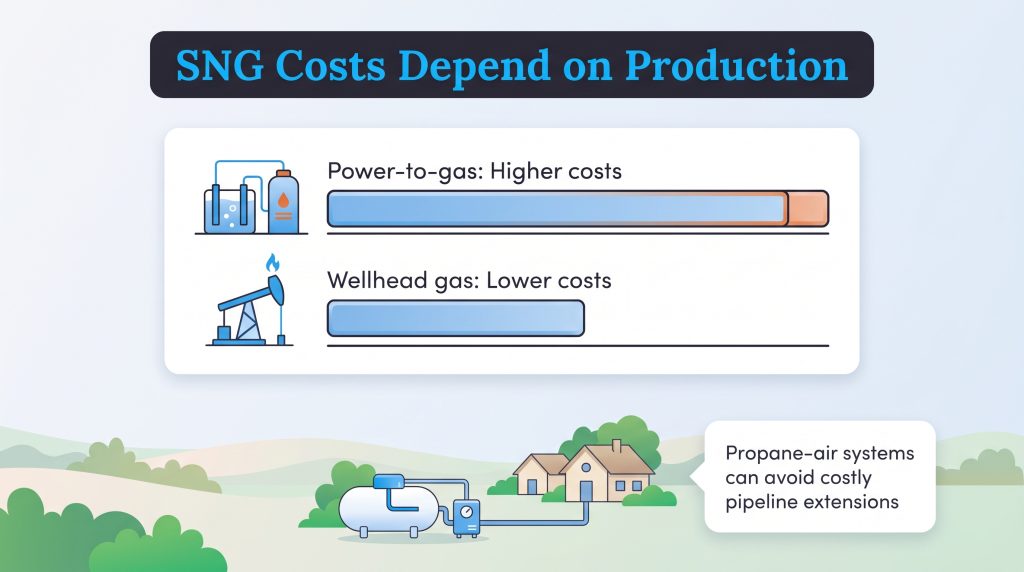
When thoroughly evaluating the complex technoeconomic assessment of our rapidly changing utility grid, money is invariably the final deciding factor for both municipalities and homeowners. Currently, manufacturing synthetic natural gas demands significantly more capital upfront than simply tapping into traditional fossil reserves. Building a standard underground drilling operation utilizes decades of highly optimized, fully established global infrastructure. Conversely, creating a commercial-scale methanation plant requires substantial, often risky upfront investments in complex chemical reactors, specialized heavy piping, and heavily refined raw materials.
The most significant financial barrier currently preventing the widespread adoption of power-to-gas technology is the incredibly steep cost of generating green hydrogen. Electrolyzers require enormous, continuous amounts of electricity to successfully split water molecules. If that incoming electricity isn’t virtually free — such as during a massive, unexpected solar surplus event — the daily operating expenses of the plant skyrocket rapidly, making the resulting synthetic methane currently much more expensive per million British Thermal Units (MMBtu) than geological gas pulled directly from a standard wellhead.
However, when looking closely at localized LPG to SNG conversion, the economic narrative shifts dramatically. For isolated off-grid communities, rural housing developments, and remote industrial parks, localized propane-air systems offer immediate, undeniable cost-effectiveness. Instead of financing massive, multi-million dollar pipeline extension projects that require trenching through miles of solid rock and difficult terrain just to reach the main grid, savvy developers can rapidly deploy self-contained propane-air plants directly on the property. This localized approach completely bypasses the exorbitant capital costs of traditional pipeline expansion, allowing communities to enjoy highly reliable, uninterrupted gas service at a mere fraction of the expected infrastructure cost.
Pros And Cons Of SNG For Residential Grids

Like any major, structural shift in utility infrastructure, the rapid push toward utilizing synthetic fuels comes with distinct advantages and notable financial drawbacks. To better understand how this highly manufactured fuel measures up for your specific household and community, we’ve broken down the main trade-offs you should consider.
Pros:
- Grid injection compatibility: SNG uses existing underground pipeline infrastructure natively, entirely eliminating the need for massively disruptive and highly expensive new city construction projects beneath your local streets.
- Appliance friendly: SNG acts as a direct, uncompromising drop-in replacement, requiring absolutely no expensive household heating upgrades, new burner orifices, or internal modifications to your appliances.
- Off-grid reliability: Propane-air SNG systems allow remote neighborhoods and rural properties to enjoy full, uninterrupted baseload gas utility service without ever needing to connect to a massive municipal pipeline.
- Seasonal reliability: It can be safely stored for months on end in vast underground caverns or heavy above-ground steel tanks, offering robust, long-term grid stability that modern lithium-ion battery banks simply cannot match.
- Waste reduction: Bio-SNG actively intercepts and recycles existing municipal solid waste, drastically offsetting raw methane emissions that would normally escape from local landfills.
Cons:
- High production costs: The highly intensive SNG production process for methanation is financially expensive and requires massive initial capital investments compared to traditional, long-established underground drilling methods.
- Variable environmental impact: Coal-based SNG is absolutely not an environmentally friendly option and continuously produces significant lifecycle emissions that easily rival heavy, unrefined petroleum.
- Combustion emissions: SNG still releases carbon dioxide (CO2) when it is physically burned inside your home’s furnace, although Renewable Natural Gas (RNG) and sustainable biomass alternatives effectively offset this release during the initial raw production phase.
Appliance Compatibility And Safety Measures
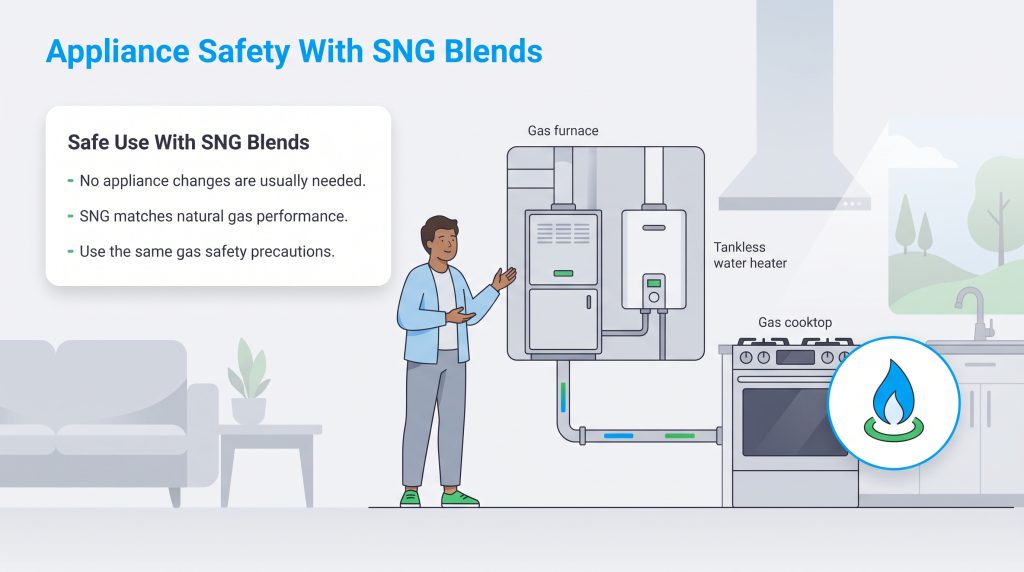
If your local utility company formally announces plans to start blending SNG into the neighborhood supply to increase sustainability or manage peak demand, you might immediately worry about the overall safety and functionality of your household appliances. The excellent news for your wallet is that you generally do not need to take any drastic action, replace your equipment, or call a specialized repair technician. Whether you rely heavily on a forced-air gas furnace to stay warm in the bitter winter, a high-efficiency tankless water heater for your daily morning showers, or a massive chef-grade gas stove in the kitchen, this manufactured alternative is specifically designed to be completely imperceptible to your home’s internal systems. Because substitute natural gas is carefully refined to be pure methane — or meticulously blended with air to dilute its intensity — it seamlessly works right alongside traditional gas without triggering any dangerous equipment malfunctions or overheating.
This seamless compatibility comes down to a highly critical engineering metric known as the Wobbe Index. The Wobbe Index is a standardized technical formula widely used by the global energy industry to measure the true interchangeability of different fuel gases. It fundamentally calculates exactly how much heat a specific gas will deliver as it passes through a standard burner orifice by weighing its raw calorific value against its specific gravity. Because substitute natural gas is heavily refined or precisely diluted to hit this exact mathematical target, it perfectly matches the required baseline rating your local neighborhood grid actively enforces. The raw flame temperature, the overall ignition speed, and the physical behavior remain completely identical to conventional fossil gas, guaranteeing your equipment operates safely and efficiently.
From a strict residential safety perspective, you won’t notice a single difference in how your home operates day to day. Synthetic natural gas carries the exact same inherent risks and requires the exact same household precautions you already diligently practice with regular fossil gas. Both fuels are naturally completely odorless and highly flammable in enclosed spaces. To ensure you can easily detect a dangerous leak before a massive crisis occurs, utility companies inject the exact same pungent chemical odorant — known as mercaptan — into the SNG before it ever enters the street mains. The unmistakable “rotten egg” smell will quickly alert you to an issue just as reliably as it always has. If this happens, it is absolutely critical to know exactly what you should do if you smell gas. As always, pairing a thoroughly well-maintained HVAC system with highly reliable natural gas detectors and carbon monoxide detectors remains the absolute gold standard for preserving household safety.
Beyond The Home Industrial And Transport Uses Of SNG
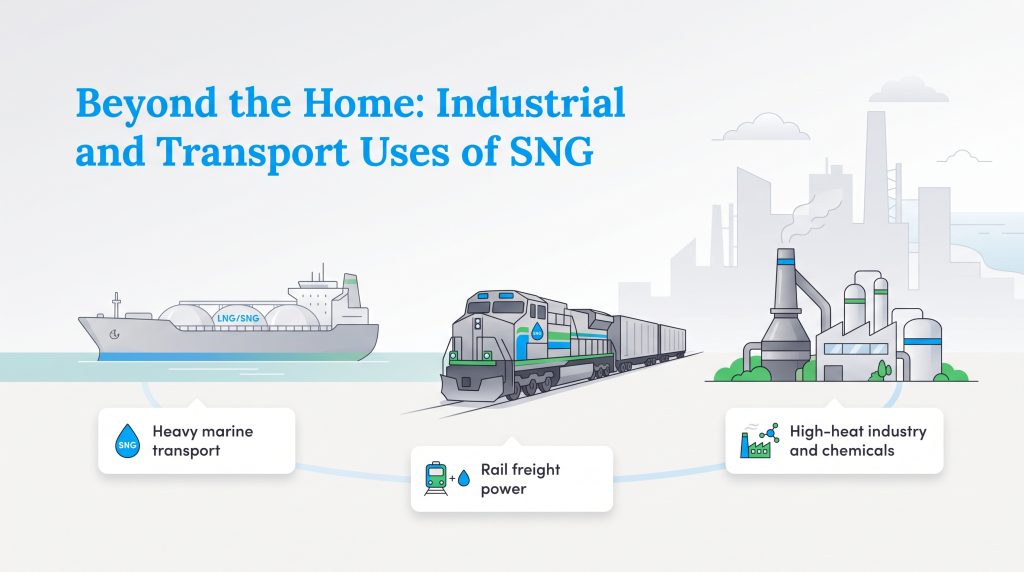
While this guide focuses heavily on the practicalities of keeping your home exceptionally warm and your stove cooking effortlessly, synthetic methane plays an equally vital and massive role in the realm of heavy industry. Decarbonizing small residential neighborhoods is truly only part of the global puzzle. Sprawling commercial sectors that demand intense, uninterrupted, and massive amounts of heat simply cannot just plug into the standard electric grid like a standard household appliance. To keep the delicate global supply chain moving securely, massive industries are actively utilizing this powerful manufactured fuel in several robust ways:
- Heavy Marine Transport: Massive ocean-faring cargo ships are actively replacing highly polluting, thick diesel with liquefied synthetic natural gas. Because the gas is super-cooled into a highly dense liquid, massive ships can travel entirely across the ocean while drastically reducing their exhaust pollutants and maintaining their immense speed.
- Rail Operations: Innovative locomotive companies are increasingly exploring compressed synthetic natural gas as a highly powerful drop-in fuel to run massive cross-country freight trains. It easily offers the heavy-duty torque strictly required for hauling massive loads across the continent without the heavy, lingering carbon emissions of traditional petroleum.
- Industrial Manufacturing Plants: Massive steel mills, commercial glass makers, and heavy cement factories require intense blast furnaces operating steadily at thousands of degrees. Substitute natural gas effortlessly provides the exact same unyielding thermal intensity as fossil gas, allowing these vital facilities to aggressively shrink their carbon footprint without ever sacrificing their high production capabilities.
- Emergency Standby Facilities: Massive hospitals, large-scale technology data centers, and critical municipal buildings demand continuous, completely uninterruptible power to function safely. Because SNG acts as a direct substitute that does not require additional gas trains or highly specialized piping, these critical facilities utilize on-site propane-air SNG systems as a bulletproof fail-safe backup, automatically taking over the power load if extreme weather severely severs the primary utility gas line.
- Chemical Feedstocks: Beyond acting simply as a combustible fuel to create heat, the highly pure methane found in SNG serves as a foundational, indispensable building block for manufacturing commercial plastics, potent agricultural fertilizers, and vital commercial chemicals without ever relying on freshly extracted oil from the earth.
Preparing Your Home For Mixed-Fuel Utility Networks
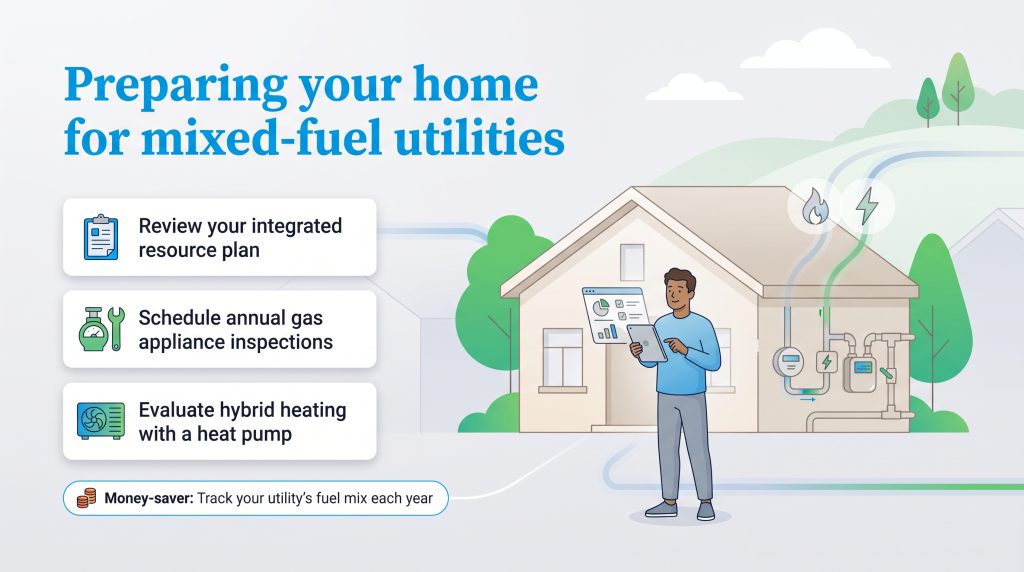
To ensure you and your family are fully prepared for the highly complex future of mixed-fuel utility networks, here is a highly actionable checklist you should follow closely as an energy-conscious homeowner. Being highly proactive allows you to easily maximize your energy efficiency and consistently maintain a highly comfortable household, regardless of what fuel flows through the pipes.
- Review your utility’s integrated resource plan: Local utility companies are legally required to publish detailed, long-term energy strategies for public review every few years. Locate your provider’s “Integrated Resource Plan” (IRP) online to see exactly when and how they aggressively plan to introduce synthetic methane, advanced power-to-gas technology, or unique hydrogen blends into your neighborhood’s supply chain over the next decade.
- Schedule annual appliance inspections: While SNG gracefully acts as an incredibly safe drop-in fuel, optimal performance heavily relies entirely on routine maintenance. Have a certified technician thoroughly inspect your furnace and water heater annually. A flawlessly clean system guarantees optimal combustion efficiency and significantly reduces dangerous carbon monoxide risks, regardless of the precise gas mixture flowing through the metal pipes.
- Explore localized off-grid solutions: You absolutely do not have to wait for your utility company to slowly update the neighborhood grid. If you are building a new home or managing a large property situated far beyond the reach of municipal pipelines, you can successfully utilize localized propane-air SNG systems today to power standard natural gas appliances reliably and affordably.
- Evaluate hybrid heating systems: Even with a noticeably cleaner supply of Bio-SNG arriving steadily at your meter, diversifying your home’s energy profile is always a highly smart financial move. Consider thoroughly exploring advanced hybrid HVAC setups that intuitively pair your existing gas furnace with an ultra-efficient electric heat pump to drastically lower your monthly overhead.
💸 Money-Saver: If your gas utility starts blending in renewable or synthetic gas, you won’t usually need to buy new home equipment. Still, it’s a smart habit to routinely check your utility’s annual fuel mix reports so you understand exactly what you’re paying for and how green your local grid really is.
Embracing The Future Of Synthetic Methane In Your Home

Ultimately, synthetic natural gas serves as a highly versatile, incredibly powerful bridge fuel that gracefully mimics the energy you already confidently use every single day. As the massive utility industry aggressively shifts away from traditional, carbon-heavy drilling, balancing eco-conscious power-to-gas developments with highly practical propane-air backup solutions guarantees both grid sustainability and robust energy security for everyone. By keeping a close eye on your local utility’s complex integrated resource plans, heavily investing in ongoing efficiency upgrades around the house, and exploring localized off-grid options when necessary, you can confidently navigate your home’s energy future while consistently finding smart, actionable ways to save on your gas bill.
Frequently Asked Questions About Synthetic Natural Gas
Can you make synthetic natural gas from propane?
What is peak shaving in the natural gas industry?
How is a propane-air mixture interchangeable with regular natural gas?
What is the difference between SNG, LNG, and CNG?
Can synthetic natural gas be used as a transportation fuel?
How does power-to-gas technology store renewable energy?
What is the difference between syngas and synthetic natural gas?
Can synthetic natural gas be used in existing home appliances?
Is synthetic natural gas considered a renewable energy source?
How efficient is the synthetic natural gas production process?
Is SNG safer than regular natural gas?
How is synthetic natural gas different from hydrogen?
About the Author

LaLeesha has a Masters degree in English and enjoys writing whenever she has the chance. She is passionate about gardening, reducing her carbon footprint, and protecting the environment. She also recently served as President of the Board for City Sprouts (a community garden).

David has been an integral part of some of the biggest utility sites on the internet, including InMyArea.com, HighSpeedInternet.com, BroadbandNow.com, and U.S. News. He brings over 15 years of experience writing about, compiling and analyzing utility data.