

Planning Your Move to Arkansas Requires Balancing Housing Costs With Practical Home Setup Choices
Key Takeaways
- Estimate your moving costs by comparing housing and utility expenses before you arrive.
- Follow a prioritized timeline to handle state requirements like driver’s licenses and vehicle registration without the stress.
- Choose practical energy-saving improvements to keep your home energy-efficient and comfortable during hot southern summers.
Moving to Arkansas means planning for more than a new address. Your housing budget, utility providers, internet options, and vehicle paperwork will depend heavily on exactly where you settle. We will help you organize those decisions, prepare for setup costs, and choose practical energy-saving improvements for your new home.
Understanding the True Cost of Living in Arkansas
Potential housing savings often draw new residents to Arkansas, depending on where they move. The state typically ranks as a budget-friendly location, but your overall cost of living will depend heavily on whether you choose a bustling urban center or a quiet rural retreat. Statewide housing figures can help you compare Arkansas with your current location, but they will not predict the cost of a particular neighborhood or property. According to the U.S. Census Bureau, median home values and rent prices in the state fall below national benchmarks.
Median Housing Costs (2020–2024)
| Expense Category | Arkansas | United States |
|---|---|---|
| Median Gross Rent | $947 | $1,268 |
| Median Owner-Occupied Home Value | $188,000 | $281,900 |
Money Saver
Always compare actual property tax bills and homeowners insurance rates before assuming long-term savings; lower base taxes might give you breathing room, but local variations determine your actual monthly budget.
Evaluating Housing and Everyday Expenses
Housing costs ultimately dictate your overall living strategy when moving from out of state. If you establish roots in Little Rock or the rapidly expanding northwest corridor, you will face higher property prices than you would in the serene, rural southern counties. Yet, even in the state’s most sought-after neighborhoods, you should compare current local listings with your existing housing costs to see how your budget translates. Groceries, healthcare, and everyday services also vary by region, so we recommend building a realistic first-month budget that accounts for moving-company fees, deposits, and initial setup charges.
Exploring the Appeal of Moving to Northwest Arkansas
Are you considering moving to Northwest Arkansas? The NWA corridor — encompassing Bentonville, Fayetteville, Rogers, and Springdale — continues to see steady population growth. Young professionals, growing families, and remote workers are moving to this specific region for corporate opportunity and access to nature. Before committing to the area, carefully evaluate actual housing costs, commute times, and address-level broadband availability.
If you prioritize outdoor access, the integration of nature in NWA is highly appealing. You can wrap up a Friday afternoon meeting and find yourself on the renowned Razorback Regional Greenway or local mountain biking trails within minutes. The cultural scene features institutions like Crystal Bridges Museum of American Art, while distinct culinary hotspots anchor the downtown squares. Communities are expanding infrastructure to meet the demand of their growing population, making it essential to confirm that your chosen neighborhood meets your specific access needs for work, health care, and daily services.
Your Essential Moving to Arkansas Checklist
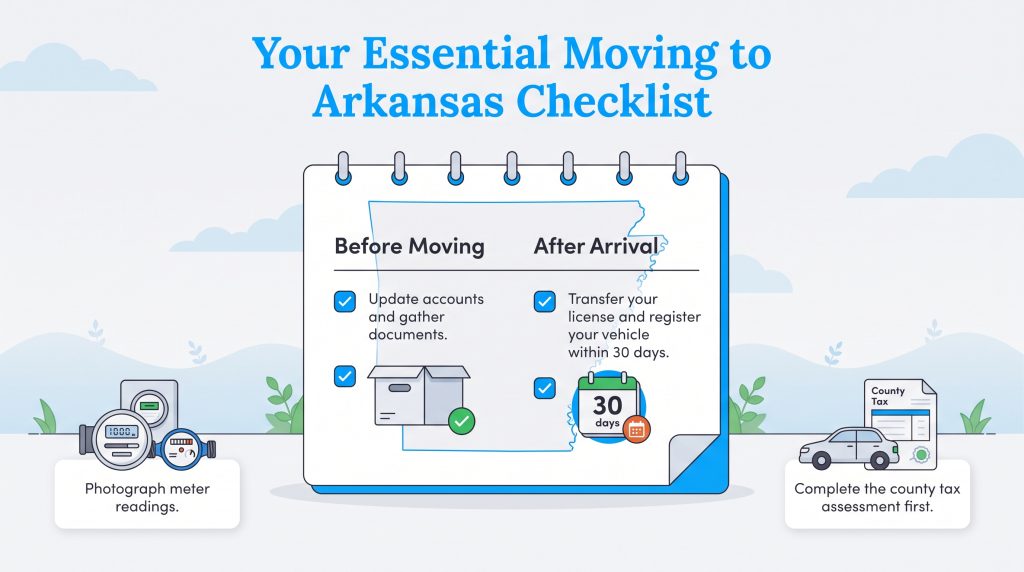
Estimating your moving costs is only half the battle; managing the administrative logistics requires a solid game plan. We recommend dividing your relocation tasks into practical recommendations before you move and strict legal deadlines once you arrive.
Recommended Pre-Move Planning
- 30 Days Out: Notify the postal service of your new address. Update your billing details with credit cards, banks, and existing subscriptions. Contact your current utility companies to schedule your stop-service date and avoid overlapping bills.
- 14 Days Out: Gather your vehicle paperwork. Arkansas registration requires your out-of-state title, proof of insurance, and a current-year county property tax assessment.
- Moving Day: Save all confirmation numbers. Arrive at your new home and photograph the accessible meter readings for both electricity and water to guarantee accurate billing for your first month.
State-Mandated Legal Deadlines
- Driver’s Licenses:
New residents must officially obtain an Arkansas driver’s license within 30 days of establishing residency. You must visit a local Department of Finance and Administration office to complete the required transfer. - Vehicle Registration:
You must register your out-of-state vehicles within 30 days of becoming a resident. However, Arkansas links vehicle tags to county property taxes. Before the Arkansas Department of Finance and Administration will process your registration, you must prove your vehicle is assessed by your local county and that no personal property taxes are owed.
Heads Up
Arkansas law requires new residents to register their out-of-state vehicles within 30 days of establishing residency, so schedule your local revenue office appointment early and complete your county tax assessment first to avoid late penalties.
Setting Up Utilities in Arkansas
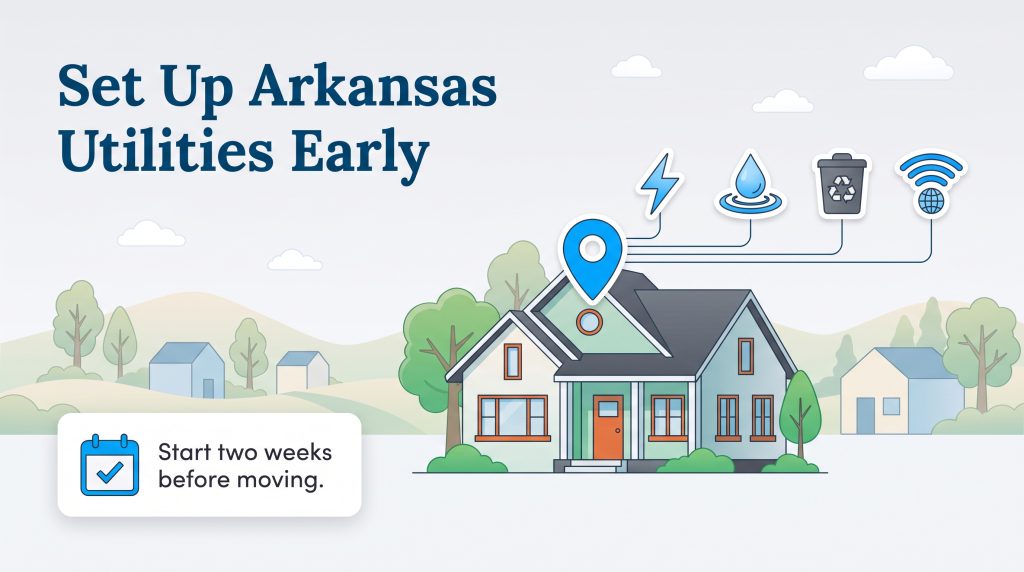
Tackling the logistics of moving to Arkansas means you must figure out how to keep the lights on and the water flowing. Depending on your exact zip code, setting up utilities in Arkansas involves navigating a diverse mix of large municipal networks and smaller local cooperatives. We strongly advise using two weeks as a planning recommendation to initiate your utility connections, which reduces the risk of arriving without service.
Your Address-Based Setup Workflow
Because service footprints change from one street to the next, generic utility advice will not help you get connected. Follow this address-based workflow to manage your essential services:
- Ask the landlord, seller, or property manager exactly which providers serve the property.
- Confirm which services (such as water, sewer, or trash) are included in your rent or homeowners association fees.
- Contact your assigned electricity, natural gas (where applicable), water/sewer, and trash providers directly.
- Ask about required deposits, connection fees, identification requirements, and specific activation timing.
- Arrange internet installation before arrival when possible, as technician appointments can book up weeks in advance.
- Confirm whether an adult must be present inside the home for any of the service appointments.
Navigating Arkansas Utility Providers
Arkansas operates on a strictly regulated electricity market. This means you do not shop around for your energy supplier; instead, the providers serving your address are automatically assigned. Major investor-owned utilities like Entergy and SWEPCO service many large communities, while a robust network of municipal electric utilities and distribution cooperatives powers other regions across the state.
Understanding your specific electric service territory is crucial for budgeting your monthly expenses. Since you cannot freely choose a cheaper provider, the best way to control utility costs is by reviewing your billing statements, optimizing your thermostat settings, and maintaining your HVAC equipment. You might also consider scheduling a home energy audit to identify and actively eliminate wasteful usage.
Choosing Arkansas Internet Providers
Internet availability can change from one address to the next. While major hubs frequently offer reliable fiber-optic networks, some urban addresses may still lack fiber access. Conversely, certain rural areas benefit from high-speed fiber installed by local cooperatives, while others rely on satellite connections or fixed wireless solutions. Before you sign a lease or purchase agreement, check address-level availability using the FCC National Broadband Map and confirm installation timing, upload speeds, equipment fees, and any data limits directly with the provider.
Eco Edge
Once your Wi-Fi is successfully installed, consider connecting a smart thermostat to your network to automate climate control, which can help optimize your energy consumption based on your household behavior.
Making Environmentally Mindful Choices in Your New Home
Maintaining a comfortable, sustainable home in a state famous for its variable weather — sweltering, humid summers and winters that bring occasional freezing temperatures — requires a proactive approach. Making an environmentally mindful choice doesn’t mean sacrificing comfort; it means optimizing your home to simply run smarter. Upgrading your attic insulation and focusing on proper air sealing helps trap cool air indoors during August heatwaves. Opting for ENERGY STAR certified appliances ensures your daily routines consume less power than older models. Furthermore, certain local electric cooperatives offer opt-in green power programs where available, allowing you to seamlessly support renewable energy generation directly from your monthly bill.
- Swap out all incandescent lightbulbs for high-efficiency LED alternatives to instantly lower your lighting energy draw.
- Install low-flow showerheads and faucet aerators to conserve water by reducing the overall flow rate.
- Seal drafty windows and doorframes with weatherstripping to create an energy-saving envelope around your living spaces.
- Always request your landlord’s approval before making hardware or equipment changes in a rental property.
Settling Into Your New Arkansas Home Successfully
Stepping foot into your new property marks the beginning of an incredible chapter. The natural beauty and welcoming communities of the state are ready to be fully explored. Combining careful logistical planning with smart, eco-conscious utility choices will make your transition to the Natural State a more manageable move. By securing your utility connections early, registering your vehicles on time, and optimizing your home for lower energy use, you protect your budget while actively minimizing your environmental footprint. Embrace the vibrant local culture, explore the sprawling state parks, and genuinely enjoy the peace of mind that comes from a well-organized relocation.
Frequently Asked Questions About Moving to Arkansas
Preparing for a major relocation often brings up highly specific questions. Here are the top answers to help you navigate your transition to Arkansas.
How Soon Do I Need to Transfer My Driver’s License?
What Should I Budget for Utility Deposits?
Can I Choose My Electric Company in Arkansas?
How Do I Check Internet Service Before Signing a Lease?
What Are the Main Pros and Cons of Moving to Arkansas?
What Should Renters Confirm About Water, Sewer, and Trash?
About the Author

LaLeesha has a Masters degree in English and enjoys writing whenever she has the chance. She is passionate about gardening, reducing her carbon footprint, and protecting the environment. She also recently served as President of the Board for City Sprouts (a community garden).

David has been an integral part of some of the biggest utility sites on the internet, including InMyArea.com, HighSpeedInternet.com, BroadbandNow.com, and U.S. News. He brings over 15 years of experience writing about, compiling and analyzing utility data.