

Transmission and Delivery Utility Charges Cover the Physical Maintenance of the Local Power Grid, but You Can Still Offset These Costs by Shopping for Lower Energy Supply Rates
Key Takeaways
- TDU charges pay for the physical delivery of electricity to your home and the ongoing maintenance of local neighborhood grids.
- While you cannot avoid or shop around for TDU delivery charges, they are heavily regulated and officially approved through state utility commission proceedings.
- Consumers living in deregulated markets can easily offset high fixed delivery fees by comparing and choosing cheaper retail supply rates.
Opening your monthly electric bill to find unexpected fees is incredibly frustrating, especially when complex industry acronyms hide the true cost of powering your home. If you live in a deregulated energy market, a significant portion of your bill goes directly toward a Transmission and Delivery Utility (TDU). These mandatory, state-regulated fees fund the crucial infrastructure that keeps the poles, wires, and local neighborhood grids functioning smoothly. While the billing terminology might seem intentionally confusing, understanding exactly what are TDU charges is the first step toward taking total control of your household energy expenses. We break down what these specific delivery charges cover, why they fluctuate predictably, and how you can strategically offset them to keep your hard-earned money right where it belongs — in your wallet.
Breaking Down TDU and TDSP Charges
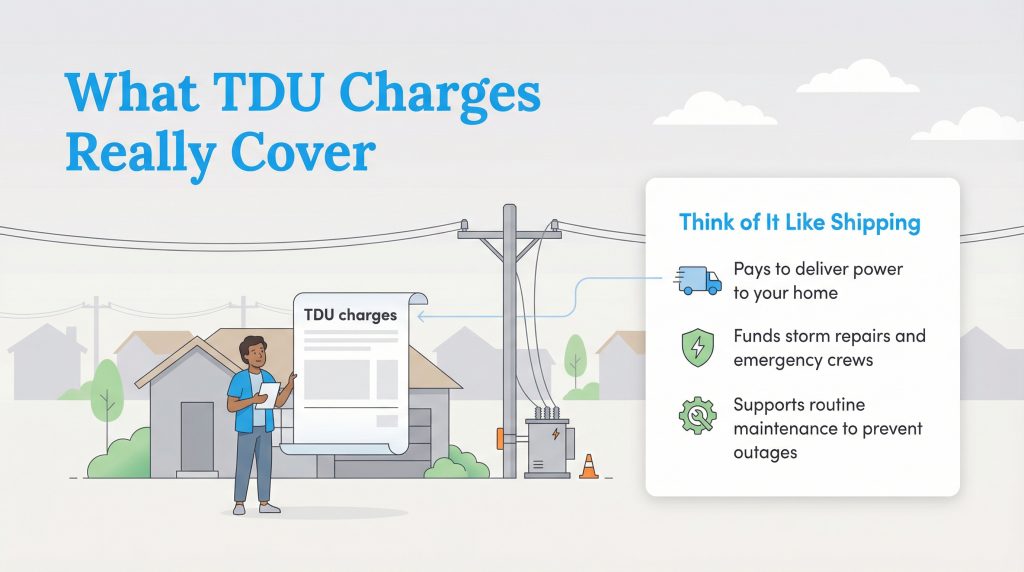
A Transmission and Delivery Utility (TDU) — frequently referred to as a Transmission and Distribution Service Provider (TDSP) — owns, manages, and repairs the physical equipment routing electricity directly to your neighborhood. In the modern energy industry, the terms TDU and TDSP are entirely interchangeable. These dedicated entities manage the wooden utility poles, the high-voltage transmission lines spanning the highway, and the advanced smart meters physically attached to your house.
It helps to think of TDU delivery charges as an essential shipping fee. You aren’t paying for the actual energy product itself, but rather the safe and highly reliable transportation of that electricity directly to your doorstep. This revenue directly finances emergency repair crews who work around the clock during severe storms, alongside the routine daily maintenance required to prevent unexpected blackouts.
Energy Delivery vs Supply Charges: What Is the Difference?
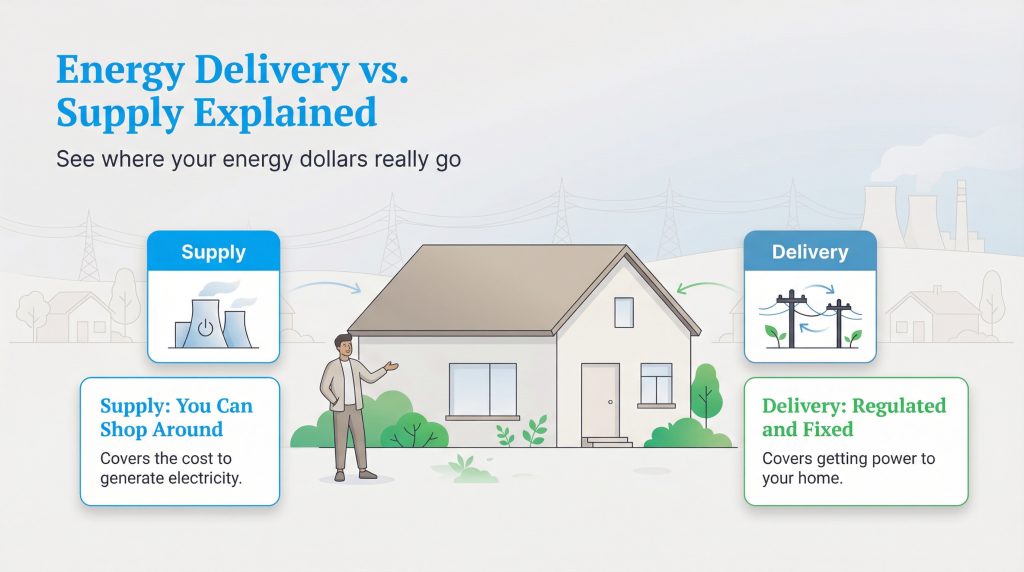
Deregulated energy bills intentionally split your total cost into two distinct halves to give you maximum purchasing power. Grasping the nuance of energy delivery vs supply charges empowers you to spot exactly where your money goes every single month. It is important to remember that retail electric providers do not mark up TDU charges; they simply pass them directly to the consumer at cost.
- Energy Supply: This charge pays for the actual raw electricity generated by a power plant. Because the electricity market is deregulated in many states, supply prices are fully shoppable. You have the total freedom to compare retail energy providers and aggressively negotiate for the best possible rate.
- Energy Delivery: This charge pays for the physical poles, wires, and transformers needed to move that electricity. Delivery fees are heavily regulated by state public utility commissions and are permanently assigned based on your home address, making them unshoppable.
How to Find Your Assigned TDU by City and Region
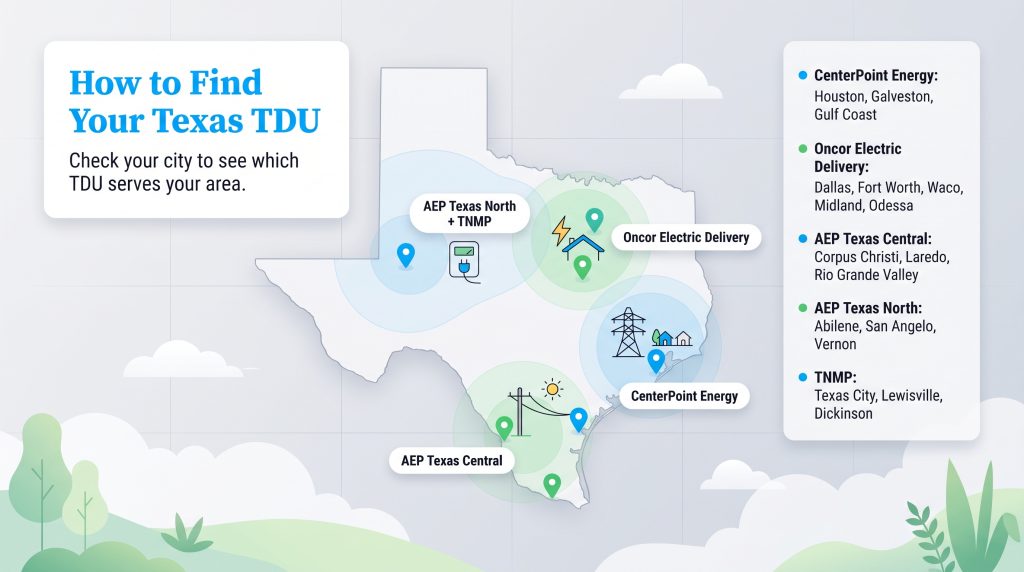
Knowing your exact transmission and distribution service provider is critical, especially when you are setting up new service or need to report a dangerous power outage. Because the state assigns utility companies based strictly on geographic zones, you cannot shop around for a different provider. If you live in Texas, you can easily identify your mandated utility company based on your specific region or city.
| Major Texas Region / City | Mandated TDU Company |
|---|---|
| Houston, Galveston, Surrounding Gulf Coast | CenterPoint Energy |
| Dallas, Fort Worth, Waco, Midland, Odessa | Oncor Electric Delivery |
| Corpus Christi, Laredo, Rio Grande Valley | AEP Texas Central |
| Abilene, San Angelo, Vernon | AEP Texas North |
| Texas City, Lewisville, Dickinson | Texas-New Mexico Power (TNMP) |
2026 TDU Delivery Charges for Major Texas Utilities
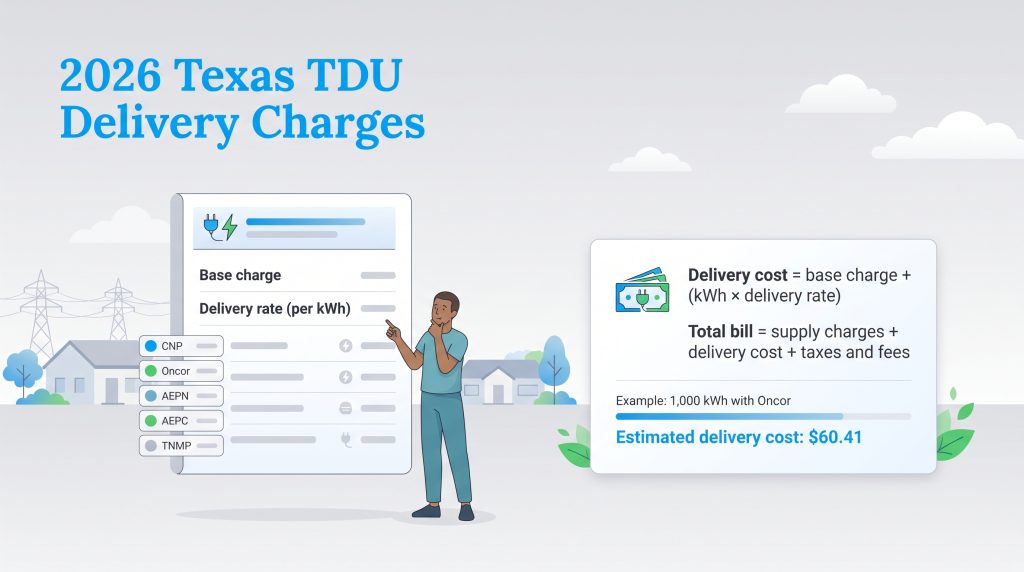
State utility commissions update delivery rates periodically to reflect the true cost of maintaining local physical infrastructure. These approved rates cover two main components: a flat monthly base fee simply for being connected to the grid, and a per-kWh usage fee that scales with your actual power consumption. Understanding Oncor delivery charges or CenterPoint TDU charges gives you a clearer picture of your baseline costs. To give you an accurate idea of what these fees look like in the real world, we have provided the exact current charges for the state’s most prominent utility companies, alongside their average cost at a standard 1,000 kWh usage level.
| Utility Company | Current Base Charge | Current Per-kWh Charge | Average Total TDU Cost (at 1000 kWh) |
|---|---|---|---|
| CenterPoint Energy | $4.90 | 4.9993¢ | $54.89 |
| Oncor Electric Delivery | $4.23 | 5.6183¢ | $60.41 |
| AEP Texas North | $3.24 | 5.9000¢ | $62.24 |
| AEP Texas Central | $3.24 | 5.9000¢ | $62.24 |
| Texas-New Mexico Power (TNMP) | $7.85 | 7.2370¢ | $80.22 |
How to Calculate Your Delivery Charges
Calculating your monthly delivery charges is a straightforward process once you know your utility’s specific rates. You can easily find these figures on your monthly statement. Here is a simple formula to help you accurately estimate your upcoming costs:
- Delivery Cost = Base Charge + (Monthly kWh Usage × Delivery Rate)
- Total Electric Bill = Supply Charges + Delivery Cost + Applicable Taxes and Fees
For example, if you live in the Oncor service territory, you face a $4.23 combined base charge and a 5.6183¢ (or $0.056183) per-kWh delivery rate. If you consume exactly 1,000 kWh in a typical billing cycle, your math looks like this: $4.23 + (1,000 × $0.056183) = $60.41 in total delivery charges.
How to Calculate TDU Charges on Your Electricity Facts Label
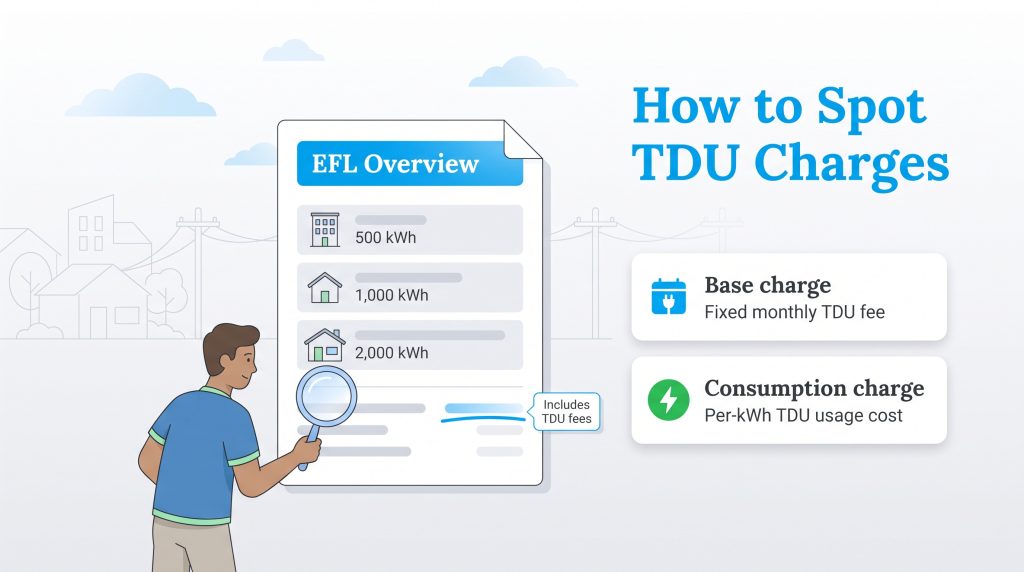
When you are shopping for a new energy plan, the most critical document you will ever review is the Electricity Facts Label (EFL). This standardized document functions exactly like a nutrition label for your energy contract, meticulously breaking down every single cost associated with the plan. Learning how to calculate TDU charges directly from this sheet ensures you are never caught off guard by hidden fees.
On the EFL, the retail provider usually displays an average price per kilowatt-hour at three standard usage levels: 500 kWh, 1,000 kWh, and 2,000 kWh. It is vital to note that these advertised average rates almost always bake in your local TDU fees. To see exactly how much of that price goes to the utility, look closer at the specific charge breakdown section:
- Base Charge: This is the fixed, flat monthly fee that your utility charges simply for keeping your address connected to the power grid. It does not change whether you use 10 kWh or 10,000 kWh.
- Consumption Charge: Also known as the per-kWh usage fee, this variable charge scales directly with the amount of electricity you consume. The more power you pull from the grid, the higher this specific portion of the fee becomes.
By locating these specific numbers on the document, you can accurately calculate what your baseline infrastructure costs will be before you ever sign the dotted line on a contract.
Why Do TDU Delivery Fees Fluctuate?
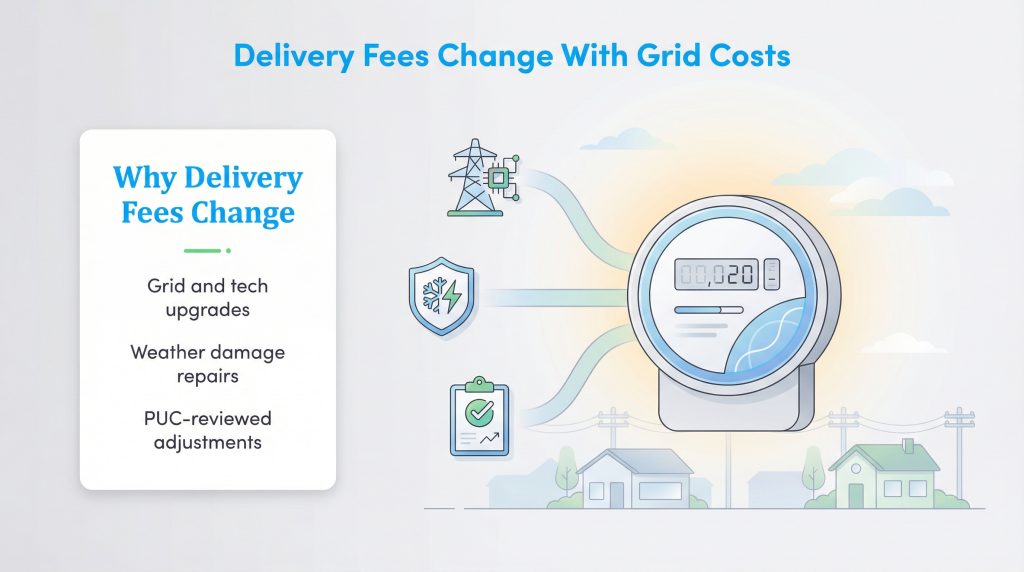
It rarely feels fair when your utility bill creeps upward, but delivery rate hikes stem from massive, verifiable operational requirements rather than arbitrary corporate greed. ERCOT utility companies must continually modernize the state’s electrical grid to handle rapidly growing suburban populations and an ever-increasing array of power-hungry smart home technologies. Severe weather events also force utilities to frequently repair damaged lines and invest in aggressive weatherization upgrades.
Fortunately, these utility companies cannot simply raise your rates on a whim. Every single price adjustment must pass through a rigorous, highly public approval process to ensure strict consumer protection. The Public Utility Commission (PUC) mandates and approves all rate changes. Through scheduled PUC rate adjustments, Texas updates these standard delivery rates twice a year (typically March 1 and September 1). This strict oversight ensures the utility has the funds required for extreme weather recovery and grid modernization without unfairly overcharging residents.
If you want to track the broader economic trends pushing these prices higher, you can explore the U.S. Energy Information Administration’s breakdown of factors affecting electricity prices to see exactly how national infrastructure investments continually impact overall residential bills.
Emergency Outages: TDU Contact Numbers and Trackers
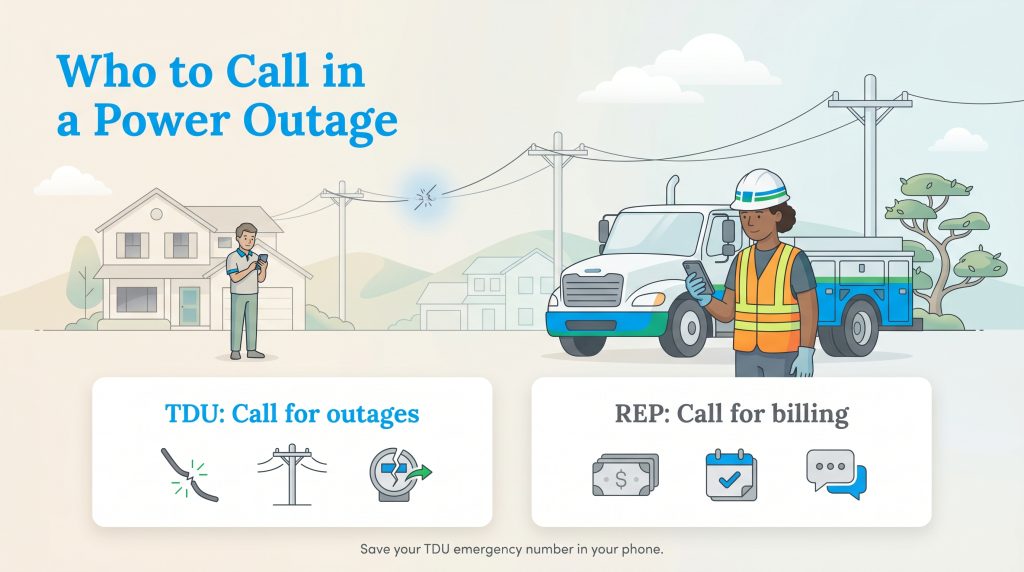
When severe weather strikes and your home suddenly goes dark, figuring out who to call can be a deeply stressful experience. It is a common misconception that you should contact the retail provider listed at the top of your monthly bill. In reality, you must immediately contact your TDU to report power outages, downed wires, or heavily damaged electric meters.
Your chosen retail energy provider is merely a billing and customer service entity; they do not have the physical equipment or authorization to repair local power lines. To help you get your lights back on faster during an emergency, we have compiled the 24/7 outage contact numbers for the top five Texas utility companies. You can also visit their respective websites to access digital outage trackers for real-time restoration updates in your specific neighborhood.
| Utility Company | 24/7 Outage Phone Number | Digital Outage Tracker |
|---|---|---|
| Oncor | 1-888-313-4747 | Available on Oncor.com |
| CenterPoint Energy | 1-800-332-7143 | Available on CenterPointEnergy.com |
| AEP Texas (North & Central) | 1-866-223-8508 | Available on AEPTexas.com |
| Texas-New Mexico Power (TNMP) | 1-888-866-7456 | Available on TNMP.com |
How Delivery Charges Work in Other Deregulated States
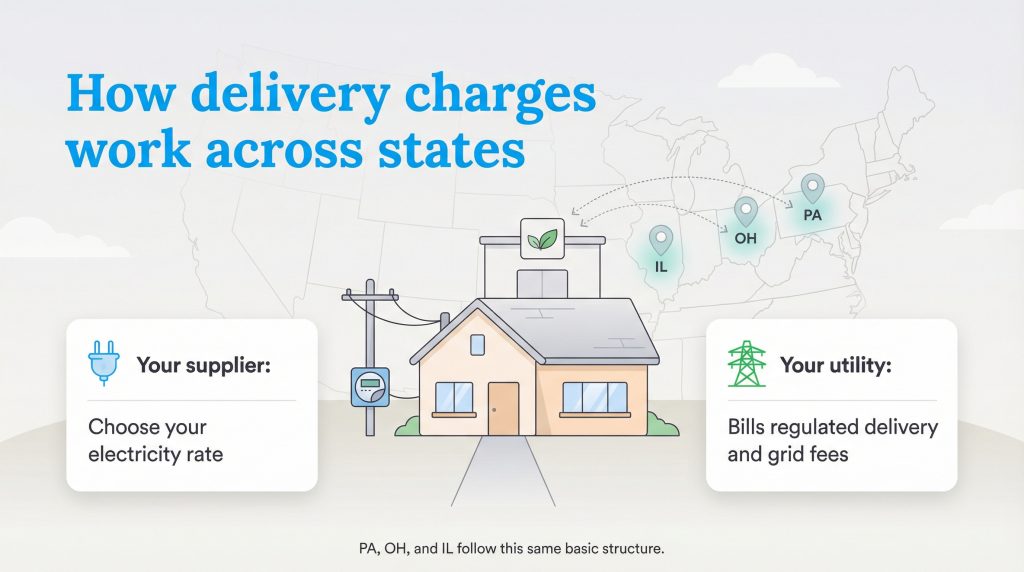
While Texas often dominates the national conversation around deregulated electricity, several other prominent states offer robust energy choice programs with surprisingly similar delivery charge structures. The fundamental rule of deregulation remains exactly the same across state lines: you have the right to shop for your electricity supply on an open market, but your locally assigned utility company still handles the physical delivery and continues to bill you for necessary grid maintenance. Each state manages its utility pricing uniquely, but the core principles of grid reliability remain consistent.
Pennsylvania
In Pennsylvania, your local utility company — such as PECO or PPL Electric Utilities — operates as an Electric Distribution Company (EDC). When you shop for a highly competitive supplier through the state’s official marketplace, your new supply rate immediately replaces the utility’s default generation price. However, your EDC confidently continues to charge fixed and variable distribution fees to maintain the local power grid.
Ohio
Ohio residents navigate a deeply similar system using the state’s Energy Choice Ohio marketplace. If you live in an area serviced by a major utility like AEP Ohio or Duke Energy, you will pay them a strictly regulated delivery fee. Even if you aggressively lock in a cheaper generation rate with a retail electric supplier, those standard delivery and transmission costs permanently remain on your monthly bill.
Illinois
If you live in Illinois and receive service from a major utility like ComEd or Ameren, you participate in a deregulated market where you can quickly choose an alternative retail electric supplier. Just like in other competitive states, your chosen supplier completely handles the generation of your electricity, while your primary utility continues to securely bill you for the physical delivery services required to transport that power to your home.
Actionable Ways to Lower Your Overall Electric Bill
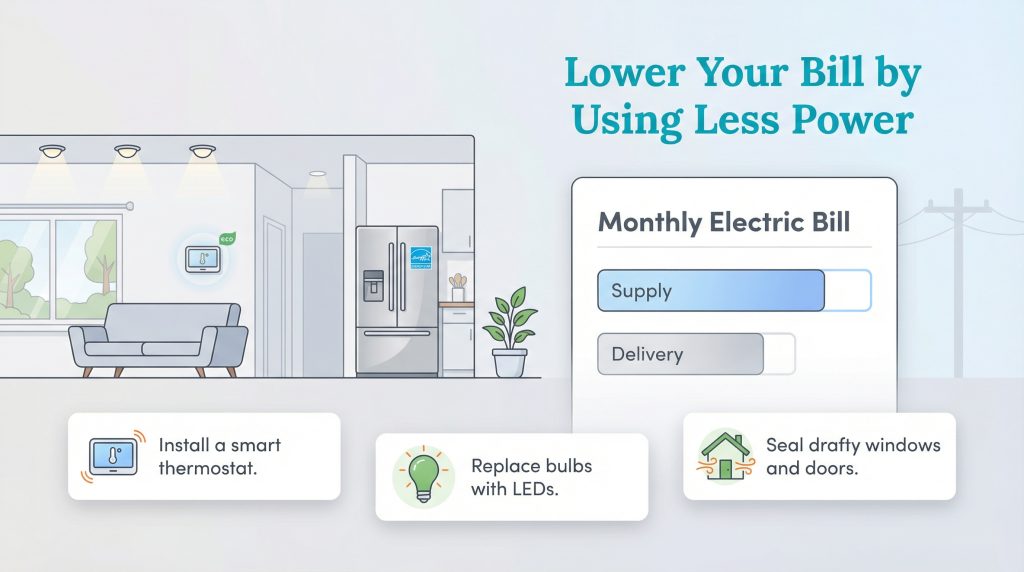
Because the state firmly mandates delivery fees, figuring out exactly how to lower TDU charges requires a slight shift in your household energy strategy. You cannot negotiate the baseline rate with your assigned provider, meaning lowering your overall kilowatt-hour consumption is the only mathematical way to reduce the variable portion of the fee. Every single kilowatt-hour you intelligently conserve drops both your retail supply cost and your utility delivery cost simultaneously.
To drastically shrink your monthly usage, try implementing a few simple, environmentally mindful choices around your home:
- Install a smart thermostat to seamlessly and automatically adjust heating and cooling schedules while you sleep or leave for work.
- Swap out older, heat-generating incandescent bulbs for highly energy-efficient LED lighting, which uses a fraction of the electricity and lasts significantly longer.
- Upgrade to verified ENERGY STAR certified appliances when replacing old refrigerators, washing machines, or dishwashers, as these units are rigorously tested to pull far less electricity from the grid.
- Seal drafty windows and doors with fresh weatherstripping and high-quality caulk to prevent your HVAC system from working overtime to replace lost air.
Beyond basic household conservation, the absolute best financial defense you have is to actively shop deregulated electricity rates and securely lock in a highly competitive supply plan. Dropping your retail supply rate by just a few cents per kilowatt-hour easily offsets the frustrating sting of high delivery fees. For a much deeper dive into adjusting your daily habits, check out our comprehensive guide on strategic ways to reduce your electricity usage. When you are ready to compare actual market prices, always use official, state-verified marketplaces like the Texas Power to Choose website to find secure, legitimate supply contracts.
Take Control of Your Future Energy Rate Adjustments
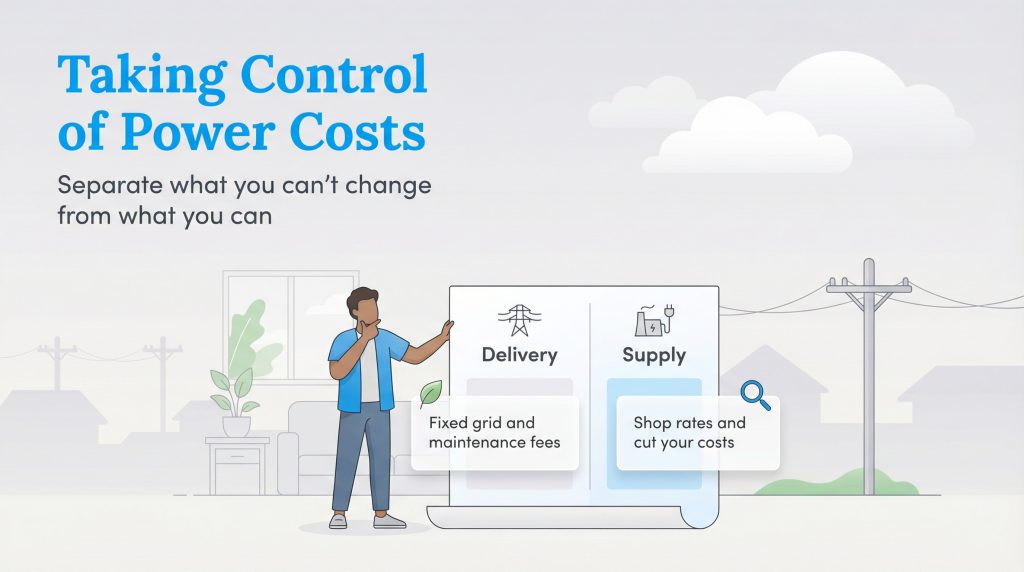
Because utility companies regularly update their robust pricing structures to keep up with inflation, infrastructure demands, and necessary grid weatherization, static delivery costs are largely a thing of the past. Taking a highly proactive approach to these inevitable rate adjustments can effortlessly save you from a major case of billing sticker shock. By systematically separating the unchangeable infrastructure costs from your highly flexible supply rates, you gain a massive financial advantage over the average, unengaged consumer.
Since these rates update predictably — typically on March 1 and September 1 in major deregulated markets like Texas — you can easily anticipate exactly when your monthly statement might jump. If you live on a strict household budget, we highly recommend planning for slightly higher utility costs during the spring and early fall months. You can also prepare by conducting a quick home energy audit right before these seasonal adjustments take effect. Upgrading your home’s insulation, servicing your heavy-duty HVAC system, and securely locking in a cheaper retail supply plan will naturally lower your total consumption, effectively cushioning the financial blow of any newly approved TDU rate hikes. Your neighborhood power grid genuinely needs expensive maintenance to keep your lights on through the worst storms, but with proactive shopping and mindful conservation, you can easily balance out those necessary costs for the long haul.
Frequently Asked Questions About Transmission and Delivery Utilities
Do retail electricity providers profit off of TDU delivery charges?
How often do TDU transmission and delivery rates change?
Can I shop around for a cheaper TDU company?
Can I refuse to pay TDU charges?
Why is my TDU charge higher than my energy supply charge?
Why did my Oncor delivery charges go up this month?
What is the difference between fixed and variable utility charges?
Do all deregulated states use the exact same TDU pricing model?
Do solar panels eliminate transmission and delivery fees?
Are TDU charges the same for renters and homeowners?
About the Author

LaLeesha has a Masters degree in English and enjoys writing whenever she has the chance. She is passionate about gardening, reducing her carbon footprint, and protecting the environment. She also recently served as President of the Board for City Sprouts (a community garden).

David has been an integral part of some of the biggest utility sites on the internet, including InMyArea.com, HighSpeedInternet.com, BroadbandNow.com, and U.S. News. He brings over 15 years of experience writing about, compiling and analyzing utility data.