
Compare the true cost, customer service ratings, and energy plans of TXU and Cirro to make the best choice for your home.
Key Takeaways
- TXU Energy offers extensive plan variety and premium perks, making it a strong choice for homeowners who want free nights or smart home bundles.
- Cirro Energy focuses on straightforward, no-frills pricing, which often appeals to budget-conscious renters or buyers looking for simple fixed rates.
- Switching between these providers is a seamless process that won’t interrupt your home’s power supply or require new equipment.
Choosing the right electricity provider in Texas can feel like navigating a maze of tricky teaser rates and confusing terms, but a direct TXU Energy vs. Cirro comparison clears up the clutter. Both companies are major players in the deregulated Texas energy market, though they operate under entirely different corporate umbrellas — TXU Energy is Vistra Corp’s premium brand, while Cirro Energy serves as a straightforward mid-tier option under NRG Energy. Whether you are moving into a new home and setting up utilities for the first time or simply hunting for the best Texas energy provider to lower your monthly bills, understanding how these two brands structure their pricing, hidden fees, and eco-friendly options is the key to maximizing your savings. We have evaluated their specific plans, compared TXU vs Cirro electricity rates, and reviewed verified PUCT complaint data so you can confidently lock in an energy-saving option that powers your life without draining your wallet.

- 11¢ /kWh
- 3-100%
- 60 days
- 1-36 Months
- Highest Trustpilot Rating 4.7/5 ★
- 7.3¢ /kWh
- 24%
- 30 days
- 12-36 Months
- Flexible Contract Lengths
*rates may vary by location and household usage
At a Glance: TXU vs. Cirro Side-by-Side
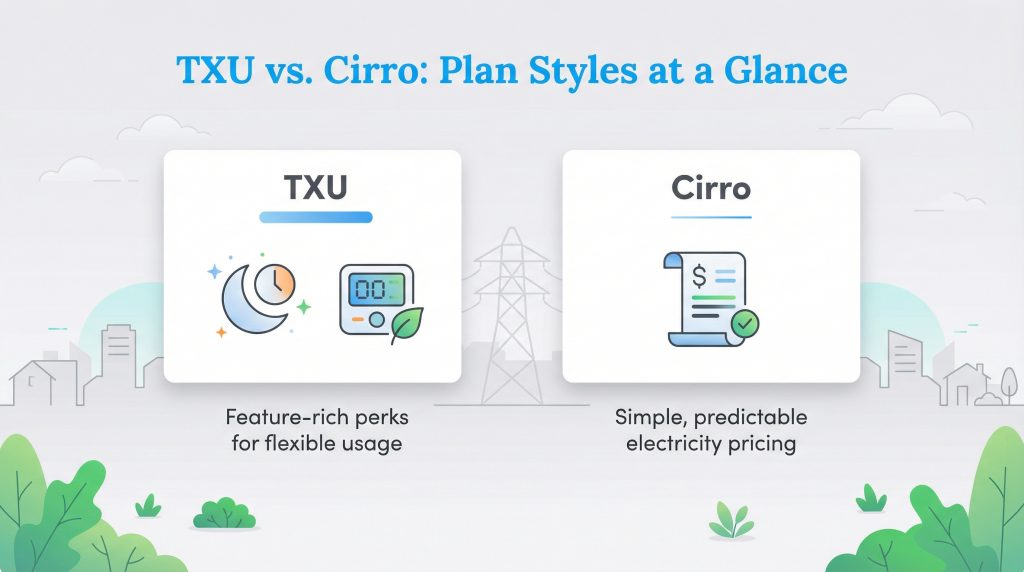
When you start to execute a Texas electricity comparison between TXU and Cirro Energy, the first thing you might notice is their distinct corporate positioning. Because TXU Energy is backed by Vistra Corp and Cirro Energy is backed by NRG Energy, both retail electricity providers boast robust financial stability and deep roots in the market. Yet, their consumer-facing benefits differ noticeably. TXU builds out broad, feature-rich portfolios packed with specialty plans, reinforcing its premium positioning in the market with robust 24/7 customer service. Cirro takes the exact opposite approach by stripping away complex tiered gimmicks to cement its mid-tier market positioning, frequently boasting default green energy inclusion for anyone wanting a simple, predictable monthly bill.
💡 Pro Tip: Even though TXU Energy and Cirro Energy have different parent companies, both are highly established providers with decades of experience delivering reliable electricity to Texas homes.
| Feature | TXU Energy | Cirro Energy |
|---|---|---|
| Parent Company | Vistra Corp | NRG Energy |
| Years in Texas | 20+ Years | 20+ Years |
| Credit Check Required | Yes (Soft check) | Yes (Soft check) |
| Green Plans Included | Add-on cost (GreenUp) | Included on many default plans |
| Average Early Termination Fee (ETF) | $150 – $295 | $150 – $295 |
| 24/7 Customer Service Availability | Yes | No (Business hours only) |
Plan Types and Pricing Structures

Shopping for electricity means you must always read the Electricity Facts Label (EFL) to dodge gimmick pricing. The EFL outlines exactly what you will pay across different consumption tiers, revealing hidden base charges or massive rate spikes if you miss a specific target. When evaluating Cirro Energy plans, you will find that the provider leans heavily toward simple options that lock in your price per kWh for a set term. TXU, conversely, heavily markets time-of-use and tiered usage plans, which means evaluating a Cirro Energy vs TXU Energy rate structure requires a close look at your historical usage to determine which framework actually saves you money. If you find yourself consistently using high amounts of power, explore ways to reduce your home’s energy consumption before locking into a new contract.
- TXU Energy plans: Known for premium, targeted specialty structures like the TXU free nights (Free Nights & Solar Days) or Season Pass plans, these options often average around 18.5 cents per kWh at 500 kWh, drop to 15.2 cents at 1,000 kWh, and level out near 15.5 cents at 2,000 kWh.
- Cirro Energy plans: Focusing on straightforward Cirro fixed-rate plans like Simple Advantage or Bill Bonus, these stable structures typically hover around 16.0 cents per kWh at 500 kWh, 14.5 cents at 1,000 kWh, and 14.2 cents at 2,000 kWh.
Note: The rates above are methodological examples representing standard deregulated market conditions, as Texas energy rates fluctuate based on the season and your specific zip code. Always check the EFL for current pricing in your area.
TXU Energy Plans (Premium & Specialty)
| Plan Name | Rate /kWH | Plan Term | Cancellation Fee | |
|---|---|---|---|---|
| Smart 1000 Saver 12 | 10.9¢ | Month to Month | N/A | Check Availability |
| Smart Edge 12 | 13.5¢ | 12 Months | $150.00 | Check Availability |
| Smart Edge 24 | 13.9¢ | 24 Months | $295.00 | Check Availability |
| Clear Deal 12 | 14.6¢ | Month to Month | N/A | Check Availability |
| Solar Value 12 | 15.4¢ | Month to Month | N/A | Check Availability |
| Smart 500 Start 12 | 16.1¢ | Month to Month | N/A | Check Availability |
| Simple Rate 12 | 16.6¢ | Month to Month | N/A | Check Availability |
| On Your Terms | 16.9¢ | Month to Month | N/A | Check Availability |
| Free Nights & Cool Summer 12 | 17.9¢ | Month to Month | $Fixed | Check Availability |
| Solar Club 12 | 19.1¢ | 12 Months | $150.00 | Check Availability |
| Flex Forward | 19.1¢ | Month to Month | N/A | Check Availability |
| Texas Choice 12 | 19.2¢ | 12 Months | $150.00 | Check Availability |
| Texas Choice 24 | 19.2¢ | 24 Months | $295.00 | Check Availability |
| Ultimate Season Pass 12 | 19.2¢ | Month to Month | N/A | Check Availability |
| Flex Rewards | 19.3¢ | Month to Month | $0.00 | Check Availability |
| Smart Deal 12 | 19.6¢ | 12 Months | $150.00 | Check Availability |
| Smart Deal 24 | 20.4¢ | 24 Months | $295.00 | Check Availability |
| Smart Deal 36 | 20.4¢ | 36 Months | $395.00 | Check Availability |
| Solar Saver 12 | 20.8¢ | Month to Month | N/A | Check Availability |
| Saver's Discount 12 | 22.6¢ | Month to Month | N/A | Check Availability |
Cirro Energy Plans (Mid-Tier & Green)
| Plan Name | Rate /kWH | Plan Term | Cancellation Fee | |
|---|---|---|---|---|
| Bill Bonus 24 | 7.1¢ | Month to Month | N/A | Check Availability |
| Bill Bonus 12 | 7.6¢ | Month to Month | N/A | Check Availability |
| Simple Bill Credit 24 | 9.9¢ | 24 Months | $295.00 | Check Availability |
| Simple Bill Credit 12 | 9.9¢ | 12 Months | $150.00 | Check Availability |
| Smart Simple 12 | 13.1¢ | 12 Months | $150.00 | Check Availability |
| Smart Simple 10 | 13.3¢ | 10 Months | $95.00 | Check Availability |
| Smart Simple 36 | 13.5¢ | 36 Months | $395.00 | Check Availability |
| Smart Simple 24 | 13.8¢ | 24 Months | $295.00 | Check Availability |
| Simple Advantage 12 | 14.2¢ | Month to Month | N/A | Check Availability |
| Simple Advantage 24 | 14.9¢ | Month to Month | N/A | Check Availability |
| Smart Value 12 | 15.5¢ | 12 Months | $150.00 | Check Availability |
| Smart Value 24 | 15.9¢ | 24 Months | $295.00 | Check Availability |
| Bill Bonus Base 12 | 17¢ | Month to Month | N/A | Check Availability |
| Smart Lock Saver 12 | 18.5¢ | 12 Months | $150.00 | Check Availability |
| Bill Bonus Saver 24 | 18.9¢ | Month to Month | N/A | Check Availability |
| Bill Bonus Saver 12 | 19.4¢ | Month to Month | N/A | Check Availability |
| Simple Bill Credit Bundle 2000 kWh 12 | 20.7¢ | 12 Months | $150.00 | Check Availability |
| Simple Bill Credit Bundle 2000 kWh 24 | 20.7¢ | 24 Months | $295.00 | Check Availability |
Green Energy and Renewable Options
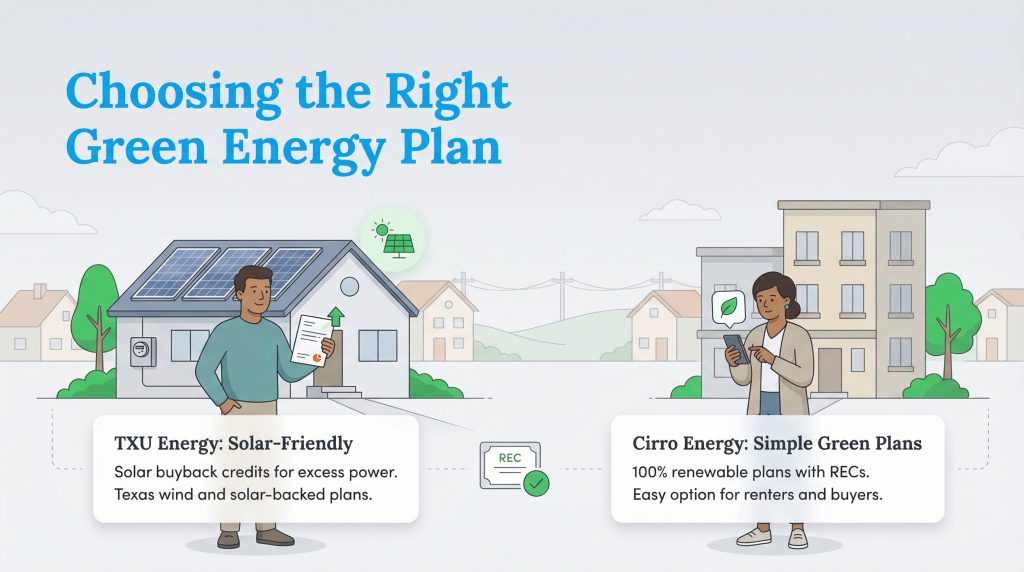
Opting for a sustainable power plan is one of the easiest ways to support a cleaner grid without overhauling your lifestyle. Rather than physically routing dedicated wind power directly to your home’s breaker box, providers purchase Renewable Energy Certificates (RECs) to offset your electricity usage with power generated from renewable sources. When comparing the two, TXU Energy often requires customers to purchase a paid “GreenUp” add-on to make their standard plans 100% renewable. However, they do shine for homeowners who have invested in their own solar panels by offering competitive solar buyback programs that credit your account for excess energy you send back to the grid.
In contrast, Cirro Energy simplifies the environmentally mindful choice by defaulting to include green energy in many of their standard fixed-rate plans at no extra add-on cost. This makes choosing an eco-conscious alternative effortless for renters or buyers who want to go green without navigating complex renewable upgrade fees or installing solar equipment.
🌱 Eco Edge: Upgrading to a 100% renewable energy plan is an affordable way to significantly reduce your household’s carbon footprint without needing to install expensive solar panels on your roof.
Hidden Fees and Early Termination Fees

Before you lock in your new Texas deregulated energy market plan, you must account for the upfront costs and potential hidden fees associated with setting up utilities. Both TXU and Cirro mandate a soft credit screening for new customers. This is a routine verification step that will not negatively impact your official credit score, though it could trigger a deposit requirement. You can bypass this deposit entirely if you can prove you are 65 years of age or older, or if you provide an official Letter of Credit from your previous utility provider showing 12 consecutive months of on-time payments.
More importantly, always review the EFL for hidden charges like minimum usage fees — specific financial penalties assessed if you do not consume a set amount of power each billing cycle. To avoid unexpected bill spikes, select a plan structure that closely matches your exact historical usage so you do not fall short of the required threshold. Finally, be aware of the early termination fees Texas providers charge for breaking a contract. If you cancel a fixed-rate electricity plan before your term expires, both TXU and Cirro typically charge an ETF ranging from $150 to $295, depending on your specific plan and contract length.
Customer Service and PUCT Complaints

Stellar customer service rarely crosses your mind until you are staring at an unexplained billing error or trying to transfer your service during a stressful move. Evaluating TXU Energy reviews versus Cirro Energy reviews gives us a clear picture of how these companies treat their customers when things go wrong. Building trust in a provider requires looking at objective metrics, such as the Public Utility Commission of Texas (PUCT) complaint scorecard. According to the latest PUCT complaint data, TXU maintains an incredibly strong track record, frequently achieving a lower complaint rate relative to its massive user base (often scoring a 4 or 5 out of 5 on the official index). While Cirro is also a highly reliable choice, it occasionally registers a slightly higher complaint ratio relative to its smaller customer count, primarily addressing common administrative or billing delays.
Navigating the logistics of setting up electricity in a major hub can be overwhelming, so having an accessible support team is crucial. TXU invests heavily in a highly rated mobile app, allowing users to track usage, pay bills, and chat with a 24/7 support team seamlessly. Cirro keeps things basic with a functional but standard web portal and more limited customer service hours. If you value robust digital tools and rapid response times, TXU holds the clear advantage in customer experience.
🚩 Heads Up: Remember that power delivery and outage management are handled by your local transmission utility like CenterPoint or Oncor, not TXU or Cirro. Always direct outage complaints to the utility company, not your retail provider.
Preparing for Your Texas Power Switch
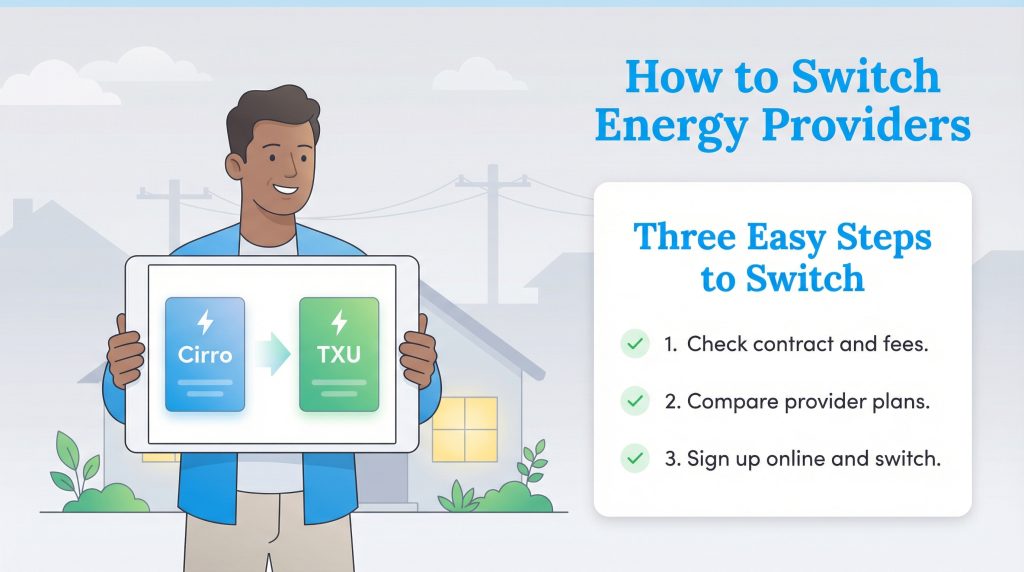
One of the biggest misconceptions about the deregulated energy market is that changing providers will cause a power interruption. If you decide to switch from Cirro to TXU, or vice versa, the transition happens entirely on the backend. No technicians will visit your home, and your lights will not flicker. The local utility continues to deliver your electricity without skipping a beat. When you are ready to make a move, you can simply check your contract for ETFs — if your contract expires within the next 14 days, you can switch without penalty — review official provider plans to find a rate structure that fits your historical usage, and sign up online.
Choosing Between TXU and Cirro With Confidence

Deciding between these two utility providers ultimately comes down to how you prefer to manage your household budget and energy usage. To simplify your decision, consider your daily routine and what you value most in an energy plan:
- Choose Cirro Energy if: You crave a straightforward, “set it and forget it” billing experience. Their mid-tier pricing models generally eliminate the stress of calculating daily usage tiers, making them a great fit for budget-conscious users who want green energy included by default.
- Choose TXU Energy if: You are a data-driven consumer who actively monitors habits. If you want smart-home integration, app-based tracking, and premium plan structures that reward strategic energy use, TXU is often a better fit despite potentially higher base costs.
If you are exploring all deregulated electric options, analyzing your unique lifestyle and past electricity bills helps you make a smart, eco-conscious choice that keeps your home comfortable and properly powered year-round.
Frequently Asked Questions About TXU Energy and Cirro
Choosing an electricity provider often brings up plenty of questions about billing, reliability, and contract terms. Here are some of the most common inquiries we receive regarding TXU and Cirro.
Is TXU Energy cheaper than Cirro Energy?
Do TXU or Cirro charge early termination fees?
Which provider has better green energy options in Texas?
Will my power go out if I switch providers?
Do TXU or Cirro require a deposit to start electric service?
Who is the parent company of Cirro Energy and TXU?
About the Author

LaLeesha has a Masters degree in English and enjoys writing whenever she has the chance. She is passionate about gardening, reducing her carbon footprint, and protecting the environment. She also recently served as President of the Board for City Sprouts (a community garden).