
Chariot Energy shines for solar owners and eco-conscious renters, while TXU Energy offers stability and broad plan variety for traditional households.
Key Takeaways
- Chariot Energy specializes in 100% renewable plans, often backed by solar energy, making them ideal for green-focused homeowners.
- TXU Energy provides established reliability and popular “Free Nights” plans, though users must watch out for higher daytime rates on these offers.
- Comparing the Electricity Facts Labels (EFL) is crucial, as both providers have different approaches to base charges and early cancellation fees.
Choosing an electricity provider in Texas often feels like a tug-of-war between the reliable giants and the innovative newcomers. On one side, you have TXU Energy, a household name with decades of history and a reputation for stability. On the other, you have Chariot Energy, a rapidly growing challenger committed to 100% solar energy and straightforward pricing. While TXU brings the comfort of a massive infrastructure and polished apps, Chariot appeals to the modern, eco-conscious Texan who wants to support green energy without installing panels, or get paid for the panels they already have. This guide breaks down their rates, fees, and solar programs to help you decide which provider powers your lifestyle best.

- 13.5¢ /kWh
- 3-100%
- 60 days
- 1-36 Months
- Best for Plan Variety & Reliability

- 7.2¢ /kWh
- 100%
- None
- 3-36 Months
- 100% Solar-Powered Electricity
*rates may vary by location and household usage
At a Glance: TXU Energy vs. Chariot Energy
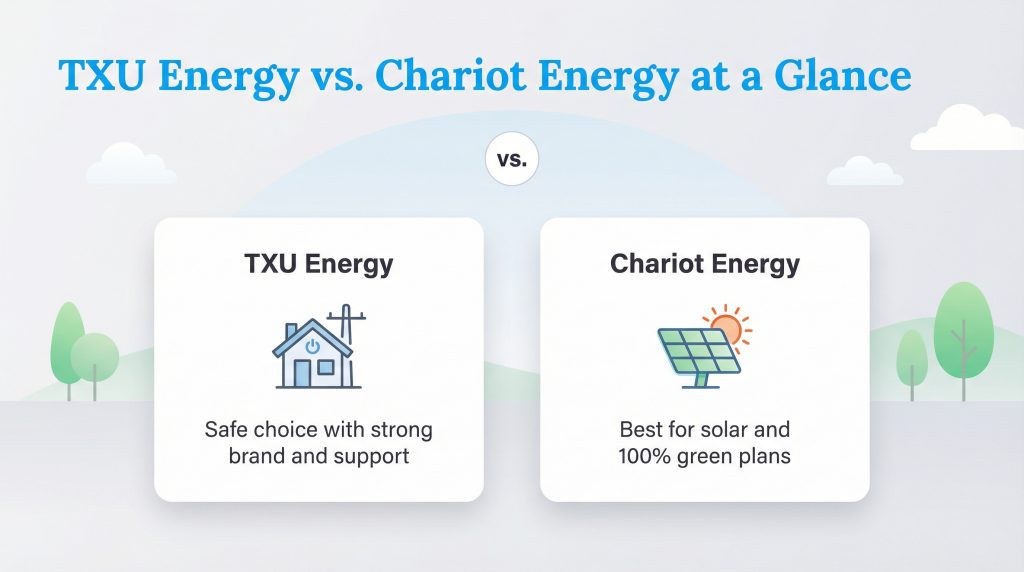
If you are skimming for a quick answer, this table highlights the fundamental differences between the two providers. TXU Energy is generally the “safe” choice for those who value brand recognition and customer support, while Chariot Energy is the specialized choice for solar enthusiasts and green energy supporters.
| Feature | TXU Energy | Chariot Energy |
|---|---|---|
| Primary Focus | Reliability & “Free Usage” Perks | 100% Solar & Solar Buyback |
| Renewable Content | Varies by Plan (Check EFL) | 100% Solar (via RECs) |
| Contract Types | Fixed, Variable, Tiered Bundles | Fixed (Simple Rates) |
| Solar Buyback | Available (Credits often < Retail) | Core Offering (Real-Time or Fixed) |
Rates and Plan Variety
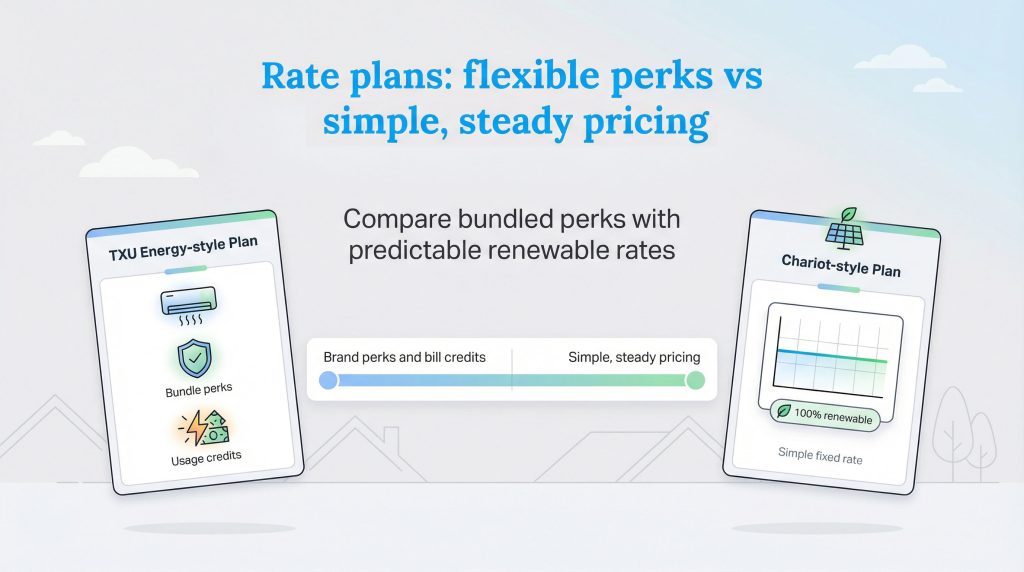
Pricing strategies differ significantly between these two companies. TXU Energy is known for its wide variety of plans, which often include bundled services like A/C protection or tiered usage credits. While these plans can offer value, they often come with a “brand premium,” meaning you might pay slightly more per kilowatt-hour (kWh) for the peace of mind that comes with a major provider. TXU plans frequently utilize bill credits, for example, you might get $30 off your bill if you use more than 800 kWh. This makes hitting your usage targets essential to getting a good rate.
TXU Energy Plans and Pricing
| Plan Name | Rate | Plan Type | Cancellation Fee | |
|---|---|---|---|---|
| Value Edge 12 | $0.135 /kWh | 12 Months Fixed Rate | $150.00 | Check Availability |
| Smart Edge 12 | $0.139 /kWh | 12 Months Fixed Rate | $150.00 | Check Availability |
| Clear Deal 12 | $0.139 /kWh | 12 Months Rate | $150 | Check Availability |
| Smart Edge 24 | $0.145 /kWh | 24 Months Fixed Rate | $295.00 | Check Availability |
| Clear Deal 24 | $0.149 /kWh | 24 Months Rate | $295 | Check Availability |
| Simple Value 12 | $0.157 /kWh | 12 Months Fixed Rate | $150.00 | Check Availability |
| Simple Rate 12 | $0.173 /kWh | 12 Months Rate | $150 | Check Availability |
| On Your Terms | $0.175 /kWh | 1 Month Months Rate | $ | Check Availability |
| Solar Value 12 | $0.175 /kWh | 12 Months Rate | $150 | Check Availability |
| Ultimate Season Pass 12 | $0.187 /kWh | 12 Months Rate | $150 | Check Availability |
| Solar Club 12 | $0.191 /kWh | 12 Months Fixed Rate | $150.00 | Check Availability |
| Texas Choice 12 | $0.192 /kWh | 12 Months Fixed Rate | $150.00 | Check Availability |
| Texas Choice 24 | $0.192 /kWh | 24 Months Fixed Rate | $295.00 | Check Availability |
| Flex Rewards | $0.193 /kWh | Variable Rate | $0.00 | Check Availability |
| Flex Forward | $0.193 /kWh | 1 Month Months Rate | $ | Check Availability |
| Smart Deal 12 | $0.196 /kWh | 12 Months Fixed Rate | $150.00 | Check Availability |
| Smart Deal 24 | $0.204 /kWh | 24 Months Fixed Rate | $295.00 | Check Availability |
| Smart Deal 36 | $0.204 /kWh | 36 Months Fixed Rate | $395.00 | Check Availability |
| Solar Saver 12 | $0.205 /kWh | 12 Months Rate | $150 | Check Availability |
| Free Nights & Solar Days 12 (8 pm) | $0.215 /kWh | 12 Months Rate | $150 | Check Availability |
| Saver's Discount 12 | $0.217 /kWh | 12 Months Rate | $150 | Check Availability |
| Saver's Discount 24 | $0.251 /kWh | 24 Months Rate | $295 | Check Availability |
Chariot Energy takes a more streamlined approach. Affiliated with Hanwha Group (a major player in solar manufacturing via Qcells), Chariot offers competitive fixed rates backed by 100% renewable energy. Their plans tend to be simpler, often avoiding the complex tiered structures found in some legacy provider contracts. For many users, this means a more predictable bill during shoulder months (spring and fall) when electricity usage drops.
Chariot Energy Plans and Pricing
| Plan Name | Rate | Plan Type | Cancellation Fee | |
|---|---|---|---|---|
| GridPlus 15 | $0.072 /kWh | 15 Months Rate | $15 x Month | Check Availability |
| GridPlus 24 | $0.077 /kWh | 24 Months Rate | $15 x Month | Check Availability |
| GridPlus 18 | $0.083 /kWh | 18 Months Fixed Rate | $15.00 | Check Availability |
| GridPlus 12 | $0.090 /kWh | 100 Months 1 Rate | $12 | Check Availability |
| GridEdge 36 | $0.109 /kWh | 36 Months Rate | $15 x Month | Check Availability |
| GridPlus 36 | $0.111 /kWh | 36 Months Rate | $15 x Month | Check Availability |
| GridEdge 12 | $0.112 /kWh | 12 Months Rate | $15 x Month | Check Availability |
| GridEdge 24 | $0.112 /kWh | 24 Months Rate | $15 x Month | Check Availability |
| Bright Nights 15 | $0.125 /kWh | 15 Months Fixed Rate | $15 per remaining month | Check Availability |
| Bright Nights 12 | $0.126 /kWh | 12 Months Fixed Rate | $15 per remaining month | Check Availability |
| GridEdge 18 | $0.131 /kWh | 18 Months Rate | $15 x Month | Check Availability |
| Bright Nights 24 | $0.131 /kWh | 24 Months Fixed Rate | $15 per remaining month | Check Availability |
| Chariot Choice 24 | $0.134 /kWh | 24 Months Fixed Rate | $150.00 | Check Availability |
| Solarize 12 | $0.135 /kWh | 12 Months Rate | $15 x Month | Check Availability |
| Chariot Choice 36 | $0.135 /kWh | 36 Months Fixed Rate | $150.00 | Check Availability |
| Solarize 36 | $0.141 /kWh | 36 Months Rate | $15 x Month | Check Availability |
| Solarize 24 | $0.142 /kWh | 24 Months Rate | $15 x Month | Check Availability |
| Free Days 36 | $0.147 /kWh | 36 Months Rate | $15 x Month | Check Availability |
| Free Days 18 | $0.148 /kWh | 18 Months Rate | $15 x Month | Check Availability |
| Free Nights 36 | $0.149 /kWh | 36 Months Rate | $15 x Month | Check Availability |
| Free Nights 24 | $0.150 /kWh | 24 Months Rate | $15 x Month | Check Availability |
| Free Nights 15 | $0.150 /kWh | 15 Months Rate | $15 x Month | Check Availability |
| Free Days 12 | $0.151 /kWh | 12 Months Rate | $15 x Month | Check Availability |
| Free Nights 12 | $0.151 /kWh | 12 Months Rate | $15 x Month | Check Availability |
| Bright Nights 36 | $0.152 /kWh | 36 Months Fixed Rate | $15 per remaining month | Check Availability |
| Free Days 24 | $0.153 /kWh | 24 Months Rate | $15 x Month | Check Availability |
| FreeDays 36 | $0.161 /kWh | 36 Months Fixed Rate | $15.00 | Check Availability |
| Free Nights 18 | $0.168 /kWh | 18 Months Rate | $15 x Month | Check Availability |
| Solarize 18 | $0.170 /kWh | 18 Months Rate | $15 x Month | Check Availability |
| Solarize 15 | $0.171 /kWh | 15 Months Rate | $15 x Month | Check Availability |
| PowerBank 24 | $0.172 /kWh | 24 Months Rate | $15 x Month | Check Availability |
| Free Days 15 | $0.175 /kWh | 15 Months Rate | $15 x Month | Check Availability |
| GridMax 15 | $0.197 /kWh | 15 Months Rate | $15 x Month | Check Availability |
| Chariot Freedom | $0.197 /kWh | Variable Rate | $0.00 | Check Availability |
| GridMax 24 | $0.197 /kWh | 24 Months Rate | $15 x Month | Check Availability |
| GridMax 36 | $0.214 /kWh | 36 Months Rate | $15 x Month | Check Availability |
| GridMax 18 | $0.215 /kWh | 18 Months Rate | $15 x Month | Check Availability |
| GridMax 12 | $0.216 /kWh | 12 Months Rate | $15 x Month | Check Availability |
Since rates change daily, it is impossible to list exact prices here. However, understanding how to compare them is key. Use the table below as a framework when looking at the Electricity Facts Label (EFL) for each provider:
| Usage Level | What to Watch For (TXU Energy) | What to Watch For (Chariot Energy) |
|---|---|---|
| 500 kWh (Apartments) | Often higher rates; look for “base charges” that penalize low usage. | Usually consistent, but check for minimum usage fees on some plans. |
| 1,000 kWh (Small Homes) | Often the “sweet spot” with bill credits (e.g., $30 off) applied. | Competitive fixed rates; simpler math with fewer tiers. |
| 2,000 kWh (Large Homes) | Check if credits expire after a certain usage limit. | Rates typically remain steady or drop slightly. |
The “Free Nights” vs. “Solar” Dilemma

One of the biggest differences between TXU and Chariot is their marketing hook. TXU Energy is famous for its “Free Nights & Solar Days” style plans. These plans encourage you to shift your heavy electricity usage, like laundry, dishwashing, or EV charging, to specific windows of time (usually 8 p.m. to 5 a.m.). If you are a night owl or have an electric vehicle, these plans can be fantastic. However, the daytime rate on these plans is often significantly higher than the standard average, meaning you could overpay if you work from home or run the A/C heavily during the afternoon.
Chariot Energy counters this with a “Solar for All” philosophy. They don’t typically rely on time-of-use gimmicks. Instead, they focus on delivering 100% renewable energy around the clock. This is an excellent alternative for customers who want to support green energy but don’t want to constantly monitor the clock to see if it’s “safe” to run the dryer. You get the environmental benefit without the behavioral gymnastics.
Solar Buyback Comparison
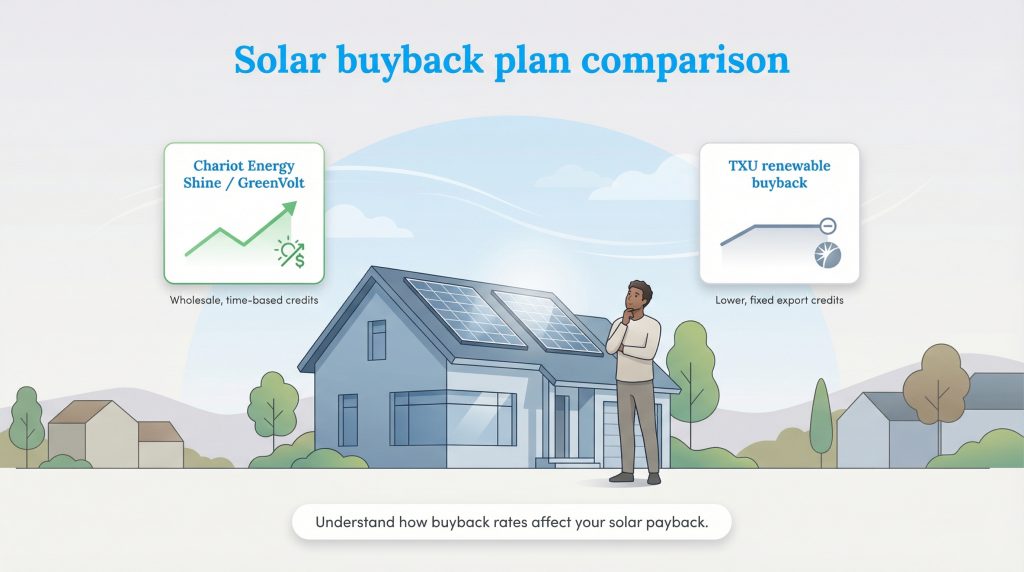
If you have solar panels on your roof, this is the most critical section for you. Chariot Energy is a “solar-native” company, and it shows in their buyback programs. Their “Shine” plan is designed specifically for solar owners, often offering credits for the excess energy you send back to the grid based on real-time wholesale market rates (subject to caps). Other plans, like “GreenVolt,” may offer a fixed buyback rate. While these rates fluctuate, they allow savvy users to earn fair value for their generation, especially during peak demand times.
TXU Energy also offers solar buyback plans, such as their Renewable Buyback plan. However, TXU is primarily a retail electric provider, not a solar specialist. Their buyback rates are often capped or set at a rate lower than what you pay for electricity. While convenient for existing TXU customers who install panels later, dedicated solar owners often find more aggressive value in Chariot’s offerings. If you are considering installing panels, check out our guide on solar energy basics to understand how these credits work.
Fees, Contracts, and Fine Print
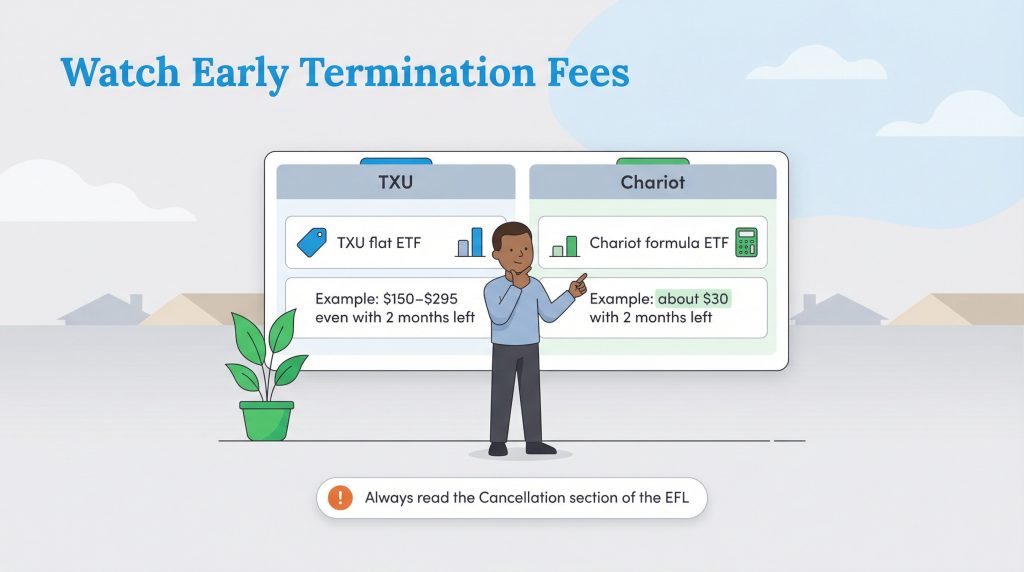
Hidden fees are the bane of the electricity market. When comparing contracts, the Early Termination Fee (ETF) is a major factor. This fee applies if you switch providers before your contract expires. TXU Energy typically uses a flat-fee structure based on the length of your plan, whereas Chariot Energy often uses a formula based on the months remaining.
| Provider | Typical Early Termination Fee (ETF) Examples |
|---|---|
| TXU Energy | $150 (12-month), $295 (24-month), $395 (36-month) |
| Chariot Energy | $15 multiplied by the number of months remaining |
For example, if you cancel a Chariot contract with only two months left, you might only pay $30. If you cancel a TXU contract with two months left, you could still be on the hook for the full $150 or $295 flat fee. Note that these are examples; always read the “Cancellation” section of the EFL before signing.
Customer Service and Reviews

TXU Energy is the premium option when it comes to customer service. They maintain a massive 24/7 call center, a highly-rated mobile app, and extensive online tools for tracking usage. If you value being able to reach a human at 3 a.m. or want detailed graphs of your hourly usage, TXU excels here. Their high customer satisfaction is often reflected in their low complaint ratios on the Public Utility Commission of Texas (PUCT) complaint statistics page.
Chariot Energy generally receives positive reviews, particularly for their transparency and green mission. However, they operate with a leaner team. While they are backed by the massive Hanwha Group, they don’t have the same infinite resources as TXU. You might find their support hours are standard business hours rather than 24/7. For most users who simply want to pay their bill and forget it, this is perfectly adequate, but it is a distinction worth noting.
Which Provider Fits Your Texas Home?

Ultimately, the decision between TXU Energy and Chariot Energy comes down to lifestyle versus stability. You should choose TXU Energy if you want the security of a trusted brand, excellent mobile tools, or if your household schedule fits perfectly with a “Free Nights” plan. On the other hand, you should choose Chariot Energy if you have solar panels, want to support 100% green energy without paying a premium, or prefer a simple fixed-rate bill without navigating complex usage tiers. Before you sign up, grab your last three electricity bills to see your actual usage, it is the only way to know for sure which plan will save you money.
Frequently Asked Questions About TXU and Chariot Energy
Is Chariot Energy really 100% renewable?
Does TXU Energy offer solar buyback plans?
Who has better cancellation fees, TXU or Chariot?
Is TXU Energy more expensive than Chariot?
How do I switch from TXU to Chariot?
About the Author

LaLeesha has a Masters degree in English and enjoys writing whenever she has the chance. She is passionate about gardening, reducing her carbon footprint, and protecting the environment.