
Learn exactly how your monthly utility fees work and discover actionable strategies to lower your total energy costs.
Key Takeaways
- TNMP TDU charges update twice a year in March and September, directly impacting your monthly electricity bill.
- Delivery charges are non-negotiable fees that pay for maintaining the physical power grid, poles, and wires in your service area.
- While you cannot change your utility company, you can offset high delivery costs by locking in a competitive energy plan and improving home efficiency.
We know the sinking feeling of opening a surprisingly high electric bill and staring blankly at confusing acronyms like TDU or TDSP. Navigating Texas-New Mexico Power delivery charges doesn’t have to be a frustrating experience. Our goal is to demystify these mandatory grid fees and share a few clever, actionable strategies to help you confidently lower your total household energy expenses.
What Is a TDSP Charge on My Electric Bill?
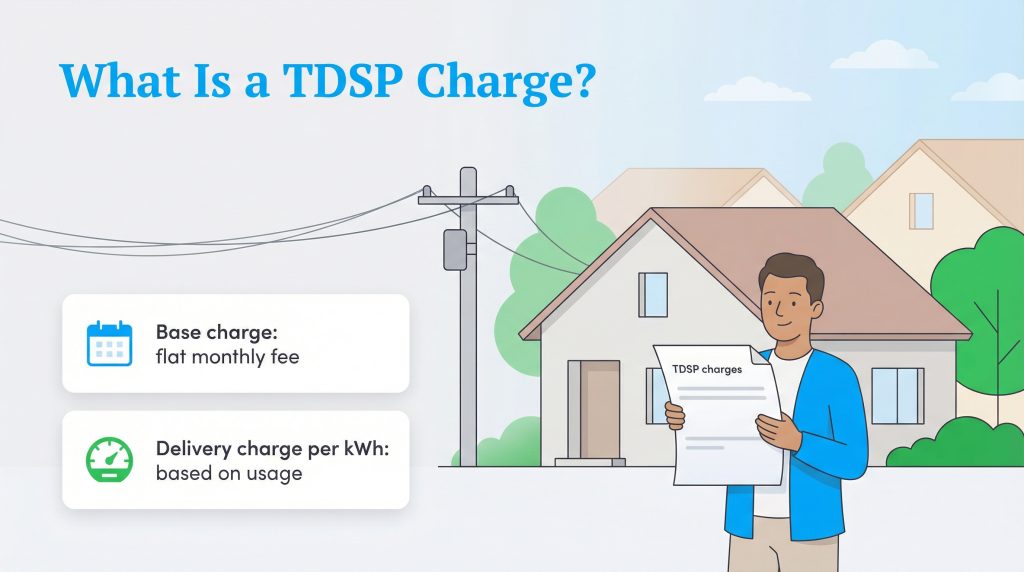
If you are scratching your head wondering, “What is a TDSP charge on my electric bill?”, you are certainly not alone. In the deregulated Texas energy market, TDSP (Transmission and Distribution Service Provider) and TDU (Transmission and Distribution Utility) mean exactly the same thing. While you buy your electricity from a retail energy provider, like Gexa Energy or TXU Energy, Texas-New Mexico Power (TNMP) is the delivery utility responsible for safely delivering that power to your home. They manage the physical infrastructure, maintain the local utility poles, and dispatch the crews when a storm knocks out your neighborhood’s power. Since you cannot choose your delivery utility, TNMP passes along these regulated costs to ensure the grid remains reliable for your community.
Included in TNMP Delivery Charges
Understanding what is included in TNMP delivery charges makes reading your monthly statement much easier. The state standardizes these fees across the entire utility footprint, breaking them down into two distinct components:
- Base Charge: A flat monthly fee applied to your account regardless of how much electricity you actually use.
- Delivery Charge Per kWh: A variable rate multiplied by your total monthly electricity consumption to fund metering, transmission, and ongoing distribution grid maintenance.
Current TNMP Delivery Charges for 2026
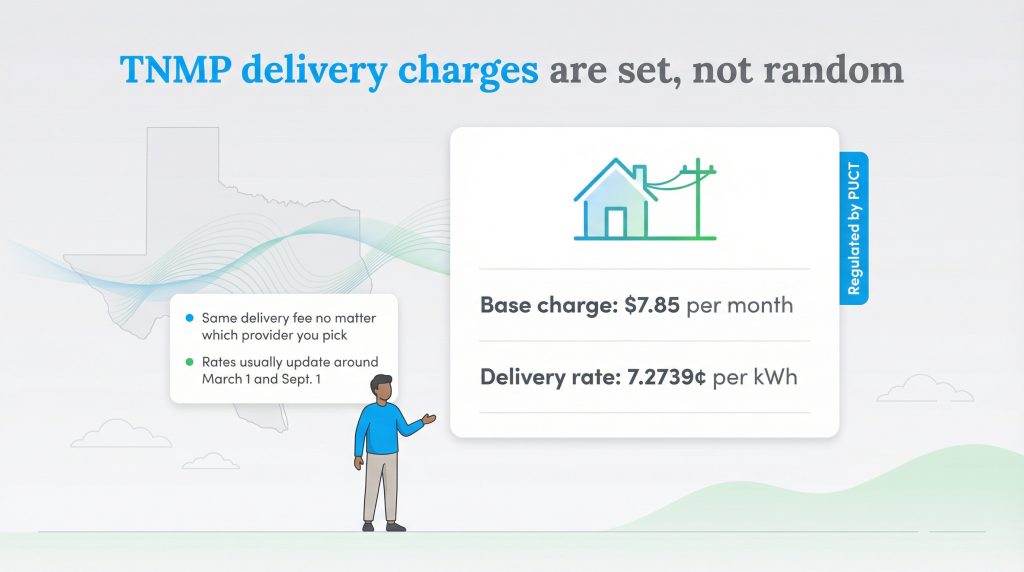
Because this topic requires precision, it is important to look at the exact numbers. According to the official tariffs from Texas-New Mexico Power, the verified current delivery charges as of April 1, 2026, are set at a flat base charge of $7.85 per month, plus a variable delivery charge of 7.7 cents ($0.077) per kilowatt-hour (kWh).
Your utility rates are not arbitrarily decided behind closed doors. The Public Utility Commission of Texas strictly regulates and approves these costs to protect consumers from price gouging. Because the state sets the rates, your delivery fees remain identical regardless of which retail electricity provider you choose. Historically, you will notice these costs adjust twice a year. While routine updates occur around March 1 and Sept. 1, these PUCT-approved rate adjustments are designed to help utilities recover costs from major transmission investments, severe weather repairs, and ongoing grid modernization efforts.
Estimating Your 2026 TNMP TDU Charges
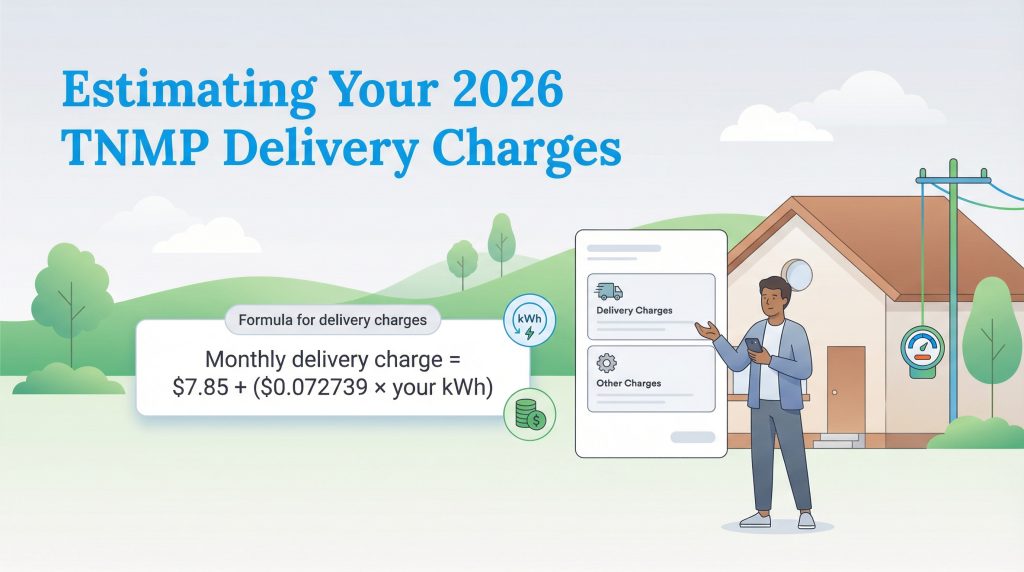
Predicting your utility expenses is a crucial part of budgeting, especially if you are managing total electricity costs across different utility zones. To help you visualize the impact of TNMP TDU charges for 2026, we calculated a few realistic scenarios. Using the verified April 2026 baseline of a $7.85 fixed charge plus $0.077 per kilowatt-hour, your delivery fees scale directly with your consumption.
| Usage Tier (Home Size) | Estimated kWh Used | Example Total Delivery Charge |
| Apartment | 500 kWh | $46.35 |
| Small Home | 1,000 kWh | $84.85 |
| Large Home | 2,000 kWh | $161.85 |
To run your own math, simply check your most recent electric bill to find your exact kilowatt-hour usage. You can calculate your localized delivery fee by using this straightforward formula:
Monthly Delivery Charge = Fixed Base Fee + (Variable Delivery Rate × Your Total kWh Usage)
Keep in mind that these figures represent the delivery portion only. State and local taxes, standard fees, and your retail provider’s energy supply charge will be listed as separate line items on your total bill.
Understanding What You Can and Cannot Control
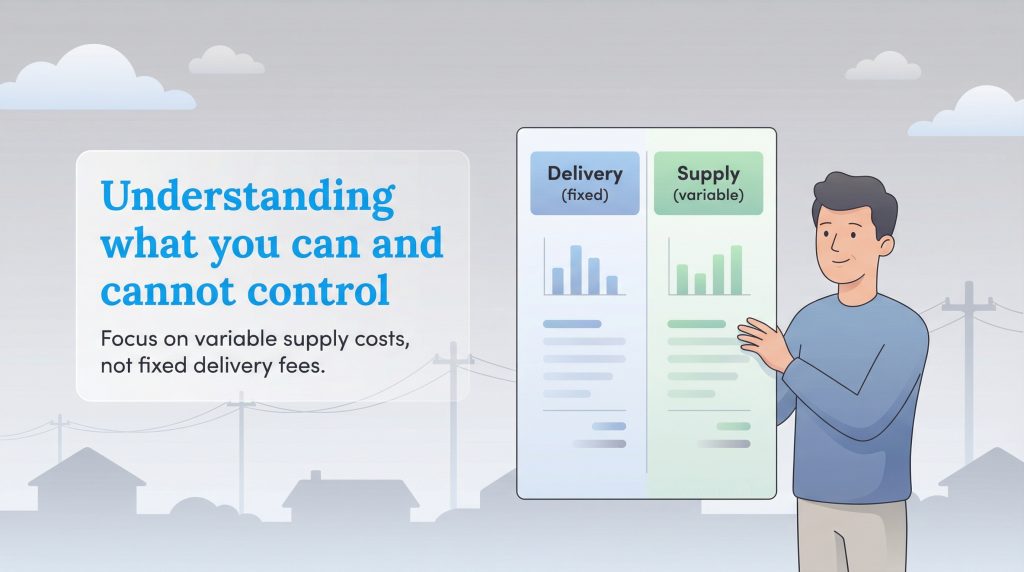
When reviewing your energy bill, it is helpful to categorize the costs so you know where to focus your cost-cutting efforts. While delivery charges might feel frustrating, recognizing the difference between fixed grid fees and variable supply costs simplifies the process.
| What You Can Control | What You Cannot Control |
| Your Retail Energy Provider: You have the freedom to shop around and choose a company with lower supply rates. | Your TDU/TDSP: Texas-New Mexico Power is assigned geographically. You cannot switch delivery utilities without moving. |
| Total Household Usage: Running appliances efficiently directly lowers both your energy charge and your variable delivery charge. | Fixed Base Charges: You must pay the monthly $7.85 TNMP base fee as long as your home is connected to the grid. |
Do Solar Panels Eliminate Texas-New Mexico Power Delivery Charges?
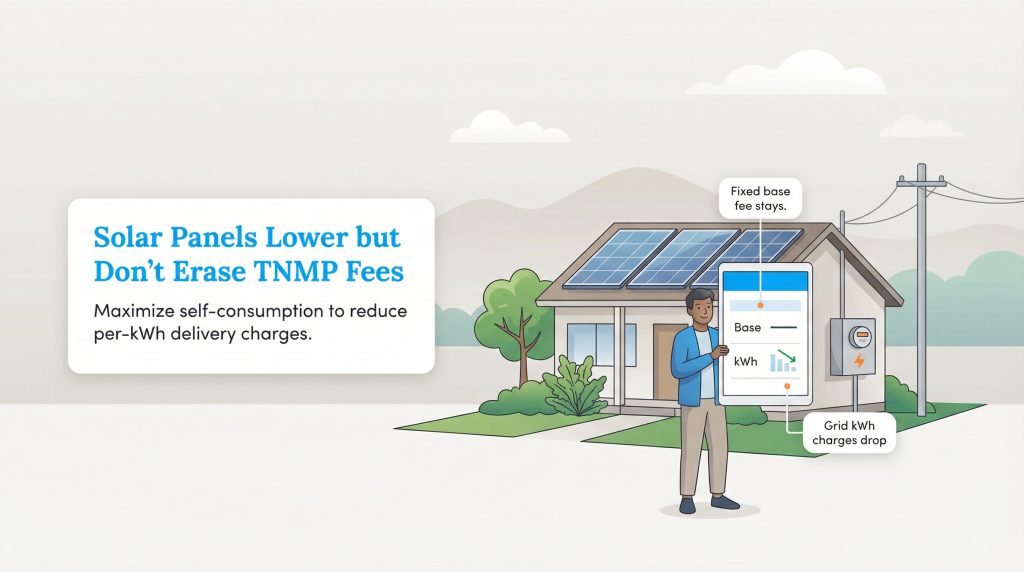
Many environmentally mindful homeowners assume that generating their own electricity completely severs their relationship with the local utility. However, as long as your property remains tied to the local grid, you cannot entirely escape TNMP delivery fees. You will still be responsible for the fixed monthly base charge to maintain your active connection. Fortunately, because your solar panels produce much of the power you need, you pull far fewer kilowatt-hours from the traditional grid. This can lower the variable per-kWh portion of your delivery cost. If you are investing in a residential solar system, maximizing your self-consumption is the key to minimizing these utility pass-through fees.
Actionable Ways to Offset High Delivery Rates

Since the state standardizes utility delivery fees, you cannot negotiate or switch away from them. However, you can protect your budget by targeting the other side of your bill: the energy supply charge.
Your most effective strategy is comparing plans carefully to find competitive TNMP electricity plans available. When comparing official state energy rates, always review the Electricity Facts Label (EFL) attached to the plan. The EFL exposes gimmick pricing and shows exactly how the provider bundles the TDU fees into their advertised average price, ensuring you spot plans with pricing that may not hold up across varying usage levels.
Beyond securing a better rate, utilizing proven strategies to lower your electric bill will organically reduce your variable delivery costs. Try adopting these three energy-saving habits:
- Install a smart thermostat: Automating your heating and cooling schedules prevents your HVAC system from running unnecessarily when you are away from home. Many local utilities even offer demand response programs or rebates for smart thermostat users.
- Upgrade home insulation: Sealing drafty windows and adding fresh attic insulation dramatically reduces the workload on your air conditioner during brutal Texas summers.
- Choose high-efficiency upgrades: Swapping out aging refrigerators or washing machines for ENERGY STAR certified appliances trims your baseline power consumption with zero impact on your daily routine.
Taking Charge of Your Total Texas Electricity Bill
Navigating the complexities of the deregulated electricity market requires a little patience, but the effort always pays off. Texas-New Mexico Power delivery charges are a regulated, unavoidable part of living in this service territory, funding the essential maintenance that keeps the lights on. However, because your daily consumption directly impacts the variable portion of these fees, you are not entirely without options. By actively shopping for a competitive retail energy plan, reviewing the details of your Electricity Facts Label, and making environmentally mindful household upgrades, you can successfully lower your overall utility footprint and shield your budget from unpredictable bill spikes.
Frequently Asked Questions About Texas-New Mexico Power Delivery Charges
Why did my TNMP delivery charge increase this month?
Are TNMP delivery charges the same no matter which electric company I choose?
Can I switch away from Texas-New Mexico Power to avoid these fees?
How do I find TNMP charges on my Electricity Facts Label?
Are TNMP delivery fees included in the advertised rate on Power to Choose?
What do I do if I experience a power outage in the TNMP service area?
How can I lower the TDU charge on my electric bill?
About the Author

LaLeesha has a Masters degree in English and enjoys writing whenever she has the chance. She is passionate about gardening, reducing her carbon footprint, and protecting the environment.