
Winter Default Supply Rates Climb Across PPL, Met-Ed, Penn Power, Duquesne Light, and Penelec Through May 2027
Key Takeaways
- Default residential electricity supply rates rise between 2.97% and 10.3% on Dec. 1, 2026 across PPL Electric Utilities, Met-Ed, Penn Power, Duquesne Light, and Penelec, staying in effect through May 31, 2027.
- PPL customers face the steepest residential jump at 10.3%, adding $13.49 per month for a 1,000 kWh household, while Duquesne Light climbs to 14.56¢/kWh, the highest default residential rate in Pennsylvania.
- Because Pennsylvania is a deregulated electricity state, you can compare fixed-rate third-party suppliers, switch to eco-conscious alternatives, or apply for winter assistance to blunt the impact on your monthly bill.
If you live in Pennsylvania and haven’t switched to a third-party electricity supplier, your winter electric bill is about to go up. Starting Dec. 1, 2026, five of the state’s largest electric utilities — PPL Electric Utilities, Met-Ed, Penn Power, Duquesne Light Company, and Penelec — are raising their default Price to Compare (PTC) supply rates through May 31, 2027. We broke down the exact numbers for each utility, the regions affected, why wholesale power costs keep climbing, and the practical steps you can take right now to protect your budget.
Side-by-Side Breakdown of Pennsylvania’s Dec. 1, 2026 Rate Increases
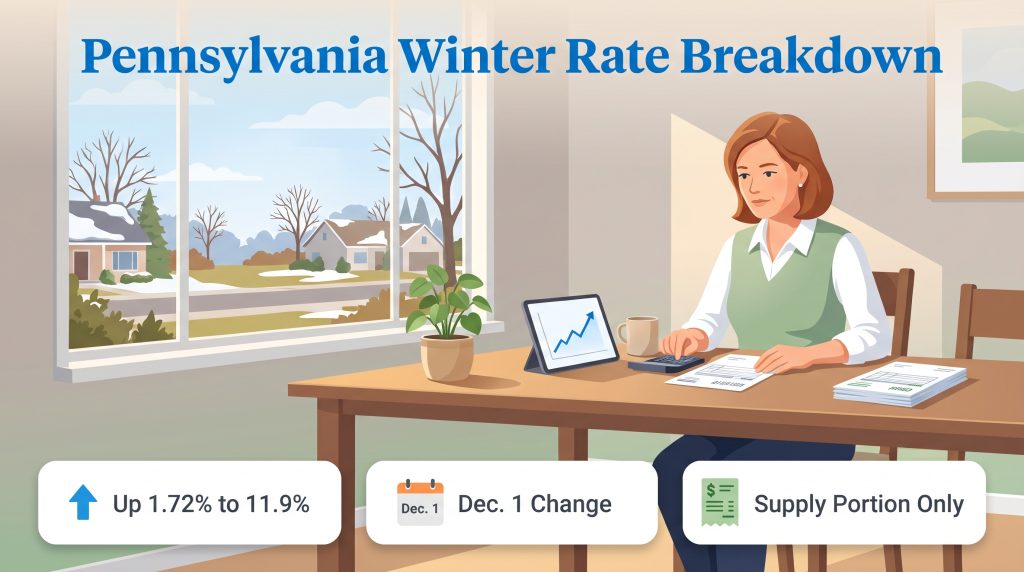
Every six months, Pennsylvania electric utilities adjust their Price to Compare, which is the per-kilowatt-hour rate you pay for electricity generation and transmission if you stay on default service. According to the Pennsylvania Public Utility Commission (PUC), statewide default residential supply rates are rising between 1.72% and 11.9% on Dec. 1, 2026.
The table below shows how the new winter rates affect typical residential and small-business customers across the five major utilities.
| Utility | Previous Residential PTC | New Residential PTC (Dec. 1, 2026 to May 31, 2027) | Percentage Increase | Est. Monthly Supply Hike (1,000 kWh) | Small Commercial PTC Change |
| PPL Electric Utilities | 13.079¢/kWh | 14.428¢/kWh | +10.3% | +$13.49/month | Adjusting Dec. 1 |
| Met-Ed | 13.951¢/kWh | 14.422¢/kWh | +3.4% | +$4.71/month | 12.864¢ to 13.882¢/kWh (+7.9%) |
| Penn Power | 13.477¢/kWh | 13.893¢/kWh | +3.1% | +$4.16/month | 13.729¢ to 18.350¢/kWh (+33.66%) |
| Duquesne Light (DLC) | 14.14¢/kWh | 14.56¢/kWh | +2.97% | +$4.20/month (+$2.49 at 600 kWh) | 10.88¢ to 11.18¢/kWh (+2.76%) |
| Penelec | 13.143¢/kWh | 13.564¢/kWh | +3.2% | +$4.21/month | 13.140¢/kWh |
Keep in mind that your PTC only covers the supply portion of your bill, which typically accounts for 40% to 60% of your total monthly charges. Delivery charges, fixed customer fees, and taxes are billed separately by your local utility.
Pennsylvania Counties and Cities Impacted by the Winter Rate Changes
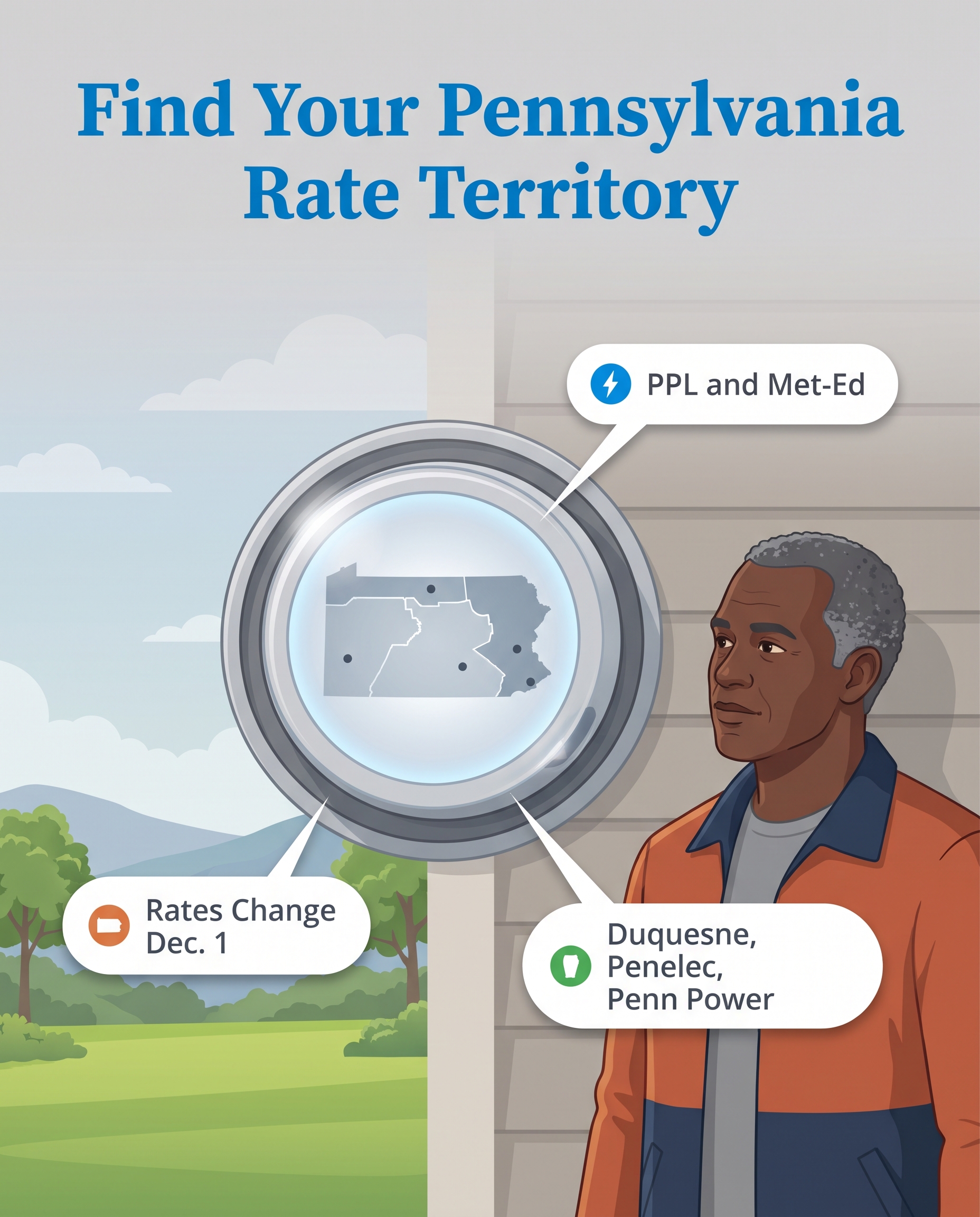
These five utilities serve millions of households and small businesses across almost every corner of the commonwealth. Knowing which service territory you live in helps you benchmark your exact rate before winter heating demand peaks.
Central and Eastern Pennsylvania: PPL Electric Utilities and Met-Ed
PPL Electric Utilities serves residential and commercial customers across central and eastern Pennsylvania, including major hubs like Allentown, Harrisburg, Lancaster, Scranton, and Wilkes-Barre. For PPL households, this 10.3% supply increase lands just five months after a July 1, 2026 base distribution hike that added $6.48 per month at 1,000 kWh and pushed a typical bill past $220 per month once the new winter supply rate takes effect. The one silver lining for PPL customers is that base distribution rates remain frozen for at least two years under the utility’s 2026 settlement.
Met-Ed, a FirstEnergy Pennsylvania utility, covers eastern and south-central Pennsylvania, including Reading, York, Easton, Lebanon, and Bethlehem. Its residential PTC has nearly doubled over the past five years, and households in Reading averaging 930 kWh per month now face roughly $134.12 in monthly supply charges alone. Local small businesses in Met-Ed territory also face a 7.9% jump in default commercial supply costs.
Western and Northern Pennsylvania: Duquesne Light, Penelec, and Penn Power
Duquesne Light Company serves more than 600,000 customers across Pittsburgh and surrounding Allegheny and Beaver counties. While its 2.97% increase adds roughly $2.49 per month for a typical 600 kWh household, the new 14.56¢/kWh default rate is the highest residential PTC in Pennsylvania.
Penelec, another FirstEnergy utility, serves roughly 600,000 customers across 31 counties in western, northern, and central Pennsylvania, including Erie, Altoona, State College, and Johnstown. Its 3.2% rise to 13.564¢/kWh adds $4.21 per month at 1,000 kWh, or $8.42 per month for all-electric homes using 2,000 kWh in winter.
Penn Power covers western Pennsylvania communities including New Castle, Sharon, Hermitage, and Cranberry Township. While residential customers see a 3.1% supply bump to 13.893¢/kWh, small businesses in Penn Power territory face a steep 33.66% commercial PTC spike to 18.350¢/kWh. Neighboring Pennsylvania utilities — including PECO (+10.3%) and West Penn Power (+2.6%) — are also raising default rates on Dec. 1, 2026.
Why Pennsylvania Electricity Supply Rates Keep Climbing
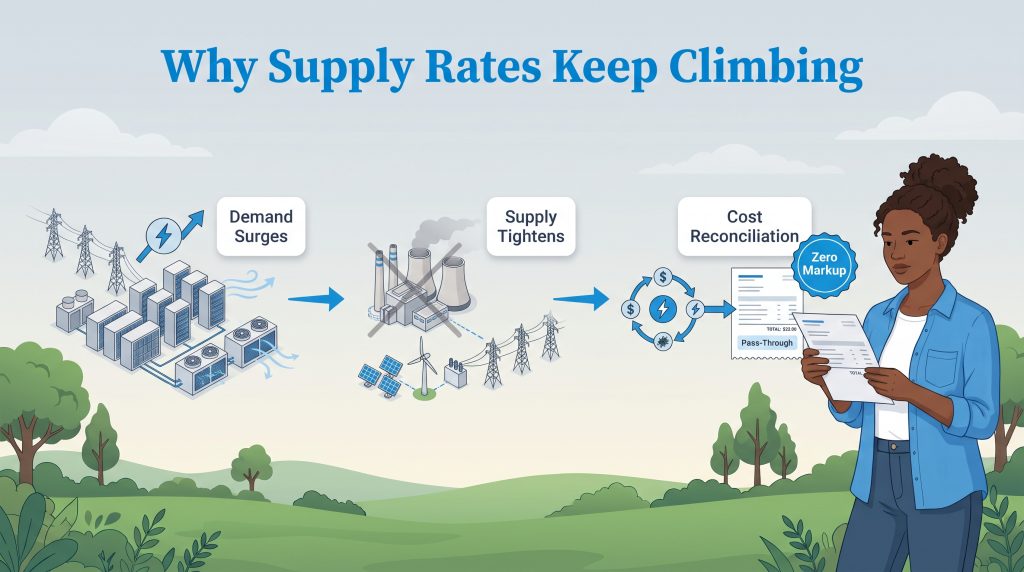
Neither your local utility nor FirstEnergy profits from Price to Compare increases. Under Pennsylvania PUC rules, utilities buy electricity on the wholesale market through competitive auctions and pass those exact costs straight through to default customers with zero markup.
Several broader forces are driving those wholesale prices higher right now:
- Data center and AI power demand: Rapid growth from artificial intelligence infrastructure and hyperscale data centers across the PJM Interconnection regional grid is outpacing new power plant construction, pushing wholesale capacity auction prices to record highs.
- Power plant retirements: Older fossil-fuel generators are retiring faster than replacement projects can connect to the regional grid, tightening available supply during peak winter and summer demand.
- Higher auction clearing prices and true-ups: As older, lower-cost supply contracts expire, utilities must replace them at current market rates while recovering prior under-collections through reconciliation charges.
According to U.S. Energy Information Administration (EIA) monthly electricity data, Pennsylvania’s average all-in residential electricity price reached 21.77¢/kWh in August 2026, well above the national average of 18.16¢/kWh. That gap makes proactive bill management even more important heading into winter.
How to Lower Your Bill in Pennsylvania’s Deregulated Market
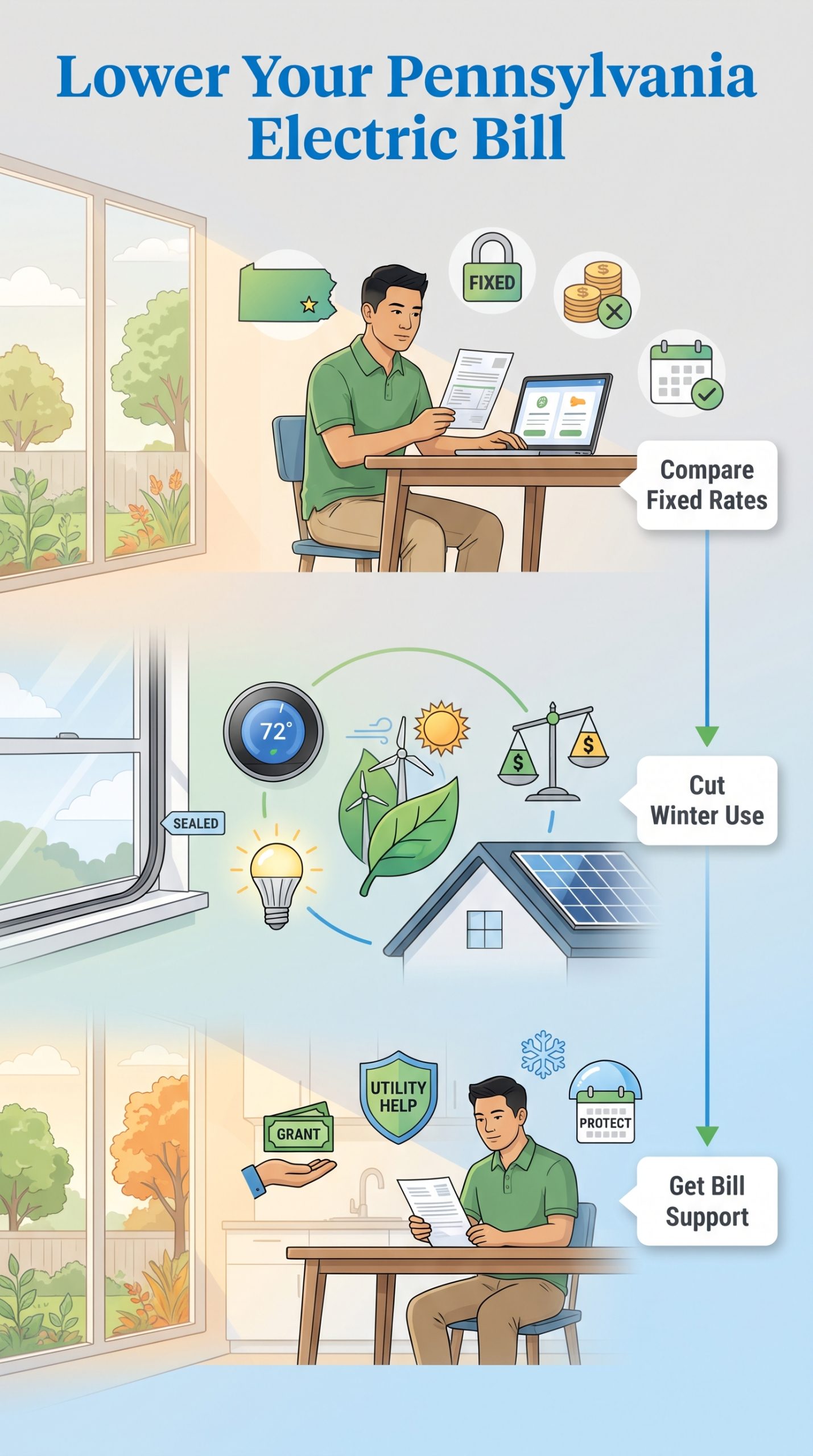
Because Pennsylvania has a deregulated electricity market, you don’t have to accept your utility’s default supply rate. You can choose a licensed third-party electric generation supplier while your local utility continues maintaining power lines, reading your meter, and responding to outages.
Compare Fixed Rates Carefully on PA Power Switch
Start by checking your current supply rate on your monthly bill and comparing offers on the official PAPowerSwitch.com electricity shopping portal against your utility’s new Dec. 1 PTC. Look for 12-month fixed-rate plans with $0 monthly fees and $0 early termination fees. If you live in a FirstEnergy territory (Met-Ed, Penn Power, or Penelec), keep your 20-digit customer number from page three of your bill handy when enrolling.
Be cautious before signing up, though. Duquesne Light reported in June 2026 that nearly 80% of its customers using third-party suppliers actually overpaid by an average of $17 per month, often because introductory fixed rates rolled over into costly variable plans. Always set a calendar reminder 30 days before your contract ends — Pennsylvania waives early cancellation fees during the final 30 days of a contract, and you always get a three-business-day rescission window after enrolling.
Choose Eco-Conscious Alternatives and Energy-Saving Options
Shopping in a deregulated market also lets you pick an environmentally mindful choice. Many competitive suppliers offer 100% renewable energy plans aligned with EPA Green Power standards at rates competitive with default utility service.
Cutting your overall winter usage delivers guaranteed savings regardless of your supplier:
- Schedule a home energy audit: Duquesne Light offers no-cost home energy audits, and income-eligible FirstEnergy customers can use the WARM Program for free attic insulation, LED lighting, and inefficient appliance replacements.
- Upgrade to ENERGY STAR gear: Swapping an older thermostat for an ENERGY STAR certified smart thermostat and sealing drafty doors or windows can trim winter heating usage by 8% to 15%.
- Enroll in Budget Billing: All five utilities offer levelized monthly payment plans that smooth out winter heating spikes across 12 predictable bills.
- Evaluate rooftop solar: Higher default supply rates shorten solar payback timelines, and Pennsylvania’s net metering rules credit homeowners for excess electricity sent back to the grid.
Tap Into Winter Assistance and Shutoff Protections
If higher heating and electric bills are stretching your household budget, state and utility programs are open right now. Pennsylvania’s Low Income Home Energy Assistance Program (LIHEAP) runs from Nov. 2, 2026 through April 23, 2027, offering $200 to $1,000 in cash grants plus crisis grants up to $1,000 for households at or below 150% of the Federal Poverty Level ($23,940 for an individual or $49,500 for a family of four). You can apply online through the Pennsylvania Department of Human Services COMPASS portal or by calling 1-866-857-7095.
You can also enroll in utility-run Customer Assistance Programs (CAP for Duquesne Light, PCAP for FirstEnergy utilities, and OnTrack for PPL) or request Dollar Energy Fund hardship grants. In addition, Pennsylvania’s winter disconnection moratorium protects eligible households at or below 250% of the Federal Poverty Level from utility shutoffs between Dec. 1, 2026 and March 31, 2027, though unpaid balances still accrue and must be addressed before April 1.
Plan Ahead to Keep Your Pennsylvania Electric Bill Manageable
Higher default electricity rates are a reality across Pennsylvania this winter, from PPL’s 10.3% jump in the east to Duquesne Light’s 14.56¢/kWh benchmark in Pittsburgh. By checking your utility’s new Price to Compare, locking in a transparent fixed-rate plan or eco-conscious alternative when the math works, and taking advantage of energy-saving upgrades or LIHEAP grants, you can stay ahead of rising grid costs. We recommend reviewing your supply rate twice a year — right before the June 1 and Dec. 1 resets — so your household never gets caught off guard.
About the Author

Claudio is a sustainability-focused writer with a background in Anthropology and Psychology from NC State University. He has spent over 15 years working in writing, interpretation, and translation, driven by a deep interest in how human culture shapes the environment. Today, he shares his curiosity with readers by writing about sustainable living solutions and the connection between everyday choices and environmental impact.