
How the Authorized 3% Delivery Charge Elevation Affects Southwestern Pennsylvania Households
Key Takeaways
- A newly implemented 3% base distribution rate increase adds approximately $3 per month, or roughly $35 annually, to the average household bill.
- Pennsylvania’s deregulated electric supply market lets you shop for lower generation rates, though distribution delivery charges remain non-negotiable.
- The revenue increase directly funds critical grid modernization, pole replacements, and substation hardening projects across southwestern Pennsylvania.
If you open your electric bill this month in southwestern Pennsylvania, you will notice delivery charges climbing slightly higher across the board. On Oct. 23, 2026, regional regulatory trackers confirmed the implementation of an authorized 3% base distribution rate adjustment by Duquesne Light Company, impacting approximately 600,000 residential accounts in Allegheny and Beaver counties. While a $3 monthly elevation might seem manageable in isolation, it marks another chapter in a decade-long series of capital investments aimed at overhauling aging local power infrastructure. We have sifted through the regulatory filings, rate schedules, and market rules to bring you the comprehensive details on what is changing, why you cannot bypass these charges through supplier switching, and how you can optimize your total energy expenses to keep your monthly budget balanced.
Breaking Down the Rate Hike and Bill Impact
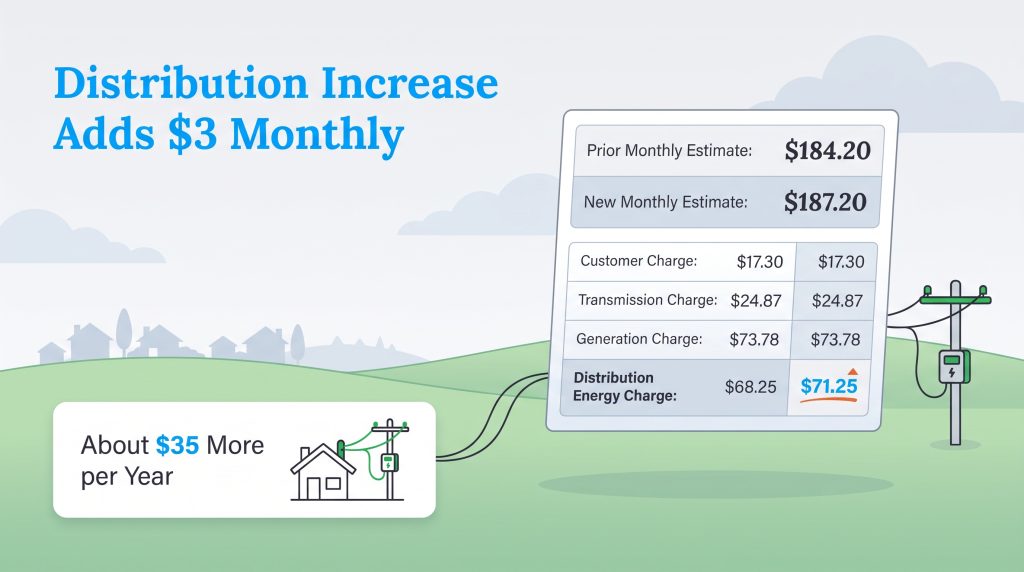
The approved rate adjustment focuses squarely on Duquesne Light’s distribution revenue requirement, which pays for the local poles, wires, meters, and customer services that carry power directly to your door. For an average residential customer using between 600 and 700 kilowatt-hours (kWh) of electricity each month, this 3% distribution revenue elevation translates to an extra $3 on your statement every 30 days, totaling roughly $35 per year.
Delivery Charges vs. Generation Supply Charges
To understand why this increase appears on your bill, it helps to look at how your electric charges are structured. Your monthly statement is divided into distinct segments:
- Customer Charge: A fixed monthly administrative charge that covers meter reading, billing operations, and basic account maintenance. This charge remains static regardless of how many kilowatt-hours you consume during the billing period.
- Distribution Energy Charge: A volumetric, per-kWh charge that funds the maintenance and operation of the local low-voltage delivery network. This is the specific line item elevated by the recent rate adjustment.
- Transmission Charge: A federally regulated fee covering the transit of high-voltage electricity from regional power generation plants to Duquesne Light’s local substations.
- Generation Supply Charge: The actual cost of the electrical commodity itself. If you have not selected an alternative retail supplier, you pay Duquesne Light’s default Price to Compare rate.
| Bill Component | Role in Electric Service | Prior Monthly Estimate | New Monthly Estimate | Estimated Change |
| Customer Charge | Fixed administrative and meter maintenance fee | $13.00 | $13.00 | $0.00 |
| Distribution Energy Charge | Local delivery per kWh across neighborhood poles and wires | ~$68.25 | ~$71.25 | +$3.00 (~3%) |
| Transmission & Riders | High-voltage grid transit and state-mandated programs | ~$11.05 | ~$11.05 | $0.00 |
| Generation Supply (PTC) | Cost of electricity commodity (~650 kWh default supply) | ~$91.90 | ~$91.90 | $0.00 |
| Total Estimated Statement | Combined monthly total for typical household usage | ~$184.20 | ~$187.20 | +$3.00 (~1.6% total bill impact) |
Regional Breakdown: Impacted Counties, Communities, and Service Territory
Duquesne Light’s service footprint stretches across an 817-square-mile corridor in southwestern Pennsylvania, encompassing dense urban centers, historic riverfront mill towns, and expansive suburban communities. Because this base distribution adjustment is a universal utility-wide tariff change approved by the Pennsylvania Public Utility Commission (PUC), every single residential customer within this designated territory is subject to the new distribution rates.
Allegheny County Municipalities
Allegheny County represents the vast majority of Duquesne Light’s customer base, spanning over 500,000 meters. The rate adjustment applies across all 130 municipalities within the county boundaries where Duquesne Light provides retail delivery, including:
- The City of Pittsburgh: Including Downtown, Oakland, Shadyside, and all surrounding urban neighborhoods.
- South Hills Suburbs: Communities including Bethel Park, Mount Lebanon, Upper St. Clair, Baldwin, and Whitehall.
- North Hills Communities: Municipalities such as Ross Township, McCandless, Shaler, and Hampton Township.
- Mon Valley and Eastern Suburbs: Residential centers including Penn Hills, Monroeville, McKeesport, Plum, and West Mifflin.
- Western Suburbs: Growing residential corridors throughout Moon Township, Robinson Township, and Findlay Township.
Beaver County Municipalities
In southern and central Beaver County, approximately 100,000 residents and businesses rely on Duquesne Light for daily electrical delivery. Communities affected by this distribution rate change include:
- Riverfront Municipalities: Historic industrial and residential hubs including Aliquippa, Ambridge, Beaver Falls, and Rochester.
- Central and Suburban Communities: Fast-growing residential pockets across Monaca, Center Township, Hopewell Township, Baden, Economy, and New Brighton.
Why Duquesne Light Has Increased Delivery Rates Since 2016
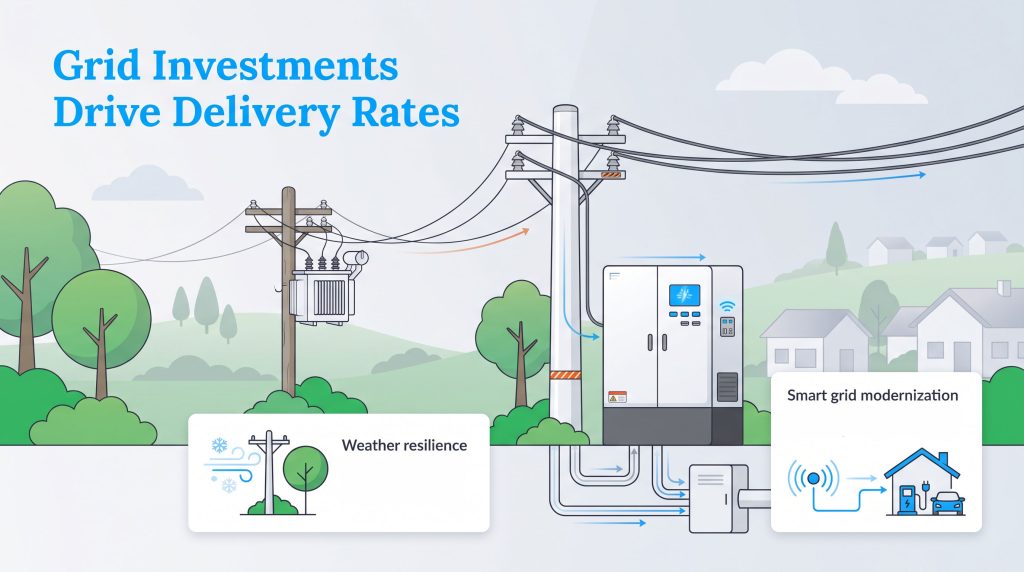
This latest adjustment continues a sustained, decade-long cycle of capital investment programs launched by Duquesne Light in 2016. Western Pennsylvania features some of the oldest electrical infrastructure in the country, requiring substantial and ongoing capital infusions to harden physical assets against severe weather events and meet evolving residential power demands.
Hardening the Grid Against Severe Weather
Southwestern Pennsylvania regularly experiences severe winter storms, heavy freeze-thaw cycles, and summer convective windstorms that can bring down mature tree canopies. Rate case capital has been dedicated to replacing aging wooden utility poles with reinforced ductile iron and composite alternatives, expanding clearance zones through proactive vegetation management, and moving vulnerable overhead lines to underground conduits in dense neighborhoods.
Substation Modernization and Transformer Replacement
Dozens of distribution substations across Allegheny and Beaver counties originally entered service more than 50 years ago. Duquesne Light’s modernization program systematically retires obsolete transformers, installs digital microprocessor relays, and expands physical substation capacity to accommodate increased electrical load from residential heat pumps and electric vehicle home chargers.
Digital Automation and Smart Grid Sensors
Capital funds have also supported the rollout of automated feeder switches, known as Fault Location, Isolation, and Service Restoration (FLISR) technology. These smart sensors detect line disruptions instantly and re-route power around damaged sections in seconds rather than hours, dramatically reducing the duration and geographic scope of local neighborhood blackouts.
Navigating Pennsylvania’s Deregulated Energy Market
Understanding the mechanics of Pennsylvania’s deregulated energy landscape is vital when evaluating your utility costs. Because the Commonwealth separated utility monopolies from energy commodity generation in the late 1990s, you hold the legal right to purchase your energy from competitive retail providers while relying on your incumbent utility for delivery.
In Pennsylvania’s deregulated electric market, you can shop for your generation supply through the state-sanctioned PAPowerSwitch directory, choosing from dozens of licensed electric generation suppliers offering fixed-rate, variable-rate, or 100% renewable energy contracts. However, energy choice only applies to the generation portion of your bill. The distribution grid remains an exclusive, fully regulated monopoly operated by Duquesne Light under the oversight of state regulators. As a result, you cannot avoid the recent 3% distribution rate increase by switching suppliers, because Duquesne Light delivers the electricity across physical wires regardless of who generates the power. Nonetheless, securing an electric supply rate lower than Duquesne Light’s default Price to Compare can easily save $5 to $15 monthly, effectively wiping out the distribution hike.
Pennsylvania also operates a deregulated natural gas market, giving homeowners the ability to shop for natural gas supply independently from local distribution utilities like Peoples Natural Gas or Columbia Gas of Pennsylvania. While natural gas delivery pipelines remain strictly regulated utility monopolies, you can use the state’s PAGasSwitch platform to compare certified retail suppliers, lock in competitive commodity prices, and shield your winter heating bills from seasonal price spikes. Because winter heating accounts for a massive share of total household energy expenditures in southwestern Pennsylvania, optimizing your natural gas contract provides another powerful lever to offset broader electrical utility increases across your annual home budget.
Practical Ways to Lower Your Monthly Utility Expenses
Even though base distribution tariffs are mandatory, you retain complete authority over how many kilowatt-hours your home consumes each billing cycle. Trimming consumption through low-impact lifestyle habits and environmentally mindful upgrades is the most sustainable path to lowering your overall energy statement.
High-Impact Energy Efficiency Upgrades
- Smart Thermostat Automation: Installing an ENERGY STAR certified smart thermostat allows you to schedule heating and cooling setbacks while you sleep or work away from home, trimming annual HVAC electricity consumption by up to 8%.
- Comprehensive Air Sealing: Older architectural homes throughout Pittsburgh and Beaver County often suffer from high air leakage. Sealing rim joists, attic hatches, and exterior door thresholds prevents conditioned air from escaping, noticeably reducing heat pump or air conditioning runtimes.
- LED Lighting and Smart Power Strips: Swapping out remaining incandescent or halogen bulbs for modern LEDs cuts lighting load by up to 85%, while smart power strips eliminate phantom energy draw from home entertainment centers and desktop computers.
Utility Rebates and Assistance Programs
Duquesne Light offers residential rebates through its Watt Choices program, helping homeowners offset the purchase price of high-efficiency heat pumps, ENERGY STAR refrigerators, and smart thermostats. If rising utility bills create significant financial strain, income-qualified households can apply for the Low Income Home Energy Assistance Program (LIHEAP) or enroll in Duquesne Light’s Customer Assistance Program (CAP), which provides discounted monthly payments and arrearage forgiveness to help families manage essential utility costs.
Proactive Steps for Pittsburgh Homeowners Facing Rising Delivery Costs
Rate adjustments like Duquesne Light’s latest 3% distribution elevation remind us that grid reliability and modernization come with direct consumer costs. While an additional $35 per year will not break every household budget, utility expenses can quickly compound when paired with broader economic pressures and seasonal cooling or heating demands. By understanding the distinct line items on your statement, leveraging Pennsylvania’s deregulated energy shopping platforms, and implementing eco-conscious home efficiency measures, you can comfortably protect your household budget from rising delivery rates. We encourage you to inspect your electric bill this month, compare your current generation supplier to the latest Price to Compare, and explore energy-saving improvements that keep your home comfortable and sustainable all year long.
About the Author

Claudio is a sustainability-focused writer with a background in Anthropology and Psychology from NC State University. He has spent over 15 years working in writing, interpretation, and translation, driven by a deep interest in how human culture shapes the environment. Today, he shares his curiosity with readers by writing about sustainable living solutions and the connection between everyday choices and environmental impact.