
Choosing the right green energy provider in Texas comes down to how they source their power, plan structures, and your home’s average usage.
Key Takeaways
- Gexa Energy excels in straightforward plans that utilize Renewable Energy Certificates to guarantee your electricity usage is offset by green power.
- Chariot Energy focuses heavily on Texas-sourced solar messaging, making it an environmentally mindful choice for keeping your energy dollars local.
- Always check the Electricity Facts Label (EFL) to bypass marketing gimmicks and calculate your actual estimated bill based on your home size.
Navigating the deregulated utility market can feel incredibly stressful, but a direct Gexa Energy vs. Chariot Energy comparison cuts through the noise. We created this comprehensive guide to help you find the best 100% renewable energy providers Texas has to offer without falling for confusing marketing traps. Whether you are buying a house or renting an apartment, our updated 2026 review helps you confidently analyze rate plan structures, local solar benefits, hidden fees, and real-world costs so you can make a smart, eco-conscious choice for your household.

- 7.3¢ /kWh
- 100%
- 60 days
- 12-36 Months
- Committed to Renewable Energy

- 7.1¢ /kWh
- 100%
- None
- 3-36 Months
- 100% Solar-Powered Electricity
*rates may vary by location and household usage
Quick Take: Gexa or Chariot?
If you want to quickly evaluate a Texas green energy plans comparison, understanding the core strengths of each provider is the best place to start. Review the breakdown below to see how these companies compare on corporate backing, renewable sourcing approaches, and standout features like EV benefits.
| Feature | Gexa Energy | Chariot Energy |
|---|---|---|
| Parent Company | NextEra Energy (Utility-scale wind and solar) | Hanwha Group / Qcells (Solar manufacturing) |
| Power Source | National Renewable Energy Certificates (RECs) | 100% Texas-sourced solar energy |
| PUC Rating | Top-tier / Historically low complaints | Highly competitive / Low complaints |
| Typical Rate Structure | Fixed-rate with targeted usage bill credits | Fixed-rate with straightforward pricing tiers |
| Solar Buyback Available | Yes (limited scope) | Yes (generous net metering) |
| EV Charging Incentives | Yes (excellent off-peak overnight plans) | Minimal / Standard rates apply |
| Best For | Bill credits, simple term lengths, and EV owners | Rooftop solar homeowners and local grid support |
Corporate Reality: Who Actually Powers These Companies?
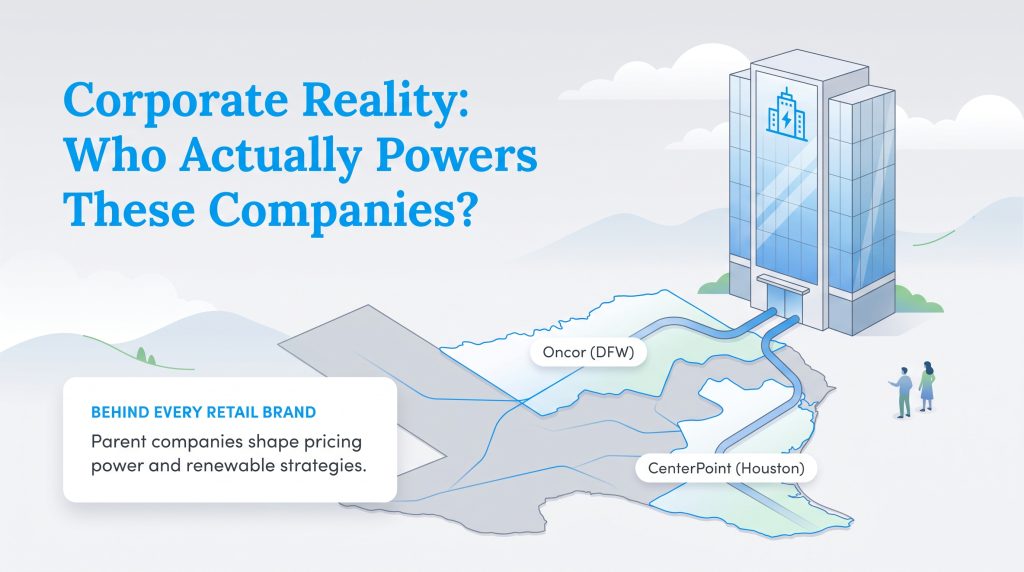
To establish true trust with a retail electric provider, you need to look behind the brand name at the corporate infrastructure powering them. In Texas, retail providers operate within distinct Transmission and Distribution Service Provider (TDSP) territories like Oncor (Dallas–Fort Worth) and CenterPoint Energy (Houston). Because these companies must purchase power from the grid to sell to you, their parent companies dictate their pricing power and renewable strategies.
Renewable Energy Power Sourcing
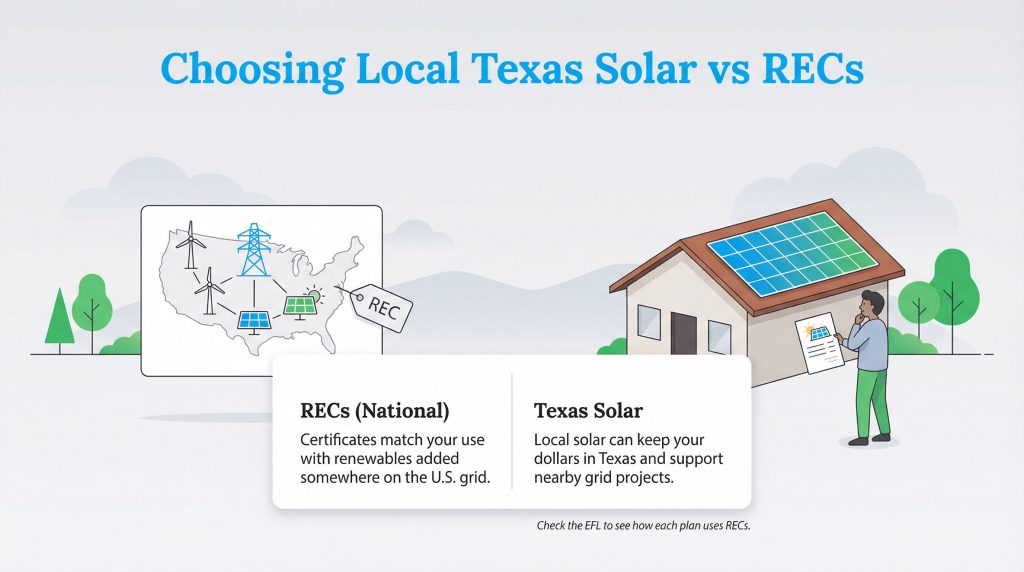
Gexa Energy operates as a retail subsidiary of NextEra Energy Resources, one of the world’s largest generators of wind and solar power. Because NextEra owns massive utility-scale wind farms, Gexa can efficiently purchase Renewable Energy Certificates (RECs) at an incredible scale. Essentially, for every kilowatt-hour you use, Gexa applies a certificate proving that an equivalent amount of renewable energy was added to the national grid somewhere in the country.
Conversely, Chariot Energy is backed by the Hanwha Group, specifically their Qcells division — a globally recognized leader in solar panel manufacturing. This vertical integration means Chariot isn’t just buying paper certificates; they are utilizing an ecosystem of physical solar farms built with their parent company’s technology. Chariot markets plans that are 100% tied to Texas-sourced solar energy, meaning your utility payments directly fund the expansion of utility-scale solar infrastructure across the local ERCOT grid.
Plan Types and Tiered Rate Comparison
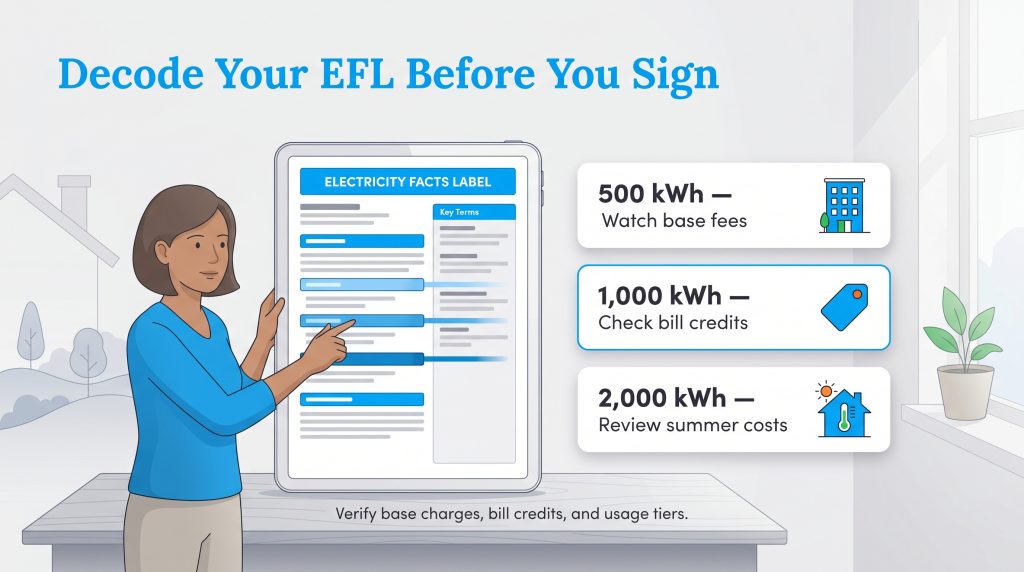
When analyzing Gexa vs Chariot electricity rates, your home size and seasonal consumption habits will dictate the actual price you pay. Providers are required to standardize the fixed-rate electricity plans Texas households consume into three specific tiers on the Electricity Facts Label (EFL). Reviewing this document helps you bypass the flashy marketing and see the actual math.
| Usage Tier | Household Profile | Gexa Energy Approach | Chariot Energy Approach |
|---|---|---|---|
| 500 kWh | Apartments & Small Homes | Often includes standard base fees; rates can seem higher if you miss bill credit thresholds. | Frequently uses flat-tier pricing, providing straightforward costs without penalizing low usage. |
| 1,000 kWh | Mid-Sized Homes | The sweet spot for Gexa’s plans; many bill credits activate precisely here, dropping the effective rate. | Maintains linear, transparent pricing that scales naturally without sudden billing surprises. |
| 2,000 kWh | Large Homes & Summer AC | Offers highly competitive flat-rate energy charges designed for heavy summer consumption. | Ideal for families wanting to offset massive summer AC demands with locally sourced solar. |
| Plan Name | Rate /kWH | Plan Term | Cancellation Fee | |
|---|---|---|---|---|
| Gexa Eco Saver Plus 12 | 7¢ | Month to Month | N/A | Check Availability |
| Gexa Saver Plus 12 | 7.3¢ | Month to Month | N/A | Check Availability |
| Gexa Eco Saver Plus 14 | 7.5¢ | 14 Months | $150 | Check Availability |
| Gexa Eco Saver Plus 24 | 8.4¢ | Month to Month | N/A | Check Availability |
| Gexa Eco Choice 3 | 11¢ | 3 Months | $150.00 | Check Availability |
| Gexa Eco Choice 8 | 11.2¢ | 8 Months | $150.00 | Check Availability |
| Gexa Eco Choice 12 | 13.8¢ | 12 Months | $150.00 | Check Availability |
| Gexa Prime Preferred 24 Plan | 13.9¢ | 24 Months | $295.00 | Check Availability |
| Gexa Prime Preferred 12 Plan | 14.4¢ | 12 Months | $150.00 | Check Availability |
| Gexa Eco Saver Value 12 | 15.1¢ | Month to Month | N/A | Check Availability |
| Gexa Light Saver 12 | 15.3¢ | Month to Month | N/A | Check Availability |
| Gexa Saver Edge 12 | 15.4¢ | Month to Month | N/A | Check Availability |
| Gexa Straight Saver 24 | 18¢ | 24 Months | $295.00 | Check Availability |
| Gexa Eco Saver Advantage 12 | 18.1¢ | Month to Month | N/A | Check Availability |
| Gexa Freedom 12 | 18.4¢ | 12 Months | $150.00 | Check Availability |
| Gexa Eco Saver Lite 12 | 18.9¢ | Month to Month | N/A | Check Availability |
| Gexa Eco Saver Premier 12 | 18.9¢ | Month to Month | N/A | Check Availability |
| Gexa Eco Saver Premier 24 | 19¢ | Month to Month | N/A | Check Availability |
| Gexa Saver Freedom 24 | 19.1¢ | 24 Months | $295.00 | Check Availability |
| Gexa Straight Saver 12 | 19.5¢ | 12 Months | $150.00 | Check Availability |
| Gexa Saver Freedom 36 | 19.8¢ | Month to Month | N/A | Check Availability |
| Gexa Prime Preferred Plus 24 | 21.4¢ | 24 Months | $295.00 | Check Availability |
| Gexa Prime Preferred Plus 12 | 21.7¢ | 12 Months | $150.00 | Check Availability |
| Plan Name | Rate /kWH | Plan Term | Cancellation Fee | |
|---|---|---|---|---|
| GridPlus 12 | 6.6¢ | 100 Months | $12 | Check Availability |
| GridPlus 15 | 7.1¢ | Month to Month | N/A | Check Availability |
| GridPlus 13 | 7.2¢ | Month to Month | N/A | Check Availability |
| GridPlus 24 | 7.7¢ | Month to Month | N/A | Check Availability |
| GridPlus 18 | 8.3¢ | 18 Months | $15.00 | Check Availability |
| GridPlus 36 | 8.4¢ | Month to Month | N/A | Check Availability |
| Bright Nights 12 | 11.1¢ | 12 Months | $15 per remaining month | Check Availability |
| Bright Nights 24 | 11.7¢ | 24 Months | $15 per remaining month | Check Availability |
| Bright Nights 8 | 11.7¢ | 8 Months | $15 per remaining month | Check Availability |
| Chariot Choice 24 | 13.1¢ | 24 Months | $99.00 | Check Availability |
| Chariot Choice 36 | 13.5¢ | 36 Months | $99.00 | Check Availability |
| Solarize 12 | 14.1¢ | Month to Month | N/A | Check Availability |
| Free Nights 12 | 14.5¢ | Month to Month | N/A | Check Availability |
| Free Days 12 | 14.5¢ | Month to Month | N/A | Check Availability |
| Bright Nights 36 | 14.6¢ | 36 Months | $15 per remaining month | Check Availability |
| Free Nights 18 | 14.8¢ | Month to Month | N/A | Check Availability |
| Free Nights 36 | 14.9¢ | Month to Month | N/A | Check Availability |
| Free Nights 24 | 14.9¢ | Month to Month | N/A | Check Availability |
| Solarize 36 | 15¢ | Month to Month | N/A | Check Availability |
| Free Nights 15 | 15¢ | Month to Month | N/A | Check Availability |
| Free Days 24 | 15.1¢ | Month to Month | N/A | Check Availability |
| Free Days 18 | 15.1¢ | Month to Month | N/A | Check Availability |
| Free Days 36 | 15.2¢ | Month to Month | N/A | Check Availability |
| Solarize 24 | 15.2¢ | Month to Month | N/A | Check Availability |
| Free Days 15 | 15.4¢ | Month to Month | N/A | Check Availability |
| Chariot Freedom | 15.5¢ | Month to Month | $0.00 | Check Availability |
| FreeDays 36 | 16.1¢ | 36 Months | $15.00 | Check Availability |
| GridMax 15 | 18.9¢ | Month to Month | N/A | Check Availability |
| PowerBank 24 | 19.1¢ | Month to Month | N/A | Check Availability |
| GridMax 12 | 19.1¢ | Month to Month | N/A | Check Availability |
| GridMax 18 | 19.3¢ | Month to Month | N/A | Check Availability |
| GridMax 36 | 19.6¢ | Month to Month | N/A | Check Availability |
| GridMax 24 | 20¢ | Month to Month | N/A | Check Availability |
Calculating Real-World Costs
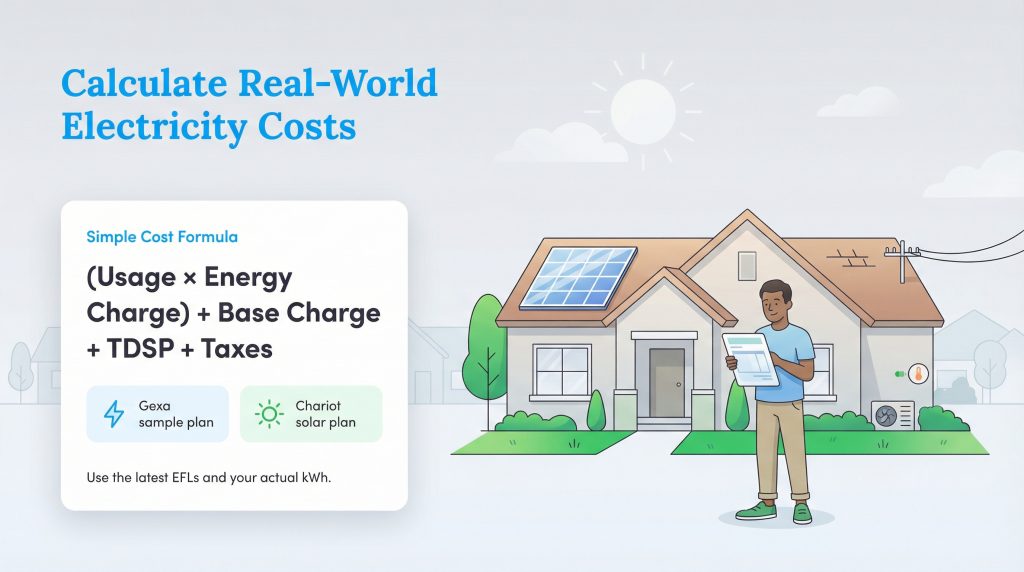
Instead of relying on estimated averages, you should always calculate your exact anticipated costs. Take a summer bill where you use 2,000 kWh of electricity to keep the air conditioning running. Using the EFL, apply this formula: (Usage × Energy Charge) + Base Charge + TDSP Delivery Charges + Taxes and Fees. Plugging your usage into this formula reveals exactly whether Gexa’s bill credits or Chariot’s localized solar power yields the lowest monthly payment.
Solar Buybacks, Batteries, and EV Charging Plans
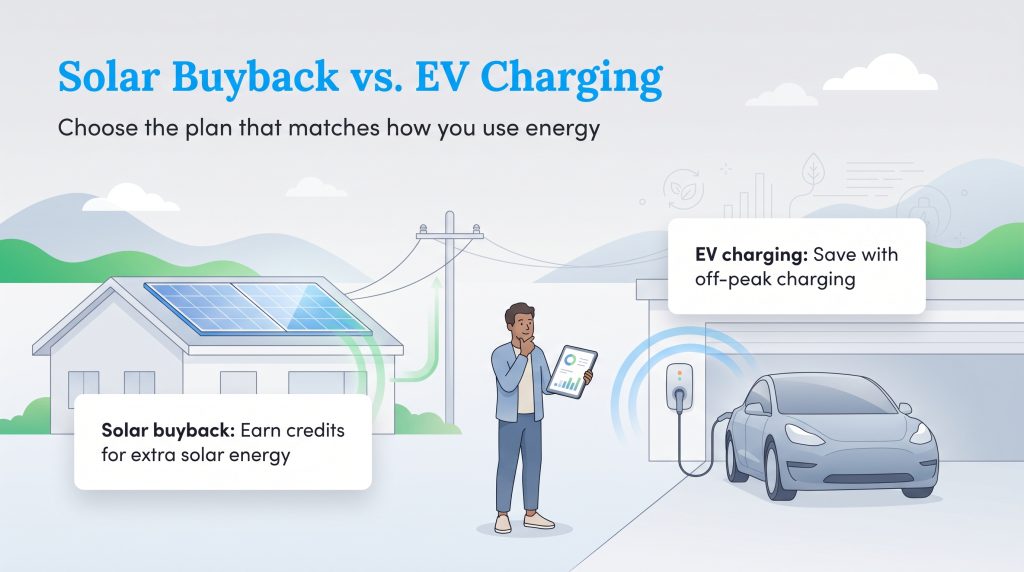
If you already have solar panels installed on your roof, a Chariot Energy solar buyback program offers a fantastic way to monetize your excess generation. Through their generous net metering structures, Chariot purchases the surplus electricity your panels produce during peak daylight hours. Rather than losing that generated power to the grid for free, you receive bill credits. Furthermore, because Chariot is deeply integrated with Qcells, they frequently offer battery reward incentives for homeowners utilizing solar storage, allowing you to maximize the value of your localized grid.
Conversely, for homeowners transitioning to electric vehicles, a dedicated Gexa Energy EV charging plan provides incredibly valuable off-peak incentives. Charging a car requires significant electricity, which can spike your monthly bills if you plug in right when you get home from work. Gexa structures their specialized plans to offer deeply discounted — or even 100% free — electricity during specific overnight windows. By simply scheduling your vehicle to charge while you sleep, you maximize your budget while utilizing renewable energy. Gexa also frequently bundles these plans with smart thermostat incentives to further optimize your home’s climate control.
Hidden Fees: Early Termination, Base Charges, and Usage Fees
Comparing advertised rates is only half the battle; the true cost of an electricity plan is often buried in the fee structure. To ensure your bill stays predictable, you must understand how Early Termination Fees (ETFs), Base Charges, and Usage Fees will impact your bottom line.
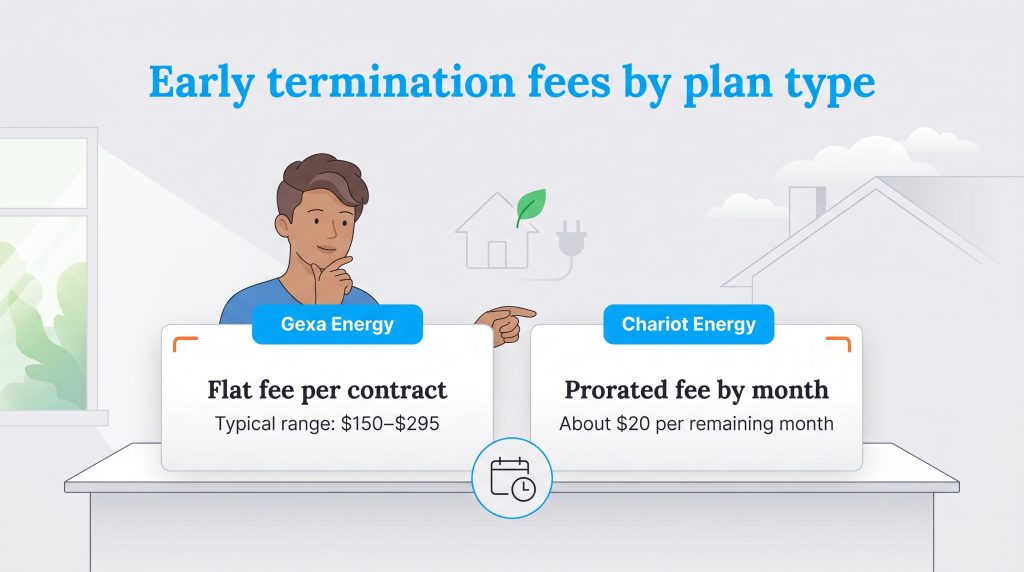
Every fixed-rate plan utilizes an ETF to discourage you from breaking your contract early when market rates drop. The Chariot Energy early termination fee is generally structured on a prorated basis, frequently charging $20 per remaining month left on your agreement. By contrast, Gexa Energy typically charges a flat fee to cancel your service early, which often ranges from $150 to $295, depending on whether you signed a 12, 24, or 36-month contract.
Beyond the ETF, you must closely monitor Base Charges and Usage Fees. A Base Charge is a flat monthly fee (often $4.95 to $9.95) applied to your bill simply for being an active customer, regardless of how much power you consume. This disproportionately impacts smaller apartments. Additionally, Usage Fees represent your actual price per kWh. In plans that utilize usage thresholds, failing to hit your required target (such as exactly 1,000 kWh) means your effective Usage Fee could skyrocket, erasing any advertised savings.
Setting Up Service for New Movers
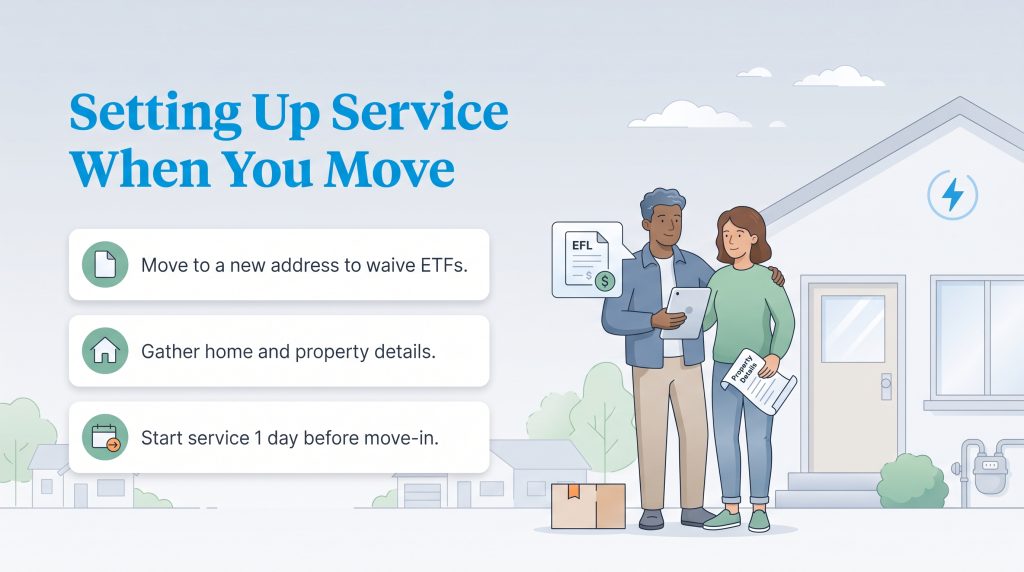
Fortunately, if you are relocating, both companies typically waive these ETFs entirely if you provide proof that you are permanently moving to a new address. When setting up service for a new home, you must gather your property details and thoroughly review the EFL for base charges. Finally, schedule your start date one day prior to move-in so the air conditioning is running when you arrive.
Customer Reviews and Texas PUC Ratings
Even the most affordable electricity plan loses its appeal if you can’t get someone on the phone to fix a billing error. When comparing customer feedback, looking at objective Texas utility PUC ratings provides a much clearer picture of reliability than reading isolated online rants.
The Public Utility Commission of Texas tracks formal complaints a company receives per 1,000 customers. This scorecard prevents massive providers from looking artificially worse just because they serve a larger volume of households. Gexa Energy reviews frequently highlight their long-standing reliability and simple online account management systems, consistently earning them top-tier marks and historically low complaint ratios on the state scorecard. The few complaints typically revolve around standard customer service hold times during peak moving seasons.
Chariot Energy also features a highly competitive PUCT standing. Their ratio benefits tremendously from their transparent, flat-tier pricing structures that naturally prevent the sudden billing surprises that lead to formal state complaints. Because their pricing is straightforward, their customer service teams deal with far fewer billing disputes.
Choosing the Right Texas Renewable Provider
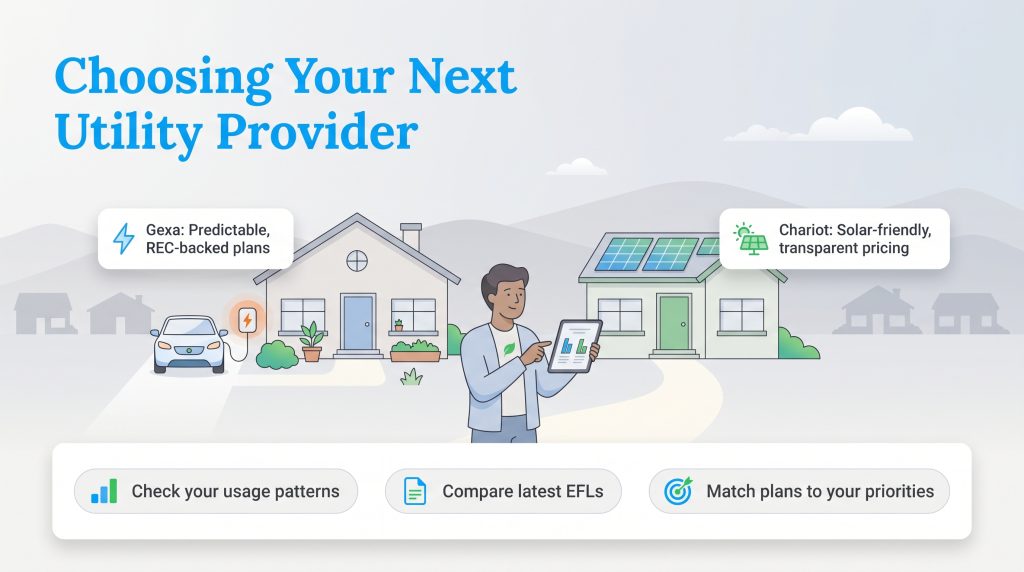
Choosing the winner in the Gexa vs. Chariot Energy debate comes down to how your household consumes power and which eco-friendly initiatives matter most to you. Both companies stand as premier Texas renewable electricity providers, but they serve very different niches in the deregulated market.
- Choose Gexa Energy if: You drive an electric vehicle and need robust overnight charging plans, you have highly predictable historical usage data that consistently hits 1,000 kWh bill credit thresholds, or you simply want straightforward, REC-backed power from a massive national supplier.
- Choose Chariot Energy if: You have rooftop solar panels and need a generous buyback program, you prefer highly transparent pricing tiers without usage gimmicks, or you specifically want your utility payments to fund local Texas solar farms.
Review your budget, thoroughly check the latest EFLs for hidden base charges, and you can confidently sign a contract knowing you made a smart, energy-saving choice for your home.
Frequently Asked Questions About Gexa Energy and Chariot Energy
Which provider has better solar buyback plans, Gexa or Chariot?
Does Chariot Energy require solar panels on my roof?
Do Gexa Energy and Chariot Energy require a credit check?
Why does my Texas electricity rate change based on my kWh usage?
How long does it take for electricity to turn on when moving?
Who actually maintains the power lines if an outage occurs?
About the Author

David has been an integral part of some of the biggest utility sites on the internet, including InMyArea.com, HighSpeedInternet.com, BroadbandNow.com, and U.S. News. He brings over 15 years of experience writing about, compiling and analyzing utility data.