

Understanding your local community choice aggregation program can help you compare costs, avoid bill confusion, and support cleaner energy.
Key Takeaways
- Community choice aggregation (CCA) is a local energy program that lets a city or county buy electricity supply for its residents.
- Your traditional utility company still delivers the electricity and maintains the power lines, even if your power is generated through a CCA.
- Customers in many programs are automatically enrolled, but you can typically opt out and return to your utility’s default supply option.
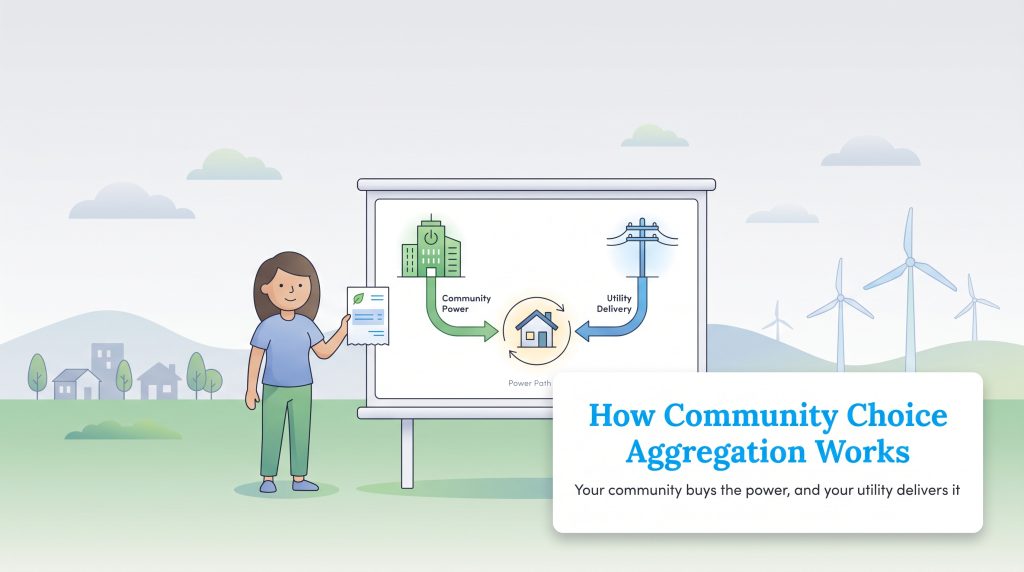
Community Choice Aggregation (CCA) is a local energy program where a city or county buys electricity in bulk for its residents. Also known as municipal aggregation or community choice energy, this model allows local leaders to negotiate competitive supply rates while your traditional utility continues delivering the power directly to your home. If you recently received a confusing letter in the mail about an automatic utility enrollment or noticed an unfamiliar supply fee on your statement, you aren’t alone. We know how frustrating it is to decipher unexpected billing changes. We are here to help you unpack exactly what community choice aggregation is, how to review your options, and whether participating makes sense for your household.
How Do CCAs Work? Generation Vs Delivery
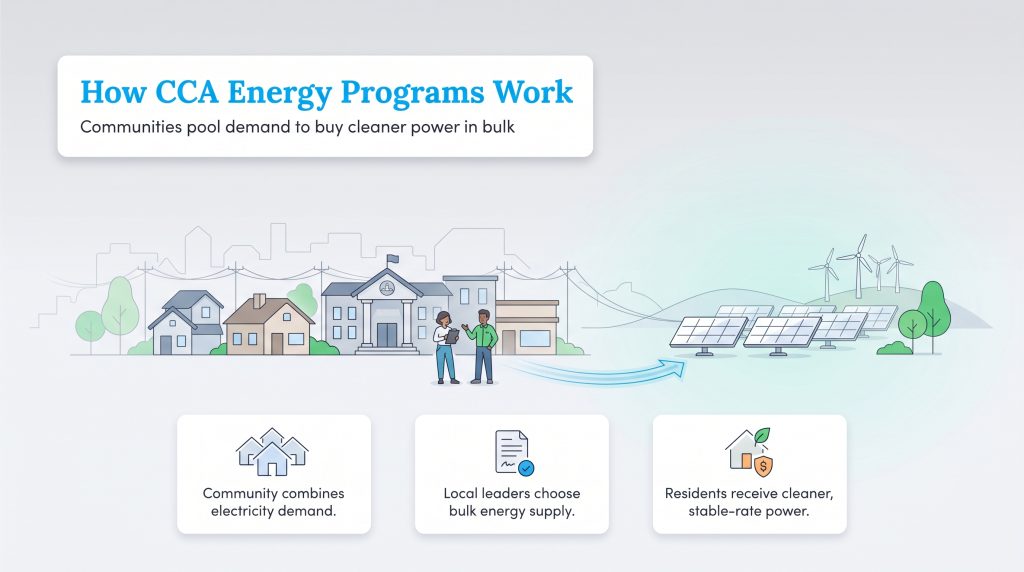
When asking how do CCAs work, it helps to view your electricity service in two distinct parts: power generation and power delivery. At its core, community aggregation pools the electric demand of a neighborhood or entire city to buy power in bulk. By leveraging the combined purchasing power of thousands of residents, local governments often secure cleaner power sources — like solar or wind — that might be too expensive for individual homeowners to procure independently.
Community Choice Aggregation Vs Utility Service
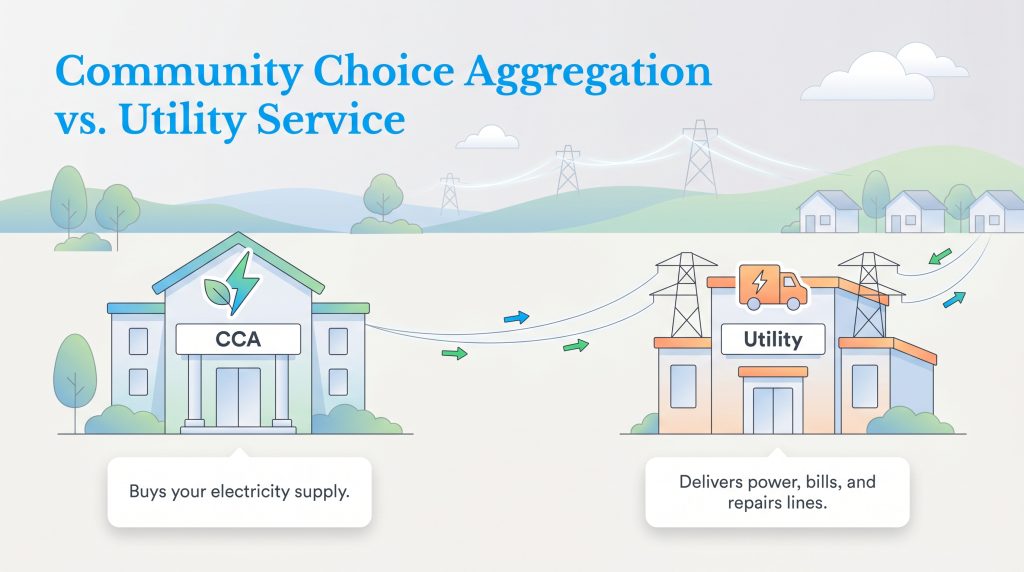
Understanding the difference between a CCA vs utility structure can make your whole setup feel less confusing. The local government entity (the CCA) is strictly responsible for purchasing the generation supply. Meanwhile, large investor-owned utilities continue to manage the physical infrastructure. Your traditional utility still owns the poles, maintains the power lines, and dispatches repair trucks when severe weather causes an outage. You can read an excellent breakdown from the U.S. Energy Information Administration to understand exactly how electricity is generated, transmitted, and distributed to consumers.
Here is a clear breakdown of who handles what when you participate in a municipal aggregation program:
| Responsibility | Generation (The CCA’s Role) | Delivery (The Utility’s Role) |
|---|---|---|
| Purchasing Power | Negotiates and buys the actual electricity supply in bulk for the community. | Does not buy the generation supply for CCA participants. |
| Green Energy Goals | Often prioritizes renewable sources and establishes green energy mandates. | Distributes whatever energy the CCA purchases through the grid. |
| Grid Maintenance | Not responsible for physical infrastructure or power lines. | Maintains wires, poles, and transformers to ensure safe delivery. |
| Outage Repairs | Does not dispatch repair technicians. | Fully responsible for restoring power during storm outages or grid failures. |
| Customer Billing | Sets the supply rate, which is sent to the utility for billing. | Issues the consolidated monthly bill containing both supply and delivery charges. |
The Financial Impact: Understanding Your CCA Bill
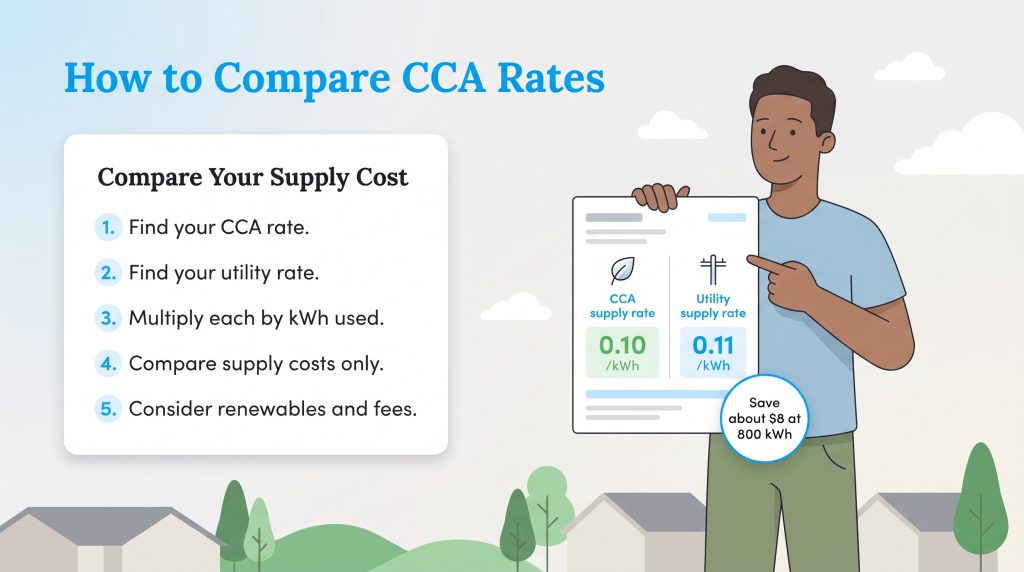
When your community transitions to a new energy supplier, you might worry about facing double charges or receiving multiple bills. Fortunately, the billing process remains streamlined. You will continue to receive one consolidated bill directly from your primary utility provider. The CCA simply replaces the utility’s default generation charge with its newly negotiated rate.
However, understanding the financial nuances requires a bit of vigilance. When a municipality leaves the utility’s default supply pool, the legacy provider sometimes applies a power charge indifference adjustment (PCIA). This is essentially an exit fee designed to cover long-term energy contracts the utility already signed on your behalf before the aggregation program launched. Over time, the benefits of a competitive bulk rate often outweigh these adjustments, but it is important to factor them into your overall cost comparison.
To ensure you are actually saving money, use this simple checklist to review your split utility bill:
- Locate the Generation Charge: Scan your consolidated bill for a line item labeled “Generation,” “Supply Charge,” or “Supplier Services.” This is the portion the CCA controls.
- Check the Delivery Charge: Verify that the transmission and distribution fees remain separate. These are standard utility costs that do not change based on your supplier.
- Find the Default Utility Rate: Visit your state’s energy comparison site or the traditional utility’s website to find their current “Price to Compare” or default supply rate.
- Compare the Math: Multiply your monthly kilowatt-hour (kWh) usage by the CCA’s rate, then do the same with the utility’s default rate. Whichever total is lower is your most cost-effective option.
- Look for Exit Fees: Check the fine print on your bill for any specific PCIA charges or transition fees applied by the legacy utility.
Opt-In Vs Opt-Out Electricity Programs
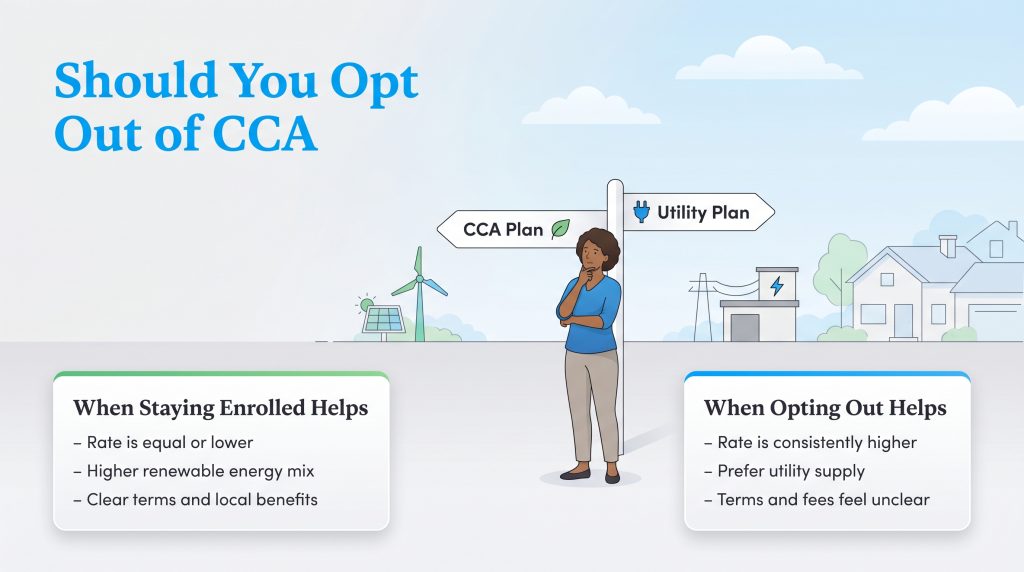
One of the most confusing aspects of municipal aggregation is discovering you were enrolled without actively signing up. This happens because most states mandate opt-out electricity programs when enacting CCA legislation. An opt-out model automatically enrolls all eligible residents within the municipality into the new supply contract unless they explicitly choose to leave. Local governments prefer this method because it guarantees a massive participant base, providing the necessary leverage to negotiate cheaper, greener energy contracts.
If you decide the local bulk rate does not align with your household budget, you retain the legal right to decline participation and return to the traditional utility’s default supply. If you wish to opt out, follow these exact steps:
- Review Your Mail Notice: Locate the initial enrollment letter mailed by your city or county. It contains your unique account PIN or opt-out code.
- Check the Deadline: Look for the 30-day or 60-day grace period outlined in the letter. Opting out during this initial window usually guarantees no exit fees or penalties will be applied.
- Contact the Provider: Visit the official website listed on the notice or call their toll-free customer service line.
- Submit Your Request: Provide your utility account number, service address, and specific opt-out code to confirm your decision to return to the legacy utility’s default service.
Where Is Community Choice Aggregation Available?
Community choice aggregation is not a federally standardized program; it requires specific state-level legislation to operate legally. Because of this, availability varies wildly depending on where you live. If you are moving across state lines, do not assume your new address will offer the same energy choices you previously enjoyed. According to the EPA’s Green Power Partnership and current legislative trackers, the following community choice aggregation states actively permit local governments to pool energy demand:
- California
- Illinois
- Maryland
- Massachusetts
- New Hampshire
- New Jersey
- New York
- Ohio
- Rhode Island
- Virginia
Even if you live in one of these authorized states, your specific town or county must still vote to enact a program locally. If you want to check the status of your region, review your local government website or visit your state’s public utility commission.
The Pros And Cons Of Municipal Aggregation
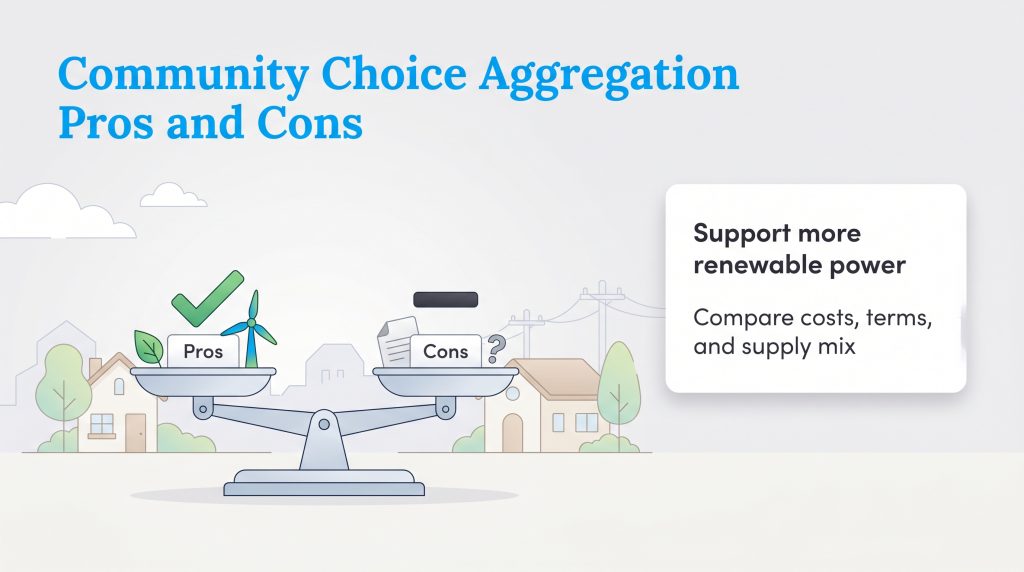
Evaluating community choice aggregation pros and cons helps you make a truly informed decision for your household. While participating in a green energy CCA can be a practical way to support sustainable electricity, the overall value depends heavily on your local rate, supply mix, and program rules. Take a look at the core benefits and drawbacks of staying enrolled in your municipality’s program.
| Benefits (Pros) | Drawbacks (Cons) |
|---|---|
| Access to a green energy CCA with higher renewable content | The automatic enrollment and opt-out confusion can frustrate residents |
| Grants local control over regional energy sourcing | Supply rates may occasionally fluctuate higher than the utility’s default option |
| Provides potentially competitive bulk electricity rates | Legacy utilities may charge exit fees or a power charge indifference adjustment |
| Often reinvests surplus revenue into local sustainability projects | Availability is strictly limited to participating municipalities in select states |
Taking Control Of Your Home’s Energy Strategy
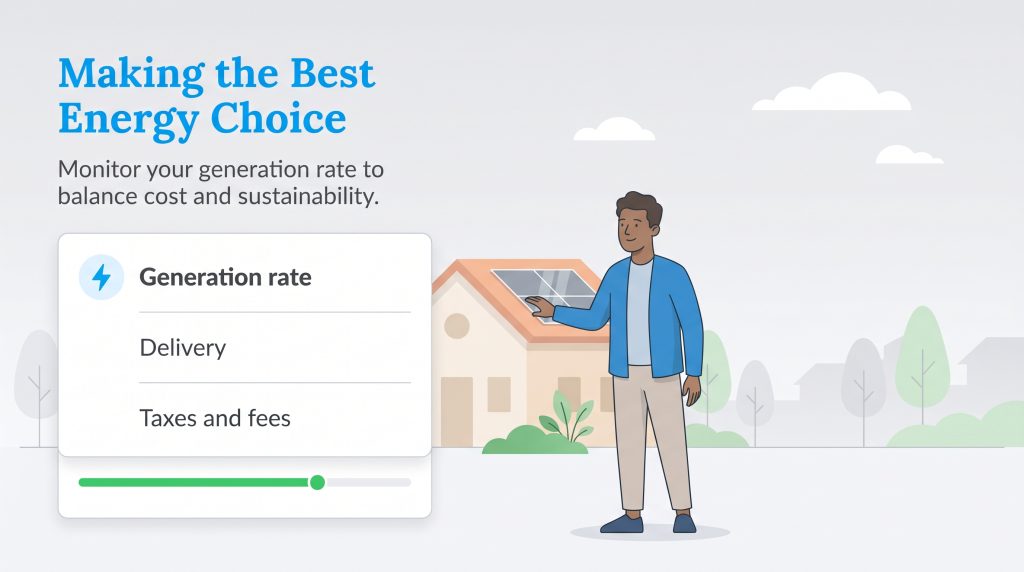
Setting up utilities in a new space often feels overwhelming, but navigating your local power options does not need to add to that stress. Participating in municipal bulk purchasing offers an incredibly simple way to support sustainable energy without overhauling your entire lifestyle. You just need to proactively monitor your monthly bill to ensure the current generation rate aligns with your household budget.
Understanding exactly where these supply costs live on your statement opens up plenty of strategic ways to save on your electric bill month after month. By staying informed about how your electricity is generated, priced, and delivered, you can confidently power your home while keeping your environmental footprint — and your wallet — perfectly balanced.
Frequently Asked Questions About Community Choice Aggregation
Still sorting out whether your CCA notice is a good thing or a headache waiting to happen? These quick answers cover the most common questions homeowners and renters have when a community choice energy program shows up on their bill.
Do I still call my regular utility company if my power goes out?
Will a community choice aggregation program save me money?
Is community choice aggregation the same as deregulation?
Is community choice energy mandatory?
How do I know if I live in a CCA service area?
Can a renter participate in a CCA program?
Can I choose a greener CCA plan?
About the Author

Claudio is a sustainability-focused writer with a background in Anthropology and Psychology from NC State University. He has spent over 15 years working in writing, interpretation, and translation, driven by a deep interest in how human culture shapes the environment. Today, he shares his curiosity with readers by writing about sustainable living solutions and the connection between everyday choices and environmental impact.

David has been an integral part of some of the biggest utility sites on the internet, including InMyArea.com, HighSpeedInternet.com, BroadbandNow.com, and U.S. News. He brings over 15 years of experience writing about, compiling and analyzing utility data.