

Understanding Your Monthly Energy Usage Is the Key to Unlocking Whether a Bill Credit Plan Will Save You Money or Cost You More
Key Takeaways
- Apartments typically use less electricity than average single-family homes, which can make hitting the strict minimum usage thresholds for bill credit plans incredibly difficult.
- The “usage cliff” can cause your monthly electric bill to spike unexpectedly if you fall just one kilowatt-hour short of a provider’s minimum requirement.
- Simple fixed-rate energy plans without usage credits often provide a much more predictable and budget-friendly pricing structure for renters compared to complex tiered systems.
Moving into a new apartment brings a wave of decisions, and choosing the right energy provider is often one of the most confusing hurdles to clear. If you live in a deregulated energy market, you have likely seen aggressive promotions promising massive discounts or even free electricity once you hit a certain usage threshold. While these offers sound incredibly appealing on paper, they are engineered with a very specific type of household in mind — and it is rarely a renter. Understanding the exact mechanics behind your monthly power consumption is essential to finding a rate that genuinely works for your living situation and answers the critical question: are bill credit plans good for renters? We are going to break down exactly how these promotional credits function, how to calculate your expected power usage, and how to protect yourself from hidden fees so you can select a provider that keeps your budget intact and your lights on.
Bill Credit Energy Plans Explained for Renters
Usage credit electricity plans operate on tiered usage models, meaning your rate changes dramatically depending on precisely how much power you consume. In deregulated utility markets like Houston, providers often lure customers with the promise of a substantial discount on their monthly bill. The credit typically applies only after you reach a specific usage threshold, such as 1,000 kilowatt-hours (kWh), or stay within a strictly defined usage range. If your apartment’s usage falls below that threshold or outside the plan’s qualifying range, you lose the credit entirely for that billing cycle. Furthermore, many of these packages impose strict apartment electricity minimum usage fees if you fail to consume enough power, actively penalizing you for being energy efficient. These plans are priced around consumption levels that are much more common in larger, detached homes, making them incredibly tough targets for anyone living in a smaller space. You might think you secured a fantastic low rate, but that math completely falls apart if your natural consumption habits do not align with their rigid parameters.
🚩 Heads Up: Many energy providers advertise a low average rate based on the assumption that you will earn the bill credit every single month. If you miss that threshold or fall outside the qualifying range, your actual rate per kilowatt-hour can be significantly higher than advertised.
Average Electricity Usage for a One-Bedroom Apartment
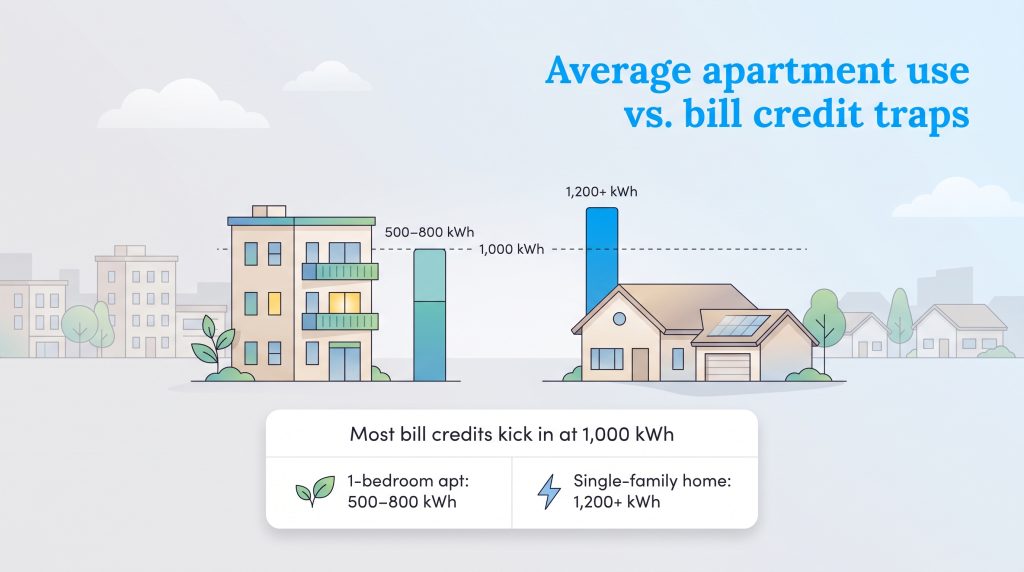
To truly grasp why those promotional credits rarely work in your favor, you need to understand the typical electricity usage for your living space. Apartments inherently feature built-in advantages for energy efficiency that naturally keep your bills lower. You share walls, ceilings, and floors with neighbors, which creates a natural insulation barrier that drastically reduces the amount of heating and cooling your HVAC system needs to produce. You also have a smaller square footage to condition and fewer heavy-duty appliances running simultaneously.
To put this into perspective, compare the typical energy demands of different living spaces:
- Average kWh usage for 1-bedroom apartment: 500 to 800 kWh per month, depending heavily on the season, local climate, and your personal thermostat habits.
- Average kWh usage for a standard single-family home: 1,200+ kWh per month, easily clearing the thresholds required by most promotional tiers.
According to data from residential energy consumption surveys, smaller multifamily homes consistently use less energy than larger detached homes, though your actual usage may be higher in extreme climates or in older buildings with electric heat. Because you naturally hover well below the 1,000 kWh mark required by most usage credit tiers, trying to reach that credit means you would have to intentionally waste power. Not only does that hurt your wallet, but it completely undermines any effort to make an environmentally mindful choice for your new home.
Why the Usage Cliff Catches Renters Off Guard
The biggest danger for anyone living in a smaller space is falling off the notorious “usage cliff.” This industry term describes the sudden, punitive spike in your monthly costs when you barely miss a provider’s minimum usage requirement. Imagine signing up for an energy plan that offers a $60 bill credit after reaching exactly 1,000 kWh. If an unexpected cool week rolls through and your air conditioner runs less frequently, you might only consume 950 kWh. Because you did not hit that magic number, your base rate per kilowatt-hour shoots up, and your final bill ends up costing significantly more despite using less power. The numbers below are illustrative only and assume a plan where the customer receives a $60 credit after reaching 1,000 kWh; your actual bill will depend on your provider’s energy charge, base fee, TDU charges, taxes, and contract terms.
| Monthly Usage (kWh) | Bill Credit Applied? | Example Math | Estimated Bill Total |
| 950 kWh | No | 950 × sample rate + fees | $150 |
| 1,000 kWh | Yes | 1,000 × sample rate + fees − $60 credit | $90 |
| 1,050 kWh | Yes | 1,050 × sample rate + fees − $60 credit | $97 |
Simple Fixed-Rate Plans vs. Promotional Bill Credit Plans
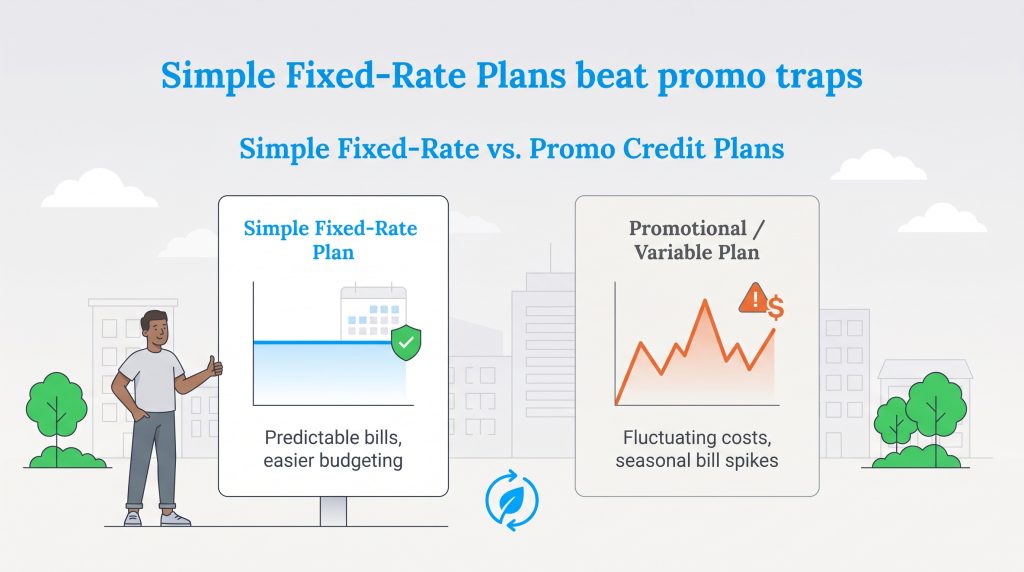
When you weigh simple fixed-rate plans vs. promotional bill credit plans, the clear winner for apartment living usually emerges quickly. However, you also need to understand the nuances of a fixed-rate vs variable-rate for renters. A simple fixed-rate plan locks in your exact price per kilowatt-hour for the entire duration of your contract, meaning your savings do not depend on hitting an arbitrary monthly target. In contrast, variable-rate plans fluctuate based on real-time wholesale energy market conditions. While a variable rate might seem incredibly cheap in the mild spring months, it exposes apartments to severe seasonal price spikes during the peak heat of summer or the freezing depths of winter.
As you explore standard electric service options and different types of energy plans, keep in mind that simple fixed-rate models offer several distinct advantages over both variable rates and complex promotional tiers:
- They offer long-term pricing predictability, shielding you from sudden market spikes and wholesale price surges.
- They make monthly budgeting far easier since your bill directly reflects your actual power consumption without complicated math.
- They impose absolutely no financial penalties for conserving energy while you are traveling, working long hours, or spending time away from the house.
From an environmental standpoint, flat fixed rates actively encourage you to adopt sustainable habits. Under a promotional tier system, you might actually be financially incentivized to leave your lights on or crank the air conditioning just to hit that 1,000 kWh mark and secure your discount. That behavior contradicts any eco-conscious alternative approach and ultimately puts unnecessary strain on the local power grid.
When a Bill Credit Plan Might Make Sense for a Renter
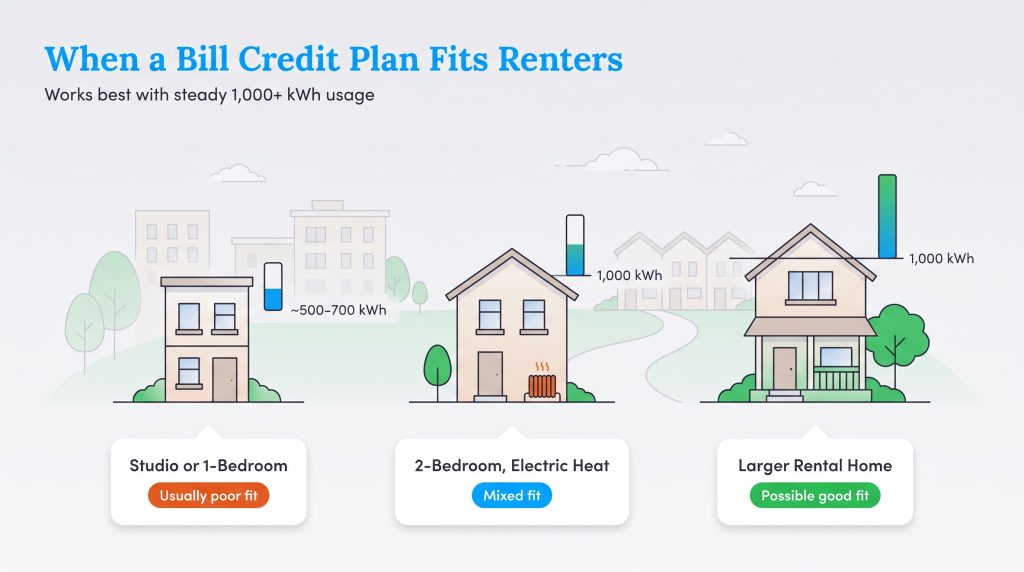
While standard fixed-rate plans are generally the safest route for most apartment dwellers, there are specific scenarios where a bill credit plan could actually work in your favor. It all comes down to knowing your exact historical usage and finding a contract that aligns perfectly with those numbers. A bill credit plan might be a viable option if your monthly consumption consistently stays well above the required threshold, even during the milder spring and fall months.
Additionally, it could be worth comparing if the provider offers a credit that applies across a much wider usage band — such as 500 to 1,500 kWh — and the advertised rates for both the 500 kWh and 1,000 kWh tiers remain highly competitive. To help you evaluate your options without getting lost in the marketing spin, consider how your current living situation matches up with these typical renting scenarios:
| Renter Situation | Bill Credit Plan Fit | Why |
| Studio or one-bedroom apartment using 400 to 700 kWh | Usually poor | You may miss common 1,000 kWh credits. |
| Two-bedroom apartment with electric heat | Mixed | Usage may reach the threshold in some months but not others. |
| Larger rental home with steady 1,000+ kWh usage | Possible fit | The credit may apply more consistently. |
| Eco-conscious renter trying to reduce usage | Usually poor | The plan may reward higher consumption. |
Navigating Renter-Specific Energy Challenges
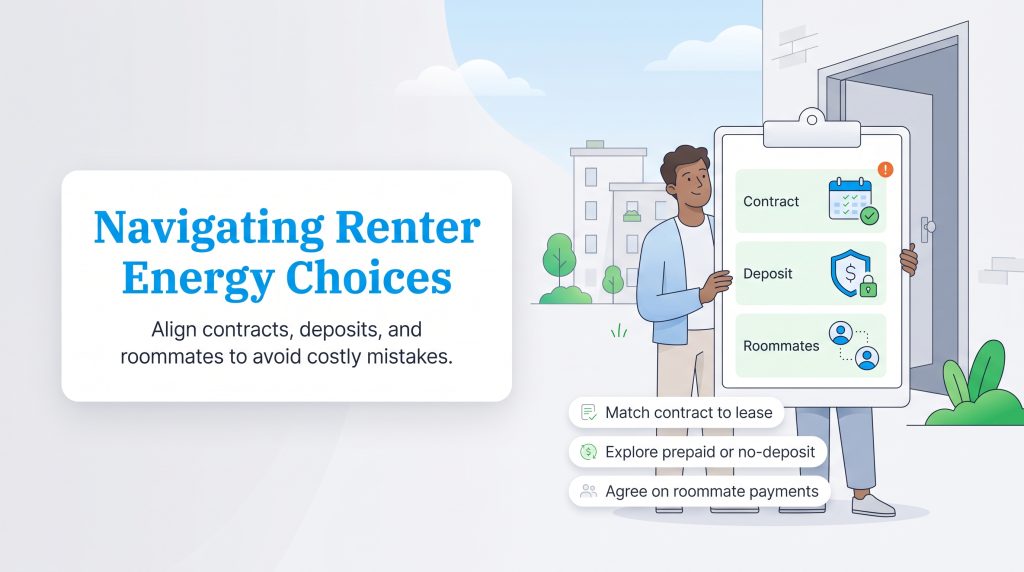
Securing a reliable energy rate involves much more than just looking at the price per kilowatt-hour. Renters face a unique set of logistical constraints that traditional homeowners rarely encounter. Whether you are dealing with rigid apartment lease agreements, strict credit requirements, or the complex dynamics of living with multiple people, your utility strategy needs to be highly adaptable. This is especially true when shopping for Texas apartment energy plans, where the sheer volume of choices can easily lead you into a restrictive, long-term contract. To successfully set up your apartment’s power without overspending, you must carefully manage your lease timelines, understand your deposit options, and establish clear guidelines if you are sharing the space.
Matching Contract Lengths to Your Lease (Avoid ETFs)
One of the most costly mistakes a renter can make is signing an electricity contract that outlasts their apartment lease. Providers offer energy plans in various term lengths, typically ranging from 12 to 36 months. If you sign a 24-month energy contract for a 12-month apartment lease and decide to move out of state when your lease ends, you will likely be hit with a hefty penalty for breaking the agreement early.
Always strive to match your energy contract term directly to your lease length. If a perfect match is not possible, you must exclusively shop for providers that willingly waive early termination fees for renters. In deregulated markets, most reputable utility companies will cancel your contract without any penalty if you can provide official proof of a new address, such as a forwarding lease agreement or a new utility bill. However, you must meticulously verify this specific waiver clause in the provider’s terms of service before you commit to the plan.
Credit Checks, Deposits, and Prepaid Plans
Setting up utilities typically requires a soft credit check, and if your credit score does not meet the provider’s minimum requirements, you will be asked to pay a substantial upfront deposit just to get your lights turned on. Fortunately, the market offers several flexible alternatives to help you bypass these steep initial costs.
No-deposit electricity plans allow you to bypass the upfront fee entirely, provided you meet certain criteria or opt into a specific billing structure. One of the most popular variations is prepaid electricity plans for apartments. Instead of receiving a massive bill at the end of the month for the power you already used, you load funds into an account upfront, and your daily usage is automatically deducted from that balance. Consider the differences before choosing your setup:
- Prepaid Energy Benefits: You avoid credit checks and deposits entirely, you can track your daily usage through a mobile app to curb wasteful habits, and you pay strictly for what you use without long-term commitments.
- Prepaid Energy Drawbacks: The average rate per kilowatt-hour is often slightly higher than standard fixed-rate post-paid plans, and your power can be disconnected very quickly if your account balance unexpectedly dips below zero.
Splitting the Bill: Roommates and Account Holders
Living with roommates adds a complicated layer to utility management, particularly because only one individual can legally serve as the primary account holder for the electricity service. The person whose name is on the bill is solely responsible for the payments in the eyes of the utility company. If your roommate fails to pay their portion, it is your credit score that takes the hit and your name tied to the late fees.
To protect your finances and your relationships, you must establish written payment agreements before the move-in date. Utilizing digital tools for splitting utility bills with roommates ensures complete transparency and eliminates the awkwardness of constantly asking for money. Command everyone in the household to set up automatic transfers through third-party financial apps so the primary account holder is fully funded several days before the official energy bill is due. This proactive approach prevents late fees and ensures your service remains uninterrupted.
Spotting Hidden Fees in Electricity Plans
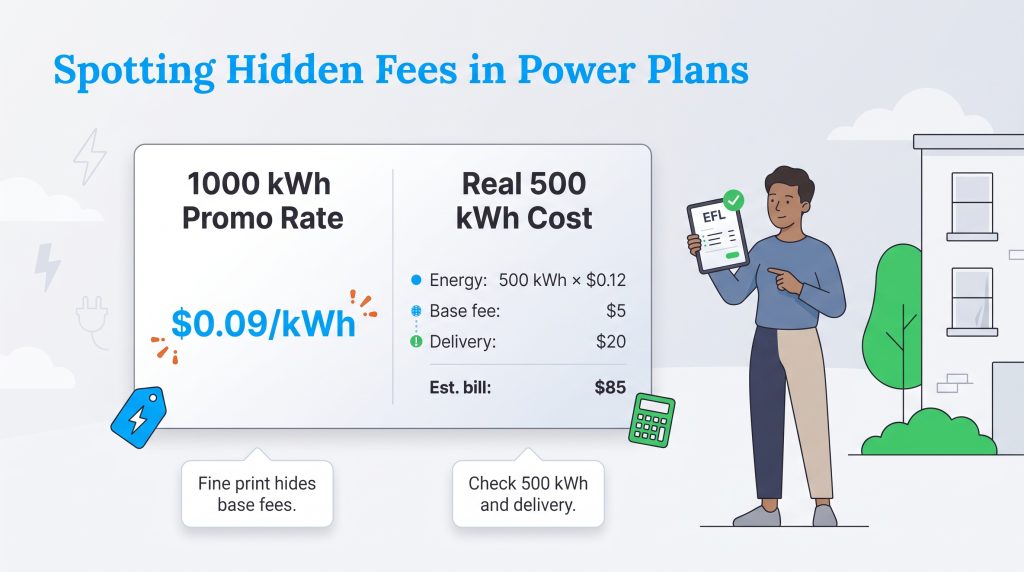
Uncovering hidden fees in electricity plans is an essential skill, especially since promotional credits are notoriously good at masking expensive back-end charges. While a provider might flash a shockingly low average rate on their bold promotional materials, they often bake in hefty base charges, minimum usage penalties, and regulated transmission and distribution utility (TDU) delivery charges, all of which heavily affect your total monthly cost. These fixed costs are tacked onto your statement regardless of how little power you consume. A $10 base fee might not seem like a major issue for a large household, but it represents a significant, disproportionate percentage of a renter’s total monthly bill.
💸 Money-Saver: Always calculate your estimated bill at the 500 kWh mark, not the 1,000 kWh mark. This provides a much more accurate picture of what a small apartment will actually cost to power. To compare plans, estimate your monthly bill this way: expected kWh × energy rate + base charges + delivery charges − any credits you realistically expect to earn. For example, using 500 kWh at $0.12 per kWh with a $5 base fee and $20 in TDU charges would estimate to an $85 monthly bill before taxes.
Your Step-by-Step EFL Checklist
In Texas, retail electricity providers must provide an Electricity Facts Label (EFL) for residential plans before you sign any contract. This federally mandated style of document serves as the ultimate source of truth for your actual rates, stripping away the clever marketing jargon and laying out the bare mathematical facts. To protect your monthly budget from nasty surprises, you should thoroughly review this document before agreeing to any terms.
- Check the average price specifically at the 500 kWh tier, which is the most realistic and reliable benchmark for a standard one-bedroom apartment.
- Locate the base charge section to see exactly what fixed monthly fees you owe simply for being an active customer, regardless of your consumption.
- Read the fine print regarding the specific conditions of any usage credits to confirm precisely when they trigger, how much they deduct, and when they vanish.
How to Find the Best Electricity Plans for Apartments
Tracking down the best electricity plans for apartments requires a strategic approach rather than just clicking the first compelling advertisement you see online. If you happen to live in a deregulated area like Texas, you can leverage official state energy comparison tools to filter providers specifically by their 500 kWh rates. This helps you actively avoid plans priced around higher usage levels that do not match the reality of most apartments. Your goal should always be to secure a reasonable, fixed rate per kilowatt-hour without steep base fees dragging down your monthly budget.
Timing is just as important as the plan itself. You must schedule your energy service at least three days prior to your official move-in date. Waiting until the last minute can result in processing delays, missed meter readings, or unexpected blackout periods during your first weekend in the new place. By giving the provider a comfortable three-day buffer, you guarantee that your lights and air conditioning are fully operational the moment you pick up your apartment keys.
Once you secure a reliable contract and move in, you can focus on controlling your overall consumption. Implementing small, daily strategies to save on your electric bill allows you to reap the rewards of a straightforward fixed rate. Whether you upgrade to LED lighting, adjust your thermostat while you are at work, or request that your landlord install ENERGY STAR certified appliances, every little adjustment helps reduce your carbon footprint and keeps your living expenses entirely predictable.
Securing the Best Rate Before Move-In Day
Choosing your utility provider does not have to feel like a high-stakes gamble. Ultimately, complex tiered promotions and massive minimum usage requirements are simply not built for the realities of modern apartment living. Verify your Electricity Facts Label (EFL) one last time to ensure you are strictly looking at the 500 kWh rate, check that your new contract length directly matches your apartment lease, and confirm there are absolutely no hidden base fees. By signing up for a straightforward, fixed-rate plan, you will secure an environmentally mindful choice that keeps your monthly bills predictable and entirely under your control.
Frequently Asked Questions About Bill Credit Plans
These quick answers can help you compare bill credit plans before you sign an electricity contract. Reviewing these common concerns is an excellent way to ensure you pick the most cost-effective option for your apartment.
Are bill credit plans good for renters?
What happens if I use less electricity than my plan requires?
Is a simple fixed-rate energy plan better for a one-bedroom apartment?
Do bill credit plans charge a base fee?
How can I avoid hidden fees on my electric bill?
Can I get a no-deposit electricity plan for my apartment?
What happens to my electricity contract if I break my apartment lease?
Are prepaid electricity plans better for renters?
About the Author

David has been an integral part of some of the biggest utility sites on the internet, including InMyArea.com, HighSpeedInternet.com, BroadbandNow.com, and U.S. News. He brings over 15 years of experience writing about, compiling and analyzing utility data.

Claudio is a sustainability-focused writer with a background in Anthropology and Psychology from NC State University. He has spent over 15 years working in writing, interpretation, and translation, driven by a deep interest in how human culture shapes the environment. Today, he shares his curiosity with readers by writing about sustainable living solutions and the connection between everyday choices and environmental impact.