

Discover active alternatives for water bill relief in your state and local communities
Key Takeaways
- The federal LIHWAP program is no longer funded at the federal level, and states are not accepting new applications.
- You can still find help paying your water bill through active local alternative programs, such as LIHEAP, community action agencies, and municipal hardship funds.
- Implementing simple water conservation habits at home can meaningfully lower your monthly utility costs over time.
Moving into a new place or just trying to keep your current household running smoothly brings enough stress without opening a water bill you simply cannot afford. If you are scouring the internet for a reliable LIHWAP guide to get some much-needed breathing room, we are here to clear up the confusion and point you in the right direction. While the federal landscape for utility relief recently shifted, you are definitely not out of options. We want to help you cut through the noise by explaining exactly what happened to LIHWAP and showing you how to tap into active, actionable programs that offer real help paying your water bill right now.
What Is LIHWAP and Is It Still Available?
What is LIHWAP exactly? The Low Income Household Water Assistance Program was a temporary federal emergency relief effort created to help eligible households with water and wastewater costs, including past-due balances, shutoff prevention, reconnection fees, and in some cases, current charges. According to federal program reporting, LIHWAP assisted more than a million households before funding ended.
So, is LIHWAP still available today? LIHWAP is no longer funded at the federal level, and states are not accepting new applications through the original federal program. Some states closed their programs earlier than others, so check your state agency only if you are looking for information about a past application or remaining supplemental payments. You can verify this closure status directly through the official LIHWAP program archive to see exactly when and how the funding wrapped up.
Heads Up
If you spot third-party websites or agencies asking for processing fees to fast-track your “LIHWAP application,” it is highly likely a scam. Legitimate government benefit programs generally do not charge application or processing fees.
LIHWAP vs. LIHEAP: Understanding the Difference
When searching for utility help, you will often see two very similar acronyms floating around, sparking the classic LIHWAP vs. LIHEAP confusion. The primary difference boils down to the specific household utility covered. While LIHWAP focused exclusively on water and wastewater costs, the Low Income Home Energy Assistance Program (LIHEAP) zeroes in on your heating and cooling expenses. LIHEAP receives recurring federal funding, but application windows, eligibility rules, and benefit amounts vary by state.
Freeing up cash that you would normally spend on energy can make a meaningful difference in your monthly budget. By securing aid for your climate control needs or learning how to save on your electric bill, you can easily redirect those extra funds toward paying off a stubborn water balance.
What to Do If You Have a Shutoff Notice
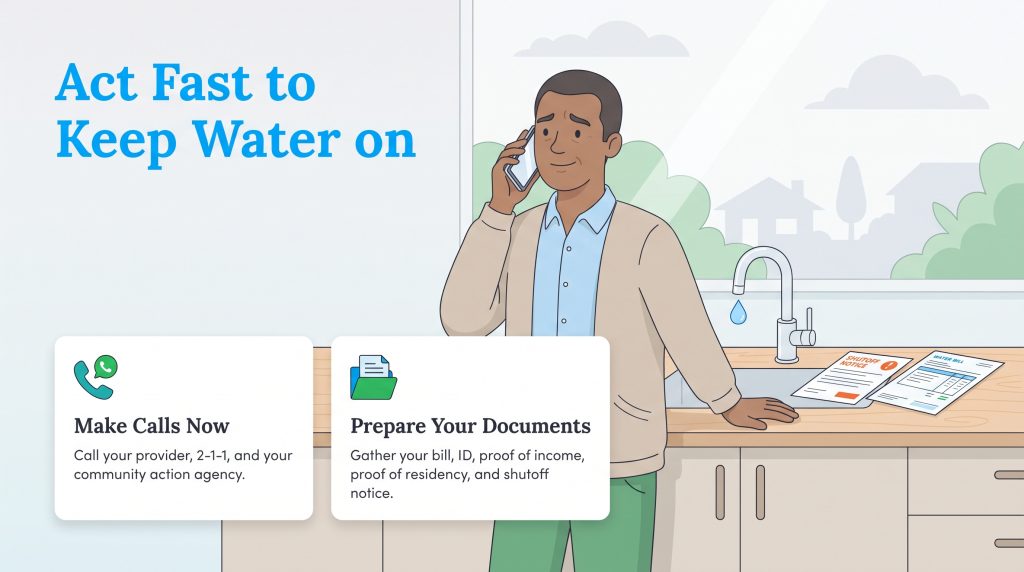
Receiving a shutoff notice can be incredibly stressful, but acting quickly can help keep your water flowing. If you are facing an imminent disconnection, follow these steps to secure emergency assistance and protect your utility services:
- Call your water provider and ask about hardship plans, leak adjustment programs, payment extensions, or shutoff protections.
- Call 2-1-1 or visit 211.org to find local emergency utility aid.
- Contact your nearest community action agency.
- Ask whether your city, county, or state has a water affordability or customer assistance program.
- Gather your bill, ID, proof of income, proof of residency, and shutoff notice before applying.
Top Water Bill Assistance Programs You Can Use Today
Since the federal water program closed its doors, you might feel stuck when facing an unexpected financial crisis. By pivoting away from federal grants and looking closer to home, you can discover several localized water bill assistance programs designed to step in and offer genuine relief. Comparing these options can help you quickly identify the best path forward for your household.
| Program or Resource | What It May Help With | Where to Start |
|---|---|---|
| Former LIHWAP | Historical water and wastewater assistance | Archived federal or state pages only |
| LIHEAP | Heating and cooling bills | State LIHEAP office or benefits portal |
| Local Water Utility Assistance | Payment plans, hardship grants, shutoff prevention | Your water provider’s customer service line |
| Community Action Agency | Emergency utility aid and referrals | Local agency or 2-1-1 |
| Water Conservation Programs | Lower long-term bills through reduced use | Utility rebates or EPA WaterSense resources |
Water Utility Customer Assistance Programs
Many municipal water authorities stepped up to fill the void left by federal closures by offering their own hardship grants, arrears management plans, and specialized payment plans. Some regions even shifted state funds to create localized utility assistance programs that operate completely independently of the federal government. Because utility relief options vary heavily depending on your specific city and local utility provider — like navigating the distinct water services detailed in our Houston utility guide — it pays to do some hyper-local research to find what applies to your neighborhood.
To find these localized options, try searching the web using specific phrases like “[your city] water bill assistance,” “[your water provider] payment assistance,” or “[your state] community action water assistance.” This targeted approach will often yield the most accurate and actionable results.
Money-Saver
Always call your utility provider directly before you actually miss a payment to ask about grace periods, emergency payment restructuring, or internal forgiveness programs. Being proactive shows good faith and often unlocks flexible options you wouldn’t find advertised online.
Community Action Agencies and United Way
Beyond your actual utility provider, local religious charities and community action networks often maintain discretionary funds specifically meant to prevent utility shut-offs. Calling 2-1-1 to connect with the United Way or reaching out to regional nonprofits can fast-track you to emergency relief. These organizations specialize in matching your unique household needs with highly localized funding pools that you might not uncover through a standard web search.
Before You Apply for Water Bill Assistance
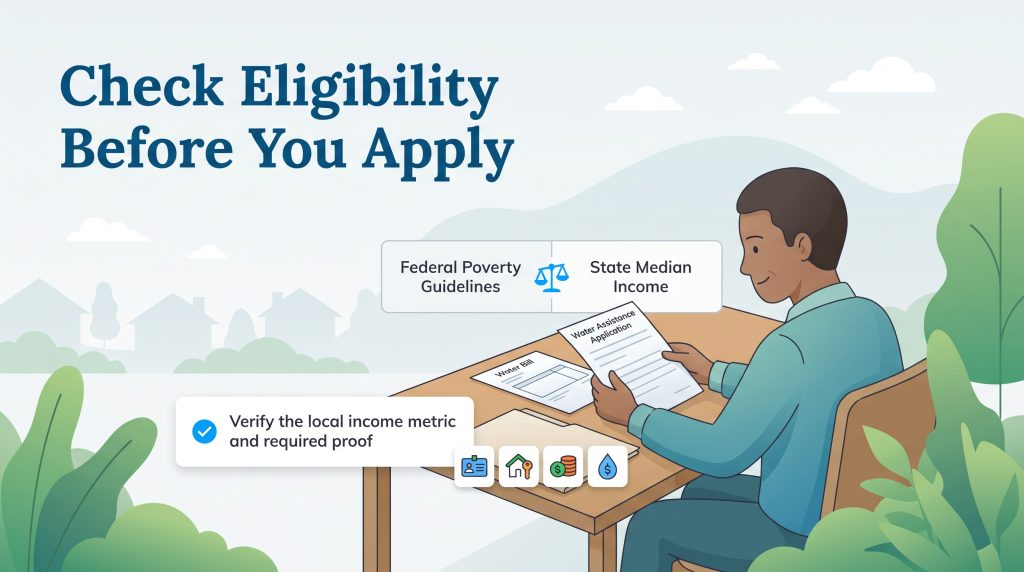
Understanding how income thresholds work is usually the biggest hurdle when applying for utility aid. While the old LIHWAP eligibility rules set a specific federal standard, localized alternative programs usually measure your qualifications using one of two distinct metrics: the Federal Poverty Guidelines or the State Median Income (SMI). This causes major confusion for applicants, as qualifying under the federal poverty line might not guarantee approval if a specific grant measures against the often-higher state median income. Always verify exactly which metric your local program uses before assuming you make too much or too little to qualify.
If you are actively renting, you might wonder if you are still eligible for aid when water is included in your rent. You should ask the assistance agency whether renters can qualify using a lease, landlord statement, or utility charge documentation. Some programs require the applicant’s name to appear on the water account, while others may accept proof that you are responsible for the cost.
For those moving into a new home and struggling with a water deposit or service setup fee, ask your utility whether assistance funds can cover startup costs. Some local programs only cover past-due balances, while others may help with reconnection or account setup charges.
When you sit down to apply for any local water assistance, gather the following standard documents to prove your eligibility and speed up the approval process:
- Recent water and wastewater utility bills showing your current balance
- Your official shut-off notice, if applicable
- Proof of gross income for all adult household members (like pay stubs or tax returns)
- Government-issued identification for the primary account holder
- Proof of residency, such as a signed lease agreement or mortgage statement
- Documentation of unemployment, medical hardship, or emergency expenses, if applicable
Eco-Conscious Tips to Lower Your Monthly Water Bill
While seeking financial assistance is absolutely crucial during an acute crisis, permanently reducing your household consumption remains the most effective long-term strategy for utility affordability. Making environmentally mindful choices does not mean you have to sacrifice comfort; it simply means recognizing where resources slip down the drain unnoticed. Whether you are actively renting an apartment or settling into a newly purchased house, taking an active role in managing your home water services empowers you to keep costs predictably low month after month.
By embracing just a few eco-conscious alternatives, you reduce the strain on your wallet and your local watershed. Consider upgrading old appliances that use a lot of water, or adjusting your daily habits by running the dishwasher only when it is completely full. When you pair these small behavioral shifts with modern, efficient hardware, the long-term financial relief quickly compounds over time.
Eco Edge
EPA WaterSense estimates that household leaks can waste nearly 10,000 gallons of water per year, and WaterSense-labeled fixtures can help reduce use without sacrificing performance. For maximum impact, swap out outdated hardware for EPA WaterSense certified fixtures to ensure you cut consumption without losing water pressure.
Finding the Right Support for Your Water Utilities
Navigating utility hurdles can feel isolating, but uncovering the right resources can make the next step feel more manageable for your household budget. Even though the federal LIHWAP initiative is no longer an option on the table, strong local safety nets and smart home efficiency practices can step up to ease the burden of heavy monthly bills. Keep leaning into community networks, proactively communicating with your service providers, and adopting mindful water habits, and you will find that securing affordable utilities is entirely within your reach.
Frequently Asked Questions About LIHWAP
Still sorting through old LIHWAP information? These quick answers cover the most common questions about applications, eligibility, LIHEAP, and local water bill assistance.
Can I Still Submit a LIHWAP Application Online?
Will the Federal Government Bring LIHWAP Back?
Does LIHEAP Cover Water and Sewer Bills?
How Do I Find Local Help Paying My Water Bill?
What Is the Maximum Income for Utility Assistance Programs?
About the Author

Claudio is a sustainability-focused writer with a background in Anthropology and Psychology from NC State University. He has spent over 15 years working in writing, interpretation, and translation, driven by a deep interest in how human culture shapes the environment. Today, he shares his curiosity with readers by writing about sustainable living solutions and the connection between everyday choices and environmental impact.

David has been an integral part of some of the biggest utility sites on the internet, including InMyArea.com, HighSpeedInternet.com, BroadbandNow.com, and U.S. News. He brings over 15 years of experience writing about, compiling and analyzing utility data.