
Mastering your home’s water meter is the first step toward lower utility bills and a more sustainable household.
Key Takeaways
- Locating your meter safely is the crucial first step, as many are housed in ground-level boxes that can be heavy or difficult to open.
- Reading the display varies by device, requiring different methods for analog dials versus modern digital screens.
- Checking for leaks using the flow indicator is a simple skill that can prevent water damage and wasted money.
Reading a water meter might look like deciphering a secret code with its spinning dials and ticking numbers, but it is actually a straightforward skill that empowers you to take charge of your home’s efficiency. Whether you are trying to stick to a tight monthly budget, hunting for a sneaky plumbing leak, or just curious about your family’s water footprint, understanding those numbers gives you the real data you need to make smart changes. We have put together this guide to demystify the process so you can spot issues early and manage your water utilities with confidence.
Locating and Accessing Your Water Meter Safely
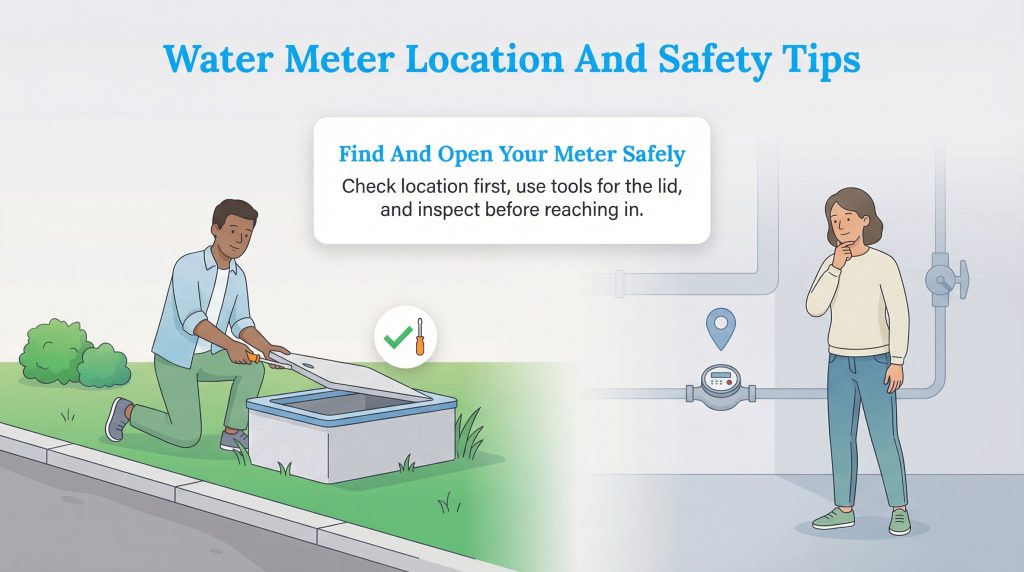
Before you can read your numbers, you need to find the device. If you live in a warmer climate, your meter is likely located outside in a concrete or plastic box set into the ground near the street curb. In colder regions where pipes might freeze, you will usually find the meter inside your home, typically in a basement or utility room near the main water shut-off valve. If you are unsure where yours is located, your local water provider can confirm your specific setup.
Accessing an outdoor meter requires a bit of caution. The lids on these boxes can be heavy and are often secured to prevent tampering. We recommend using a long screwdriver or a specialized water meter key to pry the lid open rather than using your fingers. This protects your hands from getting pinched or injured by the heavy cover. Once the lid is off, check the inside carefully before reaching in.
Identifying Your Meter Type
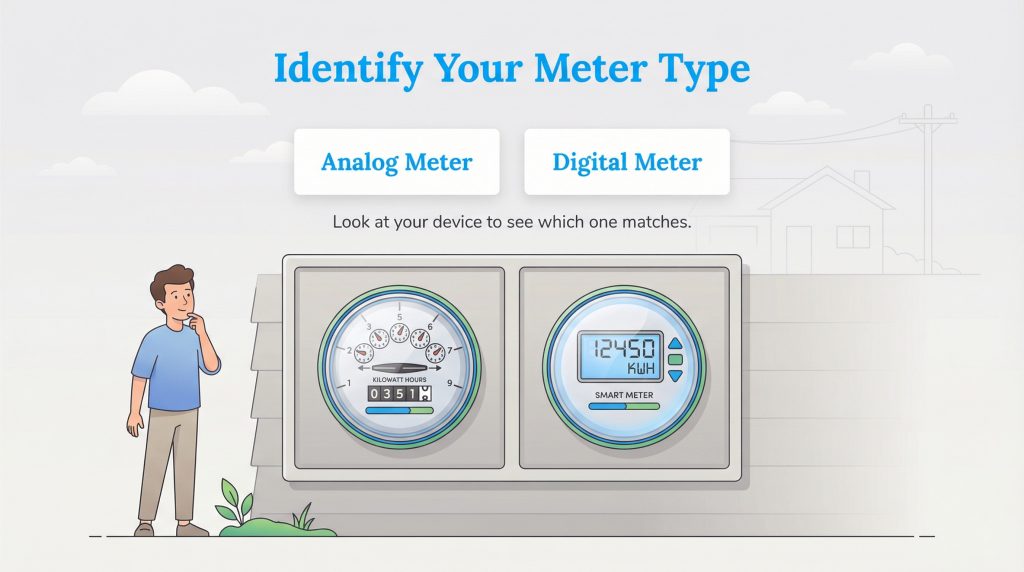
Once you have eyes on the device, take a moment to see what kind of technology you are working with. There are generally two main types of meters: Analog and Digital. Analog meters look a bit like a clock or a car speedometer, featuring a circular face with rotating hands and a row of rolling numbers. Digital meters are more modern and feature an LCD screen similar to a digital watch. While they look different, they perform the exact same function. Look at your device now to determine which section below applies to you.
How to Read an Analog Water Meter
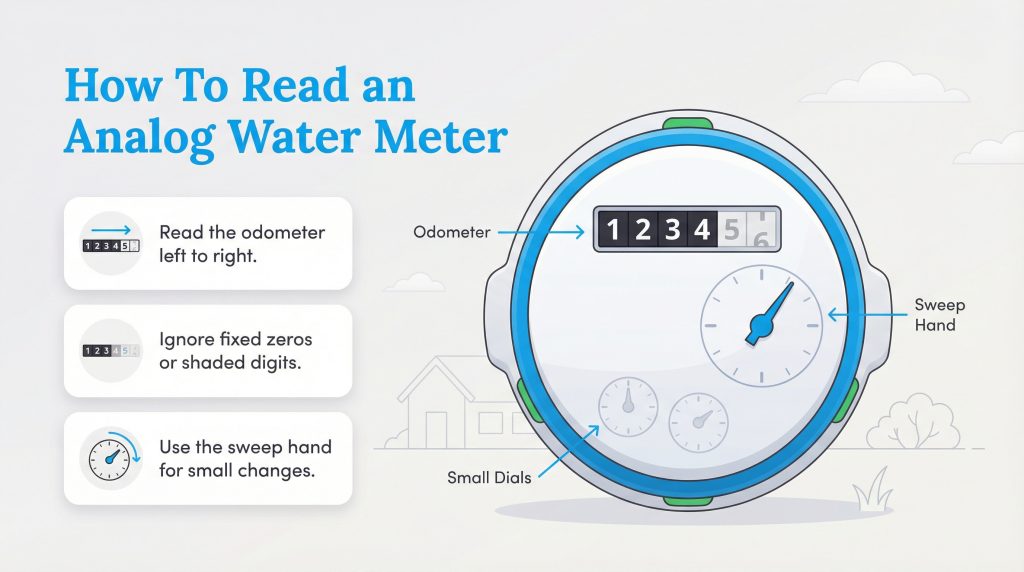
Analog meters can be intimidating at first glance because they have moving parts, but they are quite logical once you know the layout. The most important part is the odometer, which is the row of numbers that resembles the mileage counter in a car. This number represents your total water usage, usually measured in cubic feet or gallons. When your utility company reads your meter for billing, they typically only look at this row of numbers to calculate your monthly usage.
The second component is the large sweep hand, which looks like a clock’s second hand. This dial measures smaller units of water as it rotates around the face. Look for text near the dial that says something like “1 revolution = 10 gal” or “1 revolution = 1 cu ft” so you know exactly what each full sweep represents. If your meter has small circular dials that look like mini clocks, you generally read them in a clockwise direction, similar to how you would read an old-fashioned gas meter.
To get an accurate reading on an analog meter, follow these simple steps:
- Read the odometer from left to right, writing down the numbers exactly as they appear.
- Ignore the fixed zeros or shaded numbers on the far right if your utility bill uses larger units (like hundreds of cubic feet).
- Compare this number to the reading on your last bill.
- Check the sweep hand if you need to measure small amounts, such as when testing for leaks.
How to Read a Digital Water Meter
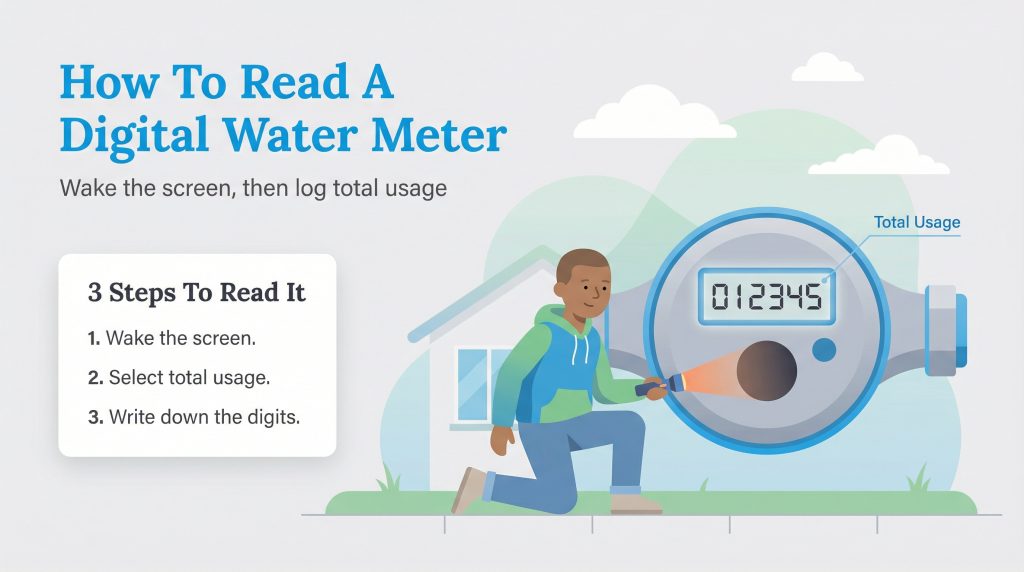
Digital water meters are becoming more common and are generally easier to read, though they have a quirk you should know about. To conserve battery life, the LCD screen on a digital water meter often goes into “sleep mode” when not in use. If the screen is blank, do not panic; it is likely just saving power. Most modern digital meters can be woken up by shining a bright flashlight on the sensor. However, if your meter doesn’t respond to light, look for a small button to press or contact your utility for model-specific instructions.
Once the screen is active, you will see a row of numbers. This is your readout. Depending on the model, the display might toggle between different modes. It will typically alternate between showing your “total usage” (the number used for billing) and the current “flow rate” (how many gallons per minute are moving through the pipes right now). Watch the screen for a few seconds to see if the numbers change or if different icons appear.
Here is the best way to capture your digital reading:
- Wake the display using a flashlight, sunlight, or the activation button.
- Identify the mode by waiting for the screen to cycle. You want the “Total Usage” number, not the flow rate.
- Write down the main digits to track your consumption over time.
Calculating Your Water Usage
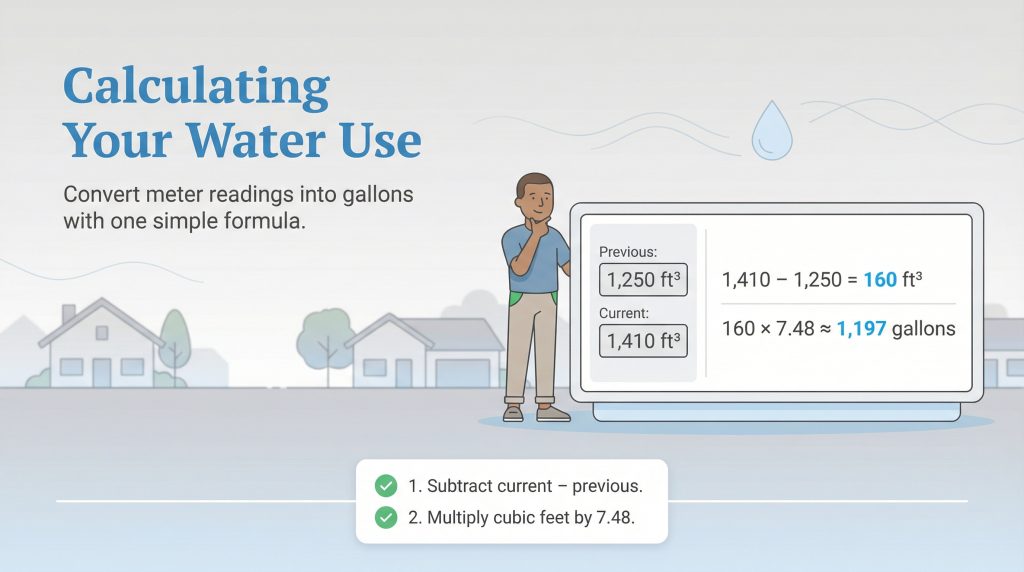
Understanding the numbers is great, but knowing what they mean for your wallet is even better. Most water utilities bill in units of 100 cubic feet (often abbreviated as CCF) or by the thousand gallons. If your meter measures in cubic feet, the number might feel abstract because we do not usually think of liquids in terms of “feet.”
To make sense of your usage, you can convert cubic feet to gallons using a simple formula. Subtract your previous reading from your current reading to find the cubic feet used. Then, multiply that difference by 7.48 to see how many gallons you used during that period. For example, if last month’s reading was 1,250 cubic feet and this month’s reading is 1,410 cubic feet, you used 160 cubic feet. Multiply 160 by 7.48 to get roughly 1,197 gallons for the month.
Using Your Meter to Detect Leaks
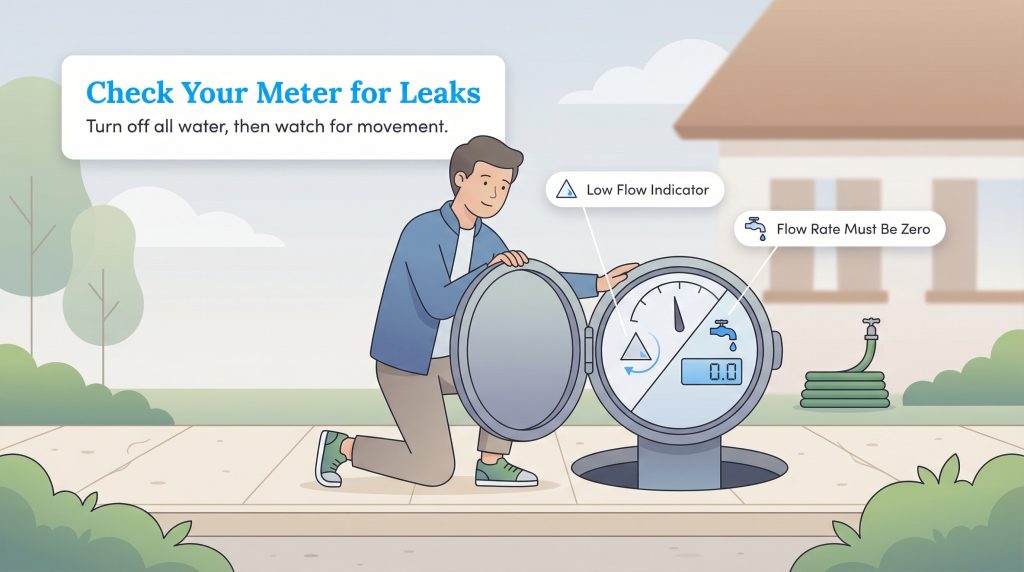
This is one of the most valuable skills you can learn as a homeowner. Your meter acts as a highly accurate water meter leak detector. On an analog meter, look for a small shape on the face, often a triangle, star, or gear, known as the “Low Flow Indicator.” If you have turned off all water sources inside and outside your house (sinks, washing machines, hoses) and this little indicator is still moving, you almost certainly have a leak.
For digital meters, leak detection is built into the screen. Look for a small icon, such as a dripping faucet, or check if the flow rate number is anything other than zero when water is off. You can check your water meter for leaks using this simple method:
- Turn off all water inside and outside the home.
- Check the low flow indicator on analog meters or the flow rate on digital screens.
- Wait 20 minutes without using any water and compare the readings.
- If the numbers increase, water is escaping somewhere in your system.
If you see movement while everything is off, don’t panic. Start by checking toilets and outdoor irrigation first, they are some of the most common hidden leaks. This simple check aligns with sustainable living practices by helping you stop waste immediately.
Take Control of Your Water Bill Today
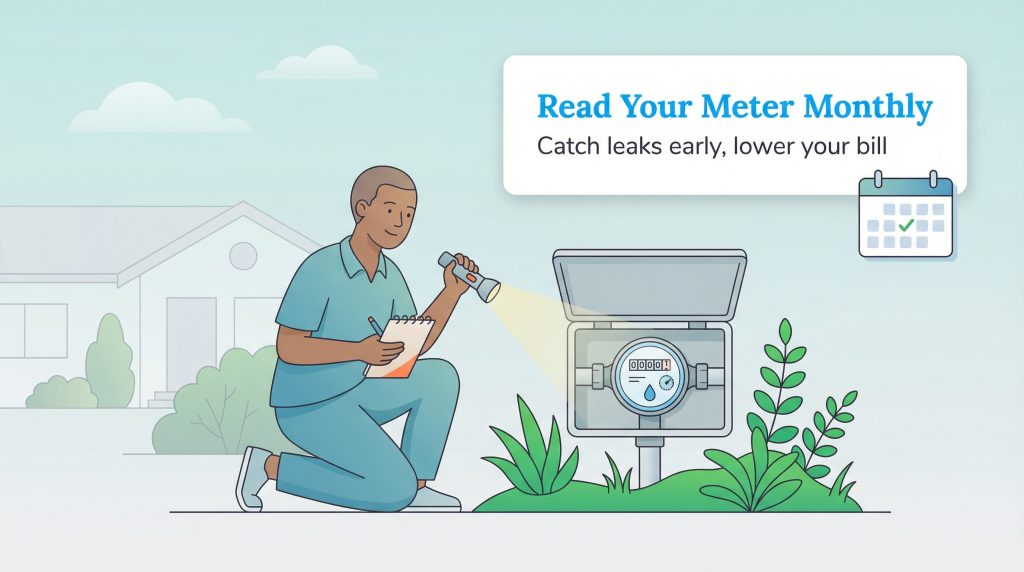
Reading your water meter is a simple maintenance habit that pays off in significant savings and peace of mind. By checking your meter once a month, you can spot irregular usage patterns before they turn into a shockingly high bill. We encourage you to grab a flashlight and a notepad today to get familiar with your specific device, it is a small step that puts you in control of your home’s most vital resource. Consider adding a recurring note to your calendar to check the meter monthly; this small habit helps support eco-conscious water use and keeps your budget on track.
FAQs About Reading Water Meters
How do I read a water meter in gallons vs cubic feet?
What is the little triangle on my water meter?
Why is my digital water meter screen blank?
Where is the water meter usually located?
How do I calculate my water bill from the meter reading?
About the Author

LaLeesha has a Masters degree in English and enjoys writing whenever she has the chance. She is passionate about gardening, reducing her carbon footprint, and protecting the environment.