
Heat Pump Water Heaters Move Heat Rather Than Generating It Directly, Offering Massive Energy Efficiency for Homeowners With the Right Installation Space
Key Takeaways
- Heat pump water heaters work like a refrigerator in reverse, pulling warmth from the surrounding air to heat the water in the tank.
- Most residential units are “hybrid” systems, meaning they switch to standard electric resistance heating during periods of high demand to ensure you don’t run out of hot water.
- Proper airflow is essential for efficiency, requiring installation in a room with at least 1,000 cubic feet of space (roughly the size of a 10×12 bedroom) to function correctly.
If you’re looking for ways to slice your monthly utility bills, your water heater is one of the first places you should look. Standard electric water heaters are notorious energy hogs, but heat pump technology has completely changed the game by prioritizing physics over brute force. Instead of creating heat from scratch, these units move existing heat from the air into your water tank, a process that can cut your water heating electricity use by more than half. In this guide, we’ll break down exactly how this technology works, why it’s often called a “hybrid” system, and the specific installation requirements you need to know before making the switch.
The “Refrigerator in Reverse”: The Basic Concept
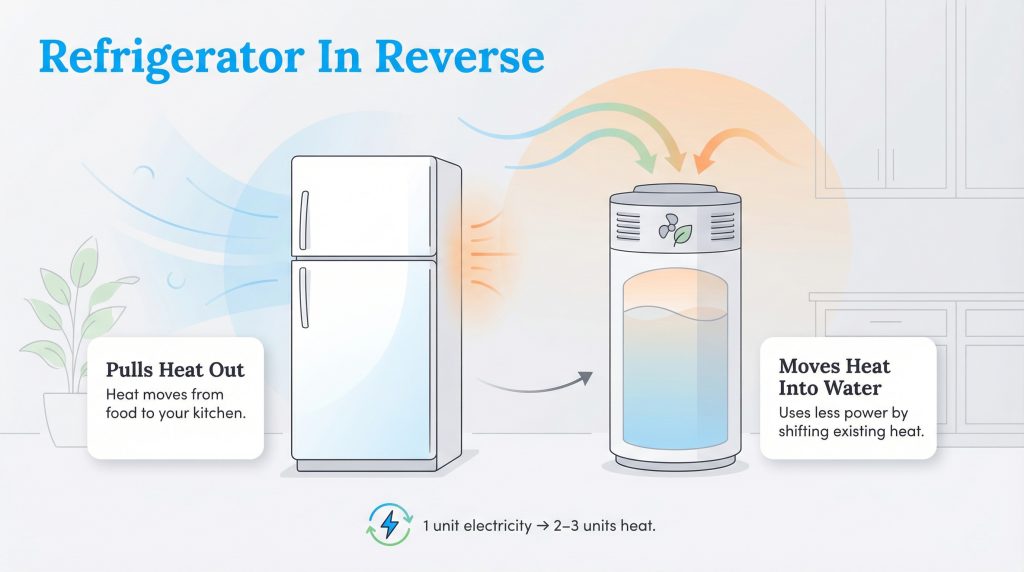
To understand how a heat pump water heater works, it helps to look at an appliance you already own: your refrigerator. A fridge keeps your food cold not by adding “coldness,” but by pulling the heat out of the insulated box and dumping it into your kitchen. That’s why the back or bottom of your fridge always feels warm.
A heat pump water heater does the exact same thing, just in reverse. Instead of pushing heat away to cool a space down, it pulls heat from the surrounding room and dumps it into the water tank. Because it’s simply moving heat rather than creating it through resistance (like a giant electric kettle or toaster), it’s incredibly efficient. In fact, for every unit of electricity it consumes to run the compressor and fan, it can move two to three units of heat energy into the water.
Step-by-Step: How the Heating Cycle Works
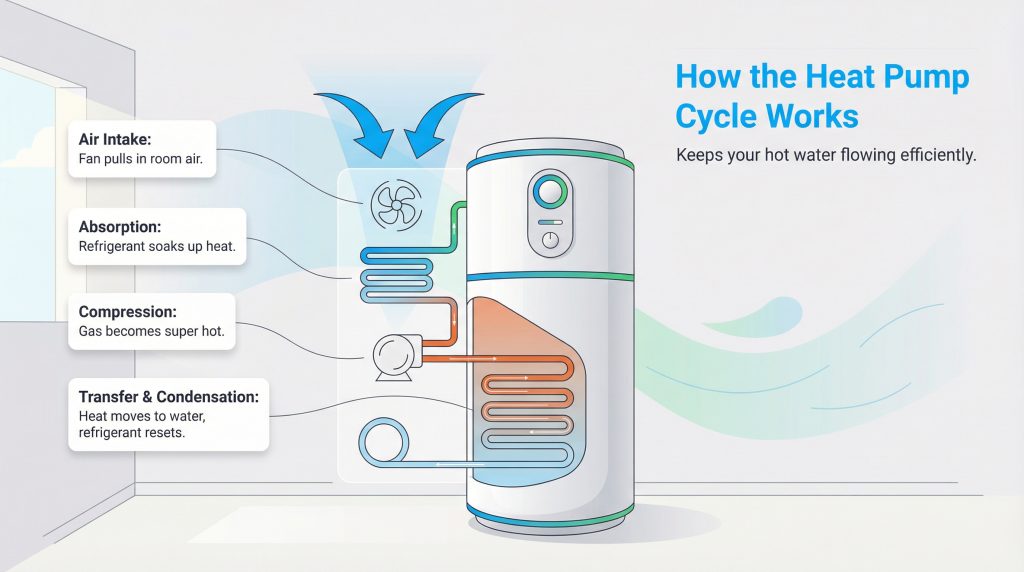
While the concept is simple, the internal mechanics rely on a smart cycle of evaporation and compression. Here’s exactly what happens inside the unit to get your shower water hot:
- Air Intake: A fan located at the top of the water heater pulls in the surrounding air from the room.
- Absorption: This air passes over an evaporator coil filled with liquid refrigerant. The refrigerant absorbs the heat from the air and immediately evaporates into a gas.
- Compression: The gaseous refrigerant travels to the compressor, which increases the pressure. This process concentrates the heat, making the gas extremely hot.
- Transfer: The now super-heated gas flows through condenser coils that are wrapped around the water tank. As the gas travels through these coils, it transfers its heat to the water inside the tank.
- Condensation: As the refrigerant releases its heat, it cools down and turns back into a liquid, ready to restart the cycle.
Why Are They Often Called “Hybrid” Water Heaters?
When you shop for these units, you’ll often see the terms “Heat Pump Water Heater” and “Hybrid Electric Water Heater” used interchangeably. This is because almost all residential heat pump units are hybrids. When you see “hybrid heat pump water heater” on a product label, that usually just means a standard heat pump water heater with built‑in electric backup elements.
While the heat pump mechanism is incredibly efficient, it has a slower recovery rate than standard heating elements. If you have a house full of guests all taking showers back-to-back, the heat pump alone might struggle to keep up. To prevent you from ending up with a cold shower, manufacturers install standard electric resistance heating elements, similar to those found in a conventional electric water heater, inside the tank as a backup.
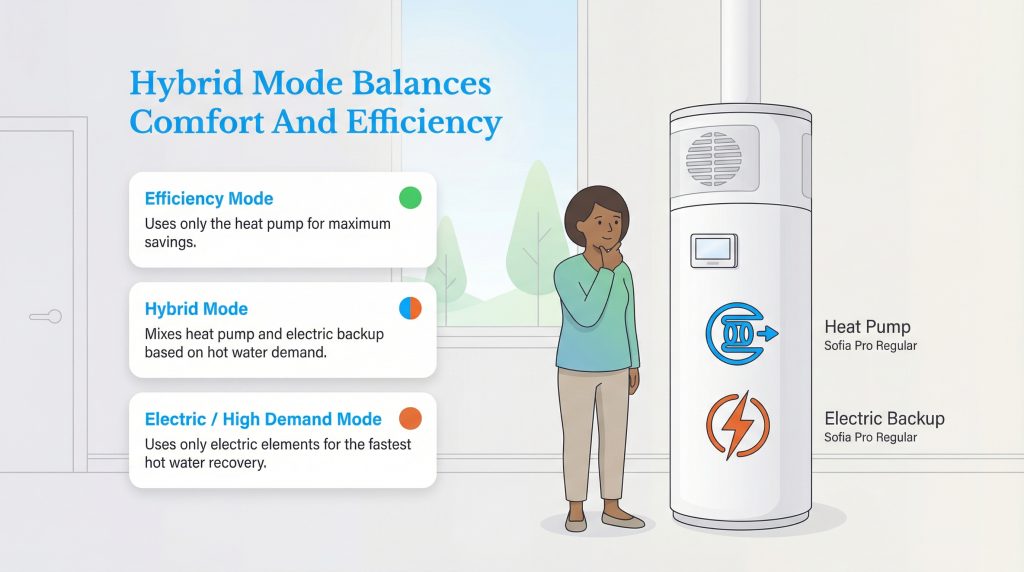
Most units offer different operating modes to let you balance efficiency with comfort:
- Efficiency Mode: Uses only the heat pump. This saves the most money but recovers hot water more slowly.
- Hybrid Mode: The unit automatically switches to standard electric resistance heating only when demand is high, prioritizing the heat pump whenever possible.
- Electric/High Demand Mode: Bypasses the heat pump entirely and uses the resistance elements for the fastest recovery (and highest electricity usage).
The Pros and Cons of Heat Pump Water Heaters
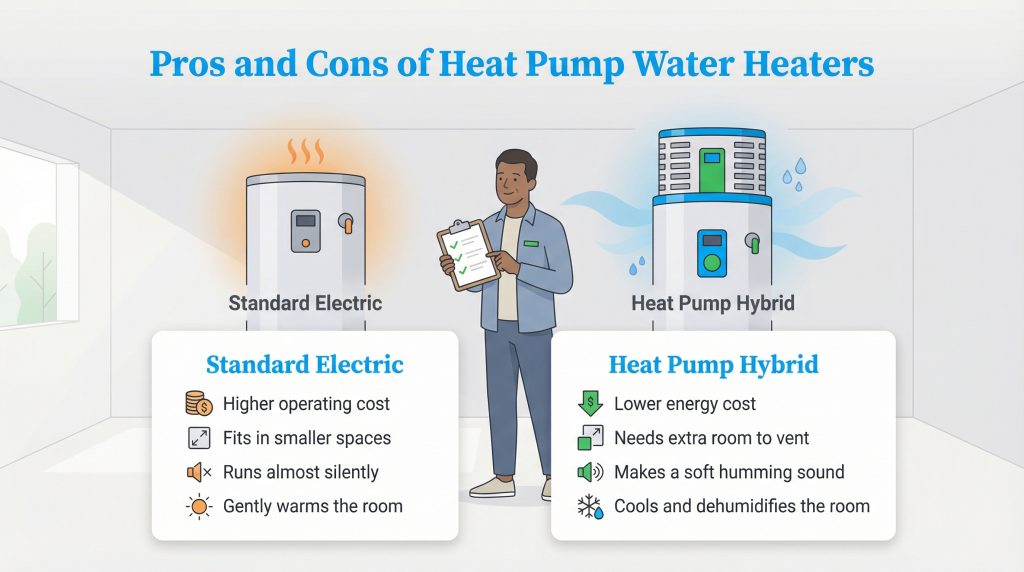
Before you commit to a hybrid system, it’s important to weigh the benefits against the operational quirks. These units are fantastic money-savers, but they behave differently than the silent, passive water heaters most of us grew up with.
| Pros | Cons |
|---|---|
| Massive Savings: High Uniform Energy Factor (UEF) ratings mean they can reduce water heating costs by up to 60%. | Upfront Cost: The purchase price is significantly higher than a standard electric unit (though rebates help). |
| Dehumidification: Reduces moisture in damp basements, preventing mold and mildew growth. | Noise: Operates with a fan and compressor, creating noise levels similar to a dishwasher (around the 50‑decibel range on many models). |
| Incentives: In many areas, eligible for significant federal tax credits and local utility rebates. | Cold Exhaust: Blasts cool air into the surrounding space, which can be a drawback in heated living areas during winter. |
| Smart Features: Many models come with Wi-Fi connectivity for monitoring usage and setting schedules. | Maintenance: Requires cleaning the air filter regularly to maintain airflow and efficiency. |
Hybrid Heat Pump vs. Standard Electric Water Heater
If you’re still on the fence, here is a quick breakdown of how the two technologies compare side-by-side:
- Operating Cost: Hybrid units are significantly cheaper to run, often saving hundreds of dollars annually compared to standard electric units.
- Installation Space: Standard units fit almost anywhere; hybrid units need about 1,000 cubic feet of breathing room.
- Noise Level: Standard units are silent; hybrid units hum like a fridge or dishwasher while running.
- Ambient Effect: Standard units radiate a small amount of heat; hybrid units actively cool and dehumidify the surrounding room.
Installation Requirements: Is Your Home Compatible?
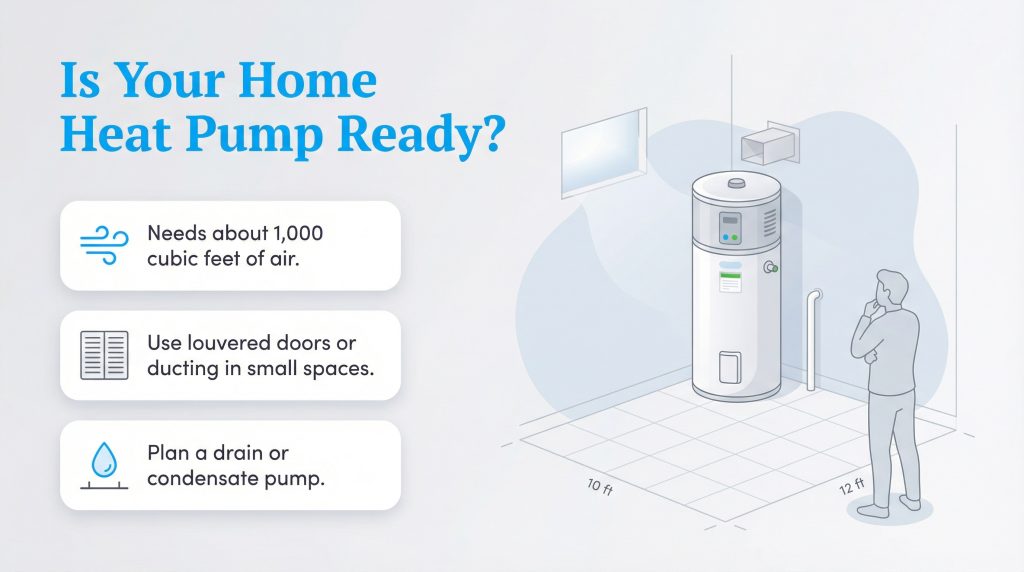
This is the most critical “barrier to entry” for heat pump water heaters. Unlike a standard tank that you can shove into a tiny closet and forget about, a hybrid unit needs to breathe.
Because the unit extracts heat from the air, it requires roughly 1,000 cubic feet of surrounding air space to operate efficiently. That’s approximately the size of a 10-foot by 12-foot room with standard ceilings. If you install it in a closet that is too small, the unit will quickly suck all the heat out of the air, turning the closet into a freezer. This causes the unit to work harder or switch to the inefficient backup electric elements.
If you must install it in a small space, you’ll need to install louvered doors (slatted doors) to allow air to pass freely between the closet and the adjoining room, or install ducting to bring in warm air from another part of the house.
Additionally, you must plan for condensate management. Just like an air conditioner, these units pull moisture out of the air, creating water that needs to go somewhere. You’ll need a floor drain, a condensate pump, or a drain line routed to the exterior.
Energy Efficiency and Cost Savings
Are Heat Pump Water Heaters Worth It for Most Homes?
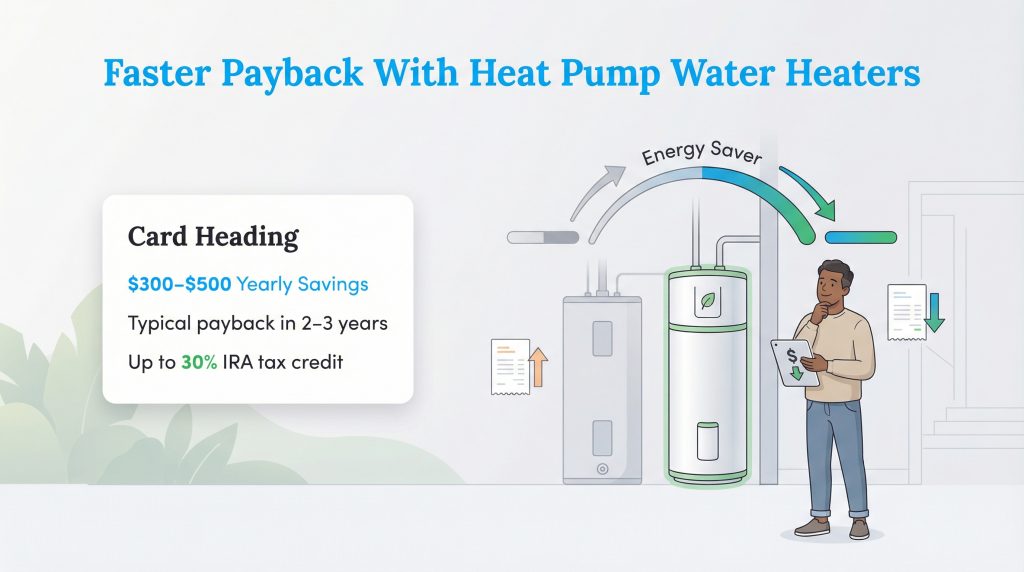
Financially, for many households, the upgrade can pay off quickly. While a heat pump water heater can cost two to three times more than a standard unit upfront, the return on investment is rapid. For a typical household of four, ENERGY STAR estimates savings of roughly $300 to $500 per year on electricity bills. This often means the unit pays for itself in just two to three years. Beyond the wallet, this efficiency translates directly to environmental impact, upgrading to a heat pump model is one of the single most effective ways to lower your home’s carbon footprint.
To sweeten the deal, the Inflation Reduction Act (IRA) currently offers federal tax credits covering up to 30% of the project cost (capped at $2,000 per year). You can check the ENERGY STAR product finder to see which models qualify and calculate your potential savings.
However, there are times when it might not be worth it. If you have very low hot water usage (for example, a single-person household), the monthly savings may not justify the higher upfront equipment cost. Similarly, if your only installation location is an unheated garage in a very cold climate, the unit may spend too much time in inefficient electric backup mode to provide a solid return on investment.
Making the Switch to Smarter Water Heating

If you have the space in your basement or garage, a heat pump water heater is a smart upgrade for many homes with the right space and usage patterns. While the mechanics might seem complex, the result is simple: you get the same hot water you’re used to, but for a fraction of the daily cost. By understanding how the technology works and preparing your installation site correctly, you can enjoy years of reliable hot water while keeping your carbon footprint, and your electric bill, firmly in check.
FAQs About Heat Pump Water Heaters
Do heat pump water heaters work in cold climates?
How loud is a heat pump water heater?
How much clearance does a heat pump water heater need?
What is the lifespan of a heat pump water heater?
Do heat pump water heaters need a drain?
About the Author

David has been an integral part of some of the biggest utility sites on the internet, including InMyArea.com, HighSpeedInternet.com, BroadbandNow.com, and U.S. News. He brings over 15 years of experience writing about, compiling and analyzing utility data.