
Understanding the Science Behind the Most Effective Home Water Filtration Method
Key Takeaways
- Reverse osmosis systems use high pressure to force water through a semi-permeable membrane, removing a high percentage of many common contaminants like lead and chlorine.
- Most residential systems rely on multi-stage filtration, including carbon pre-filters and post-filters, to protect the membrane and polish the water’s taste.
- While highly effective, these systems produce “brine” or wastewater, though modern eco-conscious features like permeate pumps can significantly reduce this impact.
If you are wondering exactly how reverse osmosis water filters work to purify your home’s water, you are in the right place. These powerful under-sink systems are the gold standard for residential purification, capable of removing up to 99% of harmful dissolved contaminants. By forcing tap water through a microscopic membrane, this robust filtration method strips away heavy metals, chemicals, and impurities, ensuring your family enjoys clean, great-tasting hydration straight from the faucet.
What is a Reverse Osmosis Water Filter?
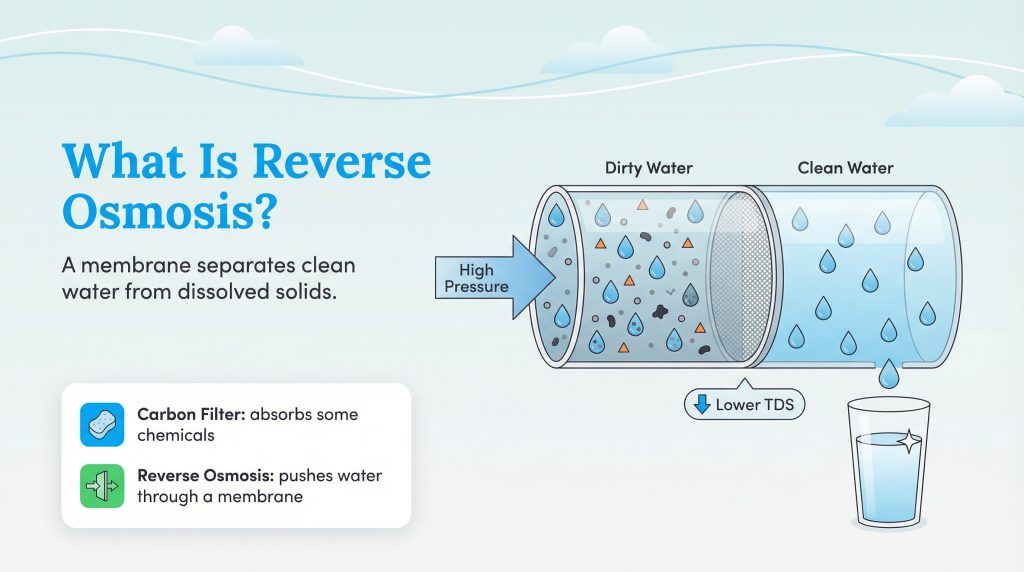
Walking down the plumbing aisle can feel like you need a chemistry degree just to understand your options. However, a reverse osmosis water filter is surprisingly straightforward once you break it down. At its core, it is an advanced water purification system that relies on physical separation rather than just chemical absorption to clean your drinking supply.
Think of a semipermeable RO membrane like an incredibly tight screen door. If you throw a handful of sand at a screen door, the breeze passes right through, but the sand bounces off. In an RO system, water molecules are the “breeze” that fits through the microscopic holes, while dissolved solids, like salt, lead, and natural minerals, are the “sand” that gets blocked and flushed away.
Most under-sink reverse osmosis units consist of a few primary components working together to achieve this deep clean:
- High-Pressure Pump: Depending on your home’s natural plumbing pressure, an internal pump helps push the water through the remarkably tight membrane pores.
- RO Water Storage Tank: Because the deep purification process is slow, this pressurized bladder tank stores the clean water so it is readily available the moment you need a glass.
- Dedicated Faucet: A separate, smaller faucet is installed directly on your kitchen countertop to dispense the purified water, keeping it entirely separate from your untreated tap water.
The Science: Osmosis vs. Reverse Osmosis
To truly grasp how these systems function, we first have to look at how nature handles hydration. Regular osmosis is a natural phenomenon you see every day. It is exactly what happens when plant roots soak up moisture from the soil. In nature, water naturally moves from a less concentrated solution to a more concentrated one to balance things out across a cellular boundary.
Reverse osmosis flips this natural process on its head. We don’t want perfectly balanced water; we want purely extracted water. By applying significant pressure from your home’s plumbing lines, the equipment overcomes the natural osmotic pressure. It forces the tap water against its natural inclination, pushing it from a concentrated, “dirty” state through the membrane to a pure, clean state on the other side.
Because you are actively fighting nature, this process takes considerable energy — which is why adequate water pressure is absolutely critical. Without enough physical force, the water simply will not push through the microscopic pores, and the system won’t effectively separate the clean H2O from the dissolved minerals and chemicals.
5 Stages of Reverse Osmosis Filtration
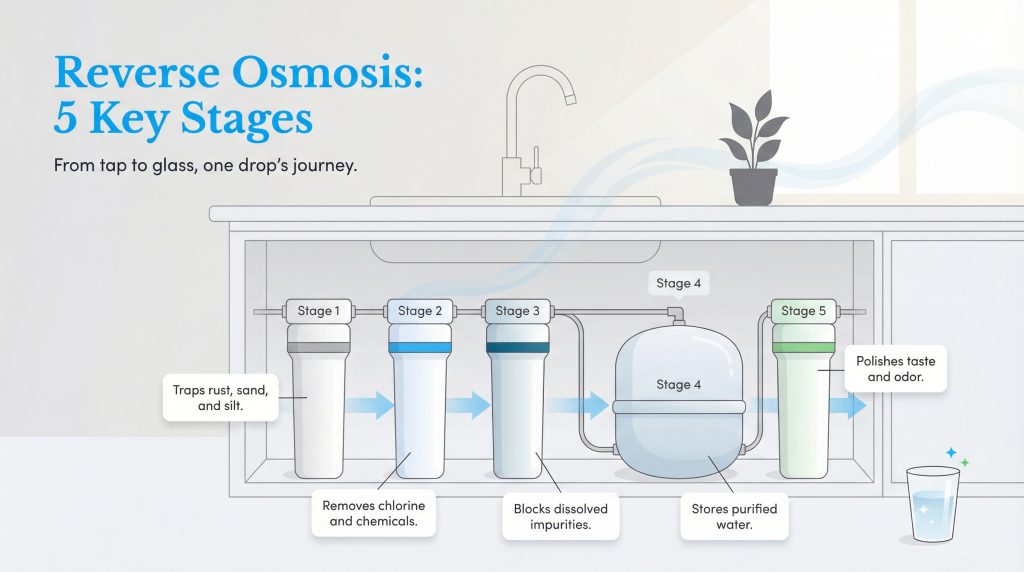
When you install an RO system, you aren’t just hooking up a single filter cartridge. You are essentially building a miniature water treatment plant right inside your kitchen cabinet. Many standard under-sink units use a sequential multi-stage process to ensure the water is spotless and tastes incredibly fresh. Here is the step-by-step journey your water takes through the reverse osmosis process steps.
Stage 1: Sediment Pre-Filtration
The first line of defense is the sediment pre-filter. As water enters the system, it passes through this dense, sponge-like cartridge designed to catch all the big, abrasive particles. We are talking about rust flaking off old city pipes, dirt, silt, and sand. If these larger particles made it further into the system, they would easily tear or clog the delicate RO membrane. Think of this stage as the bouncer at the door, keeping the most obvious troublemakers out.
Stage 2: Carbon Filtration
Once the rough sediment is cleared away, the water flows straight into an activated carbon filter. This stage is absolutely crucial because municipal city water is heavily treated with chlorine and chloramines to kill off bacteria. While fantastic for broad sanitation, chlorine acts like battery acid on a semipermeable RO membrane, degrading it rapidly. The carbon filter absorbs these harsh chemicals, neutralizing them to protect the expensive membrane while simultaneously improving the water’s initial taste and odor.
Stage 3: The Semipermeable RO Membrane
This is the undisputed heart of the entire operation. After being prepped by the first two filters, the highly pressurized water is forced against the semipermeable RO membrane. With microscopic pores sized at a staggering 0.0001 microns, it allows almost nothing but pure water molecules to physically pass through. Heavy metals, dissolved salts, fluoride, and even microscopic organic compounds are entirely blocked and flushed away down the drain. This is where the heavy lifting of true purification happens.
Stage 4: Post-Filtration (Polishing)
Because reverse osmosis works slowly — purifying the water drop by agonizing drop — the clean water is stored in an RO water storage tank until you turn on the tap. When you finally lift the handle on your dedicated faucet, the water leaves the tank and passes through one last carbon post-filter. Often called a “polishing” filter, this crucial stage removes any stagnant, slightly rubbery tastes or odd odors the water might have picked up while sitting inside the pressurized storage bladder.
Stage 5: Remineralization Filter
The RO membrane is so exceptionally good at its job that it removes healthy, naturally occurring minerals like calcium and magnesium alongside the dangerous contaminants. This can leave the water tasting slightly flat or overly acidic to some palates. A remineralization filter solves this by introducing a carefully measured dose of beneficial minerals back into the purified water just before it hits your glass. It balances the pH and provides that crisp, refreshing spring water taste many families prefer.
Contaminants Removed by Reverse Osmosis
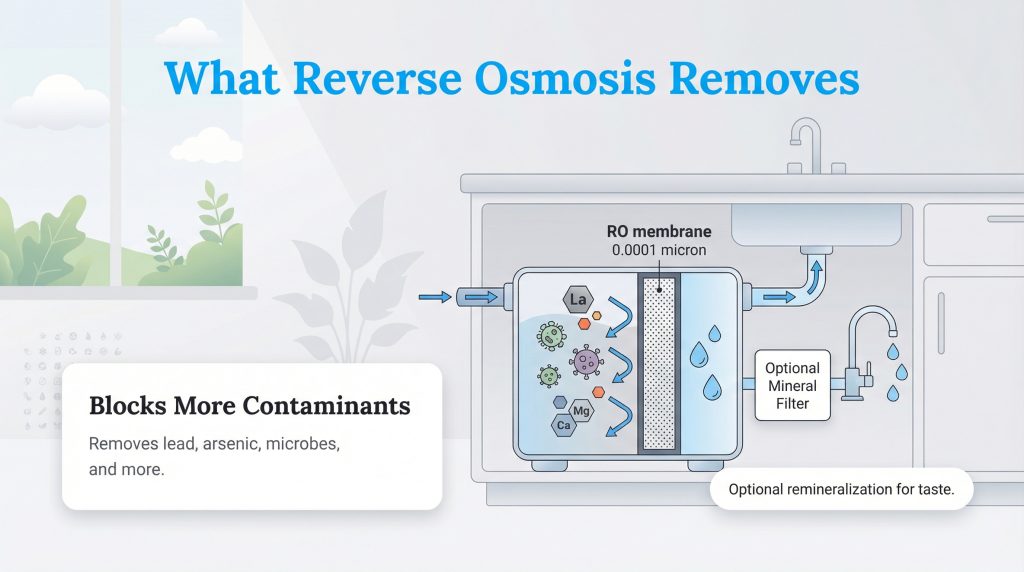
The primary reason homeowners choose this advanced technology is its unparalleled ability to strip out a vast spectrum of impurities. Pitcher filters and standard fridge filters simply cannot catch the dissolved solids that an RO membrane effortlessly blocks. Because the filtration is so fine, down to 0.0001 microns, it acts as a phenomenal safety net for your family’s health.
Below is a breakdown of common contaminants and how effectively an RO system typically removes them when properly designed, certified, and maintained:
| Contaminant | Estimated Removal Rate |
|---|---|
| Lead | Typically 95% – 98% |
| Fluoride | Typically 90% – 95% |
| Arsenic | Typically 95% – 99% |
| Chlorine | 98%+ |
| Sodium | Typically 90% – 95% |
| PFAS (Forever Chemicals) | Estimated 90% – 99% |
While the table highlights what is reliably caught, it helps to clearly understand the full picture. Here is a quick look at what a point of use RO system typically removes versus what it leaves behind:
What is Removed:
- Heavy metals (Lead, Arsenic, Copper)
- Total Dissolved Solids (TDS)
- Fluoride and Chlorine
- PFAS and industrial chemicals
- Nitrates and Sulfates
What is NOT Removed:
- Certain dissolved gases (like radon or hydrogen sulfide)
- Some Volatile Organic Compounds (if the carbon pre-filters are exhausted)
- 100% of all bacteria and viruses (unless specifically paired with an ultraviolet purifier)
Find a Reverse Osmosis System for Your Home
Reverse Osmosis vs. Carbon Filter: Which is Better?
If you are comparing a full RO system to a standard under-sink carbon filter, you might wonder if the extra bulk and investment are genuinely worth it. Carbon filters act like chemical sponges, efficiently absorbing specific impurities to dramatically improve taste, but they simply cannot physically block dissolved solids.
Here is a direct comparison to help you choose the best fit for your kitchen’s needs:
| Feature | Reverse Osmosis System | Standard Carbon Filter |
|---|---|---|
| Contaminants Removed | Removes 99% of dissolved solids, heavy metals, fluoride, and chlorine. | Primarily removes chlorine, bad tastes, odors, and large sediment. |
| Cost | Higher initial cost ($200–$500) plus ongoing multi-filter replacements. | Lower initial cost ($50–$150) and cheaper replacement cartridges. |
| Maintenance | Requires swapping 3–5 filters at different intervals and sanitizing the tank. | Very simple; usually requires changing one single cartridge every six months. |
| Wastewater Production | Produces a reject stream (brine) during the physical filtration process. | Produces zero wastewater; every drop that enters the filter goes to your tap. |
If your local municipal supply is relatively safe and you just want better-tasting ice and coffee, a simple carbon filter works wonders. However, if you are dealing with private well water, high lead content, or concerning agricultural runoff, reverse osmosis is the clear, heavy-duty winner.
Managing Reverse Osmosis Wastewater (The Reject Stream)
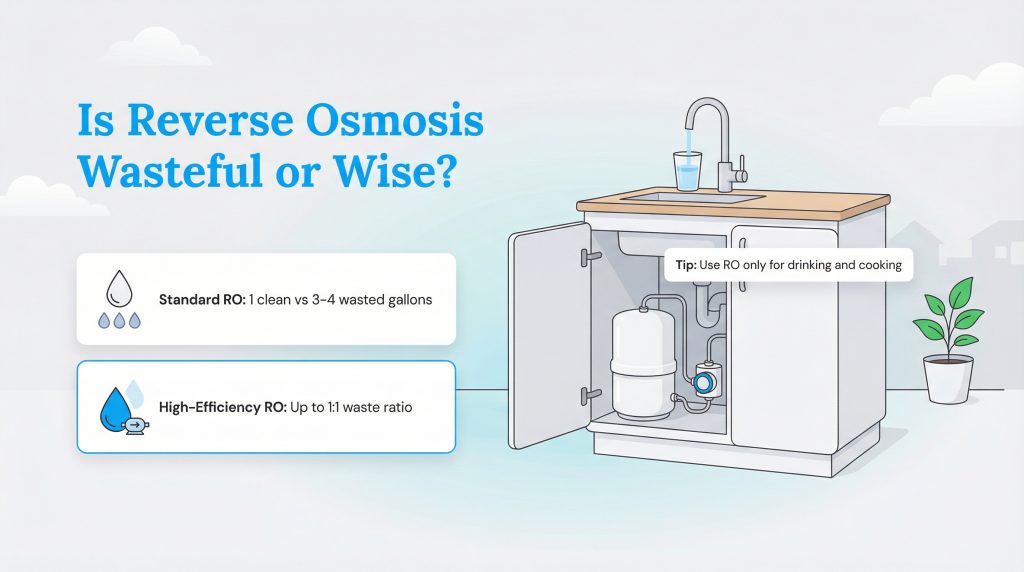
If there is one major criticism of this otherwise stellar technology, it is the reverse osmosis wastewater. To keep the delicate membrane from becoming hopelessly clogged with rejected solids, the system continuously uses incoming tap water to wash the contaminants down the drain. This necessary wastewater is commonly referred to as the “reject stream” or “brine.”
In older, standard systems, for every single gallon of pure drinking water produced, up to four gallons might go straight down the drain. For eco-conscious homeowners aiming to reduce their overall utility footprint, this lopsided ratio is understandably concerning.
Fortunately, modern engineering provides an environmentally mindful choice. High-efficiency RO systems now come equipped with a permeate pump. This non-electric, energy-saving option uses the hydraulic energy of the wastewater to boost pressure into the storage tank, dramatically reducing the waste ratio down to a respectable 1:1.
You can also take matters into your own hands to be even more sustainable. Instead of letting the reject stream flow into your plumbing drain, some creative homeowners route the brine line to a collection bucket under the sink. While you shouldn’t drink this concentrated water, it is perfectly safe for non-potable uses like watering your garden, washing your car, or mopping the floors. By choosing modern equipment and repurposing the runoff, you can enjoy pristine drinking water without the guilt of excessive waste. For more on managing your home’s water usage, check out our guide to residential water services.
Preparing Your Home for an RO System Setup
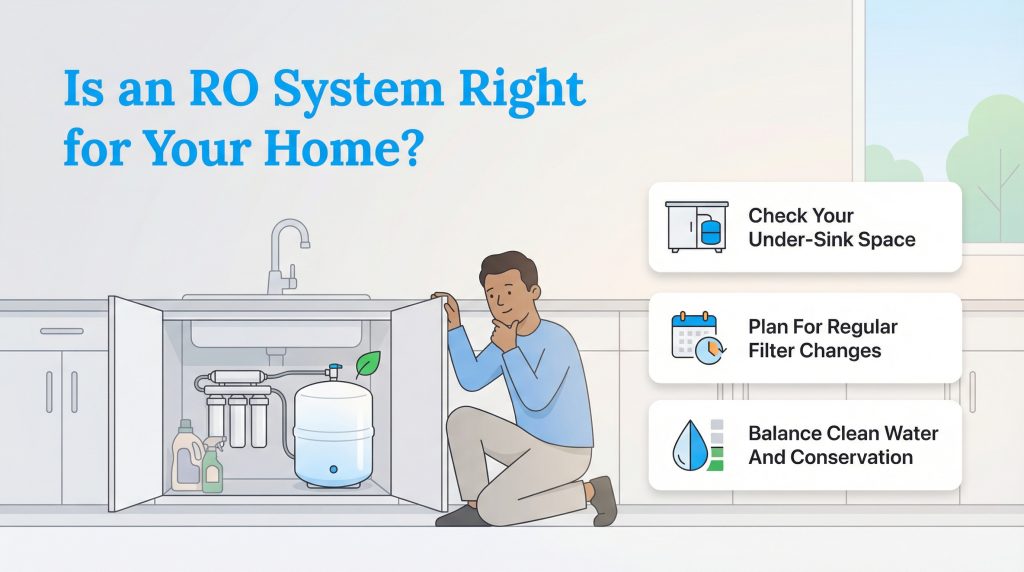
Before you clear out the cleaning supplies and start drilling a hole in your countertop, it pays to properly evaluate your kitchen space. Installing a point of use RO system is generally a straightforward weekend DIY project, but it requires a bit of thoughtful prep work to ensure it fits your lifestyle.
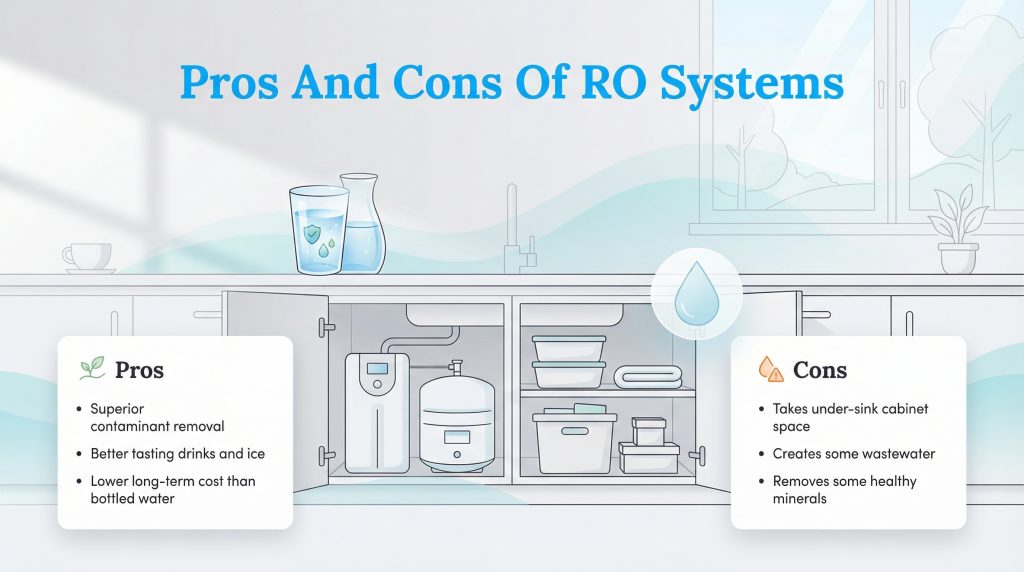
First, measure your under-sink cabinet. The RO water storage tank is roughly the size of a basketball, and the filter manifold itself will take up a significant chunk of the side wall. You need to ensure you have enough clearance to comfortably reach in and swap the filters every six months without having to dismantle your complicated plumbing setup.
Next, check your home’s overall water pressure. Because the system forces water through a stubborn semipermeable RO membrane, you need a minimum incoming pressure of 40 PSI (pounds per square inch). If your pressure is significantly lower, the system will constantly flush water down the drain without producing enough pure drinking water. In that scenario, you will need to add an electric booster pump to assist the process.
Finally, evaluate your home’s overall water hardness. If you have extremely hard water full of heavy calcium, it will scale up and destroy the delicate RO membrane prematurely. Homeowners with severely hard water should strongly consider having a whole-house water softener installed upstream. If you are on a sodium-restricted diet, an RO system is actually a fantastic investment because it removes the trace salt added by those whole-home water softeners. Speaking of whole-home utility setups, you can learn more about setting up utilities in a new home to ensure all your water systems are optimized from day one.
Learn more about Water Filtration Systems for your Home
Making the Choice for Cleaner Water
Taking the proactive step to install a reverse osmosis filter is a powerful way to seize control of your family’s hydration. While the multi-stage setup demands a bit more under-sink real estate and occasional routine maintenance than a basic fridge pitcher, the ultimate peace of mind is unmatched. You are effectively putting a microscopic security guard at your kitchen sink, ensuring every single drop you pour is free of harsh chemicals and hidden heavy metals. By carefully weighing your household’s unique water conditions, prioritizing eco-friendly permeate pumps, and staying on top of scheduled filter changes, you can confidently secure laboratory-grade drinking water for years to come.
Get a Reverse Osmosis System for your Home
Frequently Asked Questions About Reverse Osmosis
Do reverse osmosis systems remove healthy minerals from water?
Yes, the semipermeable membrane is so highly effective that it strips away beneficial minerals like calcium and magnesium alongside dangerous contaminants. However, we naturally source the vast majority of our necessary dietary minerals from the balanced food we eat, not the water we drink. If you miss the crisp taste of natural mineral water, an inline remineralization filter easily solves this by adding healthy calcium back into the final product just before you drink it.
How often do I need to replace the semipermeable RO membrane?
The core RO membrane is incredibly durable and typically lasts between two to three years under normal household use. To hit that extended lifespan, you absolutely must replace the sediment and carbon pre-filters every six to 12 months. If you neglect the pre-filters, abrasive dirt and harsh chlorine will quickly push through and destroy the delicate membrane in a matter of weeks.
Is reverse osmosis water the same as distilled water?
While both are highly purified forms of drinking water, the processes used to create them are completely different. Distilled water is created by actively boiling tap water into hot steam and then condensing it back into a liquid, leaving heavy solids behind. Reverse osmosis achieves a remarkably similar level of purity through a physical filtration method, forcing water through a microscopic membrane using high plumbing pressure rather than heat.
Is reverse osmosis water good for you?
Absolutely. Reverse osmosis water is widely recognized as a safe, highly purified option because it successfully eliminates dangerous contaminants like heavy metals, toxic nitrates, and parasites. In fact, the Centers for Disease Control and Prevention (CDC) notes that RO systems are highly effective at blocking dangerous protozoa like Cryptosporidium and Giardia.
What is the difference between reverse osmosis and a carbon filter?
A standard carbon filter significantly improves taste and odor by absorbing chemicals like chlorine, acting very much like a sponge. However, it cannot physically remove dissolved minerals, salts, or heavy metals. Reverse osmosis pushes water through an ultra-tight membrane to physically block and wash away dissolved solids, offering a much deeper and more comprehensive level of purification for your household.
Can I install a reverse osmosis system myself?
Yes, installing an under-sink RO system is considered a manageable DIY project for homeowners comfortable with basic hand tools. The setup generally involves connecting a feed water adapter to your cold line, installing the drain saddle on your pipes, and occasionally drilling a hole for the dedicated faucet. If you are handy with a wrench and a drill, it takes about two hours. If you are uncomfortable altering your plumbing, a local professional plumber can easily knock it out quickly.
About the Author

LaLeesha has a Masters degree in English and enjoys writing whenever she has the chance. She is passionate about gardening, reducing her carbon footprint, and protecting the environment.