Discover How American Electric Power Works, Compare Top Energy Plans, and Learn How to Quickly Report Power Outages in Your Area
Key Takeaways
- AEP serves as the local utility managing power lines and restoring outages across 11 states, while AEP Energy acts as a competitive retail supplier in deregulated markets.
- You can check and report outages quickly by texting “OUT” to 23701 or viewing the interactive live map on your regional subsidiary’s website.
- Understanding the “Price to Compare” on your monthly bill is the most important step in finding the best electricity rates and avoiding hidden charges when moving into a new home.
Setting up utilities in a new home can feel overwhelming, especially when you’re trying to figure out the difference between your local utility company and your energy supplier. If you’re moving to one of the 11 states served by American Electric Power (AEP), you might be wondering what role they play in keeping your lights on and how to actually get your service turned on before moving day. We’ve put together this comprehensive guide to help you set up your new AEP account, navigate regional coverage areas, understand their billing processes, and use their mobile tools. Whether you need to decode the “Price to Compare” on your monthly statement, shop for competitive AEP Energy plans, or find the best eco-conscious alternatives for your household, we’re here to help you make sense of it all.
AEP vs. AEP Energy: What Is the Difference?
American Electric Power (AEP) is one of the largest and most influential electric utilities in the United States. Headquartered in Columbus, Ohio, AEP operates roughly 225,000 miles of distribution lines and 40,000 miles of high-voltage transmission lines, making up the largest transmission network in North America. Founded in 1906, AEP has grown into an industry cornerstone with a market cap near $45 billion.
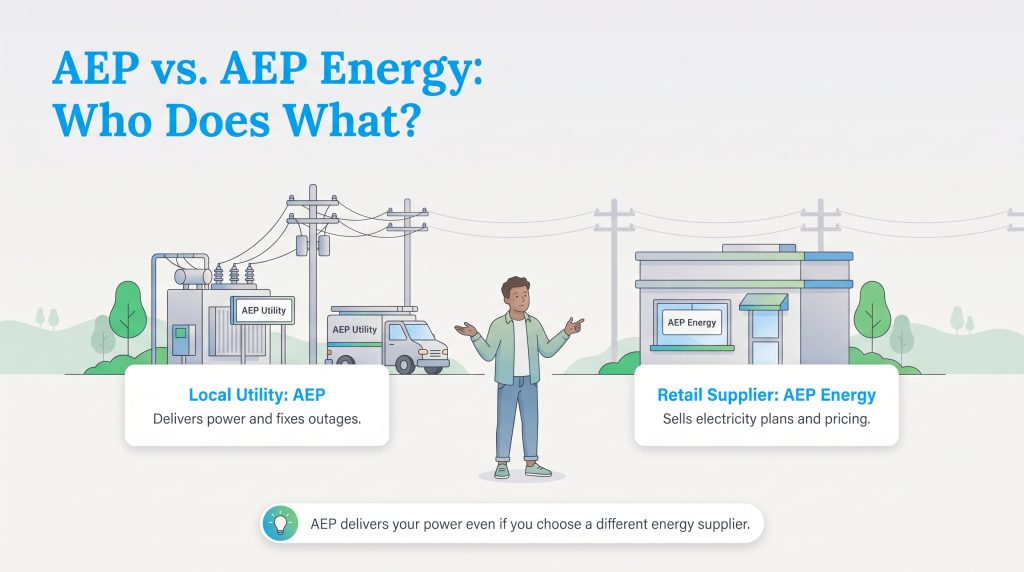
Still, a major point of confusion for many homeowners and renters is understanding AEP vs AEP Energy. If you live in a regulated state, AEP is your one-stop shop for everything related to your electricity. However, if you live in a deregulated market, their roles are strictly divided to promote competition. One common misconception involves Texas: while AEP Texas operates as a deregulated Transmission and Distribution Utility (TDU) that maintains the poles and wires, AEP Energy does not actually sell retail residential electricity plans in Texas. Instead, AEP Energy focuses its retail supply plans in six active markets: Ohio, Illinois, Pennsylvania, Delaware, Maryland, and New Jersey.
| Feature | AEP (Local Utility) | AEP Energy (Retail Supplier) |
|---|---|---|
| Primary Role | Delivers electricity, maintains physical power lines, and restores power outages. | Sells electricity directly to consumers and sets rate plan contracts and pricing. |
| Service Area | Operates across 11 states (covering both regulated and deregulated regions). | Operates exclusively in select deregulated markets: Ohio, Illinois, Pennsylvania, Delaware, Maryland, and New Jersey. |
| Billing Impact | Issues your monthly utility bill and collects mandatory delivery and distribution charges. | Appears as a line-item supply charge on your standard utility bill (or bills separately). |
| Emergency Contact | Call AEP immediately to report a downed power line or a localized neighborhood outage. | Do not call AEP Energy; they do not own the grid and cannot fix infrastructure outages. |
📌 Quick Fact: Even if you choose a completely different retail energy supplier for your home, AEP will still remain your local utility responsible for keeping the grid running smoothly.

- Calculate Your Moving Costs
- Compare Moving Companies
- Get Multiple Quotes
- Move with Confidence
AEP Coverage Area and Regional Subsidiaries
The AEP coverage area spans a massive footprint across the country, serving over 5.6 million customers. In most cases, you’ll find them operating as the delivery/distribution utility — the company responsible for maintaining the wires, poles, and meters in your neighborhood. Looking at an AEP service territory map helps illustrate just how vast their network really is.
AEP Coverage Map
AEP currently provides service across the following 11 states:
- Arkansas
- Indiana
- Kentucky
- Louisiana
- Michigan
- Ohio
- Oklahoma
- Tennessee
- Texas
- Virginia
- West Virginia
Depending on where you live, your electric service is managed by one of seven regional AEP operating companies. Notably, if you live in the Buckeye State, you may notice your statements now reflect the utility’s official corporate transition to Ohio Power Company (formerly doing business as AEP Ohio). Here is a complete reference directory of the seven regional subsidiaries, the major cities they cover, and the verified AEP customer service phone number for your area:
| Subsidiary Name | States Served | Major Cities Covered | 24/7 Customer Support & Outage Phone Number |
|---|---|---|---|
| Ohio Power Company (formerly AEP Ohio) | Ohio (Central, Southern, and Northwestern regions) | Columbus, Gahanna, Dublin, Athens, Portsmouth, Zanesville, Wooster, Canton, Findlay, and Lima | 1-800-672-2231 |
| AEP Texas | Texas (97,000 square miles across Central and North Divisions) | Central Division: Corpus Christi, McAllen, Laredo, Harlingen, and Victoria; North Division: Abilene, San Angelo, Alpine, and Vernon | Support: 1-877-373-4858 / Outages: 1-866-223-8508 |
| Appalachian Power | West Virginia, Virginia, and Northeast Tennessee | Charleston, Huntington, and Wheeling (WV); Roanoke (VA); Kingsport (TN) | 1-800-956-4237 |
| Public Service Company of Oklahoma (PSO) | Oklahoma | Tulsa, Lawton, and McAlester | 1-888-216-3523 |
| Southwestern Electric Power Company (SWEPCO) | Western Arkansas, Northwestern/Central Louisiana, and East Texas | Shreveport and Bossier City (LA); Longview and Texarkana (TX); Fayetteville (AR) | 1-888-216-3523 |
| Indiana Michigan Power (I&M) | Indiana and Michigan | Fort Wayne, South Bend, Muncie, Anderson, Elkhart, Mishawaka, Goshen, Marion, and Portage | 1-800-311-4634 |
| Kentucky Power | Eastern Kentucky (parts of 20 counties) | Ashland, Pikeville, Hazard, Paintsville, and Whitesburg | 1-800-572-1113 |
How to Start, Transfer, or Stop AEP Service for Your New Home
Moving is stressful enough without having to unpack your boxes in the dark. Whether you’re relocating across the country into an AEP territory or just moving across town and transferring your existing account, setting up your electricity only takes about 10 minutes online. Follow this step-by-step checklist to get your home connected smoothly:
- Identify Your Operating Company: Start by visiting AEP.com and entering your new five-digit ZIP code. Because AEP operates through regional subsidiaries, the portal will automatically route you to your specific state operating company (such as Ohio Power Company, Appalachian Power, or PSO) to complete your service request. Note that if you’re moving to the AEP Texas territory, you must set up your service through a competitive retail electric provider on the official Power to Choose website, and they will coordinate with AEP Texas on your behalf.
- Gather Required Documentation: Before starting your online application or calling customer support, have your essential paperwork ready. You’ll need your exact new service address (including apartment or unit numbers), your official move-in date, your Social Security Number (SSN) or government-issued photo ID to run a soft credit check, and your landlord’s contact and lease information if you’re renting.
- Pay or Waive the Security Deposit: When you apply for new service, AEP performs a soft inquiry on your credit history to determine if an upfront security deposit is required. You can typically waive this deposit automatically with a good credit score. If your credit score falls short, don’t worry — you can often get the deposit waived by submitting a formal Letter of Credit from your previous electric utility showing 12 consecutive months of on-time payments, or by enrolling in automatic bank draft (Autopay) in select territories.
- Schedule Your Connection Timeline: We recommend submitting your start, stop, or transfer request at least three to five business days before your target move-in date. While homes equipped with modern digital smart meters can often be activated remotely within 24 hours, older properties or homes where power has been shut off for several months may require an in-person technician visit.
💡 Pro Tip: If you’re transferring service from one address to another within the same AEP subsidiary territory, you can overlap your service dates by a few days in your online portal so you have power at both locations while you clean and move.
AEP Energy Plans, Pricing, and Fees
If you live in a deregulated region like Ohio, Pennsylvania, or Illinois, your electric bill is split into two distinct parts: delivery charges (paid to your local utility for maintaining the grid) and supply charges (for generating the electricity you use). If you don’t actively pick a retail electric provider, your utility will supply your electricity at a default rate known as the Price to Compare (PTC). When you are choosing an electric provider, your main goal is to find AEP Ohio electric rates — or competitive supply rates in your specific territory — that beat your utility’s PTC benchmark. Ohio residents can easily verify how AEP Energy stacks up against the default rate using the state’s Energy Choice Ohio Apples to Apples comparison tool.
AEP Energy operates as a competitive supplier offering various plans designed to fit different household budgets. Understanding the difference between their plan structures is essential to avoiding sudden seasonal bill spikes.
| Plan Type | How It Works | Best For… |
|---|---|---|
| Fixed-Rate Plans | Locks in your price per kilowatt-hour (kWh) for the entire duration of your contract (typically 12 to 36 months). | Homeowners seeking predictable monthly bills and protection against volatile summer and winter energy market spikes. |
| Variable-Rate Plans | Your price per kWh fluctuates month-to-month based on wholesale energy market conditions and seasonal demand. | Short-term renters or those who want the flexibility to switch providers at any time without paying cancellation fees. |
Fees and Guarantees
Before you commit to any AEP Energy plans, take five minutes to read the fine print on your EFLs (Electric Facts Labels) or terms of service documents. Like most retail providers, AEP Energy enforces specific contractual fees that can catch you off guard if you aren’t paying attention.
If you enroll in a fixed-rate plan and decide to cancel your service before the contract expires, you’ll generally face an early termination fee (ETF). These standard cancellation fees typically range from $50 to $150, depending on your state and the remaining length of your term. However, if you move outside of AEP Energy’s service area before your contract is up, they will normally waive the termination fee once you provide proof of relocation. Additionally, missing your payment due date will result in a 1.5% late payment fee applied to your outstanding balance on the next billing cycle.
💸 Money-Saver: Set a calendar reminder for 30 days before your fixed-rate energy contract expires. This gives you plenty of time to shop for a new rate before your provider transitions you to an expensive default variable plan.
Why Choose (or Avoid) AEP Energy: Who Is It Best For?
If you live in a deregulated state like Ohio or Pennsylvania, you aren’t obligated to sign up with AEP Energy just because AEP is your local utility. You have the freedom to stay on your utility’s default Price to Compare rate, choose AEP Energy, or pick a third-party competitor. To help you decide whether enrolling with AEP’s retail arm makes sense for your household, we broke down who benefits most from their plans and who should steer clear.
| Who Should Choose AEP Energy | Who Should Avoid AEP Energy |
|---|---|
| Long-Term Homeowners: Ideal if you want 12- to 36-month fixed-rate stability to lock in your supply rate and shield your budget from winter heating or summer cooling market spikes. | Short-Term Renters: If you might break your lease or switch providers early, you risk paying a $50 to $150 Early Termination Fee on fixed-rate contracts. |
| Eco-Conscious Consumers: Great for households looking for an eco-conscious alternative through 100% Green-e® certified renewable energy (ECO-Advantage plans). | Hands-Off Consumers: If you tend to “set and forget” your bills and miss contract renewal notices, you risk automatic rollover onto expensive month-to-month variable rates once your term ends. |
| Perk & Rewards Shoppers: Enrollees earn AEP Energy Reward Dollars simply for paying bills on time, which can be redeemed in their online store for smart thermostats, LED bulbs, and gift cards. | Strict Bargain Hunters: During mild weather seasons when the local utility’s default “Price to Compare” (PTC) drops below AEP Energy’s fixed promotional rates, you’ll save more by sticking with the default utility supply. |
| Simplicity Seekers: Best for customers who prefer consolidated billing, keeping their retail supply charges and utility delivery charges unified on a single monthly AEP statement. | Texas Residents: Because AEP Energy doesn’t offer residential retail plans in Texas, households in Corpus Christi or Abilene will need to shop for another retail electric provider. |
Deals, Discounts, and Ways to Save on Your AEP Bill
Managing utility costs goes beyond simply securing a low rate per kWh. AEP offers several practical programs, billing tools, and rebates designed to lower your consumption and provide financial relief to households that need it most.
- Power Rewards: Smart Thermostat Program: AEP heavily incentivizes smart home technology as an energy-saving option. By enrolling a qualifying Wi-Fi smart thermostat in their demand-response program, you can earn an upfront enrollment bonus (often around $50, depending on your subsidiary). AEP will occasionally adjust your thermostat by a few degrees during peak grid emergencies, though you always maintain ultimate control to override the setting.
- Energy Efficiency Upgrades: AEP routinely offers instant discounts and mail-in rebates for upgrading your home’s efficiency. Depending on your state, you can claim rebates on ENERGY STAR certified appliances, professional HVAC tune-ups, heat pump installations, and home weatherization (like sealing ducts or adding attic insulation).
- Low-Income Payment Assistance: If you are struggling to keep up with your American Electric Power bill pay schedule, you have options. AEP participates in the federal LIHEAP (Low-Income Home Energy Assistance Program). Additionally, they offer state-specific crisis programs, such as the PIPP Plus (Percentage of Income Payment Plan) in Ohio, which caps your monthly bill at a manageable percentage of your household income.
- Average Monthly Payment (AMP) / Budget Billing: Nobody likes opening a shockingly high electric bill in the middle of an August heatwave or a January freeze. AEP offers levelized billing — known as the Average Monthly Payment (AMP) plan — which averages your past 12 months of electricity usage on a rolling basis. While AMP doesn’t lower your actual rate per kWh, it smooths out seasonal winter and summer bill spikes so you pay a predictable, steady amount each month.
How to Report and Search for AEP Outages
Did the lights just flicker out? Before you panic, AEP makes it easy to see if there is a known grid issue in your neighborhood. When severe weather hits, staying informed is the best way to keep your household safe. Here is how to report an issue and track restoration updates.
- Ensure your mobile number is linked: Log into your regional AEP account online and verify that your current cell phone number is attached to your profile for text alerts.
- Send an AEP power outage text: Open your smartphone’s messaging app and text the word OUT to 23701.
- Confirm your address: Follow the automated prompts to confirm your service location and instantly report the outage to local dispatchers.
- Check the map: Open your web browser and view real-time restoration estimates on the official AEP power outage map for your state subsidiary to see how many homes are affected in your ZIP code.
If an extended blackout forces you to miss a shift as a remote worker, or if spoiled food forces you to file a homeowner’s or renter’s insurance claim, AEP has a built-in feature to back you up. Once power is restored, you can request an official Outage Verification Letter directly through your local AEP online portal to provide documented proof of the exact date and duration of your power loss.
🚩 Heads Up: If you live in an apartment, condo, or mobile home and lose power while your immediate neighbors still have their lights on, check your external breaker (usually located outside next to your electric meter) before reporting an outage to AEP, and keep a portable power bank charged during storm season to receive text alerts.
The AEP Mobile App: Features and Performance
Managing your monthly utilities shouldn’t feel like a part-time job. To streamline the process, the AEP mobile app platform gives you full control over your account directly from your smartphone. However, there is one important catch when downloading it: there is no single universal “AEP App” in the app stores. Instead, you need to search the Apple App Store or Google Play Store for your specific regional operating subsidiary app — such as Ohio Power (or AEP Ohio), Appalachian Power, SWEPCO, PSO, or Indiana Michigan Power.
Once you download your regional subsidiary’s official app, you get access to several convenient features:
- American Electric Power Bill Pay: Securely view your monthly statements, schedule one-time payments, or enroll in Autopay and Average Monthly Payment plans so you never miss a due date.
- Outage Tracking: Report blackouts with a single tap, view the interactive AEP power outage map, and monitor repair crew progress via push notifications.
- Usage Monitoring: View your daily and hourly energy consumption graphs (in smart-metered homes) to identify which appliances are driving up your costs.
While the subsidiary apps offer helpful tools, it helps to temper your expectations. When reviewing user feedback on the Apple App Store and Google Play Store, we noticed a trend of customer complaints regarding intermittent login errors and occasional missed payment glitches. Sometimes the app drops biometric login credentials (like Face ID) after a system update, forcing users to manually reset their passwords. If you experience payment processing hiccups on the mobile app, we recommend logging into the desktop web portal or calling the automated pay-by-phone system to ensure your account stays in good standing.
Sustainability and Green Energy Initiatives
If you care about your household’s environmental footprint, you’ll be glad to know that AEP has made major commitments to cleaner energy and smarter grid consumption. While the company still relies on traditional generation across its territory, they have retired more than 8,000 MW of coal capacity since 2015 and plan to cut carbon emissions 80% below 2005 levels by 2030.
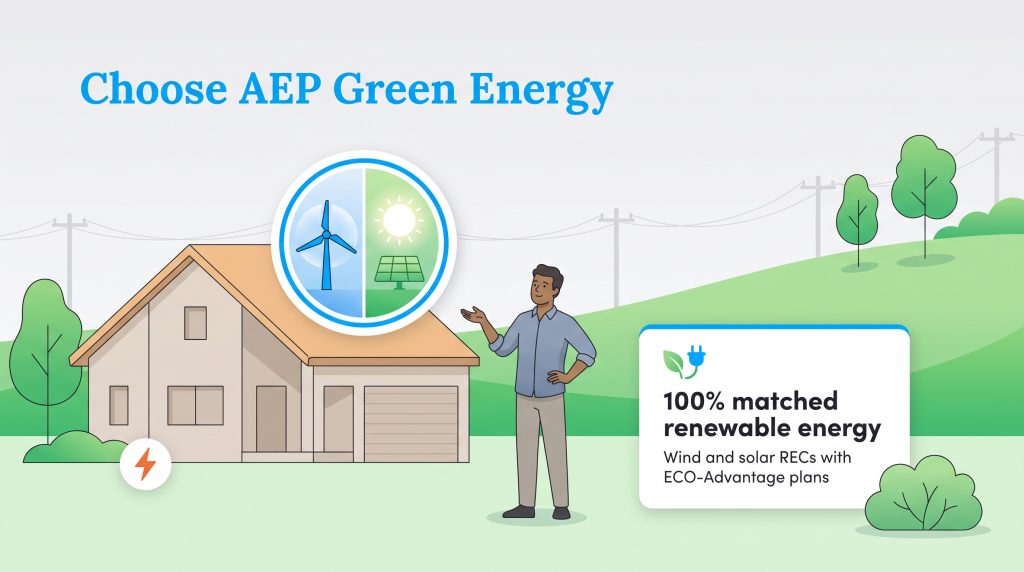
For everyday consumers looking to make an immediate impact, AEP green energy solutions provide an actionable path forward. Through AEP Energy, customers in deregulated markets can enroll in ECO-Advantage plans. These specialized retail plans guarantee that 100% of your home’s electricity usage is matched by Green-e® certified wind or solar renewable energy credits (RECs). Opting into a 100% renewable plan is a simple, environmentally mindful choice that supports clean energy infrastructure without requiring you to install expensive solar panels on your own roof.
What People Are Saying: AEP Reviews and Complaints
When evaluating any utility or retail supplier, it always helps to hear from everyday consumers. We analyzed aggregate American Electric Power reviews across Trustpilot, Better Business Bureau (BBB) profiles, local community Reddit forums, and state public utility complaint boards to understand how customers truly feel about their service.
- The Pros: Many homeowners praise AEP for the professionalism and dedication of their field technicians. Customers consistently highlight how hard the repair crews work during severe storms, often restoring power faster than initially estimated. Additionally, users appreciate the accuracy of the interactive outage map and the convenience of the text alert system.
- The Cons: Negative reviews on BBB profiles and filings with state Public Utilities Commissions (such as PUCO in Ohio and PUCT in Texas) largely center around rising mandatory delivery and distribution charges. Consumers frequently voice frustration over unavoidable infrastructure fees — such as AEP Texas TDU delivery charges and Ohio grid modernization riders — which can drive up monthly bills even when a household cuts back on electricity usage. Other common complaints involve smart meter billing disputes following meter upgrades, long hold times when calling customer service, and localized outages in heavily wooded rural areas. On the retail side, some AEP Energy customers report billing confusion when their promotional fixed rates expire and automatically roll over into pricier month-to-month variable rates.
Making the Best Energy Choice With AEP
At the end of the day, American Electric Power is an established utility you can rely on when moving into your new home. They are financially strong, tightly regulated, and investing billions into vital grid modernization and renewable energy infrastructure. Once you identify your regional subsidiary and set up your account a few days before move-in day, their outage communication tools and mobile usage tracking make managing your account straightforward.
For those living in deregulated areas, remembering the distinct difference between your local utility (such as Ohio Power Company or AEP Texas) and your retail supplier (AEP Energy or a competitor) is the secret to unlocking major savings. By actively comparing the Price to Compare against competitive retail plans, keeping an eye on your contract expiration dates, and utilizing available smart home rebates or budget billing, you can keep your home powered efficiently and affordably all year long.
Frequently Asked Questions About American Electric Power
Why does my AEP Ohio bill now say Ohio Power Company?
Does American Electric Power require a deposit to start new service?
How far in advance should I set up AEP electricity before moving into a new home?
What is the AEP customer service phone number?
Does AEP have a cancellation fee for their energy plans?
Can I pay my American Electric Power bill online?
What is the current AEP price to compare?
About the Author

David has been an integral part of some of the biggest utility sites on the internet, including InMyArea.com, HighSpeedInternet.com, BroadbandNow.com, and U.S. News. He brings over 15 years of experience writing about, compiling and analyzing utility data.