
A seasonal supply price increase combined with a restructured monthly base charge means you must take a close look at your home energy options.
Key Takeaways
- Enbridge Gas Ohio’s Standard Choice Offer rate increased by 14.8% to $3.74 per Mcf, effective June 11, 2026.
- Restructured utility billing implemented in late 2025 keeps your baseline fixed monthly service charges at $43.43 even if you use no gas.
- Ohio’s deregulated energy market allows you to compare and switch to competitive suppliers to lock in a lower fixed rate before the winter heating season begins.
If you have noticed your energy bills creeping upward recently, you are not imagining it — Enbridge Gas Ohio has raised its default natural gas rate just as summer gets underway. Starting June 11, 2026, the utility’s Standard Choice Offer (SCO) rate rose from $3.259 to $3.740 per thousand cubic feet (Mcf). While a slight bump in June might not feel like a cold splash of water when you have your air conditioning running, this price hike, combined with a restructured utility billing system that maintains high fixed charges, sets a higher baseline for your household utility costs. We want to help you make smart, sustainable choices to manage these shifting costs, so we have analyzed why these natural gas rates are changing, which cities are affected, and how you can lock in a better rate to protect your budget.
Why Enbridge Gas Ohio Rates Are Changing
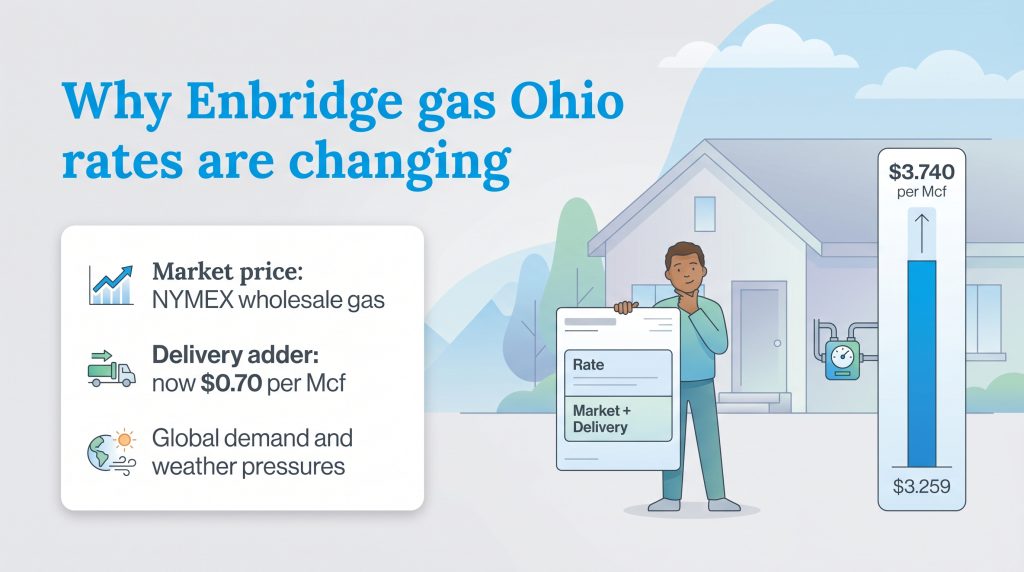
Enbridge Gas Ohio’s default rates undergo monthly adjustments based on raw energy market performance and regulated infrastructure surcharges. Because the utility passes its natural gas supply costs directly to you dollar-for-dollar without any markup, these rate changes reflect the actual price of buying and transporting natural gas.
The Math Behind Your Monthly Gas Cost
The variable rate you pay on the Standard Choice Offer (SCO) is determined by a formula approved by the Public Utilities Commission of Ohio (PUCO). The state calculates your rate by taking the month-end wholesale market settlement price of natural gas on the New York Mercantile Exchange (NYMEX) and adding a set delivery markup. On Feb. 4, 2026, under PUCO Case No. 26-0119-GA-UNC, the commission approved an increase in this Retail Price Adjustment from $0.50 per Mcf to $0.70 per Mcf. This delivery markup covers the cost suppliers face when securing physical natural gas and transporting it from production wells to Enbridge’s distribution network. This higher $0.70 per Mcf adder now acts as a permanent multiplier, meaning any future market price spikes will hit your wallet even harder.
Shifting Supply and Demand Forces
The jump from $3.259 to $3.740 per Mcf is also driven by broader market dynamics. High global demand for domestic Liquefied Natural Gas (LNG) exports has linked local Ohio heating costs directly to international energy markets. Additionally, summer weather forecasts predicting warmer-than-average temperatures have placed upward pressure on wholesale gas prices, as power plants burn more natural gas to generate electricity for air conditioning.
The physical delivery of this gas is handled by four assigned retail suppliers selected during the state-supervised auction on Feb. 3, 2026: AEP Energy, Inc., Direct Energy Services, LLC, Snyder Brothers Energy Marketing, and Southstar Energy Services (operating as Ohio Natural Gas). These companies are required to supply gas to SCO accounts through March 31, 2027, but the monthly price remains subject to market volatility.
The Bill Redesign and Your Higher Fixed Costs
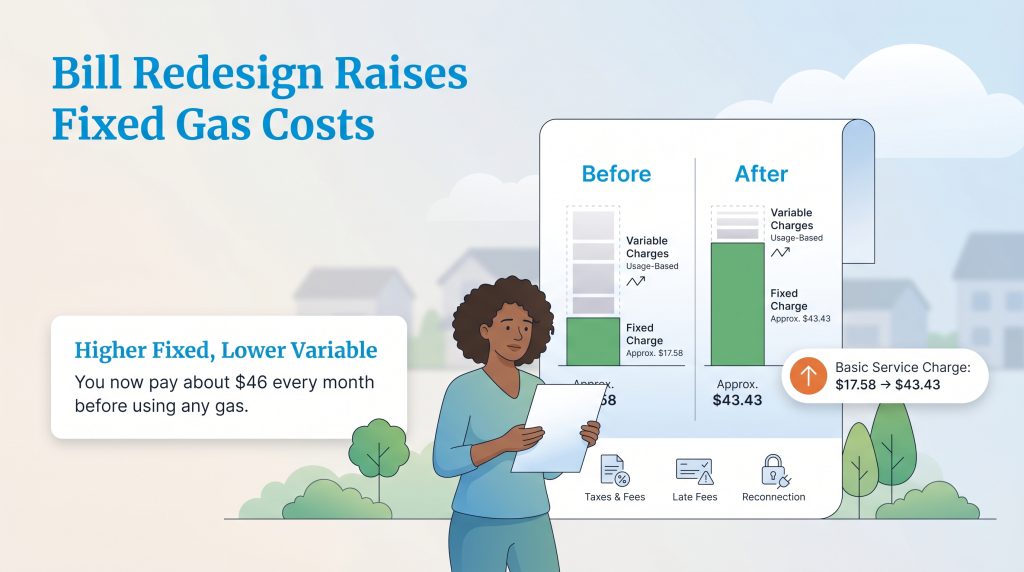
While commodity prices fluctuate monthly, the baseline cost of keeping your gas connected changed permanently on Nov. 1, 2025. Under PUCO Case No. 23-0894-GA-AIR, Enbridge Gas Ohio restructured its billing layout by heavily increasing its guaranteed monthly fixed fee.
The utility raised the fixed Basic Service Charge for residential customers from $17.58 per month to a steep $43.43 per month. To balance out this massive increase, Enbridge reduced or zeroed out several variable delivery charges on your bill, such as the Pipeline Infrastructure Replacement (PIR) cost recovery charge and the Capital Expenditure Program (CEP) rider.
The structural changes to the monthly fixed charges for both residential and business rate classes are detailed below:
| Billing Component | Tariff Before Nov. 1, 2025 | Tariff After Nov. 1, 2025 | Net Adjustment | Impact Mechanism |
| Basic Service Charge | $17.58 | $43.43 | +$25.85 | Permanent baseline cost increase |
| AMR Cost Recovery Charge | -$0.06 | -$0.17 | -$0.11 | Automated meter reading credit adjustment |
| PIR Cost Recovery Charge | $22.28 | $2.27 | -$20.01 | Direct reduction in pipeline infrastructure surcharges |
| Capital Expenditure Program Rider | $7.75 | $1.07 | -$6.68 | Capital investment cost consolidation |
| Infrastructure Development Rider | $0.02 | $0.02 | $0.00 | Static support for regional pipeline development |
| Total Consolidated Fixed Charge | $47.57 | $46.62 | -$0.95 | Total baseline monthly access cost |
This billing redesign stabilizes the utility’s revenues regardless of weather patterns. However, it also means your monthly bill is now far less responsive to conservation. Even if you turn off your water heater and use zero gas, you will still owe a baseline charge of approximately $46.62 each month.
In addition to this fixed-charge restructuring, several secondary service fees were increased:
- Gross Receipts Tax: Billed charges are subject to an increased gross receipts tax rate, which rose from 4.6044% to 4.98%.
- Returned Check Fees: The administrative fee for returned checks increased from $12 to $20.
- Gas Service Reconnection Charges: The cost to physically reconnect gas service following a disconnection increased from $33 to $76.
- Late Payment Penalties: On a positive note, late fees are now calculated solely on the current month’s outstanding balance rather than being compounded over multiple billing cycles.
- Proration of Fixed Charges: If you start or end service mid-month, you will receive a prorated Basic Service Charge based on the exact days of active service, rather than being billed the full monthly fee.
How Shifting Rates Impact Your Monthly Bill
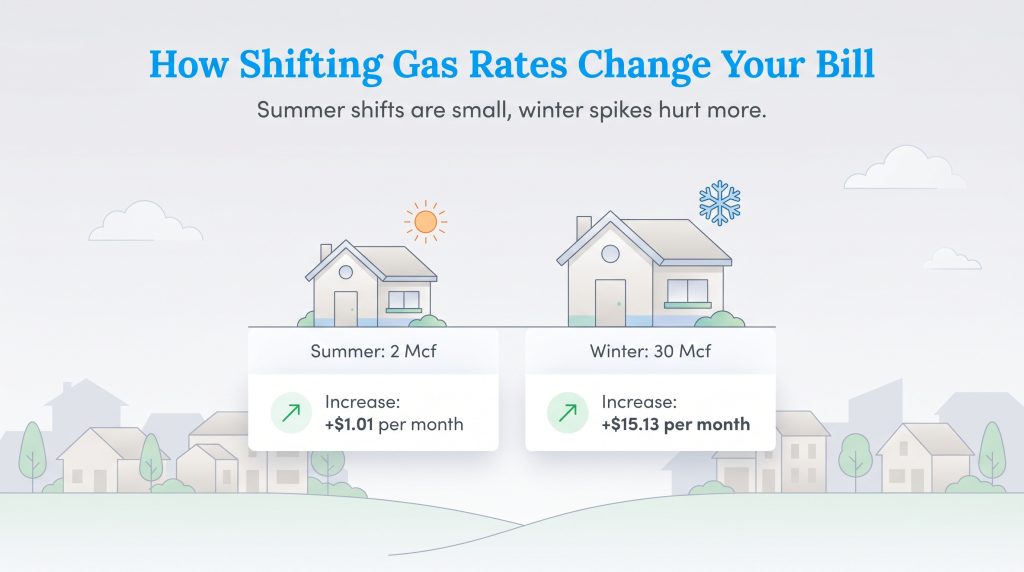
Understanding the true financial impact of the new $3.740 per Mcf rate requires looking at different seasonal usage levels. Because of the high monthly fixed charge, summer bills will only see minor increases, but cold winter billing cycles will feel a much sharper squeeze.
Using the current gross receipts tax rate of 4.98% and the fixed delivery fee of $46.62, we calculated how the May and June SCO rates compare across different usage levels:
| Monthly Usage (Mcf) | May 2026 SCO Bill Estimate ($3.259/Mcf) | June 2026 SCO Bill Estimate ($3.740/Mcf) | Absolute Monthly Increase | Relative Percentage Increase | Typical Seasonal/Usage Profile |
| 0 Mcf | $48.94 | $48.94 | $0.00 | 0.00% | Vacant property or standby account |
| 2 Mcf | $55.78 | $56.79 | $1.01 | 1.81% | Typical summer baseload (water heating and cooking only) |
| 5 Mcf | $66.05 | $68.58 | $2.53 | 3.83% | Mild spring or autumn shoulder month usage |
| 15 Mcf | $100.26 | $107.82 | $7.56 | 7.54% | Moderate winter heating requirements |
| 30 Mcf | $151.58 | $166.71 | $15.13 | 9.98% | Peak winter heating cycle in a single-family home |
This breakdown reveals that during the summer, when a typical household uses only 2 Mcf of gas for hot water, the rate hike only adds a modest $1.01 to your monthly expenses. However, when winter arrives and consumption climbs to 30 Mcf, that same rate adjustment translates to an extra $15.13 per month. This highlights why it is so important to evaluate your energy plans during the warm months before winter cold snaps drive up your volumetric usage.
Major Ohio Cities and Areas Affected
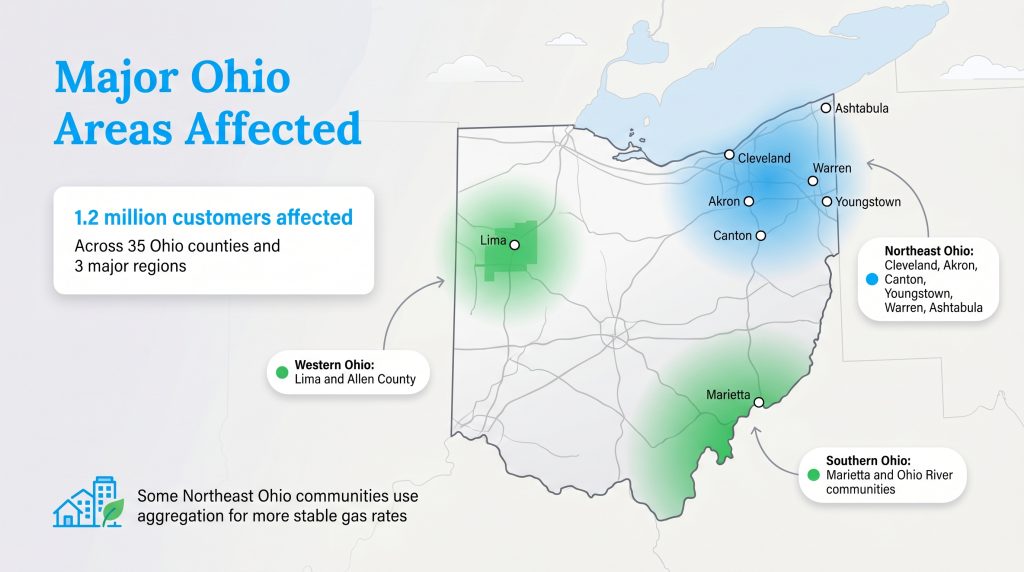
This rate adjustment is not an isolated local change. It directly impacts approximately 1.2 million residential and business customers across 35 counties in Ohio, spanning a massive pipeline network of over 22,000 miles.
The geographic boundaries of this rate restructuring cover three primary areas:
- Northeast Ohio: Cleveland, Akron, Canton, Youngstown, Warren, and Ashtabula.
- Western Ohio: Lima and surrounding parts of Allen County.
- Southern Ohio: Marietta and communities along the Ohio River.
If you live in Northeast Ohio, you may be in a community that participates in a municipal aggregation program. These programs pool the buying power of entire towns to secure wholesale natural gas pricing, which can offer a reliable path to rate stability.
Actionable Steps to Lower Your Gas Bill
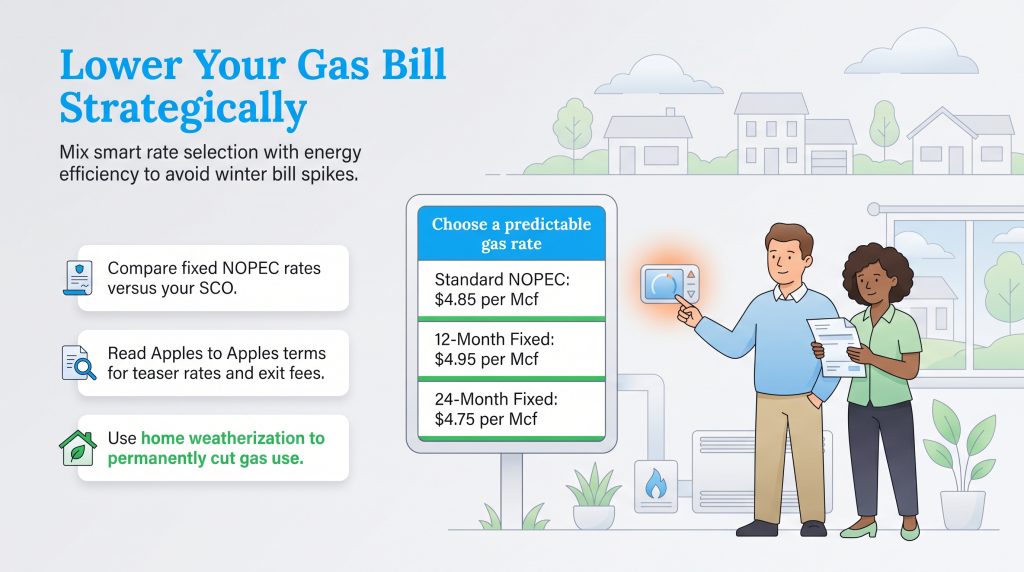
Since Ohio operates a deregulated energy market, you do not have to settle for the default variable SCO rate. You have the power to explore competitive options to lower your bills or lock in rate predictability.
Governmental Aggregation with NOPEC
For many residents in Northeast Ohio, municipal aggregation through the Northeast Ohio Public Energy Council (NOPEC) is a popular choice. NOPEC negotiates bulk rates for its member communities. For the billing cycles running from June through December 2026, NOPEC has established three distinct fixed-pricing choices:
- Standard Program Price: $4.85 per Mcf
- 12-Month Fixed Term: $4.95 per Mcf
- 24-Month Fixed Term: $4.75 per Mcf
While these fixed plans carry a premium over the current $3.740 summer SCO rate, they can serve as an effective financial hedge. Natural gas prices can spike dramatically in cold weather — read our analysis of Enbridge’s winter utility rate spikes to see how rates climbed to $4.92 per Mcf in late 2025 and surged to $7.96 per Mcf in Feb. 2026. Choosing a NOPEC plan means paying a little more during the summer to insulate your household from potentially severe winter price volatility.
Shopping Competitive Retail Supplier Portfolios
You can also shop directly on the state-run PUCO Apples to Apples Comparison Portal to select a certified competitive supplier. These retail plans vary in rate, contract length, and administrative clauses:
| Competitive Supplier | Rate ($/Mcf) | Rate Type | Contract Term | Early Termination Fee | Monthly Fee | Risk and Operational Profile |
| Shipley Choice | $2.9900 | Fixed | 6 Months | $0 | $0 | Competitive short-term rate; ideal for warm-weather savings. |
| Ohio Gas & Electric | $3.5000 | Fixed | 6 Months | $0 | $0 | Below the current SCO rate; locks in savings through autumn with zero exit penalties. |
| Eastern Power and Gas | $4.1500 | Fixed | 12 Months | $0 | $0 | Provides mid-term budget security with no financial penalty to exit early. |
| Santanna Energy Services | $3.9900 | Fixed | 12 Months | $100 | $0 | Reliable flat rate, but features a substantial early exit penalty. |
| Ohio Natural Gas (ONG) | $5.5700 | Fixed | 24 Months | $12.50 per remaining month | $0 | Long-term price lock, but features a highly punitive, prorated early exit penalty. |
| nTherm, LLC | $3.1900 | Variable | 1 Month | $0 | $0 | Low introductory rate that can be adjusted upward at supplier discretion after month one. |
| Kratos Gas & Power | $1.5900 | Variable | 1 Month | $0 | $0 | Aggressive loss-leader rate; carries high risk of price escalation in subsequent months. |
When shopping, look closely at the details. Introductory “teaser” rates like Kratos’ $1.5900 per Mcf plan look highly appealing, but they usually transition to high uncapped variable rates after only 30 days. You should also watch out for early termination fees — a prorated exit fee of $12.50 per remaining month can easily wipe out any seasonal commodity savings if you decide to switch plans mid-contract.
Permanently Lowering Your Bills Through Energy Efficiency
Beyond changing your rate, the most sustainable way to lower your gas bill is to reduce your volumetric consumption. This is especially true now that high fixed service fees make every conserved Mcf of gas highly valuable.
Consider utilizing the Housewarming Program, a utility-administered energy-saving option that provides free home energy audits and direct physical upgrades. Eligible households can receive professional weatherization improvements, including attic insulation, weather stripping, door sweeps, and pipe wraps, at no cost. Taking advantage of these weatherization resources is an environmentally mindful choice that permanently lowers your household energy footprint while keeping your winter heating bills manageable.
Financial Assistance and Winter Safety Nets
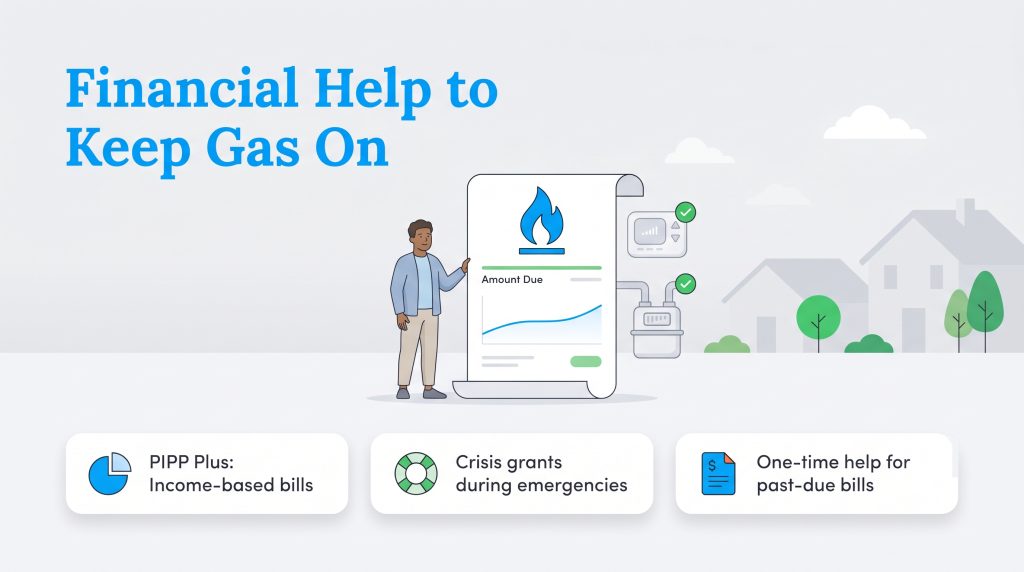
If you are facing financial hardship, several state-regulated and utility-sponsored safety nets are available to help keep your gas service connected.
The Percentage of Income Payment Plan Plus (PIPP Plus)
PIPP Plus is a state-mandated program that stabilizes monthly utility bills by linking payments directly to your household income rather than your energy usage. To qualify, your household income must be at or below 175% of the Federal Poverty Guidelines. Under this program, gas-heated households pay a consistent 5% of their gross monthly income toward their natural gas bill, with a statutory minimum payment of $10.
A key benefit of PIPP Plus is its debt-forgiveness mechanism. Every time you make your monthly payment on time and in full, you receive an incentive credit that eliminates 1/24th of your outstanding past-due utility debt. Because payments are tied directly to your income, enrolled PIPP customers are protected from standard base charge increases and seasonal commodity rate jumps.
Additional Crisis Grants and Reconnection Orders
You can also access targeted emergency assistance through several specialized channels:
- The Home Energy Assistance Program (HEAP): This program provides a non-emergency, one-time annual financial credit applied directly to your heating bill. Effective April 6, 2026, the administration of HEAP, PIPP Plus, and weatherization assistance transitioned to the Ohio Department of Job and Family Services. You can submit your application online through the centralized state’s Energy Help Ohio online application portal.
- The Special Reconnect Order: Mandated annually by the PUCO, this rule allows any residential customer — regardless of income — to restore disconnected service or avoid a pending shutoff during the cold months. By making a flat payment of $175 and paying a reconnect fee, you can maintain your service. This emergency option is restricted to one use per heating season, which runs from mid-October through mid-April.
- The Heat Care Program: Funded by utility, employee, and customer donations, this crisis program provides emergency grants to households facing sudden hardships, such as medical issues or job loss. It is administered through local branches of the Salvation Army.
- The Dollar Energy Fund: This utility-sponsored program offers a one-time grant of up to $300 to help clear past-due balances. To qualify, you must have paid at least $100 toward your account within the preceding 90 days and meet specific household income guidelines.
Taking Control of Your Ohio Natural Gas Bills
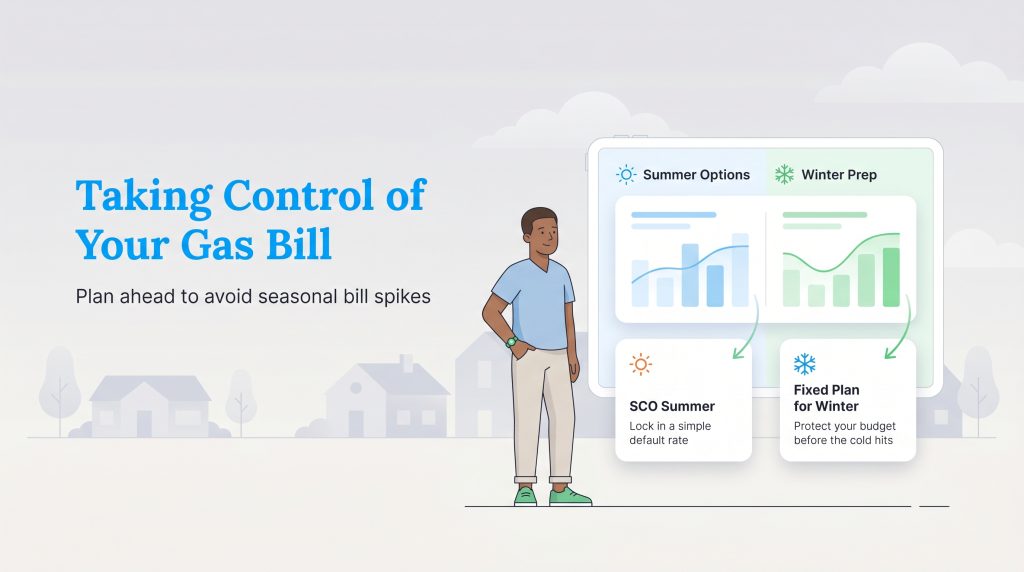
We are living through a unique period of utility billing restructuring, but you are not powerless against rising rates. By analyzing your seasonal usage, keeping a watchful eye on promotional supplier contracts, and utilizing weatherization tools, you can secure both cost savings and peace of mind. Whether you decide to stick with the default Standard Choice Offer for the summer or lock in a fixed plan to prepare for winter, a little proactive planning today will pay major dividends when the cold weather returns.
About the Author

Claudio is a sustainability-focused writer with a background in Anthropology and Psychology from NC State University. He has spent over 15 years working in writing, interpretation, and translation, driven by a deep interest in how human culture shapes the environment. Today, he shares his curiosity with readers by writing about sustainable living solutions and the connection between everyday choices and environmental impact.