
The Michigan Public Service Commission Authorized A Base Distribution Rate Hike That Increases Monthly Bills Right Before Winter Heating Season
Key Takeaways
- The MPSC approved a $139.2 million natural gas base distribution rate increase for Consumers Energy, reducing the utility’s initial $240 million request by 42%.
- Average residential customers will see an immediate $3.92 monthly delivery surcharge added to their natural gas bills starting Nov. 1, 2026.
- Michigan is a deregulated natural gas state, meaning you can shop for alternative retail gas suppliers to potentially lock in lower supply rates this winter.
As temperatures begin to drop across the Great Lakes State, millions of households are bracing for higher winter heating bills following a major regulatory decision. On Oct. 15, 2026, the Michigan Public Service Commission (MPSC) issued its final order in Case No. U-21445, granting Consumers Energy a $139.2 million natural gas base distribution rate increase. While state regulators significantly trimmed the utility’s initial $240 million request, the approved hike still delivers a financial blow to fixed-income families right at the onset of the high-consumption winter cycle. We are breaking down exactly what this rate case means for your monthly household budget, where the infrastructure funds are going, and how you can take advantage of Michigan’s deregulated energy market to help manage your utility costs.
Impacted Service Territories And Regional Breakdown
The Consumers Energy natural gas rate increase affects approximately 1.8 million homes and businesses across the state. Because the utility provides service to all 68 counties in Michigan’s Lower Peninsula, this regulatory decision impacts nearly every corner of the region.
Metro Detroit And Suburban Communities
More than half of the utility’s natural gas customers reside in the metro Detroit area and its surrounding suburbs. Municipalities like Royal Oak, Madison Heights, Warren, and Clawson will all experience these increased delivery surcharges as they turn on their furnaces this November. If you are unsure which provider covers your exact address, you can consult the MPSC’s detailed service area map.
Rural And Fixed-Income Households
The rate hike places a disproportionate burden on rural and suburban territories where alternative heating sources are often unavailable. Michigan Attorney General Dana Nessel publicly criticized the MPSC’s decision, noting that the utility had just received a $157.5 million rate increase 11 months prior, compounding the financial strain on fixed-income families.
Breaking Down The Rate Case Adjustments
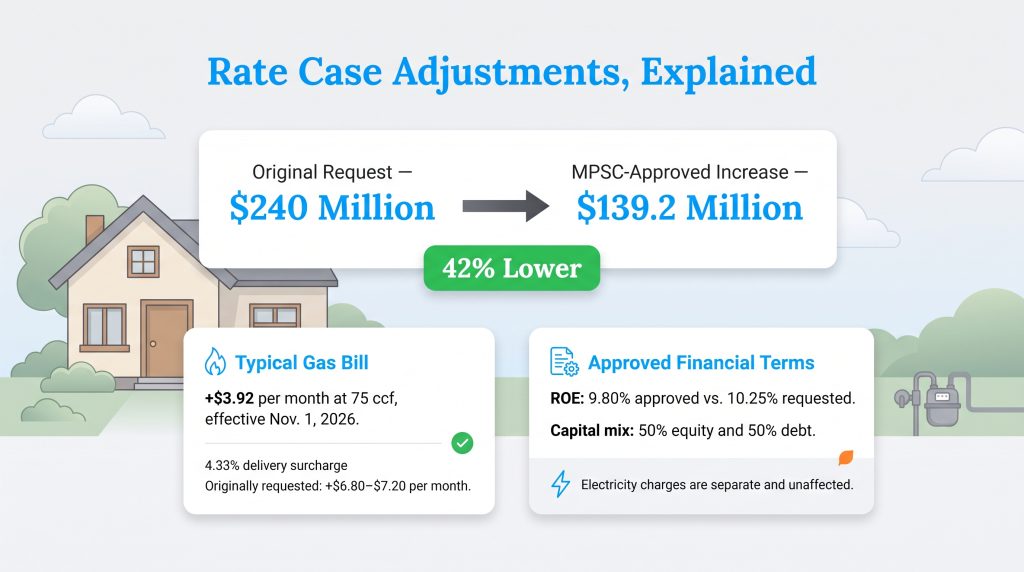
When Consumers Energy initially filed its petition in late 2025, the utility sought a staggering $240 million increase. The MPSC pushed back on several fronts, ultimately approving a final outcome that was 42% below the original request.
Monthly Bill Adjustments
Starting Nov. 1, 2026, a typical residential customer using 75 ccf of natural gas will see their monthly bill increase by $3.92. This represents a 4.33% immediate delivery surcharge, which is significantly lower than the $6.80 to $7.20 monthly hike the utility originally requested.
Capital Structure And Profit Allowances
The commission took steps to balance the financial impact on ratepayers by reducing the utility’s capital profit recovery allowances. Regulators authorized a 9.80% Return on Common Equity (ROE) — down from the requested 10.25% — and mandated a balanced capital funding structure of 50% equity and 50% debt, rather than the asymmetric equity tilt the company wanted.
A Note On Electricity Rates
While this specific MPSC ruling strictly impacts natural gas base distribution rates, Consumers Energy also provides electricity to roughly 1.8 million customers in the Lower Peninsula. It is important to remember that your electricity charges are billed separately and are not affected by this $139.2 million natural gas rate increase, though electric rates are always subject to their own separate regulatory proceedings.
Where The Infrastructure Funding Is Going
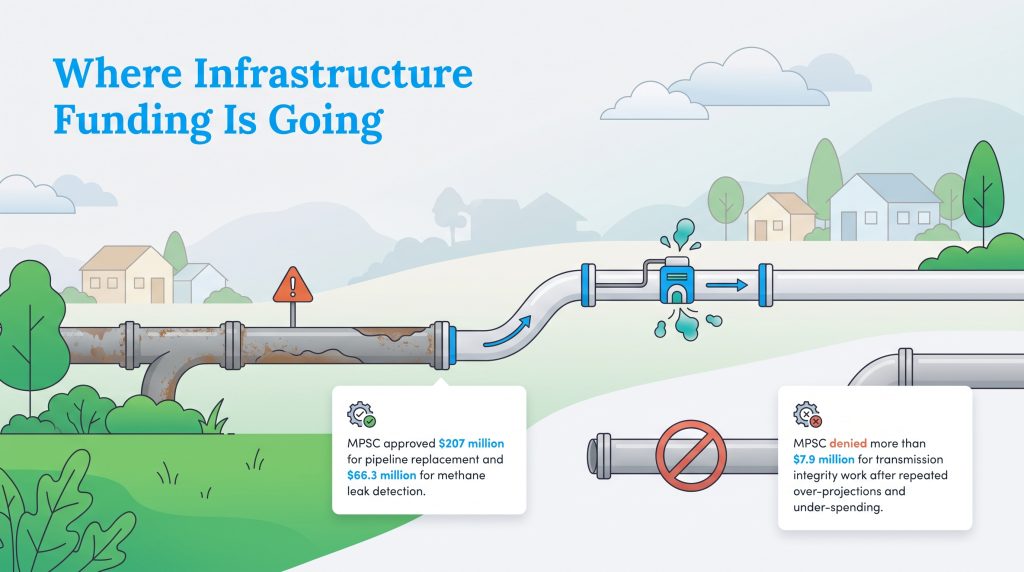
A major component of any utility rate case is funding the physical network that delivers energy to your home. The MPSC approved specific infrastructure investments for Consumers Energy to maintain the safety and reliability of its vast pipeline system.
Approved Pipeline And Leak Detection Investments
The commission authorized $207 million for the utility’s Enhanced Infrastructure Replacement Program. These funds are earmarked to replace obsolete, leak-prone cast iron and vintage bare-steel gas distribution mains. Additionally, regulators dedicated $66.3 million toward accelerated methane leak detection and pipeline remediation efforts to improve environmental safety.
Denied Transmission Funding
Regulators did not approve every infrastructure request. The MPSC strictly disallowed more than $7.9 million that Consumers Energy sought for transmission pipeline integrity work. The commission cited a documented pattern where the company systematically over-projected program expenses while under-spending on actual physical infrastructure improvements.
Navigating Michigan’s Deregulated Natural Gas Market
Michigan is one of several states that features a deregulated energy market for natural gas. Because the state offers Natural Gas Customer Choice, you have the power to shop around and compare rates from alternative retail gas suppliers.
How Deregulation Can Help You Save
In a deregulated market, your utility bill is split into two main parts: delivery and supply. While Consumers Energy will always charge you for the delivery of natural gas — and this new $3.92 monthly surcharge is unavoidable — you are not forced to buy your actual gas supply from them. By exploring alternative suppliers, you might lock in a lower fixed rate for the winter, helping you offset the cost of the MPSC’s approved distribution hike.
Preparing Your Household For Higher Winter Heating Costs
As we head into the coldest months of the year, managing your energy consumption is the best defense against rising utility rates. We recommend taking advantage of Michigan’s deregulated market to shop for competitive natural gas supply rates that fit your budget. Furthermore, consider enrolling in budget billing programs to smooth out your monthly payments, and look into an energy-saving option like a smart thermostat or improved weatherstripping to lower your overall usage. If you are a fixed-income family struggling with utility costs, reach out to local assistance programs like the Low Income Home Energy Assistance Program (LIHEAP) to ensure your home stays warm safely and affordably. Choosing an environmentally mindful choice for your household heating habits not only benefits the planet but also keeps your hard-earned money in your pocket.
About the Author

Claudio is a sustainability-focused writer with a background in Anthropology and Psychology from NC State University. He has spent over 15 years working in writing, interpretation, and translation, driven by a deep interest in how human culture shapes the environment. Today, he shares his curiosity with readers by writing about sustainable living solutions and the connection between everyday choices and environmental impact.