

Natural gas offers continuous delivery and generally lower fuel costs, while heating oil provides standalone reliability for homes off the gas grid.
Key Takeaways
- Natural gas often costs less per unit of useful heat and flows directly to your home through underground utility pipelines without requiring on-site storage.
- Heating oil is a dependable option for cold-climate homes that lack local gas utility lines, though it requires safe on-site storage and scheduled deliveries.
- Upgrading to an ENERGY STAR certified system or using supported biodiesel blends can help reduce your carbon footprint and winter heating bills regardless of which fuel you use.
Moving into a new house or replacing an aging furnace forces you to look closely at how you heat your space. When evaluating the choice between natural gas and heating oil, the right choice usually comes down to your local gas utility access, your budget for upfront equipment costs, and how much maintenance you want to handle yourself. Understanding how these heating options stack up in price, efficiency, and environmental impact will help you keep your home warm while making an informed financial decision.
How Natural Gas and Heating Oil Work in Your Home
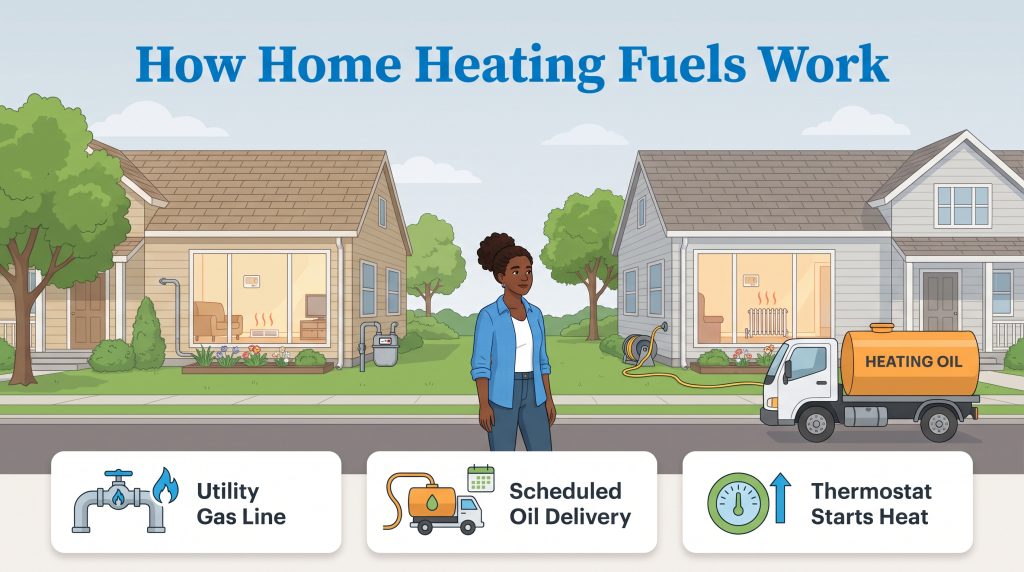
Before comparing price tags and efficiency ratings, it helps to understand how each fuel actually gets to your home and warms your living space. While both systems use a furnace to blow warm air through ducts or a boiler to circulate hot water through radiators, their delivery methods and daily operations are completely different.
Natural Gas: Piped-In Convenience
Natural gas is a fossil fuel composed mostly of methane that travels straight to your home through a network of underground pipes managed by your local gas utility. Because the fuel is always on tap, you never have to worry about checking a tank gauge or scheduling a delivery truck before a winter storm hits. You simply set your thermostat, and the utility company bills you each month based on the exact amount of gas your meter records.
Heating Oil: On-Site Storage and Control
Heating oil — officially known as No. 2 fuel oil — is a liquid petroleum product refined from crude oil that is very similar to diesel fuel. If your home uses heating oil, a local supplier delivers the fuel by truck and pumps it into a storage tank located in your basement, garage, or yard. While managing your own supply requires a bit more attention, it also gives you the ability to choose among local oil suppliers to find the lowest price per gallon or lock in seasonal delivery contracts.
Comparing Natural Gas vs. Heating Oil at a Glance
Every homeowner has different priorities, whether you want the lowest possible winter utility bill, the cleanest fuel, or dependable performance during a freeze. This side-by-side comparison breaks down the core differences between natural gas and heating oil across the metrics that matter most.
| Feature | Natural Gas | Heating Oil |
|---|---|---|
| Heat Content (BTUs) | ~100,000 BTUs per therm | ~138,500 BTUs per gallon |
| Example AFUE Ratings for New Equipment | 80% to 98% (Furnaces) | 80% to 90% (Furnaces and Boilers) |
| Fuel Delivery Method | Continuous underground utility pipeline | Scheduled truck delivery to an on-site tank |
| Annual Maintenance Needs | Professional inspection and manufacturer-recommended service | Professional combustion cleaning, inspection, and filter replacement |
| Direct CO2 Emissions per Million BTU of Fuel Burned | ~117 pounds of CO2 | ~163 pounds of CO2 |
Heating Oil vs. Natural Gas Cost Comparison
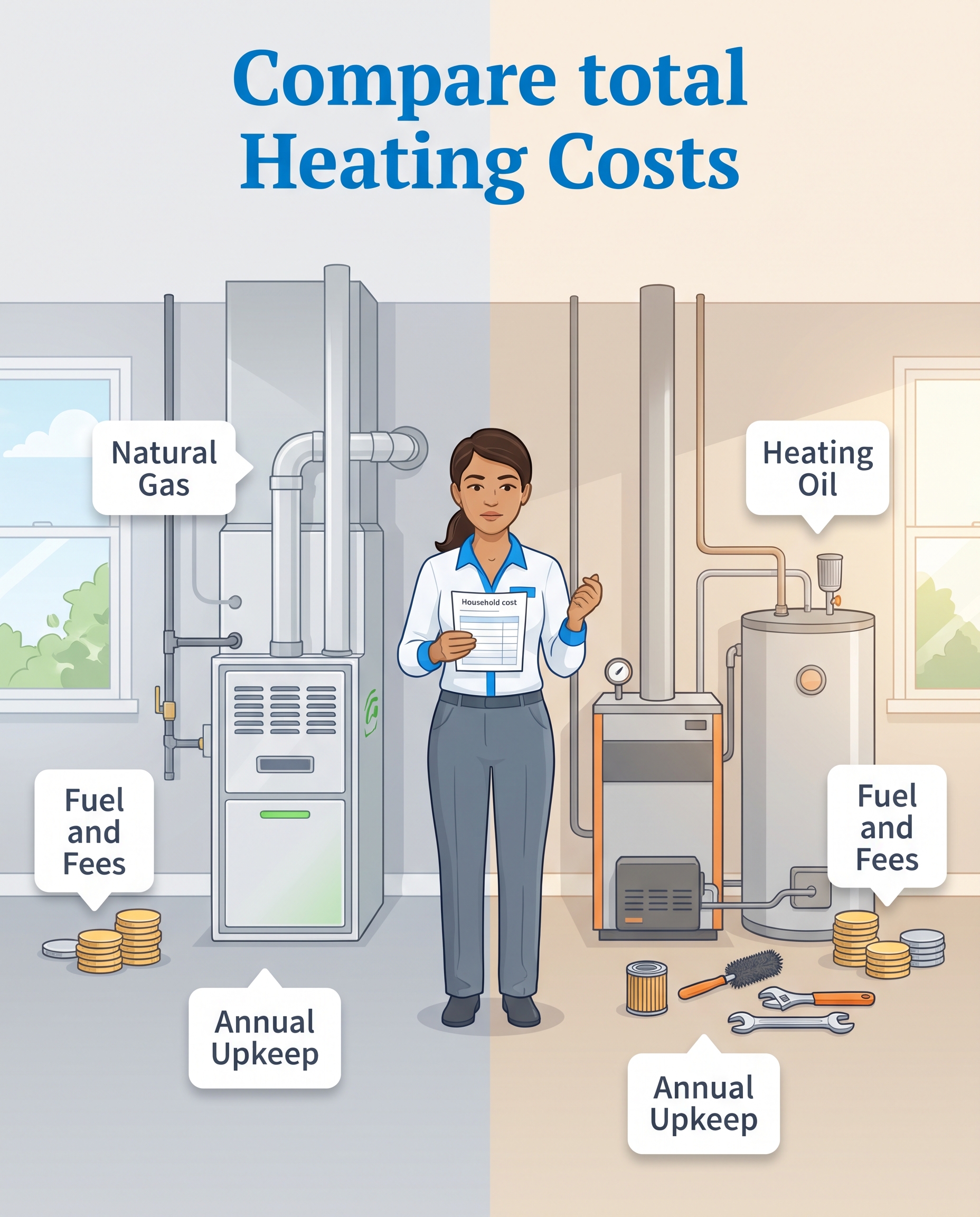
For most households, the debate between natural gas vs. heating oil comes down to dollars and cents. To get an accurate picture of what you will spend, you have to look beyond the daily price of fuel and factor in equipment installation and ongoing maintenance costs.
Annual Fuel Costs and Price Volatility
Natural gas often costs less per unit of useful heat, but your local fuel prices, equipment efficiency, utility fees, and installation costs determine the better financial choice. According to the U.S. Energy Information Administration (EIA) Winter Fuels Outlook, households heating with natural gas are generally forecast to spend less per winter on average than those relying on heating oil. However, these national forecasts blend different regions, home sizes, and climates, so they are not a perfect apples-to-apples comparison for identical homes. Both fuels can experience significant price volatility during geopolitical events, severe cold snaps, or supply chain disruptions.
Money-Saver
If you rely on heating oil, ask local suppliers about summer fill-up discounts or budget billing plans. Keep in mind that budget billing simply spreads your payments across the year; it does not necessarily lock in your fuel price. Fixed-price or capped-price contracts offer rate protection, but they may carry fees or prevent you from benefiting if market prices drop.
Installation and Maintenance Expenses
The cost to install a new furnace or boiler varies widely based on venting requirements, ductwork, and local labor rates rather than just the fuel type. Where natural gas often provides long-term savings is on annual upkeep. Heating oil produces soot and residue as it burns, meaning you must pay a technician every single year to clean the heat exchanger and replace the oil filter. Natural gas burns cleaner, but both gas and oil combustion equipment still require annual professional inspection and maintenance to operate safely and efficiently according to manufacturer guidelines.
Energy Efficiency and Heating Performance
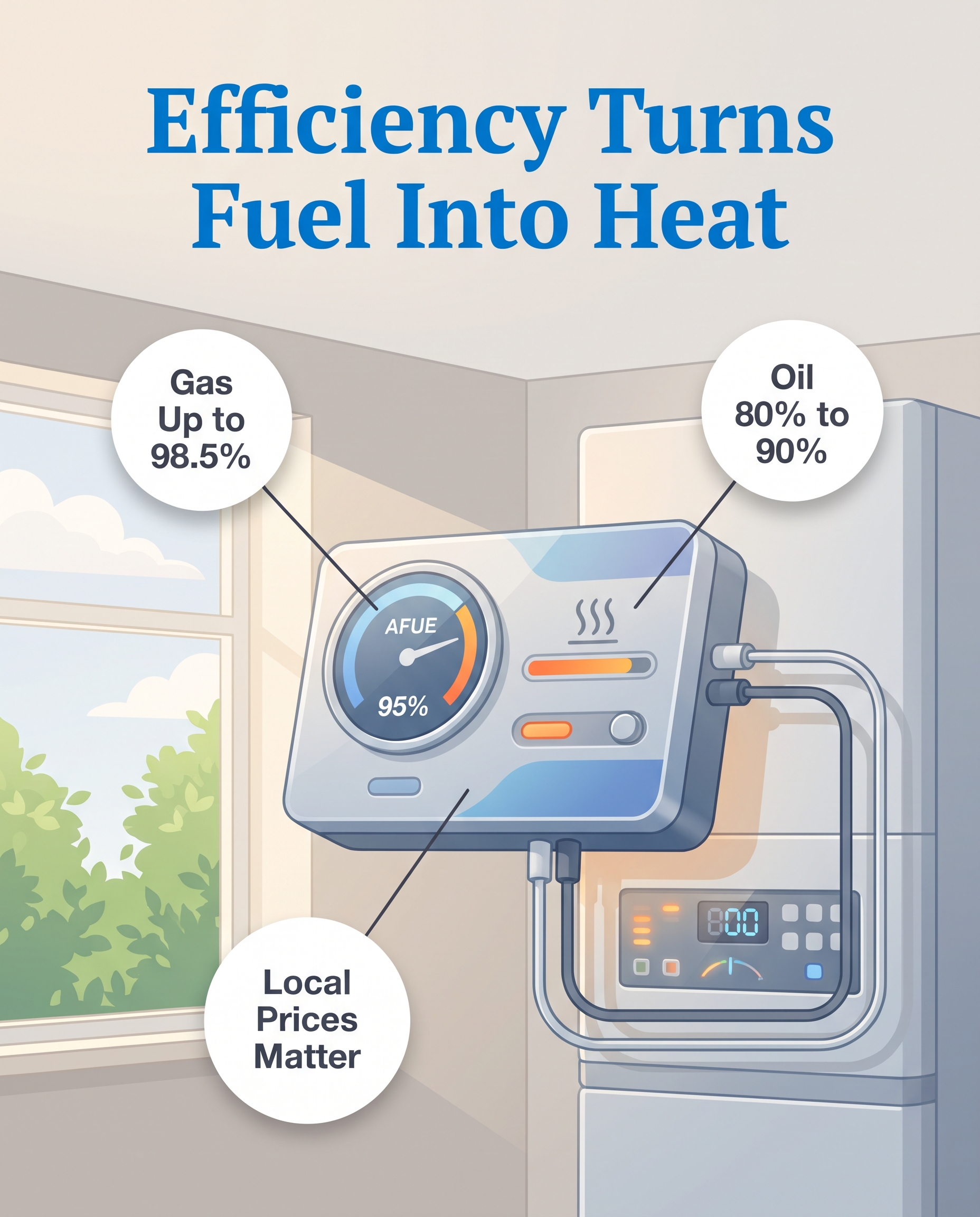
Either fuel can heat your home effectively when the equipment is properly sized and maintained. How quickly your home warms up depends more on the system’s heating output, your ducts or radiators, and your home’s insulation than on the fuel alone. Heating oil packs a bigger punch per unit, generating roughly 138,500 British thermal units (BTUs) per gallon compared to 100,000 BTUs in a therm of natural gas. However, gallons and therms are different purchasing units, not direct indicators of superior heating performance.
Modern natural gas equipment makes up for its lower BTU density with superior mechanical efficiency. Heating systems are rated by Annual Fuel Utilization Efficiency (AFUE), which measures how much fuel is converted into usable heat rather than lost through the exhaust. Note that AFUE does not account for heat lost through leaky ductwork or the auxiliary electricity used to run blower motors. According to the U.S. Department of Energy, condensing gas furnaces can reach AFUE ratings as high as 98.5%, whereas most new residential oil furnaces operate closer to the 80% to 90% AFUE range. A high-efficiency gas furnace can squeeze more usable warmth out of the fuel, but your final bills will depend heavily on local fuel prices.
Quick Fact
Compare Your Local Heating Costs: First, collect your local delivered oil price per gallon, gas price per therm, and each system’s AFUE. Next, calculate your approximate oil cost per million BTU delivered as: price per gallon ÷ (0.1385 × AFUE as a decimal), and gas cost as: price per therm ÷ (0.1 × AFUE as a decimal). Finally, compare those results, then account separately for fixed utility charges, maintenance, and installation costs.
To see how this works in practice, here is an illustrative example (not based on current market pricing):
| Assumption | Heating Oil | Natural Gas |
|---|---|---|
| Hypothetical fuel price | $4.00 per gallon | $1.50 per therm |
| AFUE | 85% | 95% |
| Approximate fuel cost per million BTU delivered | $33.98 | $15.79 |
Safety Considerations for Your Household

Both heating methods are safe when properly installed and maintained, though they carry very different risk profiles. Heating oil is relatively stable under normal storage conditions because it must be atomized into fine droplets inside a burner before it easily ignites. The primary risk with oil is an environmental leak from a rusting storage tank, along with carbon monoxide buildup if the chimney flue becomes blocked by soot.
Natural gas is highly flammable and stored under pressure, which means a leak inside your home poses a serious fire or explosion hazard. Utility companies add a harmless chemical called mercaptan to give the naturally odorless gas a distinct rotten-egg smell so you can detect leaks immediately. If you smell gas or suspect a leak, leave the building immediately. Don’t operate switches or use a phone inside; call 911 or your gas utility’s emergency number from a safe location. Regardless of which fuel heats your home, installing smoke and carbon monoxide alarms according to local requirements and manufacturer instructions — including proper placement near sleeping areas — is a non-negotiable safety step.
Heads Up
If you are buying a home with an older heating oil system, always pay for a specialized tank inspection before closing. Removing a leaking underground oil tank and cleaning up contaminated soil can easily cost upwards of $10,000.
Environmental Impact and Eco-Friendly Upgrades
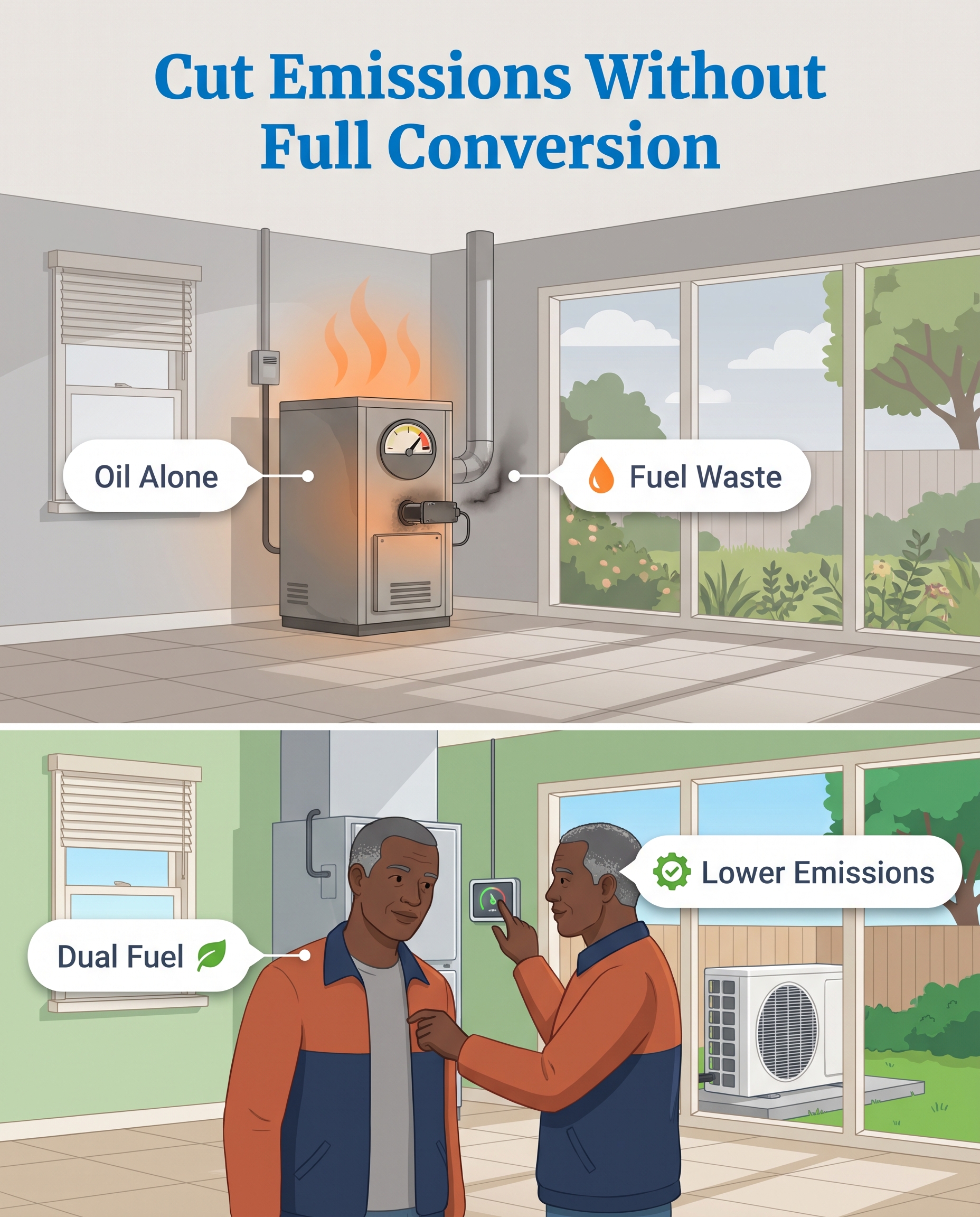
Neither fuel is a fully renewable resource, as both are fossil fuels that release greenhouse gases when burned. However, if you are looking for an environmentally mindful choice between the two, natural gas is the cleaner fossil fuel at the point of combustion. Burning natural gas emits roughly 28% less carbon dioxide per million BTUs than heating oil, and it produces fewer sulfur dioxide and soot particulates, though it still emits nitrogen oxides. Additionally, methane leaks during natural gas extraction and pipeline transport are a major climate concern that complicates a strict lifecycle comparison.
Fortunately, you don’t have to overhaul your entire home to shrink your winter carbon footprint. If you use heating oil, you can transition to biodiesel-blended heating oil, which mixes traditional oil with renewable biodiesel made from agricultural byproducts or recycled fats. Ask your fuel supplier and equipment manufacturer which biodiesel blends your burner, tank, seals, and warranty support, as blends still contain petroleum. If you are shopping for a new system, choosing ENERGY STAR certified furnaces ensures you are getting a unit that cuts both fuel waste and greenhouse gas emissions.
Eco Edge
If you are ready to move away from fossil fuels altogether, consider pairing your existing furnace with an electric heat pump. Dual-fuel systems use an energy-saving electric heat pump on mild winter days and switch to the gas or oil burner when temperatures plunge, depending on your equipment’s capacity and control settings. Keep in mind that adding a heat pump while retaining an oil or gas backup does not eliminate your fossil fuel use entirely.
What Does It Cost to Convert Oil to Gas Heat?
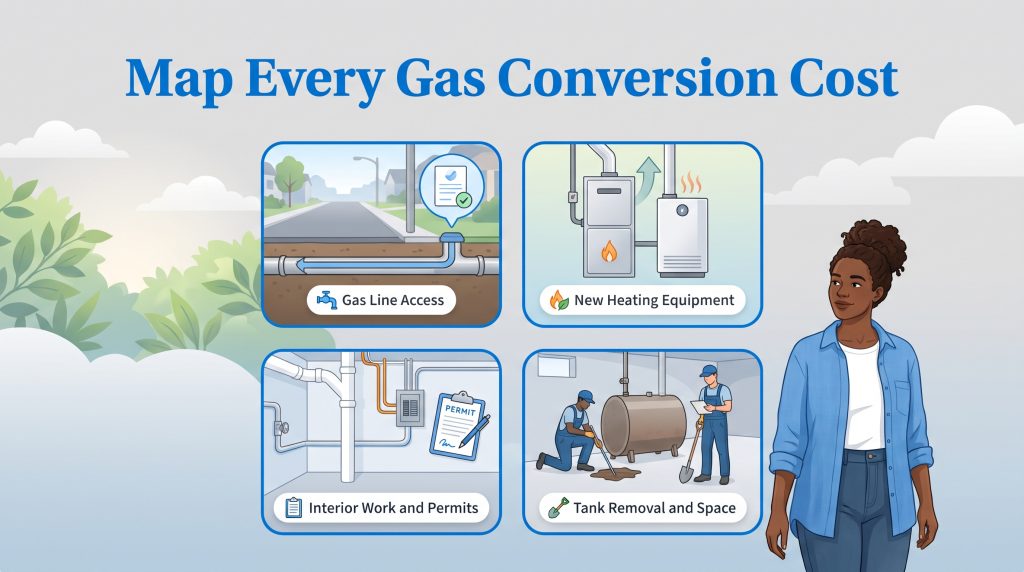
If you live in the Northeast or an older rural home currently running on heating oil, you have probably wondered whether converting to natural gas is worth the investment. Conversion costs vary drastically based on your property, the condition of your home, and local regulations. Before making the leap, it pays to understand exactly what a contractor’s quote should include.
To evaluate if converting makes financial sense, request itemized quotes that break down the following elements:
- Gas availability and connection approval: Check if a main gas line exists on your street and what the utility will charge for service-line or main-extension work.
- Equipment replacement: You will need a completely new furnace or boiler designed for natural gas.
- Interior labor: Factor in interior piping, venting modifications, permits, and electrical work.
- Tank removal: Include the cost for tank removal or approved abandonment, plus potential contamination assessment and remediation if the old tank leaked.
- Space reclamation: Removing a bulky basement tank can free up usable square footage, which is a major benefit for many homeowners.
Moving-In Checklist for Your New Home’s Heating System

Taking over a home’s utilities can be overwhelming. Follow this checklist to ensure a seamless transition for your heating system:
- Identify your system: Confirm whether you have a furnace (forced air) or boiler (hot water/steam) and identify the exact fuel type it uses.
- Review the history: Request past service records and available fuel bills from the previous owner.
- Schedule an inspection: Arrange for a qualified HVAC technician to perform a routine equipment inspection and tune-up.
- Manage oil assets: For oil systems, check the tank’s condition, verify ownership (some are leased), review current service arrangements, ensure delivery truck access, and measure the remaining fuel.
- Investigate buried tanks: For properties with a buried or previously removed oil tank, request all relevant records and professional advice to rule out soil contamination.
- Set up gas service: For natural gas, arrange your account setup with the utility and confirm any activation or meter-reading requirements.
- Prepare for emergencies: Test all smoke and carbon monoxide alarms and ensure your family understands local emergency procedures.
If you are renting, always confirm your responsibility for fuel purchases, routine maintenance, and account setup with your landlord before making any system changes or calling for service.
Evaluating the Right Heating Option for Your Home
Deciding between natural gas vs. heating oil ultimately comes down to working with what is available in your neighborhood and matching your system to your long-term homeownership goals. If you have access to a local gas utility line, natural gas is tough to beat for its lower monthly bills, high-efficiency equipment, and no scheduled fuel deliveries. If you live off the gas grid, modernizing your heating oil setup with a high-efficiency burner and supported biodiesel blends will keep your family cozy through the harshest winter freezes while keeping your energy use in check.
Frequently Asked Questions About Natural Gas vs. Heating Oil
When comparing home heating systems, you likely have specific questions about performance, cost, and maintenance. Here are answers to some of the most common concerns homeowners face.
Which Heats a House Faster: Natural Gas or Heating Oil?
Is It Cheaper to Heat With Natural Gas or Oil?
How Long Does a 275-Gallon Tank of Heating Oil Last?
Can You Use a Natural Gas Furnace With Heating Oil?
What Happens if My Heating Oil Tank Runs Completely Empty?
Is It Better to Switch From Oil to Natural Gas or an Electric Heat Pump?
About the Author

David has been an integral part of some of the biggest utility sites on the internet, including InMyArea.com, HighSpeedInternet.com, BroadbandNow.com, and U.S. News. He brings over 15 years of experience writing about, compiling and analyzing utility data.

LaLeesha has a Masters degree in English and enjoys writing whenever she has the chance. She is passionate about gardening, reducing her carbon footprint, and protecting the environment. She also recently served as President of the Board for City Sprouts (a community garden).