
Planning your utility transfer four weeks in advance ensures you won’t be left in the dark on moving day.
Key Takeaways
- Gather necessary documents like account numbers and your new lease or deed before calling providers.
- Schedule service transfers at least two weeks prior to your move date to avoid gaps in coverage.
- Conduct a final meter reading on moving day to prevent paying for energy usage after you leave.
Moving is often cited as one of life’s most stressful events, filled with endless boxes, packing tape, and logistical hurdles. While you can’t easily avoid the physical heavy lifting, you can absolutely prevent the administrative headache of dealing with your power and water service at the last minute. This moving utilities checklist is designed to transform potential chaos into a streamlined process, ensuring the lights are on and the internet is up and running the moment you walk through the front door of your new home. Whether you need an apartment utilities checklist for a local lease or a comprehensive guide for relocating across the country, following these proactive steps guarantees your home will be comfortable, efficient, and fully functional on day one.
Before You Start: Gather Your Utility Documentation
Most people make the mistake of picking up the phone before they have their paperwork ready, leading to frustrating hold times and callbacks. Before you dial a single customer service number, take a moment to hunt down the specific details providers will ask for. Having a dedicated “utility folder,” whether physical or digital, saves you incredible amounts of time and keeps you organized. You will need the following information close at hand before starting your journey:
- Current account numbers for all active services
- Social Security number or other primary personal identification
- Exact move-out date for your current residence
- New address (double-check the zip code and specific unit number)
- Lease start date or final closing date for the new home
The Complete Utility Transfer List (What to Move)
Before you pack a single box, you must identify exactly which moving house utilities require your direct attention. Keeping a master utility transfer list prevents critical services from slipping through the cracks during the overwhelming chaos of relocation. While it is tempting to search online for a moving utilities checklist pdf to print, we highly recommend keeping your checklist entirely digital so you can easily update account numbers and installation dates in real time on your smartphone. To successfully map out your move, make sure the following essential services are accounted for on your list:
- Electricity: The most critical service to transfer, ensuring your lights, refrigerator, and HVAC systems operate smoothly from the moment you arrive.
- Natural Gas: Essential for heating, hot water, and cooking in many homes, often requiring an in-person technician visit for strict safety purposes.
- Water and Sewer: Typically managed by local city or county municipalities, requiring prompt setup to avoid shutoffs and maintain basic home sanitation.
- Internet and Cable: Crucial for remote work and home entertainment, demanding early scheduling to secure highly coveted installation appointments.
- Trash and Recycling: Managed either by the city or private waste management companies, depending strictly on your local municipal regulations.
- Home Security: Requires proactive coordination to ensure continuous monitoring and the seamless transfer of your smart home security devices.
- Lawn Care and Pest Control: Secondary services that keep your new property compliant with neighborhood HOA regulations and looking well-maintained year-round.
Your 4-Week Moving Utilities Timeline
Managing your accounts does not have to be a stressful, last-minute scramble. By breaking down the tasks into a comprehensive four-week timeline, you can tackle each step methodically, avoid lengthy hold times with customer service agents, and sidestep unexpected gaps in your utility service.
4 Weeks Out: Audit, Compare, and Download
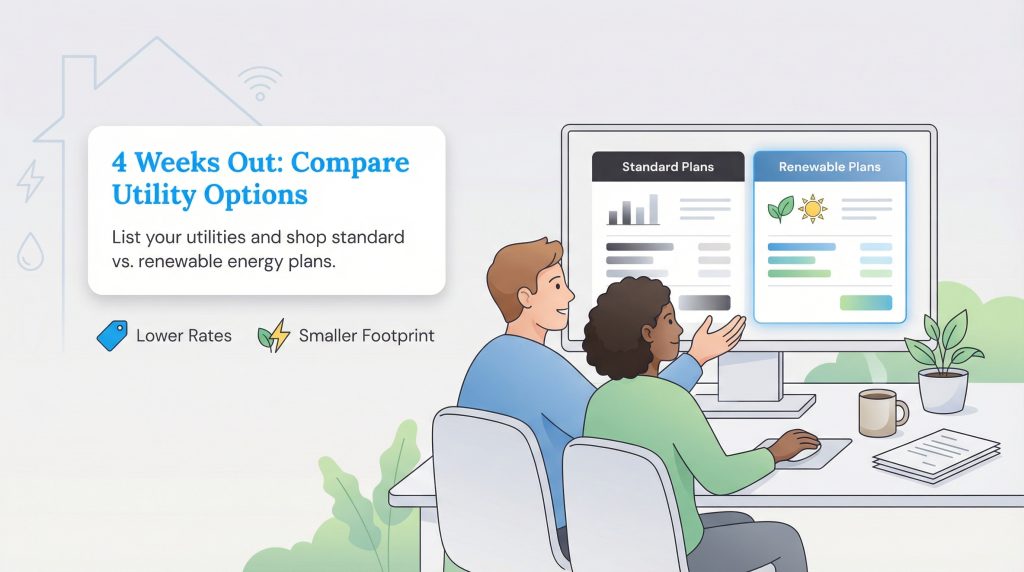
About a month before your move, sit down and conduct a full audit of your utility transfer list. This usually includes electric, natural gas, water, sewer, trash, internet, and home security. Research which specific providers service your new address. In some cases, you might simply transfer your current service locally, but moving to a new region often means starting fresh with an entirely new company. Take a brief moment to download your current provider’s official mobile app or billing statements so you have all your necessary account numbers completely organized.
If you are moving to or within a state with a deregulated energy market — such as Texas, Pennsylvania, or Ohio — you have a unique financial opportunity. In deregulated states, you can choose a separate electricity supplier for your rate and plan while the local utility still maintains the physical power lines and handles local outages. Use this time to research your state’s Public Utility Commission (PUC) website to compare plans. You can shop around for competitive rates that suit your family’s lifestyle. This is the perfect time to look for an eco-conscious alternative. Many modern providers offer renewable energy plans sourced strictly from wind or solar power. These environmentally mindful choices are frequently priced competitively with standard fossil fuel options, so you can easily lower your monthly bills and reduce your carbon footprint simultaneously.
2 Weeks Out: Schedule Transfers and Cancellations
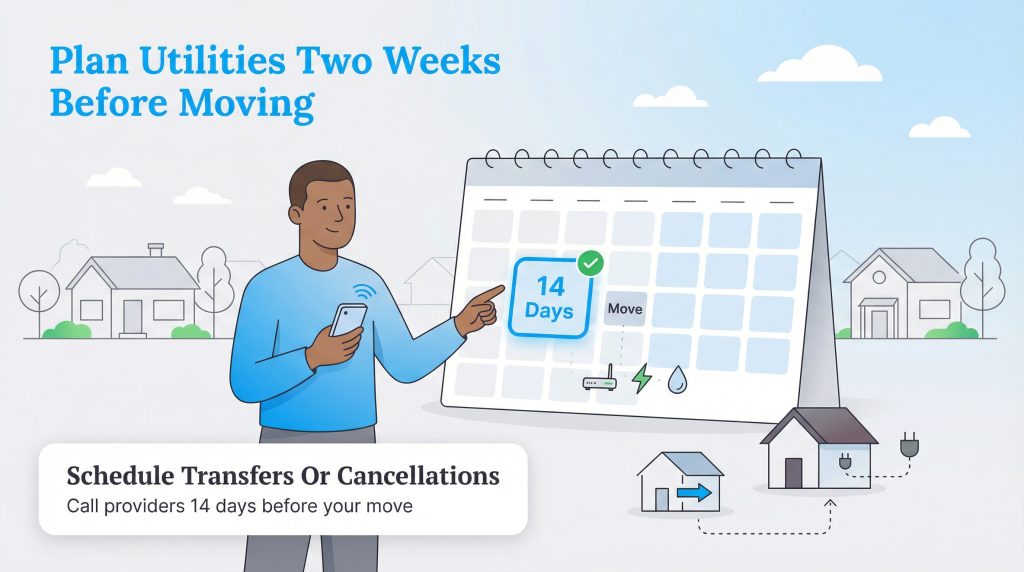
The well-known “14-day rule” is the sweet spot for successfully managing your connections. Knowing exactly when to set up utilities for new home connections ensures technicians have adequate lead time to dispatch to your new address. Calling two weeks ahead gives utility companies enough time to schedule a physical technician without being so early that your request falls through the administrative cracks. How you handle this stage depends entirely on how far you are moving.
If you are staying within the exact same utility territory, simply contact your current provider to seamlessly transfer the service. You will likely retain your existing account number. For long-distance moves, however, you must explicitly close your existing accounts and proactively open new ones. When it is time to formally cancel utilities when moving, it helps to read from a prepared script so you don’t forget to ask for essential documentation.
Read this exact script to the customer service agent: “Hello, I am officially moving out of [Current Address] on [Date]. Please safely disconnect my service on [Date + 1 Day] and send my finalized bill to [New Address]. I would also like a formal confirmation number for this cancellation request before we end the call today.”
1 Week Out: Notify Secondary Parties
Once the primary utility companies are scheduled, immediately turn your attention to the secondary services that are incredibly easy to forget until you suddenly need them. Crucially, you must notify the United States Postal Service (USPS) to officially forward your mail. You can accomplish this easily online through the official USPS Change of Address page. Doing this a week early ensures you do not miss important final bills, closing documents, or security deposit refund checks from your previous utility companies.
| Primary Utilities | Secondary Subscriptions |
|---|---|
| Electricity and Natural Gas | Streaming Services and Entertainment |
| Water and Sewer Services | Gym Memberships and Fitness Apps |
| Internet, Cable, and Phone | Meal Delivery and Grocery Kits |
| Trash and Recycling Collection | Magazine and Newspaper Subscriptions |
| Home Security Systems | Lawn Care and Pest Control |
Moving Day: The Final Meter Reading
On the busy day you officially hand over the keys, take five quiet minutes to locate your gas and electric meters. Use your smartphone to take a clear, date-stamped photo of the exact numbers displayed on the meter dials. This is a vital step for protecting your wallet. If a billing error occurs or the new tenant runs up a massive power bill before the company legally processes your disconnect, you possess indisputable photographic evidence of exactly how much energy you used. Before you lock the door for the final time, strictly turn off the main water valve to prevent devastating pipe leaks, and verify that all appliances, lights, and thermostats are switched completely off.
Utility-by-Utility Setup Guide
A robust new home utility checklist requires more than just basic dates and account numbers; it requires specific logistical instructions. Every type of utility possesses distinct connection nuances, and understanding these exact procedures will shield you from frustrating moving-day delays.
Electricity and Natural Gas
While most modern electricity transfers are handled remotely through smart meters, natural gas almost always requires special, hands-on attention. For strict safety reasons, gas providers typically mandate an in-person technician visit to visually inspect the physical lines and manually engage the service. If your new home features older gas appliances, the technician must handle specific pilot light relighting requirements and conduct a meticulous safety inspection to check for dangerous carbon monoxide leaks before leaving the premises.
Water and Sewer Services
Unlike electricity, water and sewer services are almost universally managed by local city or county municipal offices, meaning you will rarely have a choice of provider. To establish your service, you must directly contact your local municipal office or visit their local branch. Many municipalities strictly require new residents to fill out specific enrollment forms and pay an upfront security deposit before the service is legally transferred into your name.
Internet, Cable, and Smart Security
The delicate process of transferring internet to new address locations requires early and precise planning, particularly if your current provider does not maintain a fiber network in your new neighborhood. If you are forced to switch providers entirely, be sure to carefully pack and return modems, routers, and cable boxes via certified mail to avoid exorbitant unreturned equipment fees. For smart home security setups, aggressively contact your provider to update your physical address for 911 emergency dispatch and verify that your existing wireless cameras are compatible with your new home’s floor plan.
Trash, Recycling, and Municipal Services
Consult with your new city municipality or Homeowners Association (HOA) board to determine precisely how residential waste management is handled. In certain regions, trash collection is seamlessly bundled into your municipal water bill, while in more rural or suburban areas, you must independently contract with a private waste management firm. Request your rolling bins as early as possible, as physical delivery can sometimes take over a week during peak moving seasons.
How to Manage Account Balances and Deposits
Handling the financial logistics of a relocation is just as crucial as the physical transfer of the services themselves. When closing out old accounts, you must make absolutely sure to pay off all outstanding balances in full. Leaving an unpaid utility bill to languish can severely damage your credit score if the debt is eventually sold to an aggressive collections agency.
Furthermore, when setting up utilities for the first time or switching to a brand new regional provider, customer service agents will likely ask you to pay a hefty security deposit to mitigate their financial risk. You can frequently bypass these expensive fees by proactively requesting a formal “Letter of Credit” from your previous provider. This standard document serves as undeniable proof of your consistent, on-time payment history and often waives deposits entirely.
Eco-Conscious Upgrades for Your New Home
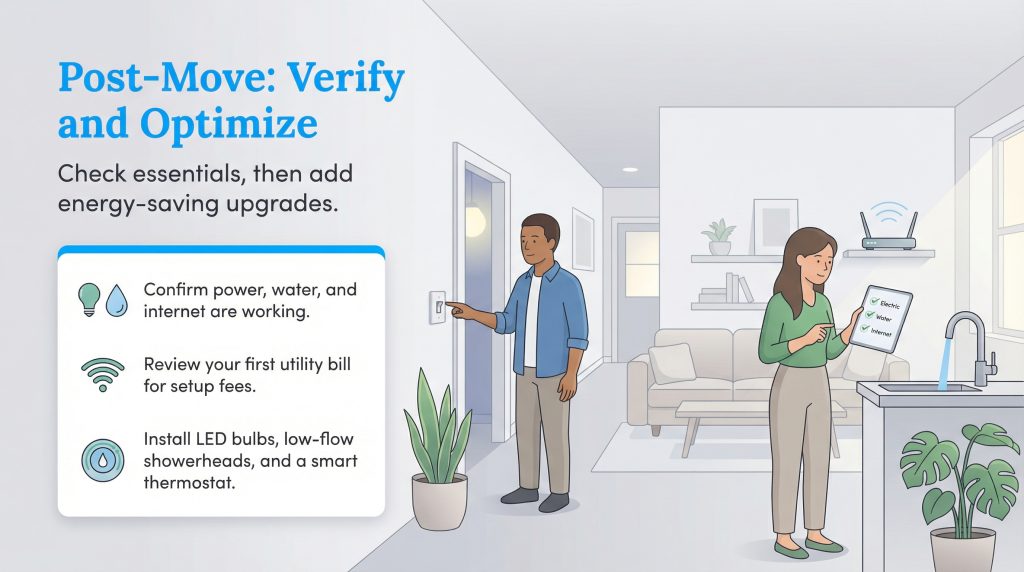
When you arrive at your new home, immediately test the essentials. Flip the light switches, run the water taps, and check that the Wi-Fi network is live. Once you confirm the basics are operational, recognize that this fresh start is an excellent time to implement meaningful, sustainable upgrades. Since you are setting up the space from scratch, look for immediate opportunities to integrate an eco-conscious alternative into your daily routine. Start by swapping out old, inefficient incandescent bulbs for ENERGY STAR–certified LED light bulbs. A standard 60-watt incandescent bulb can easily be replaced by a modern 9-watt LED, offering the exact same brightness while consuming a mere fraction of the raw power.
Additionally, strongly consider installing a programmable smart thermostat. These brilliant devices learn your family’s daily schedule and automatically adjust HVAC temperatures when you leave the house, acting as a highly effective energy-saving option that makes your new home significantly more efficient from day one. If you plan to upgrade major appliances, always search for the ENERGY STAR label on refrigerators and dishwashers to ensure top-tier performance. These environmentally mindful choices will drastically lower your carbon footprint and reduce your long-term utility expenses. For more comprehensive strategies, check out our in-depth guide on how to save on your electric bill.
Preparing for a Seamless Move-In Day
Taking the proactive time to completely organize your utility accounts before the moving truck even arrives saves you money and prevents unnecessary emotional stress. Instead of anxiously worrying about whether the hot water heater will work for your much-needed first shower, you can focus your energy on unpacking boxes and enjoying your beautiful new space. When you combine a clear, structured timeline with a handful of smart, eco-conscious upgrades, you effectively set yourself up for a comfortable and hyper-efficient home environment from the very beginning. Enjoy the unparalleled peace of mind that comes with confidently checking every necessary box on your list before you even cross the threshold.
Frequently Asked Questions About Moving Utilities
How do I transfer utilities to a new owner?
To transfer utilities to a new owner, you must strictly contact your current providers to schedule a service disconnection for the day after your closing or move-out date. The new owner must independently contact those exact same providers to establish brand new accounts in their own name. Utility companies generally will not allow you to put an account directly into another person’s name due to liability and credit checks.
What is the earliest I should set up utilities for a new home?
You should begin researching providers four weeks in advance, but the optimal time to actually schedule the connection is two to three weeks before your formal move-in date. This 14-day window provides a comfortable buffer for companies to dispatch technicians if physical installation is required at the property.
Can I transfer my current internet modem to my new address?
If you are staying with the exact same internet service provider and moving within their active coverage area, you can typically bring your current modem and router to the new address. However, if you are explicitly switching providers or moving entirely out of state, you will need to pack and return the old equipment to avoid hefty unreturned equipment fees.
How do I find out who the current utility providers are at my new house?
The easiest way to find out is to directly ask the previous owner, your new landlord, or your real estate agent. If that isn’t possible, you can easily search your local county or city municipal website for water and sewer details, and check your state’s Public Utility Commission website to see which electric and gas companies service your new zip code.
When should I call to transfer utilities?
We highly recommend calling your providers at least two full weeks before your move. This 14-day window allows ample time for companies to process your request and schedule a technician if an in-person visit is required for installation.
Do I need to be home when utilities are turned on?
For standard electricity and water connections, you usually do not need to be physically present as long as the meter is safely accessible from the outside. However, for natural gas service or new internet installation, an adult typically needs to be home to grant access to the technician for necessary indoor safety checks.
Does turning off utilities affect my credit score?
Simply closing a utility account in good standing does not negatively impact your credit score. However, if you carelessly leave an unpaid balance or forget to close an account that subsequently accrues late fees and goes to a collections agency, that will undoubtedly damage your overall credit history.
Can I have utilities active at two homes during my move?
Yes, most utility companies easily allow for an overlap in service, which we highly recommend. Scheduling your disconnection at your old home for the day after you move out and your connection at your new home for the day before you move in ensures you have uninterrupted power, water, and heat at both locations while you are transitioning.
About the Author

Claudio is a sustainability-focused writer with a background in Anthropology and Psychology from NC State University. He has spent over 15 years working in writing, interpretation, and translation, driven by a deep interest in how human culture shapes the environment. Today, he shares his curiosity with readers by writing about sustainable living solutions and the connection between everyday choices and environmental impact.