

Planning Ahead for Utah’s Unique Climate and Utility Providers Can Help You Avoid Setup Delays and Budget Surprises
Key Takeaways
- While housing costs have climbed in recent years, Utah’s residential energy rates often fall below the national average, giving your household budget welcome breathing room.
- For most residents, setting up utilities in Utah starts with confirming your exact address with Rocky Mountain Power or local municipal providers, alongside regional fiber internet networks.
- Adapting to one of the nation’s driest states means checking local eligibility for smart thermostat rebates and water-wise landscaping programs to lower your monthly bills.
Whether you’re chasing deep mountain powder, trading your commute for a career along the booming “Silicon Slopes” tech corridor, or longing for weekend road trips through the red rock canyons of the Mighty Five national parks, moving to Utah is a major transition. Still, packing up your life and learning the quirks of a new state takes real work. Between navigating high-altitude weather swings and figuring out who keeps the lights on in your new neighborhood, there are plenty of practical things to know before moving to Utah. We’ve put together this guide to walk you through everyday utility costs, show you how to set up your essential home utilities without a hitch, and help you thrive in Utah’s high-desert climate from day one.
Weighing Utah’s Advantages and Drawbacks: What to Expect Before You Pack
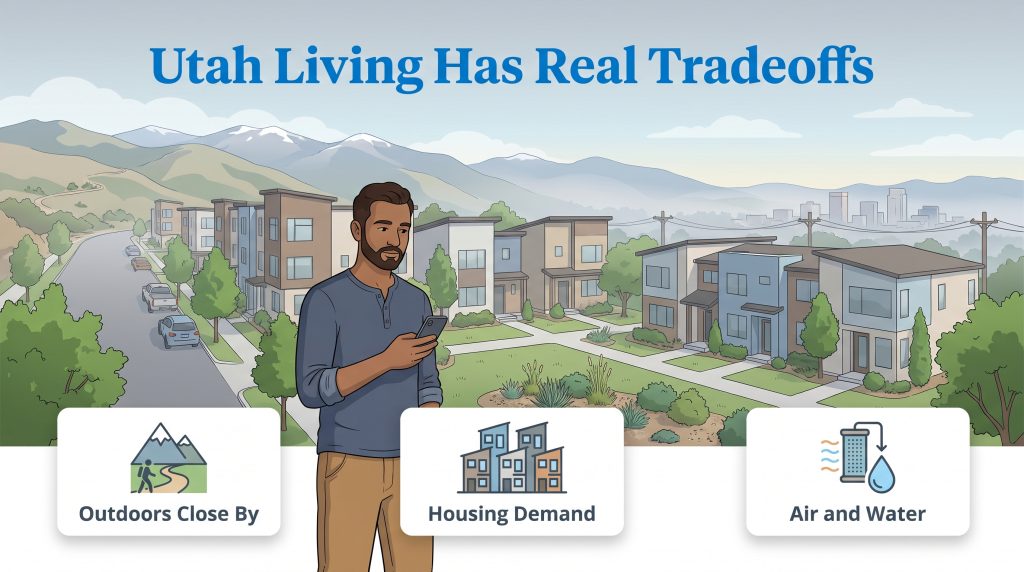
Relocating to the Beehive State brings a major lifestyle shift that catches many newcomers by surprise. You’ll gain proximity to five world-famous national parks and world-class ski resorts located just a short drive from downtown Salt Lake City, all while sharing the valleys with a fast-growing population. You’ll also quickly notice fun local traditions, from neighborhood drive-thru “dirty soda” shops to the state’s signature fry sauce served at almost every burger joint.
When weighing Utah’s advantages and drawbacks, it helps to look at how the state’s booming economy balances out against housing demand and environmental realities. While job growth remains strong, geography traps winter air in the mountain valleys, and severe summer droughts require every homeowner to rethink how they use water. Comparing these everyday trade-offs will help you decide which neighborhood and home setup best fit your household.
| Pros of Living in Utah | Cons of Living in Utah |
|---|---|
| Thriving job market: Fueled by tech, healthcare, and finance along the Wasatch Front, the state maintains a highly competitive job market. | High housing costs: Median home prices make starter homes highly competitive in major metro areas. |
| Simple tax structure: Compare Utah’s income, property, and sales taxes with what you currently pay. Your overall tax burden depends on your income, available credits, and where you live. | Winter temperature inversions: Bowl-shaped mountain valleys can trap cold air and smog along the Wasatch Front during winter months. |
| Below-average utility rates: According to the U.S. Energy Information Administration, Utah residents typically enjoy residential electricity and natural gas rates that rank below the national average. | Persistent summer drought: As one of the driest states in the nation, summer water restrictions and tiered pricing are common. |
| Abundant sunshine: Over 220 sunny days per year boost your mood and make rooftop solar panels highly productive. | Retiree tax considerations: Utah taxes 401(k) withdrawals, pensions, and Social Security benefits, though qualifying seniors can claim a state retirement tax credit. |
| Unmatched outdoor access: Hiking, mountain biking, boating, and skiing sit a short drive from most suburban backdoors. | Growing traffic congestion: Rapid population growth along the I-15 corridor means heavier rush-hour commutes. |
Heads Up
During poor-air-quality episodes, high-pressure weather systems often trap cold air and fine particulate pollution inside valleys like Salt Lake, Utah, and Cache counties. Consider running a properly sized portable air cleaner and the highest-efficiency HVAC filter your system supports. Check your equipment guidance before switching to MERV 13, and follow local air-quality advisories.
Breaking Down the Cost of Living in Utah and Your Average Utility Bill
When you crunch the numbers on the cost of living in Utah, you’ll notice an interesting split between housing expenses and everyday household bills. Utah’s overall cost of living index sits above the national average, driven almost entirely by real estate demand. Thankfully, strong local wages help offset housing prices for many relocating professionals.
Once you sign your lease or close on your mortgage, estimating your monthly operating costs requires looking at your specific property. Ask your real estate agent or landlord to request the home’s utility usage history so you can build an accurate budget based on your expected square footage, heating fuel, and cooling system. According to the U.S. Energy Information Administration’s Utah profile, Utah residents enjoy residential electricity and natural gas rates that rank well below the national median, leaving extra cash in your budget for home upgrades.
How Utah’s Four-Season Desert Climate Impacts Your Monthly Bills
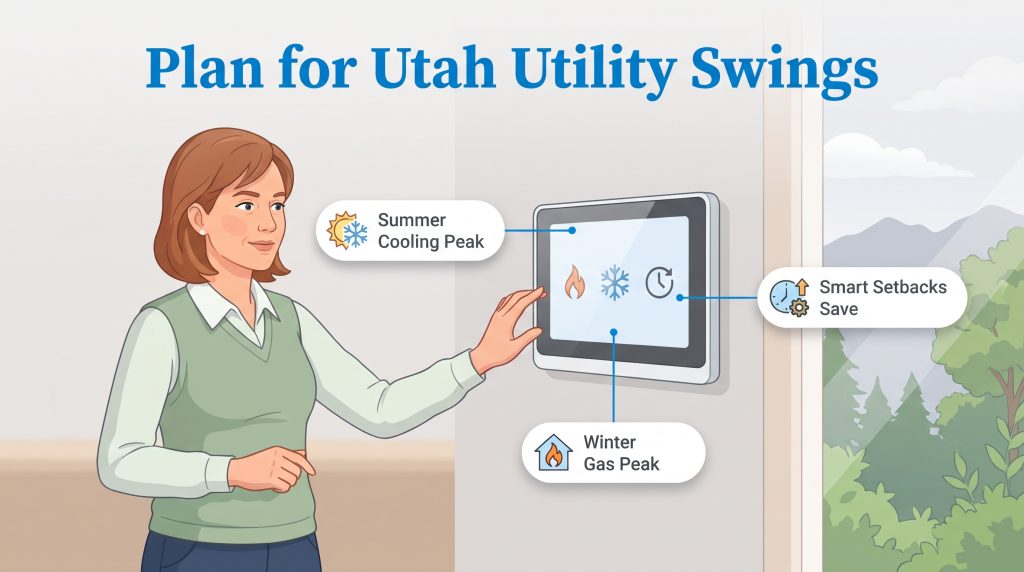
Unless you’re moving to the mild Mojave Desert corner of St. George, you’ll experience four distinct, dramatic seasons in Utah. High-elevation desert air doesn’t hold moisture, which means summer afternoons regularly climb into the upper 90s while winter nights plunge well below freezing. Because of this swing, your utility bills won’t stay flat from month to month; instead, your primary expense shifts between your electric meter and your gas meter depending on the season.
In July and August, running central air conditioning and watering your yard will push your electric and municipal water bills to their yearly peak. Once November arrives, your air conditioner goes into hibernation and your natural gas furnace takes over through March. Installing an energy-saving option like a Wi-Fi-enabled smart thermostat is one of the easiest ways to tame both extremes, automatically dialing back your heating or cooling while you’re away at work or out on the trails.
Setting Up Utilities in Utah: Electric, Gas, Water, and Internet Providers
One piece of good news about setting up utilities in Utah is that you won’t have to wade through dozens of confusing third-party energy marketers. Utah operates as a regulated energy state, meaning your street address determines your electric and natural gas utility providers. Start by confirming which providers serve your address, giving you a clear picture of who to call and what you’ll spend each month.
If you are renting your new home, check your lease agreement before setting up these services. Landlords often bundle water, sewer, and trash into a flat monthly fee, and they will specify whether you need to establish your own electric or natural gas accounts.
| Utility Service | Primary Utah Providers | When to Set Up |
|---|---|---|
| Electricity | Rocky Mountain Power, Municipal Utilities, or Electric Cooperatives | Coordinate with lease or closing date |
| Natural Gas | Enbridge Gas Utah (where available) | Coordinate with lease or closing date |
| Water, Sewer & Trash | Local City, County, or Private Water District | 1–2 weeks before closing |
| High-Speed Internet | Google Fiber, Quantum Fiber, Xfinity, UTOPIA Fiber Network | 2–4 weeks before move-in |
Electricity and Natural Gas Providers
When setting up your electric service, your first step is checking whether your new town uses the state’s main investor-owned utility, a city-run power department, or a rural electric cooperative. Rocky Mountain Power supplies electricity to a large portion of Utah residents, covering major hubs like Salt Lake City, West Valley City, Ogden, Sandy, and Park City. However, many communities across the state operate their own municipal power utilities. Regardless of which territory you land in, residential electric rates generally sit below the national average, keeping summer cooling bills manageable compared to neighboring southwestern states.
For your home heating, water heater, and stove, natural gas service is straightforward if your home is connected to a gas line. Enbridge Gas Utah — which many locals still refer to by its former name, Dominion Energy or Questar Gas — serves a significant majority of the state. While some rural homes rely on electricity or propane, Enbridge Gas offers competitive residential rates for most suburban and urban residents. Your bill may dip significantly in July and climb past triple digits during a frigid January cold snap, making seasonal budgeting essential.
Water, Sewer, Trash, and High-Speed Internet
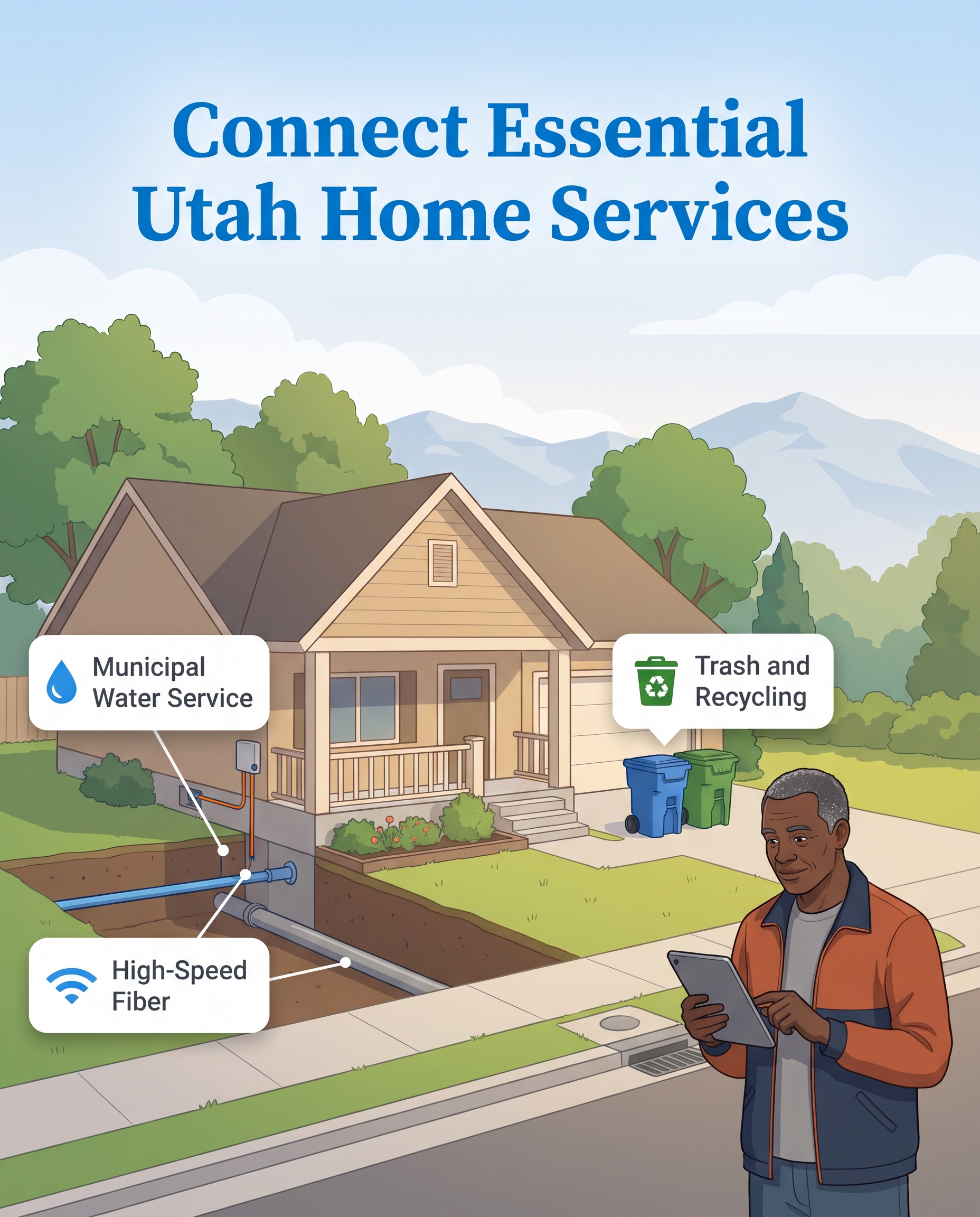
Water, sewer, storm drain, and curbside trash and recycling collection are handled by a variety of entities depending on your neighborhood. While many residents are served directly by their city or county government, others rely on independent water districts or private waste collection services. If you’re renting an apartment or townhome, your landlord will usually bundle water and trash into your monthly rent check, but always verify this in your lease. If you’re buying a house, you’ll need to contact your local billing office with your closing documents to transfer the account into your name and arrange for your waste bins, which vary by municipality.
When it comes to home internet options, Utah’s Wasatch Front is one of the best-connected corridors in the country. Thanks to the state’s booming tech sector, multi-gigabit fiber is widely available. Depending on your neighborhood, you can choose between Google Fiber, Quantum Fiber, and Xfinity cable internet. Even better, more than 20 Utah cities partner with UTOPIA Fiber, an open-access community fiber network. This infrastructure lets you pick from over a dozen competing local internet service providers on a single line. When comparing plans, check the full monthly internet price, including equipment, installation, promotional expiration dates, and any separate network charges.
Money-Saver
Ask to enroll in Enbridge Gas’s budget plans and Rocky Mountain Power’s equal payment plans or Time-of-Use billing once you have established a usage history. Equal payment plans smooth out winter heating and summer cooling spikes into predictable monthly bills, while Time-of-Use rates can help lower electricity prices when you shift running your dishwasher, laundry, or EV charger to off-peak hours.
Comparing Utah Regions: The Wasatch Front, Northern Valleys, and Southern Desert
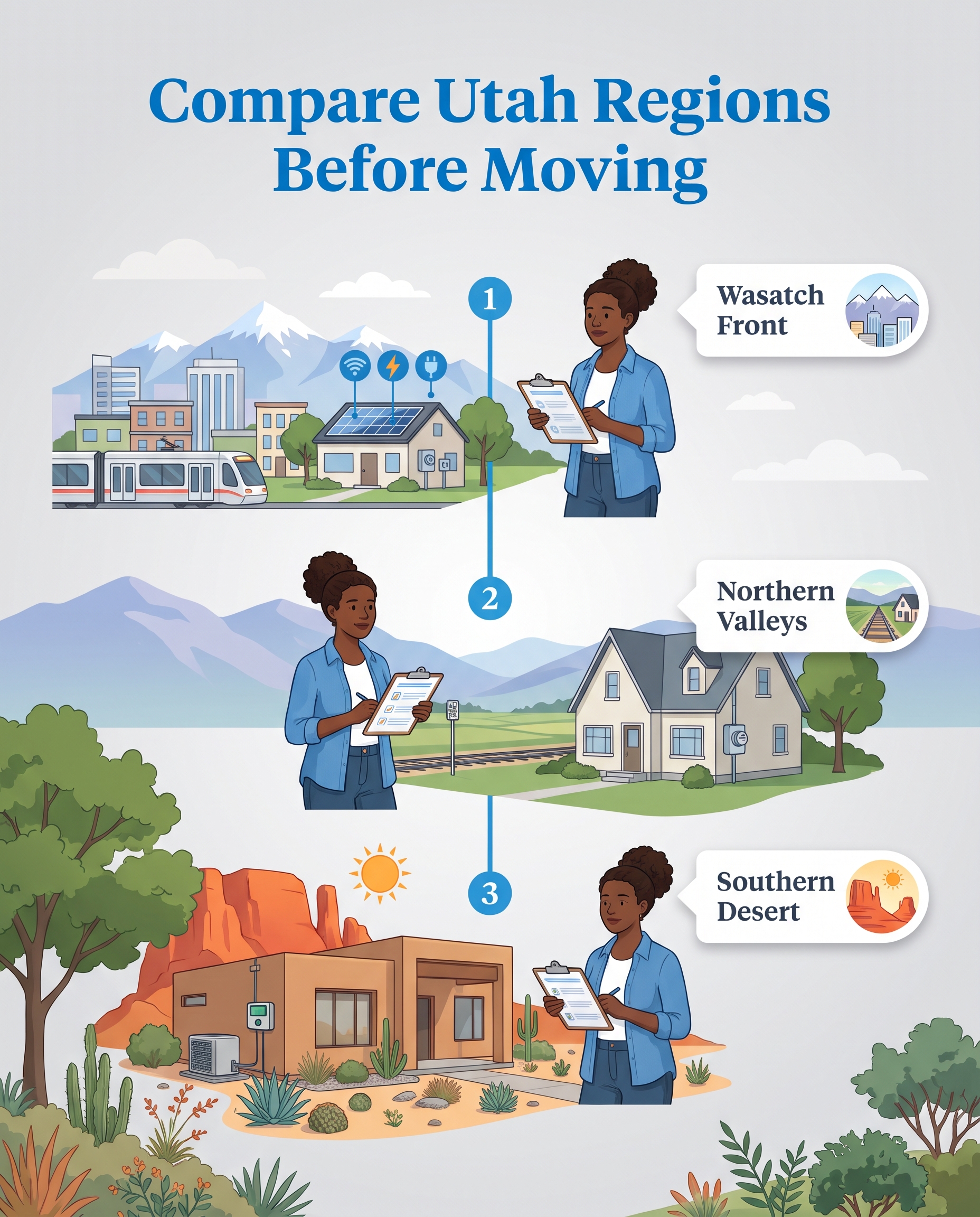
Exploring the different regions of Utah means matching your lifestyle preferences with the right microclimate and utility setup. Nearly 80% of Utahns live along the Wasatch Front — a narrow chain of valleys stretching 120 miles from Ogden south to Provo — while southern Utah offers a completely different red-rock desert experience. Your housing costs, commute, and even your monthly electric and water rates will shift depending on which region you call home.
Moving to Salt Lake City and Northern Utah
If you’re moving to Salt Lake City, you’ll find a vibrant, walkable urban core surrounded by historic neighborhoods like the Avenues, Sugar House, and 9th and 9th. Salt Lake City residents enjoy four true seasons, easy public transit via UTA TRAX light rail and the FrontRunner commuter train, and widespread access to Google Fiber. Power is supplied by Rocky Mountain Power, and the city’s public utilities department utilizes tiered water-conservation pricing to encourage efficient usage.
Just 20 minutes south of downtown, suburbs like South Jordan and Herriman attract families looking for newer construction and sustainability-focused planning. Master-planned communities like Daybreak in South Jordan feature select homes with ENERGY STAR certification, solar-ready roofs, geothermal heating options, and drought-tolerant neighborhood landscaping designed to slash monthly water and energy bills. Heading north of Salt Lake, Ogden offers a historic railroad town vibe, more affordable home prices, and rapid access to quiet ski resorts.
Provo, Silicon Slopes, and Southern Utah’s Red Rock Country
Straddling the border of Salt Lake and Utah counties, the “Silicon Slopes” hub of Lehi, Draper, and American Fork is ground zero for tech workers at companies like Adobe and Qualtrics. Continuing south into Provo and Orem, you’ll find a lively college-town atmosphere anchored by Brigham Young University and Utah Valley University. Homeowners in Provo benefit from Provo Power — the largest municipal electric utility in the state — alongside established fiber internet connectivity.
If shoveling snow sounds miserable, look 300 miles south to St. George and Washington County. Tucked into the Mojave Desert zone near Zion National Park, St. George skips the freezing mountain winter in favor of sunny, mild January afternoons. The trade-off comes between June and September, when triple-digit temperatures make heavy air conditioning a necessity. Because water is scarce in the southern desert, St. George operates strict tiered water rates and rewards residents who maintain desert xeriscaping instead of turf grass.
Sustainable Living in One of the Nation’s Driest States: Solar Incentives and Water Rebates
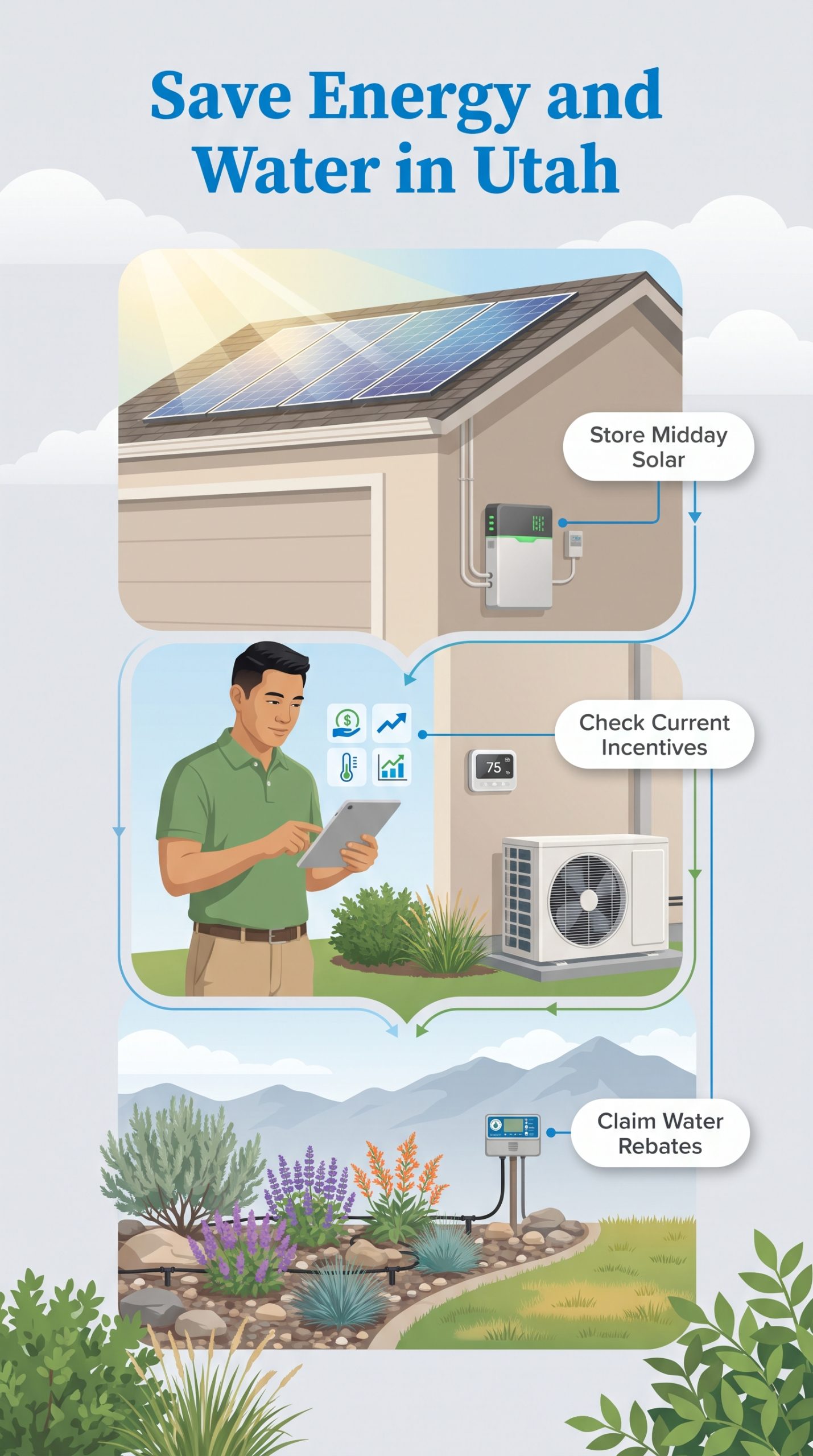
With high-altitude sunshine beaming down and statewide precipitation averaging lower than most of the country, Utah rewards homeowners who embrace sustainable utility habits. Making an environmentally mindful choice in how you power, cool, and water your property isn’t just about protecting Utah’s snowpack and reservoirs. It’s also one of the smartest ways to insulate your wallet from rising summer utility rates.
Utah Solar Incentives, Rebates, and Clean Energy Options
If you’re buying a house with an unshaded roof, navigating available Utah solar incentives and rebates can dramatically shrink your carbon footprint. Before comparing solar quotes, check current tax rules, your utility’s export-credit schedule, and available battery incentives. Don’t assume an incentive advertised in an older guide still applies. Because Rocky Mountain Power uses a net billing structure that credits exported solar power at a lower rate than retail electricity, pairing your rooftop panels with a home battery can be a strategic way to store your midday sunshine and use it yourself during expensive evening hours. Be sure to model your potential savings using your utility’s specific tariff and account for your roof’s condition before committing to an installation.
Even if you aren’t ready for rooftop solar, local utilities offer opportunities to save through efficiency upgrades. Rocky Mountain Power’s Wattsmart program periodically provides rebates for smart thermostats, cold-climate heat pumps, and high-efficiency evaporative coolers, plus ongoing bill credits if you enroll a home battery in their Wattsmart Battery program. Meanwhile, Enbridge Gas’s ThermWise program often features rebates for attic insulation, high-efficiency furnaces, and tankless water heaters. Before buying any new appliance, check the ENERGY STAR rebate finder by entering your new Utah zip code to stack every available incentive, and confirm current eligibility terms on the utility provider’s website. If you rent your home or live in a shaded townhome, enrolling in Rocky Mountain Power’s Blue Sky renewable energy program or their Subscriber Solar program offers an easy eco-conscious alternative that supports regional wind and solar projects right on your monthly bill.
Smart Water Conservation Programs That Pay You Back
Newcomers moving from the Midwest or East Coast are often shocked by how much water a traditional Kentucky bluegrass lawn guzzles in Utah’s bone-dry summer air. Outdoor landscape irrigation accounts for roughly 60% of residential water use across the state. To help residents cut back without sacrificing curb appeal, the state-backed Utah Water Savers portal unites local water districts to offer financial rebates for water-wise upgrades.
Through Utah Water Savers, you can often claim rebates for upgrading to WaterSense-labeled smart sprinkler controllers that automatically skip watering cycles when rain is in the forecast, as well as rebates for converting spray sprinklers to targeted drip irrigation. Even better, many municipalities participate in the statewide “Flip Your Strip” and turf buyback programs, which pay homeowners to rip out thirsty park-strip grass and replace it with attractive, drought-tolerant native perennials and rock mulch. Always check your local eligibility and secure preapproval before removing any turf or purchasing new equipment.
Eco Edge
Swapping out one older, inefficient toilet for a WaterSense-labeled model and installing a smart weather-based irrigation controller can save a typical Utah household thousands of gallons of water every year. Better yet, applying through the Utah Water Savers portal lets you claim state rebates that can offset a significant portion of the cost of the hardware.
Your Step-by-Step Moving to Utah Checklist for a Smooth Transition
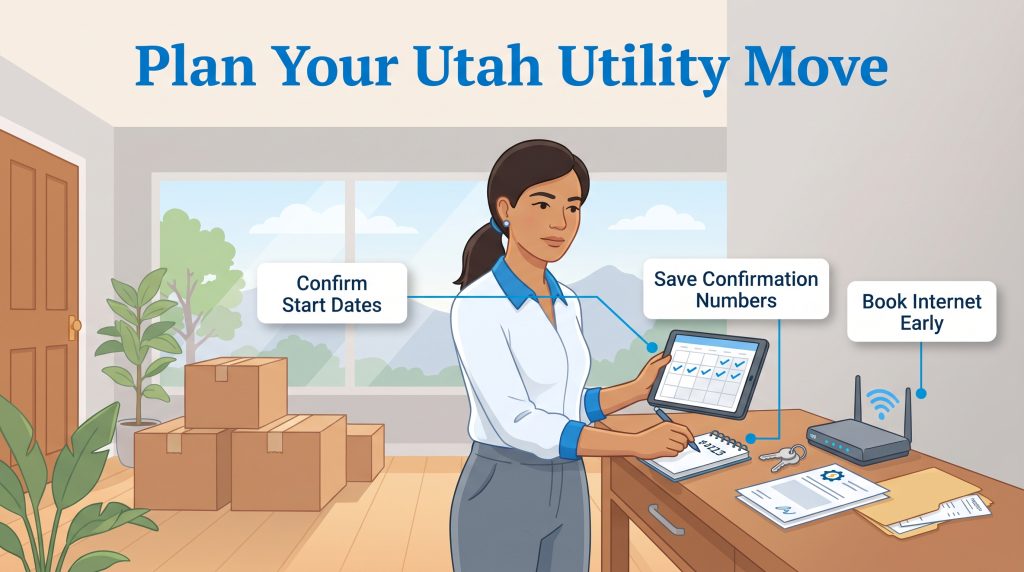
Coordinating utility start dates alongside movers and closing paperwork doesn’t have to feel overwhelming when you break the process down week by week. Following this moving to Utah checklist will ensure your lights, hot water, and Wi-Fi are humming the moment you unlock your front door, while Utah’s official newcomer portal makes it easy to wrap up your driver’s license, vehicle registration, and voter registration once the boxes are unpacked.
Before making your calls, gather this essential information:
- Your exact service address and unit number
- Your targeted lease start or closing date
- Personal identification and contact information
- Your landlord’s instructions for any tenant-paid services
- A pen and paper to record confirmation numbers and scheduled activation dates
- Four Weeks Before Your Move: Look up your exact Utah street address to confirm whether you fall under Rocky Mountain Power, an electric cooperative, or one of the state’s municipal electric utilities. Check fiber internet availability with Google Fiber, Quantum Fiber, Xfinity, or UTOPIA Fiber, and book an installation appointment early if your home needs a new fiber drop run from the street.
- Two Weeks Before Your Move: Set up your electric account and contact Enbridge Gas Utah online to schedule service activation for the day you take legal possession of the home. If you’re buying a home, call your local city utility billing department or water district to set up water, sewer, and trash service, and request delivery of your curbside trash and recycling cans.
- Moving Week: Verify that your electricity, natural gas, and water are active before the moving truck pulls up. Do a quick safety walkthrough of your new home to locate the main water shut-off valve and electrical breaker panel, test all smoke and carbon monoxide detectors, and slide a fresh filter into your furnace return.
- Within 30 Days of Arrival: Install a smart thermostat and submit your receipts for Rocky Mountain Power Wattsmart or Enbridge Gas ThermWise rebates, or schedule a discounted home energy assessment. Additionally, check the current Utah Driver License Division and DMV deadlines to transfer your driver’s license and register your vehicles, as these timelines can vary.
Settling Into the Beehive State With Smart Utility Habits
Moving to Utah opens the door to an incredible outdoor lifestyle, friendly neighborhoods, and some of the most affordable home energy rates in the West. When you take a little time before moving day to line up your utility accounts and work with the high-desert climate rather than against it, your home will run smoothly through hot July afternoons and snowy January nights alike. Whether you’re programming a smart thermostat, tapping into Utah’s abundant sunshine, or trading thirsty turf for vibrant native plants, smart utility choices put money right back into your pocket. Now all that’s left to do is unpack your gear and start exploring your new backyard.
Frequently Asked Questions About Moving to Utah
If you’re still wrapping your head around your upcoming relocation, you aren’t alone. Here are a few common questions newcomers ask when setting up their essential home services in the Beehive State.
How Much Does It Cost to Set Up Utilities When Moving to Utah?
Can I Choose My Own Electric or Natural Gas Company in Utah?
What Is a Swamp Cooler, and Do Utah Homes Still Use Them?
Is Utah a Tax-Friendly State for Retirees and Remote Workers?
How Early Should I Transfer Electric and Gas Service Before Moving to Utah?
Are Solar Panels Worth Installing on a Home in Utah?
About the Author

LaLeesha has a Masters degree in English and enjoys writing whenever she has the chance. She is passionate about gardening, reducing her carbon footprint, and protecting the environment. She also recently served as President of the Board for City Sprouts (a community garden).

David has been an integral part of some of the biggest utility sites on the internet, including InMyArea.com, HighSpeedInternet.com, BroadbandNow.com, and U.S. News. He brings over 15 years of experience writing about, compiling and analyzing utility data.